18-Month Sleep Regression: Signs and How to Handle It

Sarah Mitchell
Sarah Mitchell is a Registered Pediatric Nurse and a mother of three who has spent over a decade helping families navigate the beautiful, chaotic early years of childhood. She combines evidence-based medical knowledge with real-world parenting experience to offer practical, compassionate advice. At Awesome Parent, Sarah's mission is to help exhausted parents find solutions, trust their instincts, and finally get some sleep.
If your toddler was sleeping decently and then suddenly starts waking up crying at 1 AM, refusing naps, or staging a tiny protest at bedtime, you are not imagining it. What many families call the 18-month sleep regression is a commonly reported (and very normal) bump in the road. It is not a formal medical diagnosis, and not every toddler goes through it, but it is a pattern pediatric providers hear about all the time.
As a pediatric nurse and a mom of three, I’ll tell you the same thing I told families in clinic: regressions are usually a sign of growth, not failure. Your child is not “broken,” and you did not ruin sleep with one rough week. Let’s walk through why this happens, what it looks like, how long it can last, and the calm, research-informed ways to get through it.
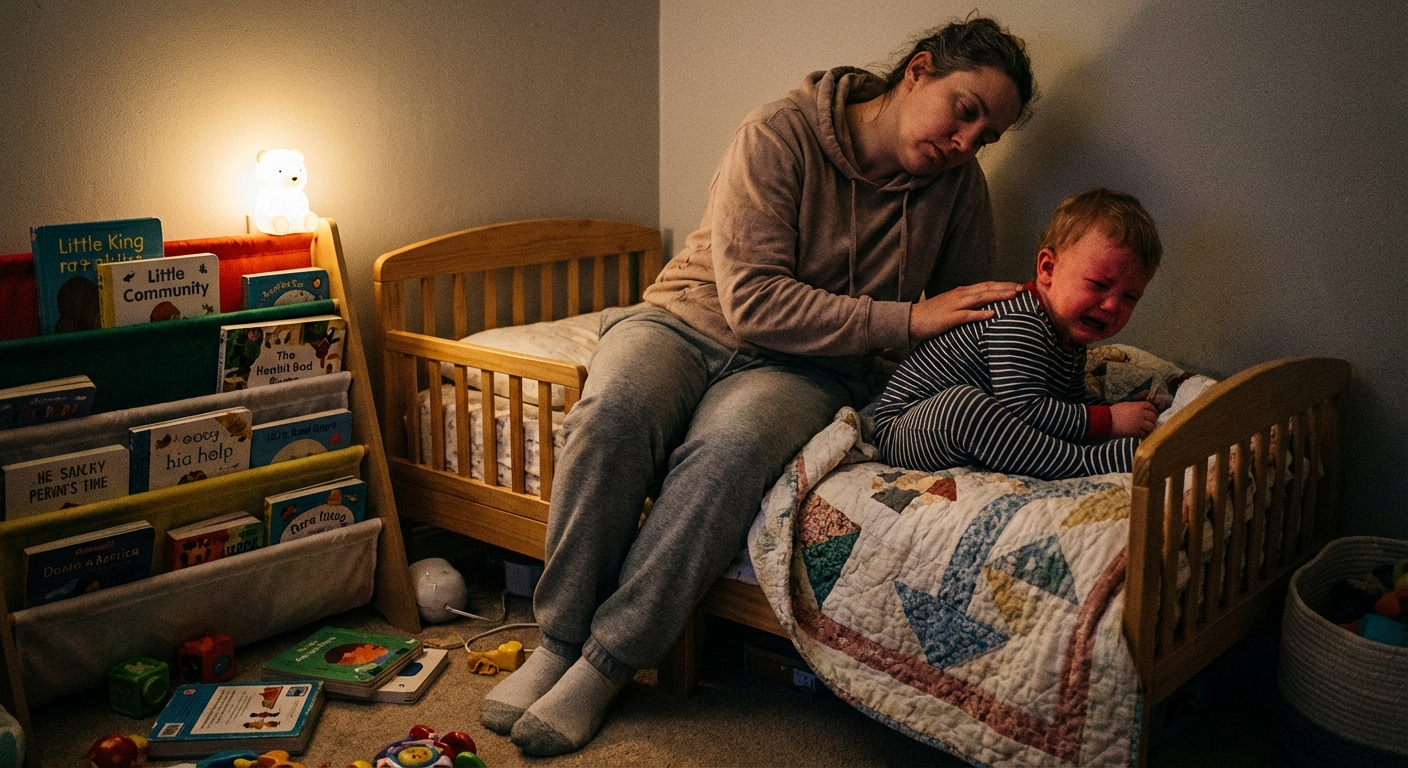
What is it?
The 18-month sleep regression is a phase when a toddler who previously slept fairly well suddenly has more trouble falling asleep, staying asleep, or napping.
How long does it last? Many parents report about 1 to 3 weeks, but it varies widely. Some kids bounce back quickly, and some take longer, especially if it overlaps with travel, illness, daycare changes, weaning, or a big milestone like moving rooms.
At this age, sleep disruptions are usually driven by a mix of development and emotions, not just schedule math. Many toddlers are learning new skills, testing boundaries, and feeling separation anxiety more intensely, all while possibly cutting molars. That is a lot for a small brain to process at 2 AM.
Common signs
- Bedtime resistance: Suddenly fighting pajamas, stories, or crib time.
- Longer time to fall asleep: Rolling around, calling for you, or popping up as soon as you leave.
- Night waking: Waking and crying, sometimes multiple times.
- Early morning wake-ups: Starting the day very early and refusing to go back down.
- Nap refusal or shorter naps: Skipping naps altogether or taking a short, cranky nap.
- More clinginess: Needing extra reassurance at bedtime and overnight.
- New skills at night: Standing, talking, climbing, or practicing words in the crib like it’s a rehearsal stage.
Important note: If your child is sick, snoring loudly, or waking in pain, that is a different category than a typical “regression.” We’ll cover when to seek help below.
Why it happens
1) Development: a busy brain
Around 18 months, many toddlers hit major cognitive and language growth. They understand more, say more, and want more control. That can make bedtime feel like a separation they can finally object to with conviction.
You may also see:
- New words appearing daily
- More imagination (and sometimes new fears)
- Big feelings with limited coping skills
- Boundary testing: “No” as a lifestyle
2) Separation anxiety (again)
Separation anxiety can return in toddlerhood, and 18 months is a classic time for it. Your child may be completely fine during the day, then panic when you leave the room at night. From their perspective, bedtime is not “rest,” it is “goodbye.”
3) Molars and discomfort
First molars often come in around 13 to 19 months, but eruption timelines vary a lot from child to child. Some toddlers barely notice, and others have sore gums and wake more easily. Teething does not usually cause weeks of severe sleep disruption on its own, but it can absolutely add fuel to the fire.

Regression or nap transition?
One more thing that can look exactly like a “regression” is the 2-to-1 nap transition. Many toddlers settle into one nap by 15 to 18 months, but some are still mid-transition at 18 months. During this phase, you might see short naps, nap fighting, bedtime battles, or early wakings simply because the old schedule no longer fits.
If your child recently dropped a nap (or daycare did it for you), consider that schedule adjustment may be the main driver, with a developmental leap layered on top.
What to do
The goal is not to force sleep. The goal is reduce stress, increase predictability, and keep boundaries loving and clear. Here are the strategies I recommend most often.
Keep the routine consistent
A predictable routine cues the brain that sleep is coming. At 18 months, routines work best when they are short, repeatable, and not negotiable.
- Aim for 20 to 30 minutes total.
- Do the same steps in the same order (example: bath, pajamas, teeth, two books, song, lights out).
- Keep the environment calm: dim lights, quiet voices, no screens.
If your toddler asks for “one more” a dozen times, you can respond warmly but consistently: “All done. It’s sleep time. I love you.”
Use a simple night-waking plan
Pick a plan you can repeat at 2 AM without renegotiating with your exhausted brain.
- Brief reassurance: A calm voice, a quick pat, a key phrase (“You’re safe. It’s sleep time.”).
- Keep it short: Try 30 to 60 seconds, then leave.
- Avoid new fun habits: Bright lights, snacks, playtime, or long conversations can accidentally reward waking.
If your toddler escalates when you leave, a gradual approach can help (checking in at intervals, or sitting nearby and slowly moving farther away over several nights). The best method is the one you can do consistently and calmly.
Offer choices during the routine
Toddlers crave control, so give it to them in safe ways.
- “Do you want the blue pajamas or the green pajamas?”
- “Two books. Do you pick Book A or Book B?”
- “Do you want a hug or a high five before I go?”
Notice the pattern: choices are real, but sleep is not optional.
Check the schedule
A common issue at 18 months is a schedule that no longer fits. Both overtired and undertired toddlers can wake overnight.
- Overtired toddlers often fight sleep and wake more overnight.
- Undertired toddlers may take a long time to fall asleep or wake and want to party at 3 AM.
Most 18-month-olds do well with:
- 11 to 14 hours total sleep in 24 hours (varies by child)
- One nap lasting about 1 to 2.5 hours
- Wake windows of roughly 4.5 to 6 hours (many land around 5 to 5.5)
Protect the nap
During a rough patch, parents sometimes drop the nap because it is being refused. In most cases, that backfires and leads to a very overtired toddler.
- Offer the nap at the usual time even if it is shorter.
- If the nap is running late, consider waking your toddler to protect bedtime.
- If your child naps in the car or stroller, try to keep it consistent and not too close to bedtime.
Support discomfort (without creating new sleep props)
If your toddler is drooling more, chewing, or waking with obvious discomfort, it is reasonable to support them.
- Use cool teething toys during the day.
- Ask your pediatrician about appropriate pain relief if needed, especially for nighttime. Use only as directed and avoid around-the-clock dosing unless you are specifically advised.
- Avoid numbing gels unless your pediatrician specifically recommends them.
Comfort matters. Just try not to add brand-new sleep props you will not want long term.
Skip screens close to bedtime
Many sleep experts recommend keeping screens out of the hour before bed. Evening light and stimulation can make it harder to settle. If you need a sanity break, swap to something calmer like:
- Music
- Coloring
- Simple blocks
- Bath or water play
Optimize the sleep environment
These are optional supports, but they can help reduce wake-ups:
- Dark room: blackout curtains if early morning light is a problem
- Comfortable temperature: cool and consistent is often best
- White noise: if it works for your child, keep volume low and steady
Safety check (especially if climbing starts)
At 18 months, many toddlers start experimenting with climbing. If your child is trying to climb out of the crib, review your crib manual and talk to your pediatrician about safe next steps. Also keep the sleep space simple and safe, and avoid adding pillows, loose blankets, or extra items that could create hazards.

Sample schedule (1 nap)
Here is a realistic example for an 18-month-old. Adjust by 30 minutes based on your child and your household.
Baseline
- 6:30 AM Wake
- 12:00 PM to 2:00 PM Nap
- 7:30 PM Bedtime
If bedtime battles start
Try a small shift for 5 to 7 days before changing again.
- 6:30 AM Wake
- 12:30 PM to 2:00 PM Nap (cap at 1.5 hours if bedtime is taking forever)
- 7:45 PM Bedtime (slightly later if your child seems undertired)
Or, if your toddler seems overtired (meltdowns, very early waking, short naps), you might do the opposite:
- 6:30 AM Wake
- 11:45 AM to 1:45 PM Nap
- 7:15 PM Bedtime (slightly earlier)
The key is to make one change at a time. When you change nap timing, bedtime, and your response to night waking all at once, it becomes impossible to tell what helped.
What not to do
- Do not introduce a brand-new big sleep crutch unless you are comfortable keeping it long term (like hours of rocking or sleeping in your bed every night).
- Do not start the day super early if you can avoid it. Treat anything before your target wake time (often around 6 AM) as nighttime: dim lights, minimal interaction.
- Do not assume your toddler is ready to drop the nap. Most 18-month-olds still need one, even if they are fighting it.
- Do not blame yourself. Sleep disruptions happen in loving, consistent homes too.
If you co-sleep or room-share
Many families bed-share, room-share, or bring a toddler into their bed during hard seasons. You do not have to “do it perfectly” to make progress. The biggest sleep saver is still consistency.
- If your toddler sleeps in your room, keep the response boring and predictable: a short phrase, quick reassurance, then back to sleep.
- If your toddler comes into your bed, decide ahead of time what you will do each time (for example: one quick cuddle, then back to their sleep space). Doing the same thing each wake-up is what helps most.
- If you change your plan, do it on purpose and stick with it for at least a week so your child is not getting mixed signals.
When to seek help
Most regressions are temporary. But call your child’s pediatrician or seek guidance if you notice any of the following:
- Snoring, gasping, or labored breathing during sleep (possible sleep-disordered breathing)
- Wheezing, persistent cough, or repeated vomiting at night
- Signs of ear infection (fever, ear tugging, new intense nighttime pain, trouble lying flat)
- Reflux-like symptoms with discomfort and frequent waking
- Night terrors that are frequent or severe (these are different from nightmares and often happen earlier in the night)
- Sleep disruption lasting longer than 3 to 4 weeks with no improvement
- Parental exhaustion or safety concerns (if you are too sleep-deprived to drive safely or function, you deserve support)
If you are unsure, trust your gut. You know your child’s normal better than any article can.
Quick reassurance
The 18-month sleep regression can feel personal because toddlers are louder, more persistent, and much better negotiators than babies. But it is usually a short-lived season.
Focus on three things: consistent routine, predictable boundaries, and a schedule that matches your child’s sleep needs. Most toddlers settle back into sleep once their brains catch up with all the growth happening.
If you’re reading this at an absurd hour, I want you to hear this clearly: you are not failing. You are parenting a tiny human with a developing brain and big feelings. This gets better.
References (for the “evidence-based” parents)
- American Academy of Pediatrics (AAP): Healthy sleep habits and screen-time guidance
- American Academy of Sleep Medicine (AASM): Recommended sleep duration for children