4-Month Sleep Regression Survival Guide

Sarah Mitchell
Sarah Mitchell is a Registered Pediatric Nurse and a mother of three who has spent over a decade helping families navigate the beautiful, chaotic early years of childhood. She combines evidence-based medical knowledge with real-world parenting experience to offer practical, compassionate advice. At Awesome Parent, Sarah's mission is to help exhausted parents find solutions, trust their instincts, and finally get some sleep.
If your baby used to give you a decent stretch of sleep and now wakes up like it is their new part-time job, you are not imagining things. The 4-month sleep regression is very real for many families, it is common, and it can feel downright rude.
Also true: not every baby has a dramatic “regression.” Some just get a little more wakeful for a bit, and some barely notice the shift.
Take a breath. This phase is usually a sign of healthy brain development, not a sign you “broke” your baby’s sleep. Below is the plan I give families again and again in clinic, plus the realistic mom-of-three version of what actually works at 2:47 AM.

What it is
Around 3 to 5 months, many babies shift from newborn-style sleep into more mature sleep cycles. Instead of drifting into deep sleep and staying there longer, sleep becomes more structured, with clearer transitions between stages and more frequent moments of lighter sleep.
Those transitions are where things get loud. Your baby briefly stirs, notices they are awake, and may need help getting back to sleep.
So the “regression” is not your baby going backward. It is a developmental leap forward that can temporarily make sleep messier.
Common signs
- More frequent night wakings, sometimes every 45 to 120 minutes
- Shorter naps or sudden nap resistance
- Increased fussiness in the evening
- Needing more help to fall asleep than before
- Early morning wake-ups that feel wildly unfair
Why the 45 to 60 minute pattern? Many babies’ sleep cycles settle into something close to 45 to 60 minutes, so some families see wakings that line up with a single cycle.
How long it lasts
For many families, the worst of it lasts about 2 to 6 weeks. But there is a lot of normal variation. It can be shorter, or it can stretch longer if new habits form (like needing to be rocked fully asleep every time). The good news is that small, consistent changes can shorten the suffering.
Rule out the basics
When parents come to triage saying, “Sleep fell apart overnight,” I always ask a few practical questions first. They are not glamorous, but they matter.
Quick checklist
- Is baby eating enough in 24 hours? A growth spurt can increase hunger and night feeds.
- Is baby sick or congested? Even a mild cold can wreck sleep.
- Is teething a factor? Teething can cause short-term disruption, but it should not cause weeks of hourly screaming on its own.
- Any recent changes? Travel, visitors, starting daycare, dropping a swaddle.
- Is the sleep space still safe? At this age, many babies start rolling. That changes what is safe overnight.
Safe sleep note
If your baby shows signs of rolling (or you are not sure), stop swaddling. A swaddled baby who rolls is at higher risk for suffocation. Use a sleep sack instead, place baby on their back, and keep the crib free of pillows, blankets, bumpers, and stuffed animals.
Some organizations also recommend discontinuing swaddling by around 8 weeks even if your baby is not rolling yet, because rolling can happen suddenly. When in doubt, talk with your pediatrician and choose the more conservative option.
Do only this tonight
If you are too tired to do all the things, do these three:
- Make sleep safe: back to sleep, firm mattress, empty crib, no swaddle if rolling is possible.
- Make it boring: dark room, steady white noise, minimal talking and light overnight.
- Pick one response plan: choose a soothing approach you can repeat for 5 to 7 nights.
Your step-by-step plan
Here is the approach that tends to help the fastest: protect sleep pressure, tighten your schedule a bit, create a simple bedtime routine, and respond to night wakings consistently.
Step 1: Daytime sleep
An overtired baby usually sleeps worse, not better. Around 4 months, many babies do well with about 3 to 4 naps per day, depending on nap length.
- Aim for wake windows around 75 to 120 minutes (shorter in the morning, longer toward bedtime).
- If naps are suddenly 30 minutes, that is common at this age. Try not to stretch wake windows too far to “force” longer naps. It often backfires.
- Use one “rescue” nap (contact nap, stroller, carrier) to prevent total meltdown.
- Get outside light in the morning. Natural light helps set their internal clock.
Normal nap changes: Cat naps are developmentally normal here. Many babies cannot link nap cycles reliably yet, even if they can sometimes do it at night. “Good enough” naps often lead to better nights than fighting for perfect naps.

Step 2: Bedtime routine
At 4 months, routines work because they are predictable, not because they are elaborate. Think: simple and repeatable even when you are exhausted.
- Feed (try to separate feeding from the moment of falling asleep by a few minutes if you can)
- Diaper
- Sleep sack
- Dark room and white noise
- One book or a short song
- Into crib drowsy but awake, or at least calm and not fully zonked
If “drowsy but awake” makes you laugh-cry, you are not alone. Start with “awake-ish.” Tiny steps count.
Step 3: Sleep environment
These basics really do move the needle.
- Dark: Aim for a room dark enough that you cannot easily read text on a book.
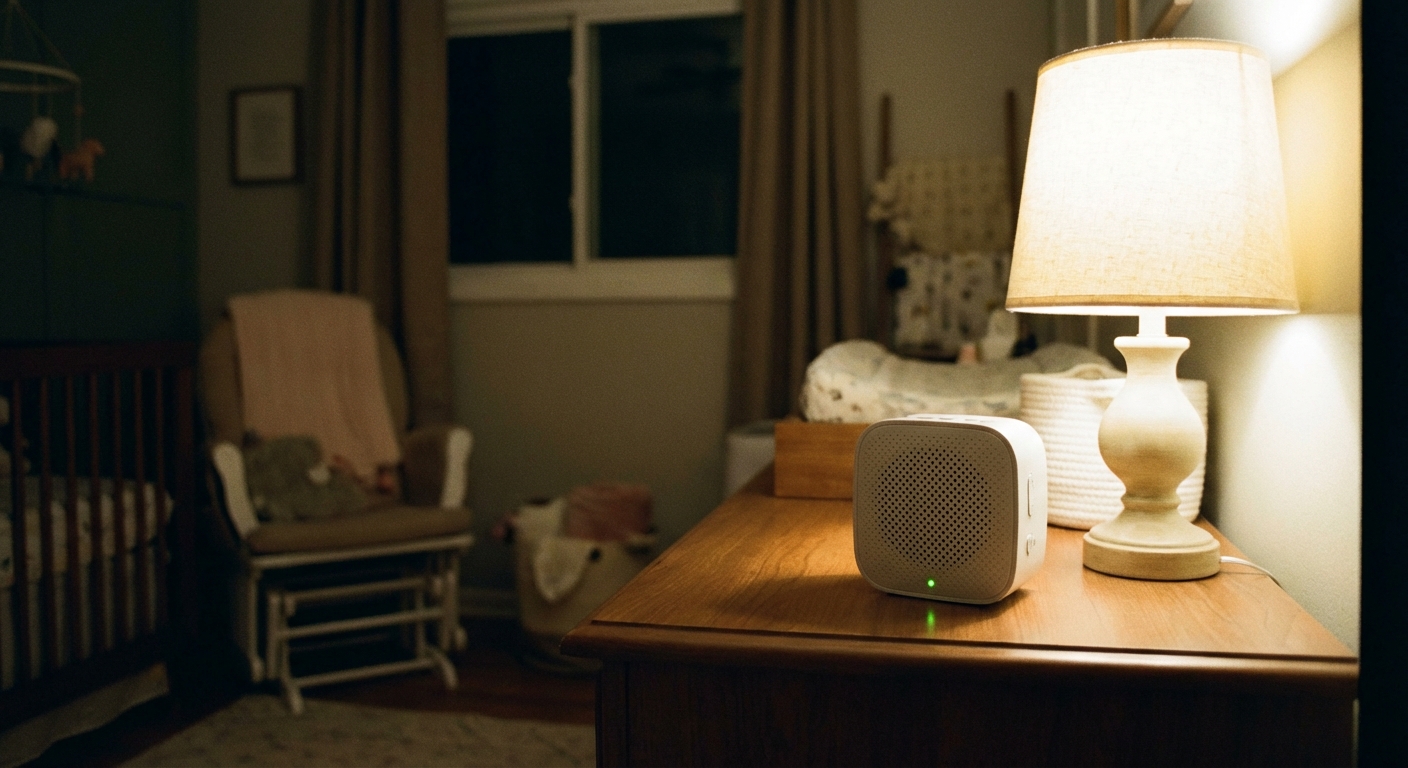
- White noise: Steady, continuous sound can reduce wake-ups from household noise. Keep it at a safe volume and place the machine away from the crib. Many experts suggest aiming roughly under 50 decibels at the baby’s sleep space, which is about the level of a running shower heard from a distance.
- Cool: Many babies sleep best around 68 to 72°F (20 to 22°C), but comfort matters more than a perfect number.
- Simple crib: Firm mattress, fitted sheet only.
Step 4: Night wakings
The hardest part of the 4-month regression is that babies wake more often during lighter sleep and then need help linking sleep cycles. Your job is to decide what “help” looks like in your family, then repeat it consistently for 5 to 7 nights.
Option A: Supportive soothing
This is a good fit if you want to reduce wake-ups without a lot of crying.
- Pause 20 to 60 seconds. Many babies fuss between cycles and settle.
- If baby escalates, try a hand on the chest, gentle shush, or rhythmic pat.
- If that does not work, pick up to calm, then place back down before fully asleep (repeat as needed).
- Keep the room dark and boring. No chatting, no phone light, no “party.”
Option B: Timed checks
Put baby down awake, then check at planned intervals (for example: 3 minutes, 5 minutes, 10 minutes) with brief reassurance. This can work well for some families, but it is not the only way and it is not required.
Option C: Full assist (survival mode)
If you are in pure survival mode, it is okay to use more help temporarily. Rocking, feeding, or contact sleep can be a bridge. The key is to choose the safest possible version and make a plan for how you will step back out of it later.
Important safety note: If you are doing contact sleep, plan it for times when you are awake (for example, a supervised contact nap). Avoid falling asleep with your baby on a couch, recliner, or armchair. Those situations carry a high suffocation risk. For overnight sleep, follow your pediatrician’s guidance and your local safe-sleep recommendations.
If you are so tired you feel unsafe caring for your baby, that is an emergency in its own right. Tag in a partner, friend, or family member, even for two hours, and sleep.
Step 5: Feeds
At 4 months, many babies still need at least one night feed. Some need more. What we are aiming for is reducing “snack feeding” every hour that happens because baby cannot settle, not because baby is truly hungry.
Important: If your baby was premature, has had weight-gain concerns, or your pediatrician has advised more frequent feeds, follow that medical plan.
A simple approach
- If baby wakes and it has been less than 2 to 3 hours since the last full feed, try soothing first (if weight gain is on track and your pediatrician has not advised otherwise).
- If it has been longer, feeding is reasonable.
- Keep feeds calm, dim, and businesslike. Offer a full feed rather than a quick snack if possible.
- If you are breastfeeding and baby is popping on and off every 45 minutes, consider that they may be using you like a pacifier. That is common. It is also exhausting. It is okay to soothe in other ways sometimes.
Step 6: Protect your sleep
As a nurse, I will tell you what I told parents in triage and what I still tell myself now: sleep deprivation makes everything feel louder, scarier, and harder. You deserve support.
- Do shifts if possible (for example, one parent covers 8 PM to 1 AM, the other 1 AM to 6 AM).
- Lower standards for everything else. This is not the week for homemade muffins.
- Nap when you can, even if it is one nap every other day.
- If anxiety is spiking at night, put your phone across the room and stop doom-scrolling “sleep schedules” at 3 AM. Ask me how I know.
Milestones that stir things up
Sleep can get bumpy when your baby’s brain and body are doing a lot at once. Around this age, you may also see:
- Rolling practice: babies may roll, get stuck, then yell about it.
- More awareness: they notice changes in light, sound, and where you are.
- New skills: reaching, babbling, and general “I have opinions now” energy.
None of this means you are doing anything wrong. It just means your baby is waking up to the world.
Sample schedules
Use these as a starting point, not a strict script. Wake windows matter more than exact times.
Four naps (short naps day)
- 7:00 AM wake
- 8:15 to 9:00 nap
- 10:15 to 11:00 nap
- 12:30 to 1:30 nap (often the “rescue” nap)
- 3:00 to 3:30 nap
- 6:45 to 7:30 PM bedtime routine and bed
Three naps (longer naps day)
- 7:00 AM wake
- 8:30 to 10:00 nap
- 12:00 to 1:30 nap
- 3:30 to 4:15 nap
- 7:00 to 7:45 PM bedtime routine and bed
If bedtime starts drifting later and later because naps are a mess, you are not alone. A slightly earlier bedtime for a few nights can help reset overtiredness.
Mistakes that drag it out
- Bedtime too late. Overtired babies often wake more.
- Inconsistent response. If you rock to sleep sometimes and do checks other times, baby gets mixed signals. Choose a plan for a week.
- Accidental new sleep crutches. Introducing a brand-new association during this phase can make it stick.
- Expecting naps to be perfect. Short naps are often normal at this age. “Good enough” naps can lead to better nights than fighting for perfect naps.
When to call the pediatrician
Most sleep regressions are normal and do not need medical care. Call your pediatrician if you notice:
- Fever in a baby under 3 months, or fever that concerns you at any age
- Signs of illness like trouble breathing, persistent cough, ear pulling with significant irritability, vomiting, or dehydration (fewer wet diapers, very dry mouth)
- Poor weight gain or feeds that suddenly drop off
- Reflux symptoms that seem painful, feeds that are difficult, or frequent spit-up with distress (talk with your pediatrician rather than changing sleep position)
- You feel unsafe from exhaustion, depression, or intrusive thoughts
That last one matters. Postpartum anxiety and depression can show up later than you expect, and sleep disruption can amplify it. You are not failing. You deserve care.
7-night reset
If you like a checklist, here is a simple reset you can start tonight.
Nights 1 to 2
- Set a consistent bedtime routine.
- Dark room, white noise, sleep sack.
- Pause briefly before responding to wakings.
- Use your chosen soothing method consistently.
Nights 3 to 5
- Work on putting baby down slightly more awake than before.
- Reduce extra help gradually (for example, less rocking time, shorter feeds if they are clearly comfort-only and your pediatrician agrees weight gain is on track).
- Keep first morning light exposure consistent to anchor the day.
Nights 6 to 7
- Keep the plan steady. This is where many families see improvement.
- Decide what you will do for early wakes (before 6 AM): keep it dark and treat it like nighttime.
If you try for a week and nothing improves, it does not mean you did it wrong. Some babies need schedule tweaks, feeding adjustments, or a different settling approach. It can also help to check in with your pediatrician or a reputable sleep specialist for personalized guidance.
The bottom line
The 4-month sleep regression is brutal, but it is also a sign your baby’s sleep is maturing. You do not need a perfect schedule or a magical technique. You need a safe sleep setup, a consistent plan, and enough support that you can function.
You are not alone in the dark. And you will sleep again.