A Toddler Morning Routine That Works

Sarah Mitchell
Sarah Mitchell is a Registered Pediatric Nurse and a mother of three who has spent over a decade helping families navigate the beautiful, chaotic early years of childhood. She combines evidence-based medical knowledge with real-world parenting experience to offer practical, compassionate advice. At Awesome Parent, Sarah's mission is to help exhausted parents find solutions, trust their instincts, and finally get some sleep.
Morning with a toddler can feel like a tiny hostage negotiation where the demands involve the “wrong” spoon and pants that suddenly have bad vibes.
As a pediatric nurse and a mom of three, I promise you this: you do not need a perfect routine. You need a repeatable one. Many toddlers do best when mornings are predictable, choices are limited, and you are not asking them to do eight hard things in a row while they are hungry.
This guide gives you a simple visual routine plus the small tweaks that prevent a lot of meltdowns before they start. It is general parenting guidance, not medical advice. If you are worried about your child’s health, check in with your pediatrician.
Quick note on age: When I say “toddler,” I mean roughly ages 1 to 3 (sometimes up to 4). Younger toddlers usually need more hands-on help and fewer steps.
Why mornings melt down (and why it is not you)
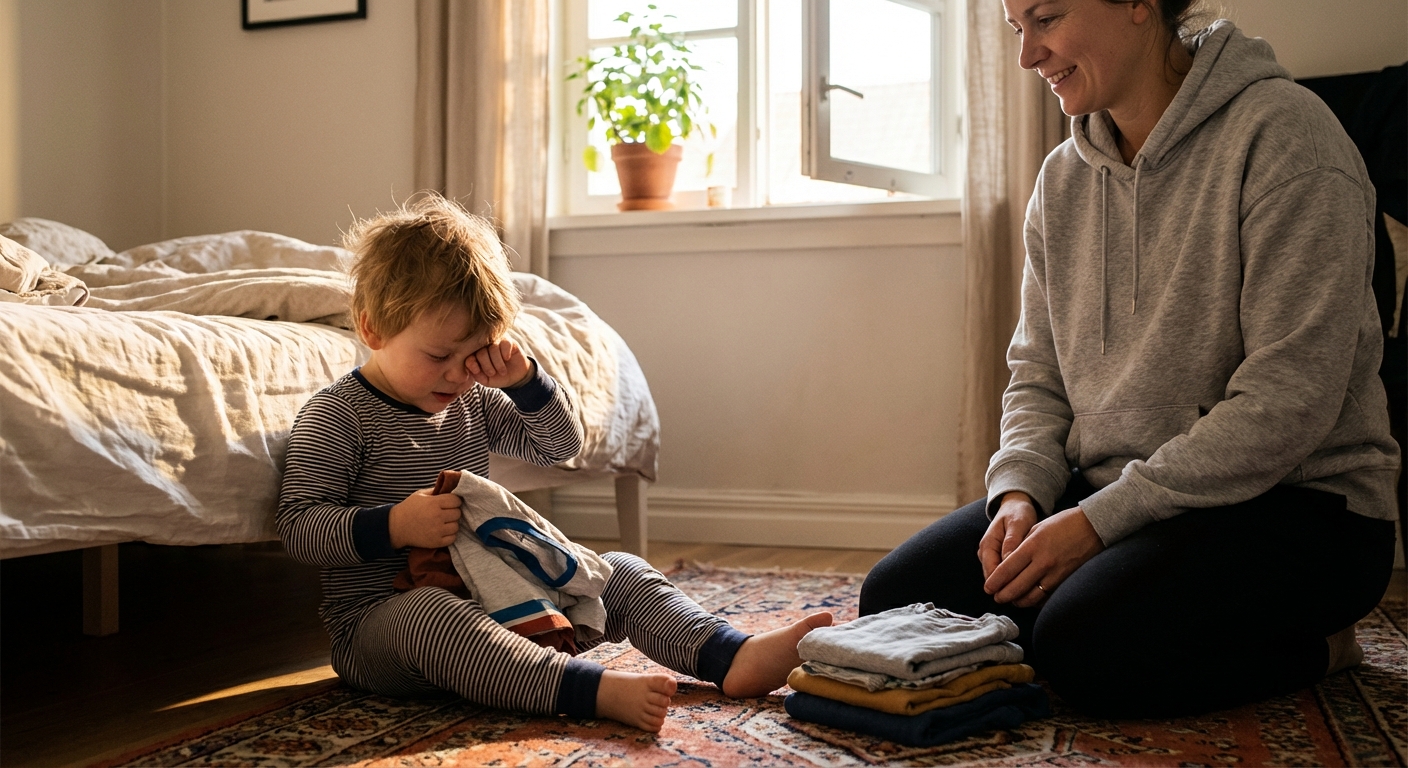
Toddlers are wired to struggle with mornings for a few very normal reasons:
- Transitions are hard. Stopping one thing to start another is peak toddler frustration.
- They want control. Independence is their full-time job.
- They have “low fuel.” Hunger and tiredness tank impulse control fast.
- Too many words can backfire. When they are dysregulated, a long explanation can feel like noise.
So the goal is not “no feelings.” The goal is fewer surprises, fewer decisions, and fewer opportunities to get stuck.
The routine: short and the same
A toddler routine works best when it is as few steps as possible, often around 5 to 7 steps, in the same order every day. Even if you do not love the order, stick with it. Consistency is what makes it feel safe to them.
The basic flow (template)
- Connect (30 seconds)
- Bathroom or diaper
- Get dressed
- Breakfast
- Teeth and face
- Shoes and coat
- Out the door
If you are thinking, “My child will absolutely demand breakfast before pants,” that is fine. The best routine is the one your child will follow. Many toddlers do better with breakfast first, then clothes.
Visual routine (no fancy printing)
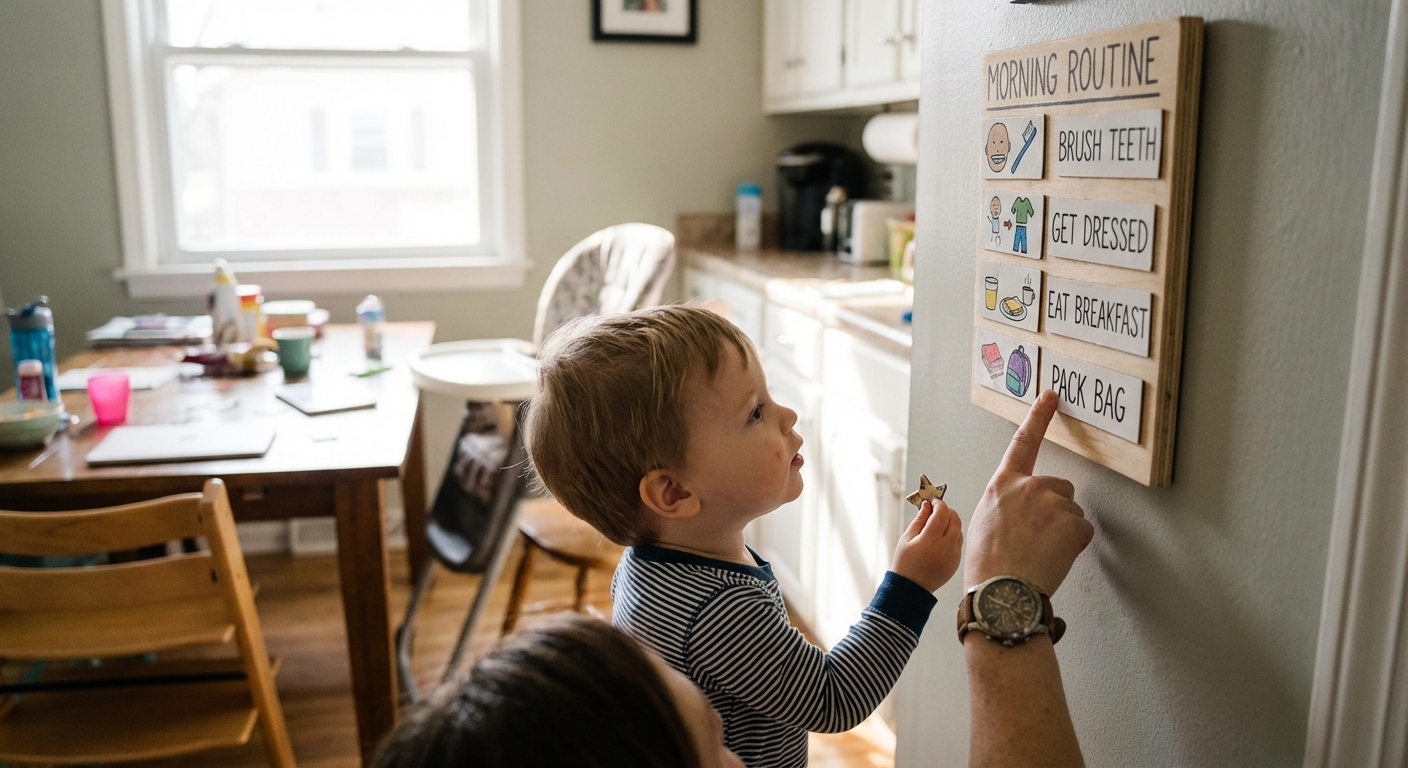
Toddlers love visuals because pictures do not change. Your tone might. Your patience might. The picture stays calm.
What to use
Use 5 to 7 pictures that match your routine. You can use:
- Photos you take on your phone of your child doing each step
- Simple icons
- Magazine cutouts
Where to put it
- On the fridge (breakfast and teeth steps live there)
- By the door (shoes, coat, out the door)
- In the bedroom (diaper, clothes)
How to use it
- Point more than you talk: “What is next?”
- After each step, let your toddler move a magnet, flip a card, or put a clothespin on the next picture
- Celebrate progress, not perfection: “You did step two. Nice work.”
Night-before prep (5 minutes)
If mornings feel like a sprint, do these at night. It is not about being “on top of it.” It is about removing friction.
- Pick clothes. Offer two weather-appropriate options and let your toddler choose. Put the chosen outfit in a visible spot.
- Stage breakfast. Set out the bowl, spoon, cup, and an age-appropriate shelf-stable option (like an oatmeal packet or a soft snack you know they handle well). Skip hard, sticky, or crumbly foods that can be a choking risk for younger toddlers.
- Pack the bag. Diapers, wipes, extra clothes, water, any forms.
- Set a launch pad. Shoes, coat, and your keys in the same place every time.
- Decide on “emergency food.” A predictable, boring option you can serve when the toddler refuses everything. Consistency can make it less of a power struggle.
Daycare note: If you are tempted by pajamas-to-daycare on survival mornings, double-check your childcare rules and the weather. Some centers are fine with it, some are not. Either way, you are not the only parent who has considered it.
Step by step (with scripts)
Here is a realistic sequence you can follow tomorrow morning. The scripts are short on purpose.
1) Connect (30 seconds)
This sounds too simple, but it prevents a surprising number of battles. Before you ask for cooperation, give a tiny dose of attention.
- “Good morning. I am happy to see you.”
- “Do you want a hug or a high five?”
Then move on. Connection is not a 15-minute cuddle session. It is a quick signal of safety.
2) Bathroom or diaper
Toddlers dig in when they feel rushed or manhandled. Give a warning and a job.
- “First bathroom, then breakfast.”
- “Do you want to walk or do you want me to carry you?”
3) Get dressed (two choices)
Too many choices overwhelm toddlers. Two choices feels empowering and keeps you in control of the boundaries.
- “Blue shirt or green shirt?”
- “Do you want to put your shirt on first or your pants?”
If they refuse, stay calm and repeat the boundary:
- “It is time to get dressed. You can choose blue or green. If you do not choose, I will choose.”
Solo-parent tip: If you are doing mornings alone, this is one place to simplify. Consider letting them sleep in next-day clothes (soft leggings, a t-shirt) when it makes sense. Not every day has to be a skill-building day.
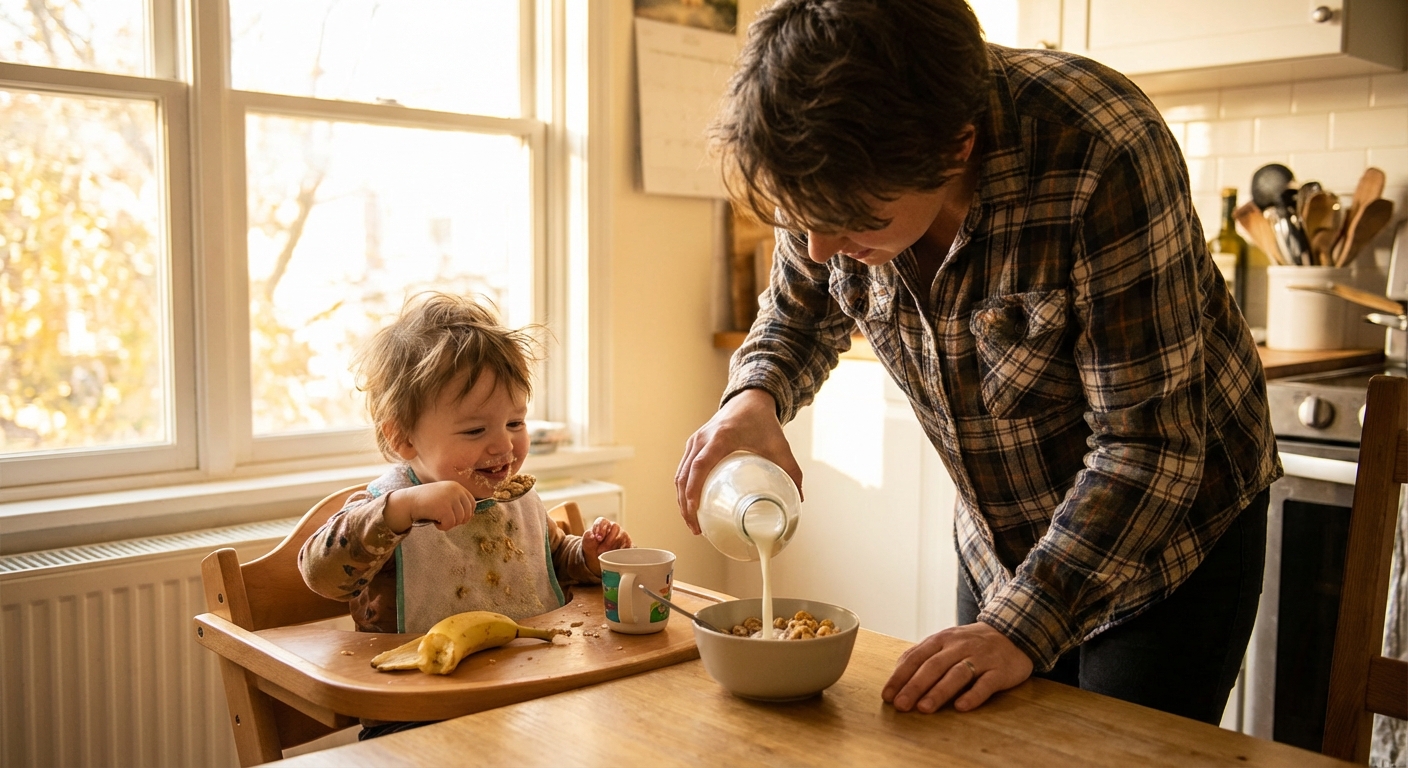
4) Breakfast (keep it predictable)
Decision fatigue is real for toddlers too. Rotating through a small set of familiar breakfasts can reduce battles.
A simple structure that works for many families:
- One safe food you know they usually eat
- One protein or fat (yogurt, egg, avocado, nut butter if appropriate)
- One fruit
Safety note: Serve foods in an age-appropriate way. Nut butter is safest when thinly spread or mixed into yogurt or oatmeal (not in big sticky globs). If your child has allergy concerns, follow your pediatrician’s guidance.
Try keeping breakfast time bounded. Many families find that 15 to 20 minutes is a workable target, but do what fits your morning and your child. If they eat, great. If not, you stay neutral.
5) Teeth and face (game, not debate)
- “Do you want to brush like a lion or like a bunny?”
- “I will count to ten while you brush the top. Then I get a turn.”
Most toddlers still need an adult to finish the brushing for a truly good clean. If toothbrushing is a daily war in your home, you are not alone. The most effective approach is often consistent routine plus calm follow-through, not stronger arguments.
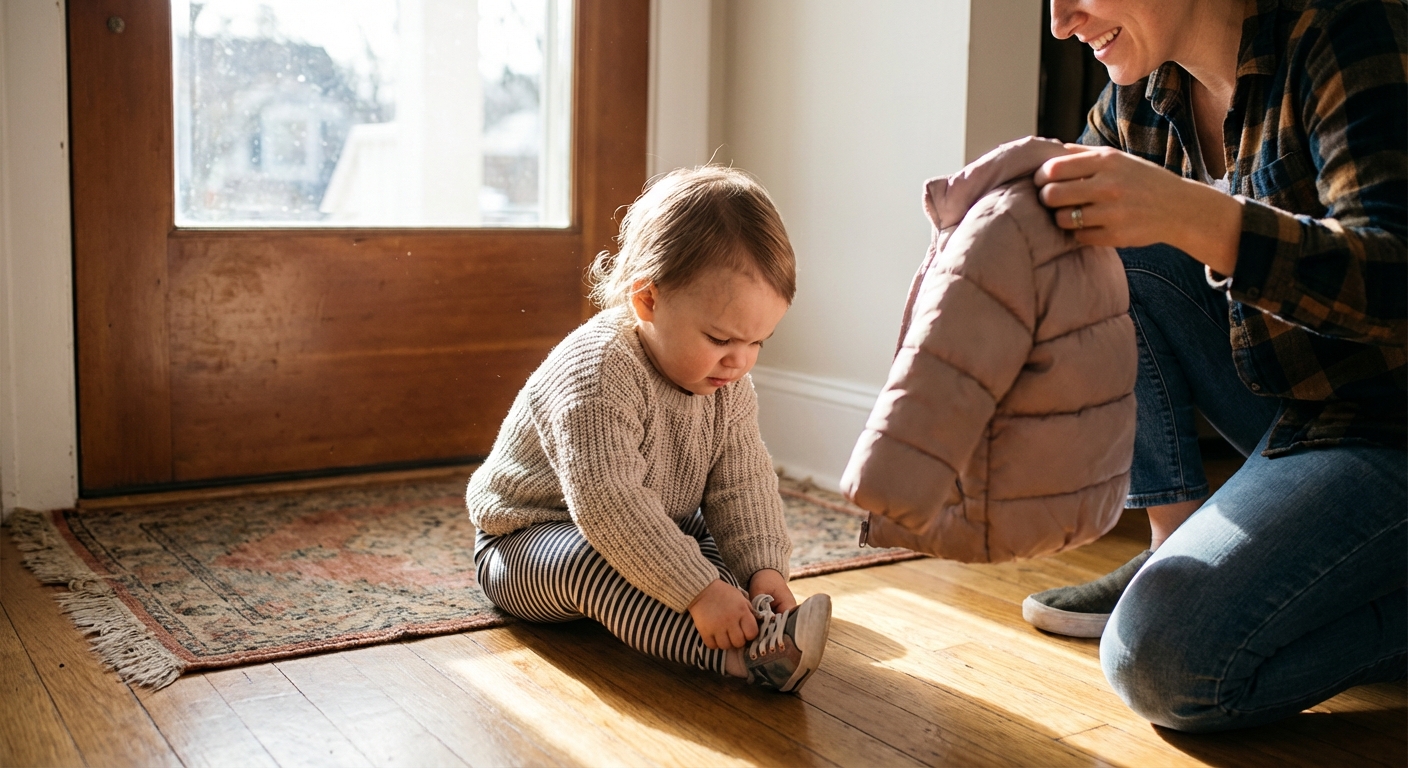
6) Shoes and coat (timer + job)
Timers help because the timer is the “bad guy,” not you.
- “When the timer beeps, it is shoes time.”
- “Can you bring me your shoes from the launch pad?”
Meltdown prevention checklist
If mornings regularly explode, check these common triggers (my triage nurse brain loves this part):
- Not enough sleep. An overtired toddler has fewer coping skills. If mornings are rough, look at bedtime first.
- Hunger too early. Try offering a small “starter snack” right after wake-up (half a banana, yogurt, applesauce) before the bigger routine steps.
- Too many transitions. Combine steps: bathroom then clothes in the same room, shoes and coat by the door.
- Too much talking. Use fewer words and repeat the same phrase.
- Rushing. If possible, wake 10 to 15 minutes earlier for buffer time. This one change can feel like buying your nervous system a whole new personality.
When a tantrum starts
Zero tantrums is not a reasonable goal for toddlers. The win is shorter tantrums and faster recovery.
1) Safety + low voice
Get down to their level, move breakables, and speak slowly.
- “You are mad. I am here.”
2) One-sentence boundary
- “We are putting on shoes. Then we go.”
3) Small choice or helper role
- “Do you want to stomp your feet two times, then shoes?”
- “Can you hold the keys while I put on your coat?”
4) Do the minimum and move on
Some days you will carry a wiggly toddler to the car. That is not failure. That is Tuesday. After everyone is calm, you can practice the skill again tomorrow.
Two routines to copy
You already have the template above. These are ready-to-copy versions you can paste into your visual chart and test for a week.
Option A: Clothes before breakfast
- Wake up and cuddle
- Bathroom or diaper
- Get dressed
- Breakfast
- Brush teeth and wash face
- Shoes and coat
- Go
Option B: Breakfast first
- Wake up and cuddle
- Quick snack or breakfast
- Bathroom or diaper
- Get dressed
- Brush teeth and wash face
- Shoes and coat
- Go
Troubleshooting
“My toddler refuses clothes.”
- Use two choices, both acceptable.
- Try softer, tagless clothes and check for sensory issues (seams, tight waistbands).
- Practice dressing during playtime when no one is rushed.
- If it is safe and weather-appropriate, consider pajamas to daycare occasionally (if allowed). You can work on the skill when you have more bandwidth.
“Everything takes forever.”
- Reduce steps. Aim for essentials only.
- Add buffer time, even 10 minutes.
- Give one direction at a time.
- Use a simple timer for high-friction steps.
“They melt down when it is time to leave.”
- Use a consistent leaving cue: same phrase, same sequence.
- Give a two-minute warning: “Two minutes, then shoes.”
- Do a quick goodbye ritual: a special wave, a door knock, a “blastoff” count.
- If daycare drop-off is hard, coordinate a consistent handoff routine with staff. Predictable goodbyes usually help more than sneaking out.
“My toddler only listens to the other parent.”
Common and frustrating. Sometimes kids act out more with the caregiver they feel safest with, but there can be lots of reasons too (timing, routines, and what has been reinforced in the past). Start by having both parents use the same words for key steps. If possible, take turns owning the same step each morning for a week so it becomes predictable.
Neurodivergent kids
If your child is autistic, has ADHD traits, or has big sensory sensitivities, you may need a more explicit visual (real photos, fewer icons), more transition time, and fewer “surprise” steps. This is also a situation where OT or behavioral support can be incredibly helpful. You are not doing it wrong. Some kids simply need a different level of structure.
When to call the pediatrician
Most morning battles are developmental and improve with routine. Check in with your child’s clinician if you notice:
- Snoring, gasping, or very restless sleep
- Morning headaches, extreme daytime sleepiness, or behavior that suddenly changes
- Ongoing feeding concerns (frequent choking, very limited intake, poor growth)
- Sensory sensitivities that make dressing, toothbrushing, or transitions feel impossible most days
You are not overreacting by asking. Sometimes a small underlying issue makes a big difference in how mornings feel.
Your next 7 days
Pick one change and do it consistently for a week:
- Make the visual routine and point to it instead of repeating yourself
- Set up a launch pad by the door
- Offer two choices for clothes, every time
- Add a 10-minute buffer to wake-up time
If you do just one of those, you are building the foundation. Toddlers love predictable mornings, even when they loudly insist they do not.
And if you get everyone out the door with shoes on the correct feet, I would like you to accept your trophy: it is imaginary, but deeply deserved.