Baby Milestones by Month: Birth to 12 Months

Sarah Mitchell
Sarah Mitchell is a Registered Pediatric Nurse and a mother of three who has spent over a decade helping families navigate the beautiful, chaotic early years of childhood. She combines evidence-based medical knowledge with real-world parenting experience to offer practical, compassionate advice. At Awesome Parent, Sarah's mission is to help exhausted parents find solutions, trust their instincts, and finally get some sleep.
If you are reading this at an ungodly hour with one hand on a swaddle and the other on your phone, welcome. I am Sarah, a pediatric nurse and mom of three, and I promise you this: milestones are not a race. They are a wide, wiggly path. Some babies speed-walk. Some babies stroll. Many babies take a detour to practice blowing raspberries for three weeks straight.
This month-by-month guide will help you know what is typical in the first year, what you can do to support development, and when it is worth looping in your pediatrician. Think of it as a calm map, not a report card.

How to use milestones calmly
Most baby milestones have a range. Your baby can be perfectly healthy and hit a skill earlier or later than a friend’s baby. Premature babies also get their own timeline, and that is normal.
- Look for progress over weeks, not perfection on a specific birthday.
- One skill builds another. A baby who is busy mastering rolling may “pause” babbling for a bit.
- Temperament matters. Cautious babies often observe longer before trying something new.
Quick note for premature babies: If your baby was born early, your pediatrician may use a “corrected age” (based on due date) for milestones often until about age 2, and sometimes longer for very early babies. Ask at your next visit if you are not sure.
Month-by-month milestones (0 to 12 months)
Each month below includes common benchmarks across four areas: physical, cognitive, social/emotional, and communication. Your baby does not need to do everything listed to be doing great.
Month 1 (0 to 4 weeks)
- Physical: Lifts head briefly when on tummy, turns head side to side, hands mostly fisted.
- Cognitive: Tracks faces or high-contrast objects for short periods, startles to loud sounds.
- Social/emotional: Calms with caregiver voice, looks at caregiver’s face.
- Communication: Cries to signal needs, makes reflexive sounds like grunts, sighs, and little “ah” noises (cooing may begin toward the end of this month).
Help at home: Short, frequent tummy time (even 30 to 60 seconds counts) and lots of face time. Babies love faces more than toys at this age.
Month 2
- Physical: Holds head up a little steadier, smoother arm and leg movements.
- Cognitive: Pays attention to faces, follows things with eyes more consistently.
- Social/emotional: Social smile often appears, begins enjoying interaction.
- Communication: Coos more, different cries for different needs begin to emerge.
Help at home: Talk during routine care: “Now we are wiping your hands.” This builds language before “words” happen.
Month 3
- Physical: Pushes up on forearms during tummy time, brings hands to mouth, opens and closes hands.
- Cognitive: Watches moving objects, recognizes familiar caregivers.
- Social/emotional: Smiles at familiar people, may begin to laugh.
- Communication: Coos back and forth, responds to voices.
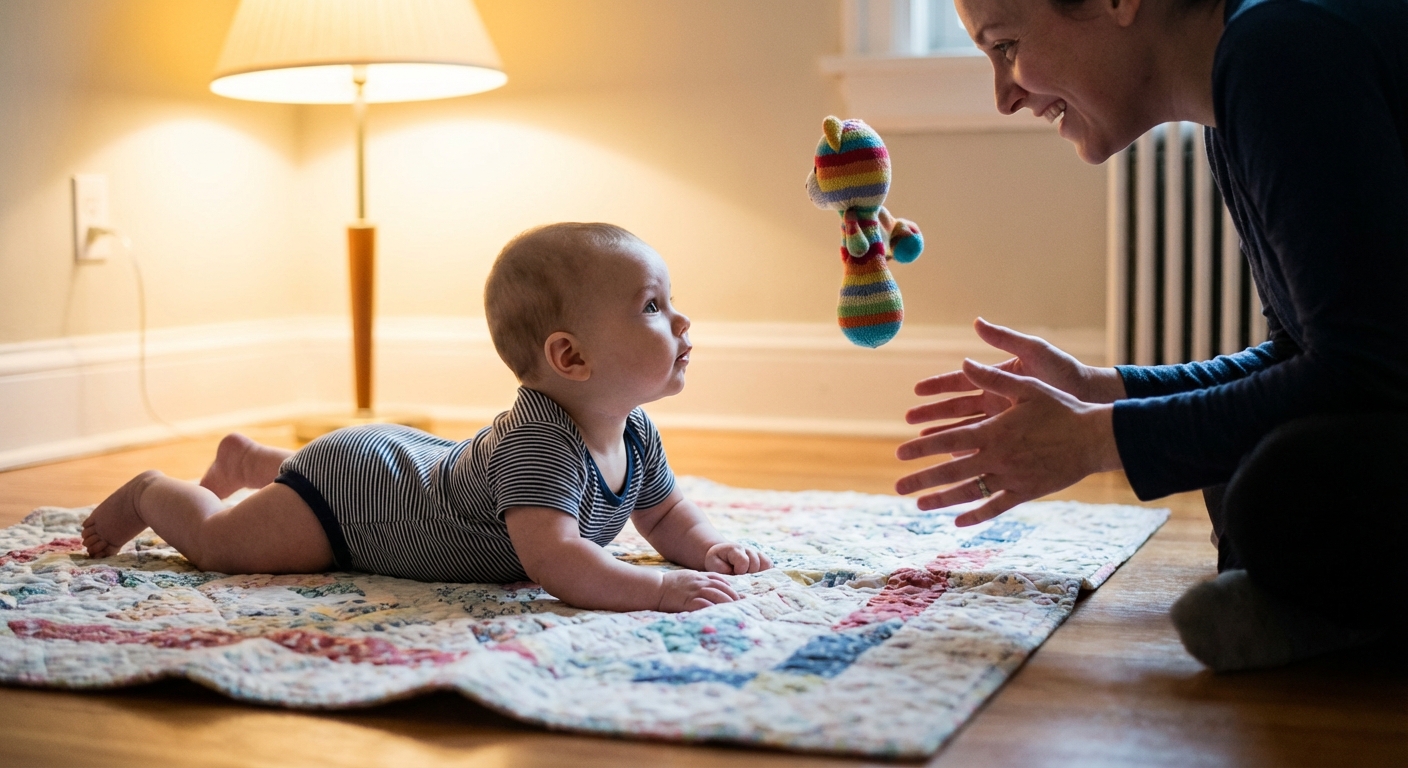
Help at home: Try “serve and return” interaction: baby coos, you respond, baby responds. It is conversation training, baby edition.
Month 4
- Physical: Good head control, pushes up on hands, may roll from tummy to back.
- Cognitive: Reaches for toys, looks at hands with fascination.
- Social/emotional: Enjoys play, may cry when play stops (tiny CEO energy).
- Communication: Babbles more, laughs, vocalizes to get attention.
Help at home: Give safe things to grab and explore. Babies learn through hands and mouths, so choose easy-to-clean, baby-safe objects.
Month 5
- Physical: May roll both ways (some do, many are still working on it), sits with support, brings feet to mouth.
- Cognitive: Explores objects by mouthing and banging, interested in mirrors.
- Social/emotional: Recognizes familiar vs unfamiliar people, enjoys silly games.
- Communication: Babbling strings like “ba” or “ga” may begin, turns toward sounds.
Help at home: Lots of floor time. This is prime time for rolling practice, and it is also when babies start scooting toward trouble with shocking speed.
Month 6
- Physical: Sits with minimal support or briefly unsupported, transfers objects hand to hand, may start rocking on hands and knees.
- Cognitive: Shows curiosity, begins understanding simple cause-and-effect (shake toy, hear sound).
- Social/emotional: Recognizes familiar people, may show frustration when a toy is out of reach.
- Communication: Responds to name sometimes, babbles with more variety.
Help at home: Narrate cause-and-effect: “You kicked and the music played!” It helps connect actions to outcomes.
Month 7
- Physical: Sits more steadily, may start crawling or “army crawling,” supports weight on legs when held.
- Cognitive: Looks for partially hidden objects (early object permanence).
- Social/emotional: May begin stranger anxiety, prefers familiar caregivers.
- Communication: Babbles with emphasis like “da-da-da,” responds to tone (happy vs upset).
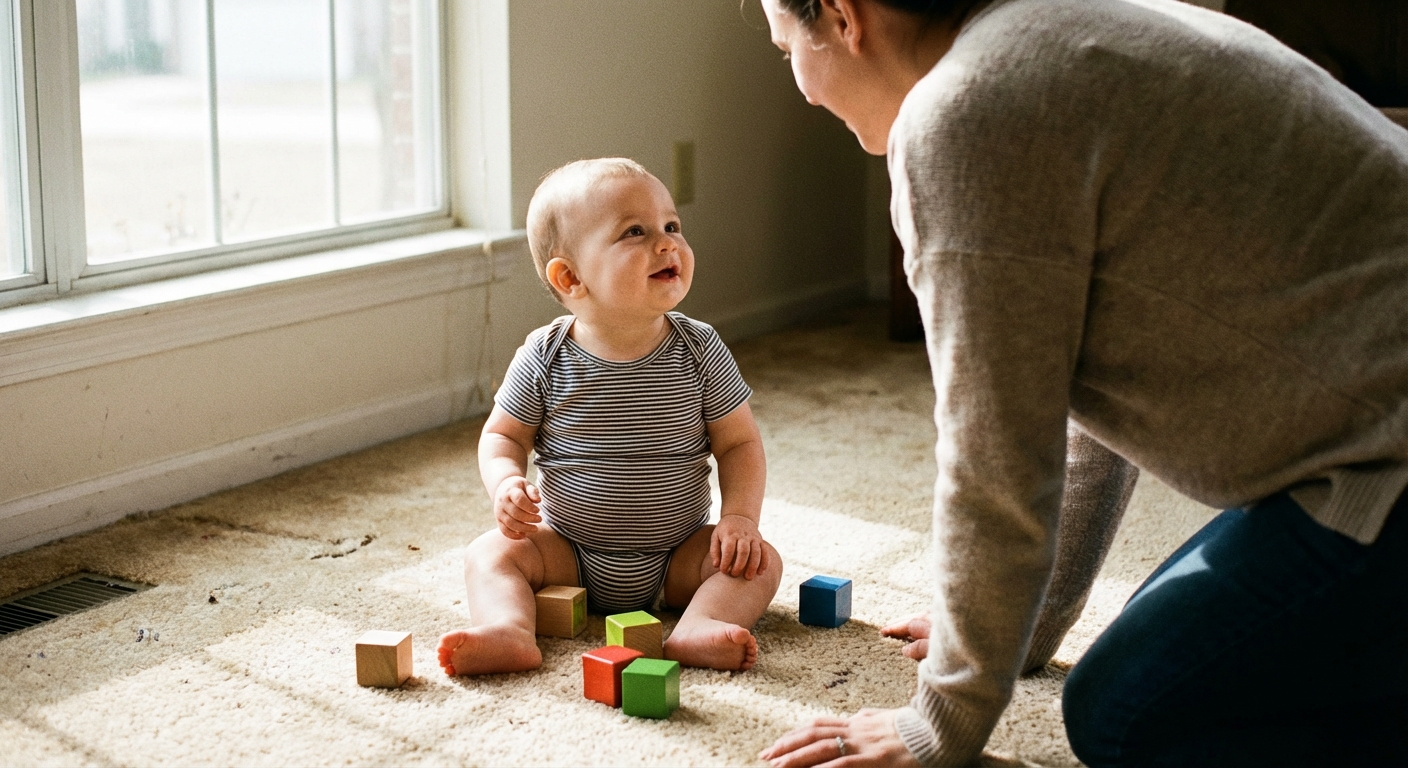
Help at home: Play gentle “where did it go?” games by covering a toy halfway with a cloth and letting baby find it.
Month 8
- Physical: Gets into sitting position, crawls or scoots, begins pulling to stand for some babies.
- Cognitive: Stronger object permanence, explores objects in different ways (drop, pick up, repeat forever).
- Social/emotional: Separation anxiety often ramps up around this age, and goodbyes can feel dramatic.
- Communication: Understands simple words like “no” (doesn’t always agree), uses sounds to get attention.
Help at home: Practice quick, confident goodbyes. Sneaking out usually makes separation anxiety worse, not better.
Month 9
- Physical: Pulls to stand, cruises along furniture, early pincer grasp may begin (thumb and finger).
- Cognitive: Understands cause-and-effect more clearly, enjoys putting things in containers.
- Social/emotional: Has favorite people and comfort objects, may show strong preferences.
- Communication: Uses gestures like reaching or raising arms to be picked up, may imitate sounds.
Help at home: Offer safe containers and big objects to put in and take out. This is learning, not “making a mess.”
Month 10
- Physical: Cruises well, may stand briefly without support, picks up small items with finger-thumb grasp.
- Cognitive: Looks for hidden objects, anticipates routines (bath comes after pajamas).
- Social/emotional: Tests boundaries, checks your reaction, seeks comfort after minor bumps.
- Communication: Understands simple requests like “give me,” uses varied babbling and vocal tones.
Help at home: Use consistent, simple phrases for routines: “Diaper, then book, then sleep.” Predictability helps babies feel safe.
Month 11
- Physical: Squats while holding on, may take a few assisted steps, climbs onto low furniture.
- Cognitive: Copies actions (stirring, talking on a pretend phone), explores how things work.
- Social/emotional: Plays interactive games, may hand you objects to share.
- Communication: Uses gestures like waving or shaking head, may say “mama” or “dada” with meaning.

Help at home: Model gestures. Wave when you say goodbye, clap when you are excited. Babies love copying you.
Month 12
- Physical: Many babies take first independent steps around this age, stands alone, may climb stairs with help.
- Cognitive: Follows one-step directions with a gesture (“Come here”), enjoys simple pretend play.
- Social/emotional: Shows clear preferences, may have big feelings and bigger opinions.
- Communication: May say one to a few words besides “mama/dada,” points to show interest, responds to simple questions.
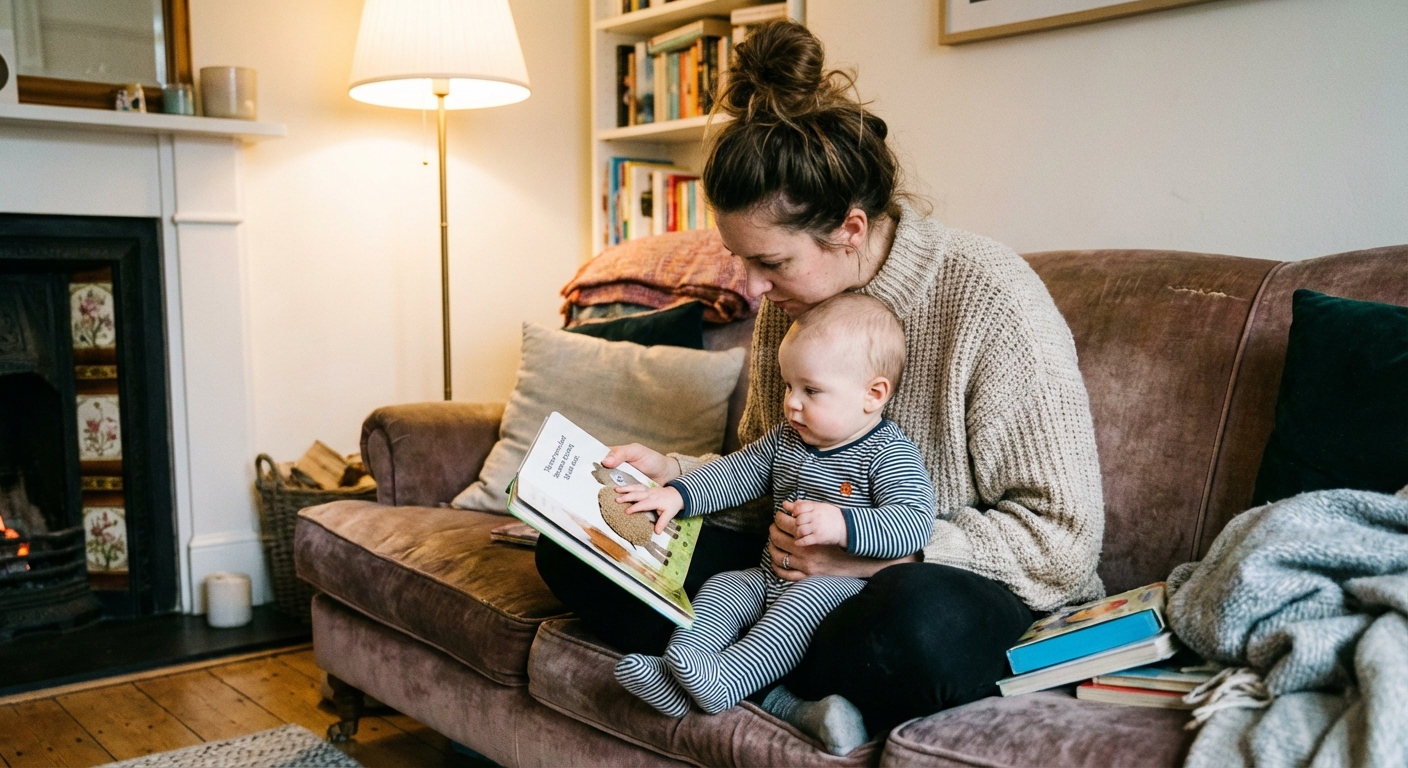
Help at home: Read daily, even if it lasts 90 seconds. Point to pictures, name them, and let your baby turn pages (or attempt to).
Milestone myths
- Myth: Babies must crawl before walking. Reality: Some never crawl and still develop normally.
- Myth: Earlier is always better. Reality: Development is not a competition, and early walking can come with more tumbles.
- Myth: A baby who is quiet is behind. Reality: Some babies focus on motor skills first, then language surges later.
When to call the pediatrician
I am a big fan of trusting your gut. You do not need to wait for the next well visit if something feels off. Call and ask. In triage, we would always rather reassure you early than miss something important. This is general guidance, so always follow your clinician’s advice for your specific baby.
Bring it up soon (or message your pediatrician) if you notice any of the following:
- By 2 months: Not responding to loud sounds, not watching faces at all, very floppy or extremely stiff.
- By 4 months: Poor head control, not bringing hands to mouth, not smiling at people.
- By 6 months: Not reaching for objects, not showing affection toward caregivers, not making vowel sounds (cooing).
- By 9 months: Not sitting without support, not babbling consonant sounds (like “ba,” “da”), not bearing weight on legs with support.
- By 12 months: Not showing some form of mobility to get around (rolling, scooting, crawling, cruising), not pointing or using gestures (like waving or reaching to be picked up), not responding to name consistently, or not using any consistent words or word-like sounds to communicate (especially if gestures are also limited).
- Any time: Loss of a skill they previously had, persistent eye crossing after 4 months, no interest in interaction, or you feel something is “not right.”
Urgent note: If your baby is having trouble breathing, turning blue/gray, having a seizure, is unusually hard to wake, or you suspect serious injury, seek emergency care immediately.
Support development simply
- Prioritize safe floor time: It builds rolling, crawling, and core strength.
- Talk all day: Narrate what you are doing, respond to sounds, and pause so your baby can “answer.”
- Read and sing: Repetition is how babies learn. Your baby does not care if you cannot carry a tune.
- Offer age-appropriate challenge: Put a toy slightly out of reach during tummy time, then cheer effort, not perfection.
- Limit containers: Car seats, swings, and bouncers have a time and place, but too much time in them can reduce practice time for movement.
Safety as skills change
Milestones are exciting. They are also the moment your baby discovers new ways to surprise you.
- Rolling: If baby can roll, assume they can roll off a bed or changing table. Keep one hand on them, every time.
- Grabbing and mouthing: If it fits through a toilet paper roll, it is a choking risk. Do a quick floor scan like you are looking for treasure, but the opposite.
- Pulling to stand and cruising: Anchor dressers and bookcases, and keep cords and heavy objects out of reach.
- Hearing and vision: If you notice your baby never startles to sound, never turns toward your voice, or seems to avoid eye contact, it is worth checking in. Early support can make a big difference.
A gentle reality check
The first year is a lot. You are recovering, learning your baby, and functioning on a wildly unfair amount of sleep. If you take nothing else from this guide, take this: your baby is not behind just because they are not doing what the internet says they should do today.
Use this timeline as a reference, celebrate the small wins, and lean on your pediatrician when you are concerned. That is what we are here for.