Walk through your home like a baby would. Use this practical room-by-room baby-proofing checklist, plus a printable checklist concept and a simple timeline b...
Baby Walkers, Jumpers, and Activity Centers: Safety Risks and Safer Play

Sarah Mitchell
Sarah Mitchell is a Registered Pediatric Nurse and a mother of three who has spent over a decade helping families navigate the beautiful, chaotic early years of childhood. She combines evidence-based medical knowledge with real-world parenting experience to offer practical, compassionate advice. At Awesome Parent, Sarah's mission is to help exhausted parents find solutions, trust their instincts, and finally get some sleep.
At about the same time your baby discovers that legs are useful, the internet starts whispering: “Get the walker.” I get it. You want a safe place to set your baby down. You want them happy. And you would love, just once, to drink your coffee while it is still warm.
But here is my calm, nurse-y bottom line: traditional infant walkers with wheels are a well-documented injury risk, and the American Academy of Pediatrics (AAP) has urged that they not be used. Jumpers and stationary activity centers are not automatically “safe,” either. They can be used more safely, but they still come with real hazards and a few developmental trade-offs.
Quick clarity, because the names are confusing: In this article, “baby walker” means the sit-in, wheeled kind that rolls. A push toy or “push walker” is different (and can be a better option when your baby is already pulling to stand and cruising).
Why the AAP warns against infant walkers
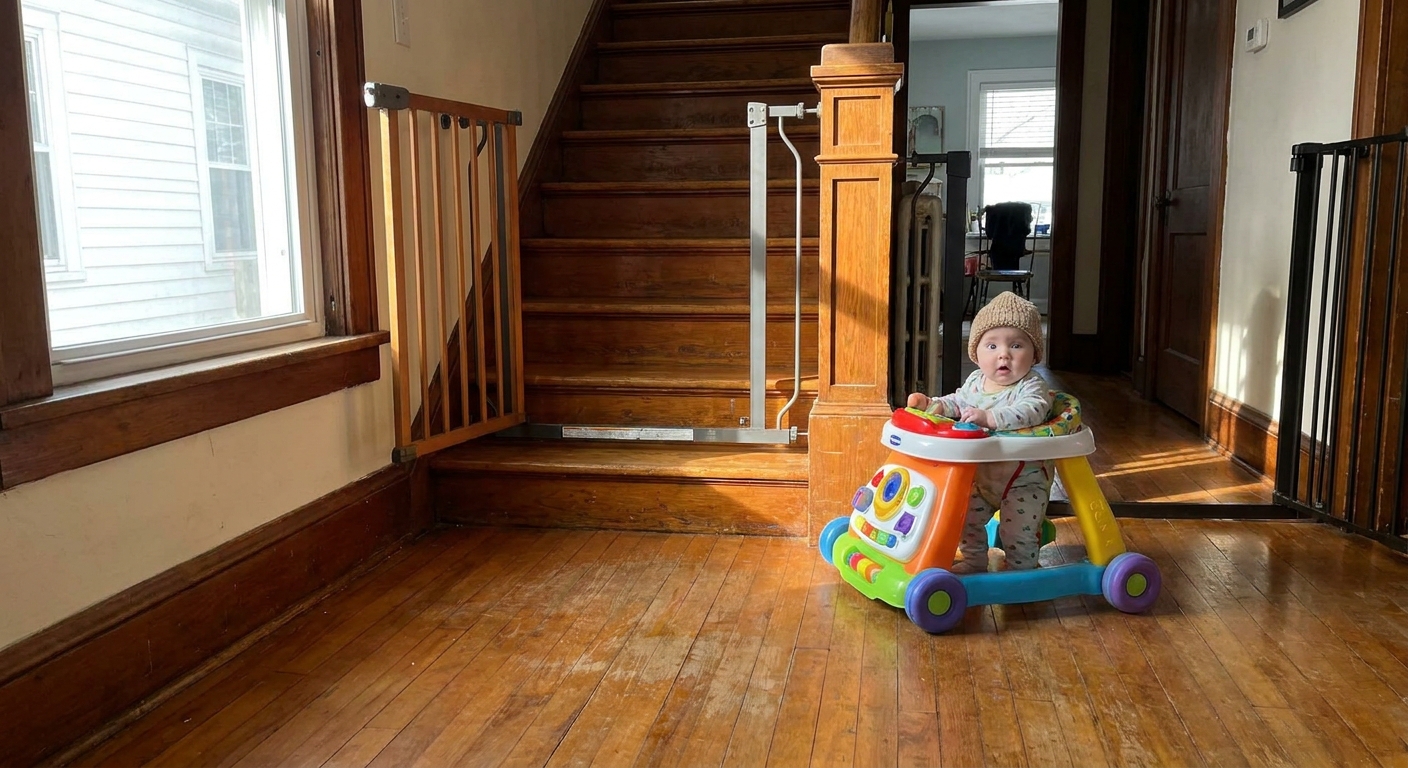
When pediatricians talk about “baby walkers,” we mean the wheeled seats that let babies scoot around the house. The AAP has been clear for years: these walkers have sent thousands of babies to emergency departments over time, most often for falls, especially down stairs.
The biggest problem: speed plus height
A baby in a wheeled walker can move surprisingly fast. That speed, combined with the extra height from the walker frame, creates a perfect storm:
- Stair falls are the classic injury. Even a single step can cause serious injury.
- Tip-overs can happen on thresholds, uneven flooring, area rugs, or when the walker catches on a toy.
- Reach hazards increase because the baby is taller and mobile. Hot coffee on a table. A dangling cord. A pet water bowl. Cleaning products you thought were out of reach.
- False sense of security is a sneaky one. Parents understandably look away for a moment because baby seems “contained,” but walkers are the opposite of contained.
Even with supervision, injuries happen quickly because the whole point of a wheeled walker is mobility.
Note: If you have any mobile baby gear in the home, stair gates and a truly blocked-off staircase are non-negotiable. (And even with gates, the AAP recommendation is still to avoid wheeled walkers.)
Do walkers help babies learn to walk?
No. Evidence does not show that walkers help babies walk sooner. Some research suggests they may delay certain motor skills. One reason is that babies may practice pushing on their toes and leaning forward in a supported position rather than building the core strength, balance, and coordination needed for independent walking.
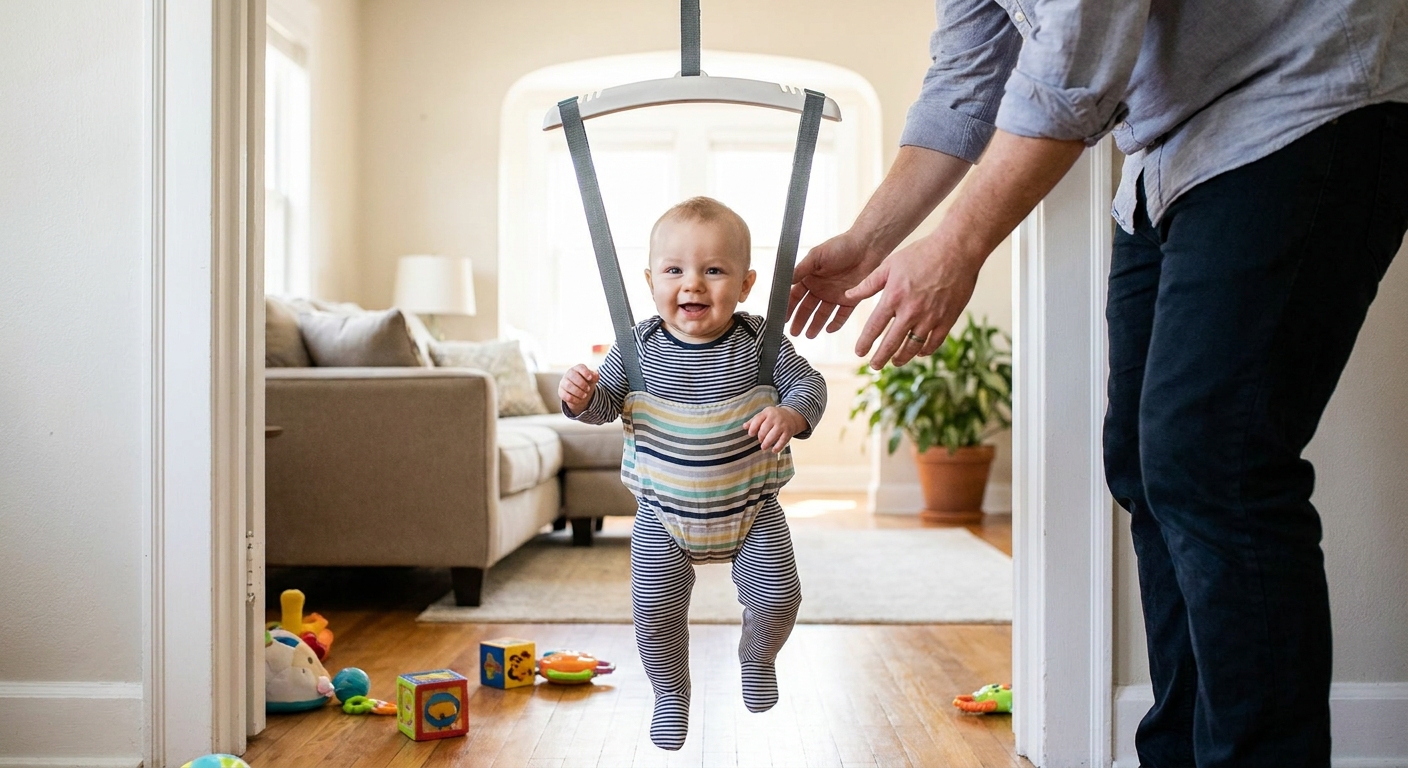
Doorway jumpers: fun, but not risk-free
Doorway jumpers look harmless: baby bounces, baby giggles, everyone wins. In real life, the risks depend heavily on the doorway setup, your baby’s size and head control, and how closely it is used as a “parking spot.”
Most manufacturers recommend use only once baby has strong head and neck control (often around 4 to 6 months), and only within the product’s stated height and weight limits.
Common jumper concerns I see as a pediatric nurse
- Falls from hardware failure or poor installation: weak trim, improper clamps, or worn straps can lead to a sudden drop.
- Head and face impacts: babies can twist and bounce into the door frame.
- Pinched fingers: curious little hands find the moving parts.
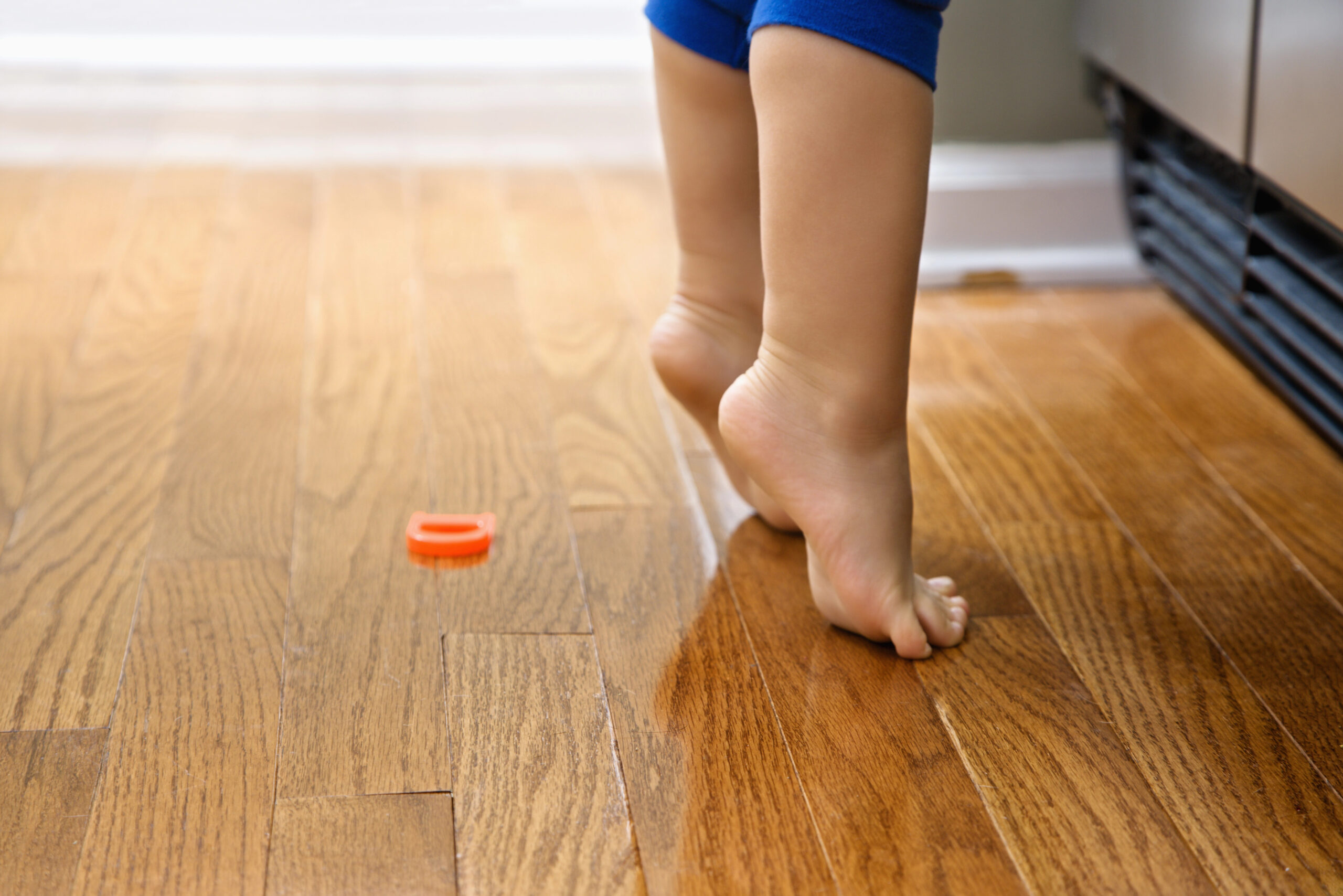
- Hip and leg strain: prolonged bouncing or a poor fit (especially when baby is mostly on tiptoes) can put extra stress through hips, knees, and ankles. This is one reason to keep sessions short and adjust the height so feet can rest more flat.
If you use a jumper at all, think “short bursts, closely watched, properly installed,” not “hands-free time.”
Activity centers and exersaucers: safer than walkers, still need rules
Stationary activity centers can be a reasonable option because they do not roll around the home. That said, I have seen preventable injuries when they are used on unsafe surfaces or as long-duration containment.
Where things can go wrong
- Tip-over risk: uneven flooring, thick carpet, a sibling bumping it, or a product used outside its weight limits.
- Falls: baby pushing up and partially climbing out as they get older and stronger.
- Choking hazards: small detachable parts, older siblings “customizing” the toy tray, or nearby floor items baby can grab.
- Overuse: too much time in “containers” can limit floor time that builds strength, coordination, and exploration.
A practical time guideline
Many pediatric therapists recommend keeping time in any container (activity center, bouncer, swing, seat) limited and balanced with plenty of supervised floor play. A practical approach for many families is 10 to 15 minutes at a time, then a reset to the floor. If your baby is spending long stretches in one, it is a good moment to create a safe floor zone instead.
Safer alternatives that build motor skills
If you are reading this at 3 AM wondering what you are supposed to use instead, you are not alone. The good news: the safest “gear” is usually your floor, plus a few simple toys and a little structure.
Newborn to 3 months
- Tummy time on your chest: recline slightly, place baby on your chest, and let them lift and turn their head.
- Blanket on the floor with you right there: a high-contrast card or simple rattle is plenty.
- Side-lying play: great for head shaping and early hand discovery.
3 to 6 months
- Tummy time stations: rotate a mirror, soft book, and one or two toys so it stays interesting.
- Reach and roll games: place a toy just out of reach to encourage pivoting and rolling.
- Supported sitting for short periods: sit baby between your legs or with a nursing pillow behind them while you stay hands-on.
6 to 10 months
- Big safe playpen or gated area: one of my favorite sanity savers, because it gives freedom without wheels.
- Cruising-friendly setup: a sturdy couch or anchored activity table they can pull up on once they are ready.
- Push toys (when baby is pulling to stand and steady): choose wide, stable bases and use on a clear, flat surface.
10 to 15 months
- Obstacle-free cruising paths: clear coffee tables and sharp-edged furniture from their route.
- Ball play and squatting games: rolling a ball back and forth builds balance and core strength.
- Follow me walking: holding hands is fine, but let them lead the pace and take breaks.

If you still use gear: a quick safety checklist
I am not here to shame you for owning baby gear. I am here to help you use it with eyes wide open. If you choose to use a jumper or stationary activity center, run through this list first.
Buying and setup checks
- Avoid wheeled infant walkers (the rolling kind). If you have one, consider dismantling it and disposing of it safely so it cannot be reused by another child.
- Check recall history before buying secondhand. Avoid items with missing manuals, unknown model numbers, or homemade repairs.
- Look for a wide, stable base on stationary centers and ensure baby cannot tip it by pushing.
- Confirm weight and height limits, then stop using once your baby approaches them or starts attempting to climb out.
- Inspect straps, stitching, buckles, clamps, and springs every time for jumpers. If anything looks worn, retire it.
- Only use on flat, stable surfaces, away from stairs, thresholds, and fireplaces.
- Use stair gates and keep stairs fully blocked off in homes with any mobile baby gear or early climbers.
Use checks
- Supervise closely: within arm’s reach for jumpers, and always in the same room for activity centers.
- Limit time: think minutes, not hours. Mix in lots of floor time every day.
- Feet position matters: baby should be able to place feet flat, not only bounce on tiptoes. Adjust height accordingly.
- Dress safely: no long strings, bib ties, or necklaces that could snag.
- Keep the floor clear: remove small toys and choking hazards, especially if older siblings play nearby.
Stop using if you see
- Baby slumping, poor head control, or obvious fatigue.
- Toe-walking that seems persistent during gear use.
- Any bruising, redness, or rubbing at the thighs or groin from the seat.
- Any wobble, looseness, or damage to the frame.
When to call your pediatrician
If your baby has a fall, seems unusually sleepy, vomits repeatedly, has a seizure, is inconsolable, or you notice new weakness or trouble using an arm or leg, seek urgent medical care right away. Trust your gut. You do not need to “wait and see” if something feels off.
And if you are unsure what is age-appropriate for your baby’s movement and play, your pediatrician or a pediatric physical therapist can usually help you sort it out quickly. Sometimes a tiny tweak to your setup makes a huge difference.
My tired-parent take: Your baby does not need wheels to learn to walk. They need safe space, floor time, and you nearby. And yes, you still deserve that coffee.
This article is general education and is not a substitute for medical advice for your child.