Button Battery Swallowing in Toddlers: What to Do First

Sarah Mitchell
Sarah Mitchell is a Registered Pediatric Nurse and a mother of three who has spent over a decade helping families navigate the beautiful, chaotic early years of childhood. She combines evidence-based medical knowledge with real-world parenting experience to offer practical, compassionate advice. At Awesome Parent, Sarah's mission is to help exhausted parents find solutions, trust their instincts, and finally get some sleep.
If you think your toddler swallowed a button battery, I want you to treat it like a house fire. Not because I want to scare you, but because time matters in a way it does not with most other swallowed objects.
Button batteries can start burning tissue quickly, especially if they get stuck in the esophagus. The tricky part is that early symptoms can look like a cold, a stomach bug, or a cranky day. Parents often do not realize what happened until things get worse.
Bottom line: If a button battery might be swallowed, assume it is an emergency until imaging and clinicians confirm otherwise.
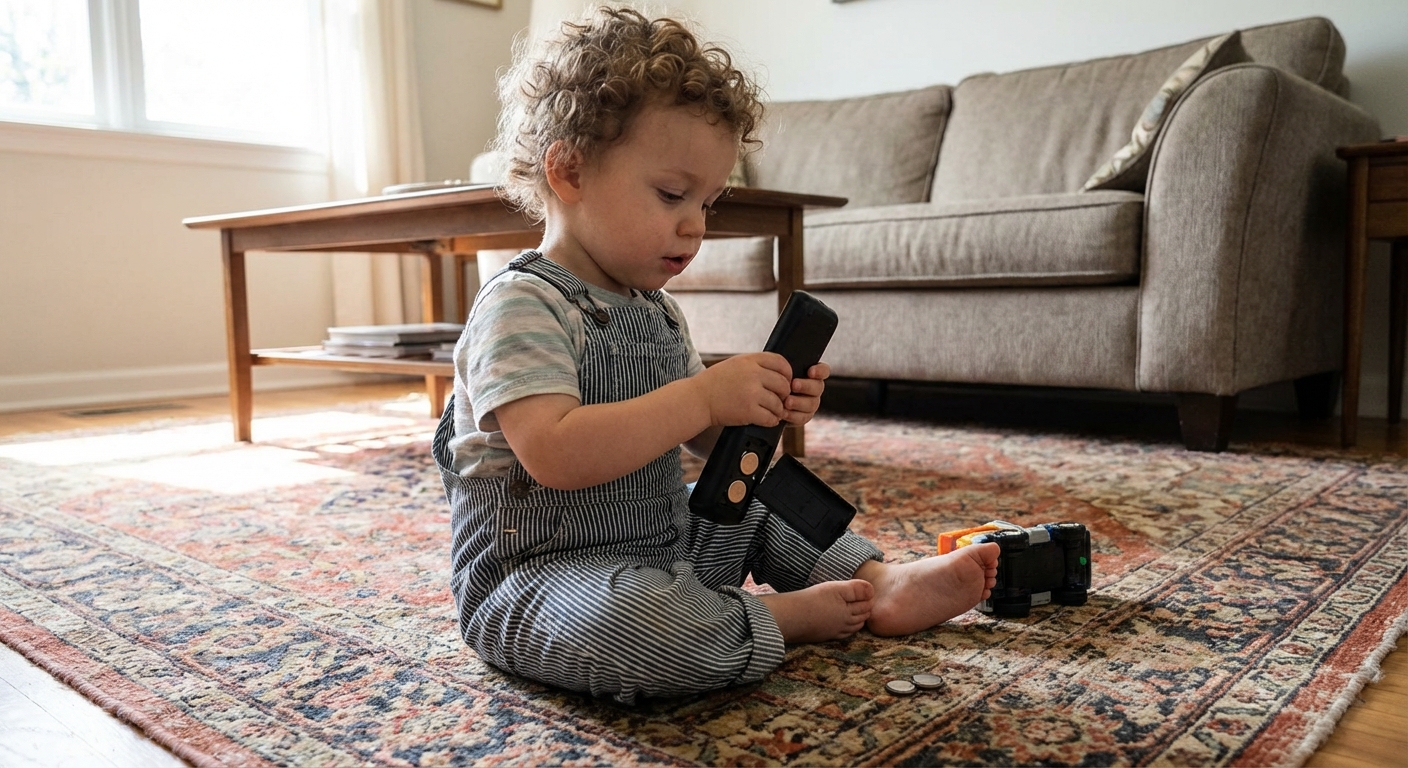
Why button batteries are so dangerous
A coin or small toy piece can be a choking hazard. A button battery is different. It can injure even when your child is breathing fine.
It is not “battery acid,” and it is not just sharp edges
When a button battery touches moist tissue, it can create an electrical current. That current triggers a chemical reaction that makes a strong alkaline substance right at the contact point. This can cause a deep burn. The biggest risk is when the battery is stuck in the esophagus, where it can press against the same spot and keep injuring it.
Injury can start fast
Per Poison Control guidance, serious burns can begin within 2 hours when the battery is lodged in the esophagus. Even after the battery is removed, damaged tissue can continue to break down, which is why follow-up matters.
Large lithium coin batteries are especially risky
The larger 20 mm lithium coin batteries (often labeled CR2032) are common in remotes, key fobs, flameless candles, bathroom scales, and musical greeting cards. Their size makes them more likely to get stuck in a toddler’s esophagus.
First steps if you think a battery was swallowed
If you are reading this at 3 AM with your heart pounding, here is your simple plan.
- Call emergency services (911 in the US) immediately if your child has trouble breathing, is drooling a lot, cannot swallow, is turning blue, seems very weak or confused, or has noisy breathing (including stridor or wheezing).
- If your child is stable, call Poison Control right away: 1-800-222-1222 (US). They can guide you while you head to emergency care.
- Head to the nearest emergency department even if your child seems okay. Say clearly: “Possible button battery ingestion.”
- If possible, bring the device or matching batteries (or a photo of the packaging) so the team can identify the size and type.
Trust your gut. If you cannot find the battery that used to be in the remote, that is enough reason to get checked.
Honey: when it helps, and when it does not
You may have heard that giving honey can help before getting to the hospital. In specific situations, it can reduce injury by coating the battery and decreasing the burn reaction while you are on the way to emergency care.
Honey may be recommended if all are true
- Your child is 12 months or older (no honey for babies under 1 year due to botulism risk).
- You suspect the battery was swallowed within the last 12 hours.
- Your child is awake and able to swallow (no choking, no severe drooling, no trouble breathing).
- You are already on the way to the emergency department or waiting for emergency services.
Typical dosing (per Poison Control public guidance)
- 10 mL (2 teaspoons) of honey every 10 minutes
- Up to 6 doses total
- Do not delay transport to give honey.
Important: Honey is not a substitute for emergency care. It is a temporary measure while you are getting help. In some settings, clinicians may use sucralfate (Carafate) as well. Only use it if Poison Control or your medical team specifically directs you.
Do not give honey if
- Your child is under 12 months.
- They are gagging, vomiting repeatedly, very drowsy, drooling heavily, or having trouble swallowing or breathing.
- You are not sure what was swallowed and choking is a concern.
If you are unsure, call Poison Control. They can give you step-by-step guidance for your exact situation.
Symptoms can look like a cold
Some toddlers swallow a battery and act totally normal at first. Others have vague symptoms that mimic everyday childhood illnesses. If a battery could be missing, do not wait for “more obvious” signs.
Possible signs of a battery in the esophagus
- Drooling or spitting more than usual
- Trouble swallowing, refusing food, or saying “owie” with swallowing
- Chest discomfort, throat pain, or neck pain
- Gagging, coughing, or noisy breathing (including stridor or wheezing)
- Vomiting
- Fever or irritability with no clear reason
Delayed or serious warning signs
These can happen later, sometimes even after the battery has moved or been removed. Seek emergency care immediately if you see:
- Blood in saliva or vomit
- Black, tarry stools or blood in stool
- Severe chest pain, worsening cough, or trouble breathing
- Sudden weakness, fainting, or extreme sleepiness
Not every symptom means a battery injury, but with button batteries, we do not “watch and wait.” We check.

What the ER will do
Most of the time, the first step is imaging. The team needs to know whether a battery is present and where it is.
- X-rays are typically done to locate the battery. Imaging often includes the neck, chest, and abdomen so an esophageal battery is not missed.
- If the battery is in the esophagus, removal is urgent, usually by endoscopy.
- If the battery has passed into the stomach, the plan depends on your child’s age, battery size, symptoms, and time since ingestion. Some cases require removal, others close monitoring and follow-up imaging.
Ask the team what symptoms should send you back right away, and whether your child needs scheduled rechecks. With button batteries, follow-up is not “extra.” It is part of safe care.
What not to do
In panic, it is natural to want to “do something.” The safest “something” is getting expert help fast.
- Do not induce vomiting. It can increase risk of choking and may re-expose tissue.
- Do not give food or drink unless Poison Control or an emergency clinician specifically advises it (honey is a common at-home measure for eligible children; sucralfate is sometimes used when directed by clinicians).
- Do not wait for symptoms. A toddler can look okay while an injury is starting.
- Do not assume it is “just in the stomach.” You cannot tell location without imaging.
- Do not let sleep become a delay. If a battery may be missing, wake them and go in. The urgency is about time to evaluation, not about sleep itself.
Button batteries vs magnets
Parents mix these up because both are small, shiny, and dangerous. Here is the quick difference:
- Button battery: causes an electrical injury and alkaline burn, especially if stuck in the esophagus.
- Magnets (especially more than one): can pinch the bowel between them and cause holes and infection.
Both deserve urgent medical evaluation. If you suspect either one, say so clearly when you call Poison Control or arrive at the ER.
If it is in the nose or ear
This is also an emergency. Button batteries can burn through tissue in the nose or ear canal.
- Do not try “home removal” with tweezers or cotton swabs.
- Go to urgent emergency care now and tell them: “Possible button battery in the nose” or “in the ear.”
- If there is severe pain, bleeding, or your child cannot cooperate safely, call 911.
How to prevent button battery injuries
As a nurse, I love prevention. As a mom, I know prevention has to be realistic. Here is what actually makes a difference.
1) Lock down the source
- Check battery compartments on remotes, key fobs, thermometers, bathroom scales, flameless candles, and small toys.
- A secure compartment should require a tool (usually a screwdriver) to open. If it slides open easily, treat it like an open candy bowl.
- Use strong tape as a temporary fix for a loose battery door, but do not rely on tape long-term. Replace the device or the cover.
2) Store spare batteries like medication
- Keep new and used button batteries up high and locked.
- Do not leave them in junk drawers, bowls, or “safe” shelves that little climbers can reach.
- Dispose of used batteries promptly and safely. Used does not mean harmless.
3) Watch for unexpected battery products
Some of the most surprising sources I have seen in triage are greeting cards that play music, light-up shoes, and small novelty items. If it lights up or makes noise, assume there is a battery inside and check the compartment.
4) Do quick sweeps at toddler eye level
Every once in a while, get down on your hands and knees and scan under couches and along baseboards. Button batteries are shiny, roll easily, and love to disappear until the exact moment your toddler finds them.
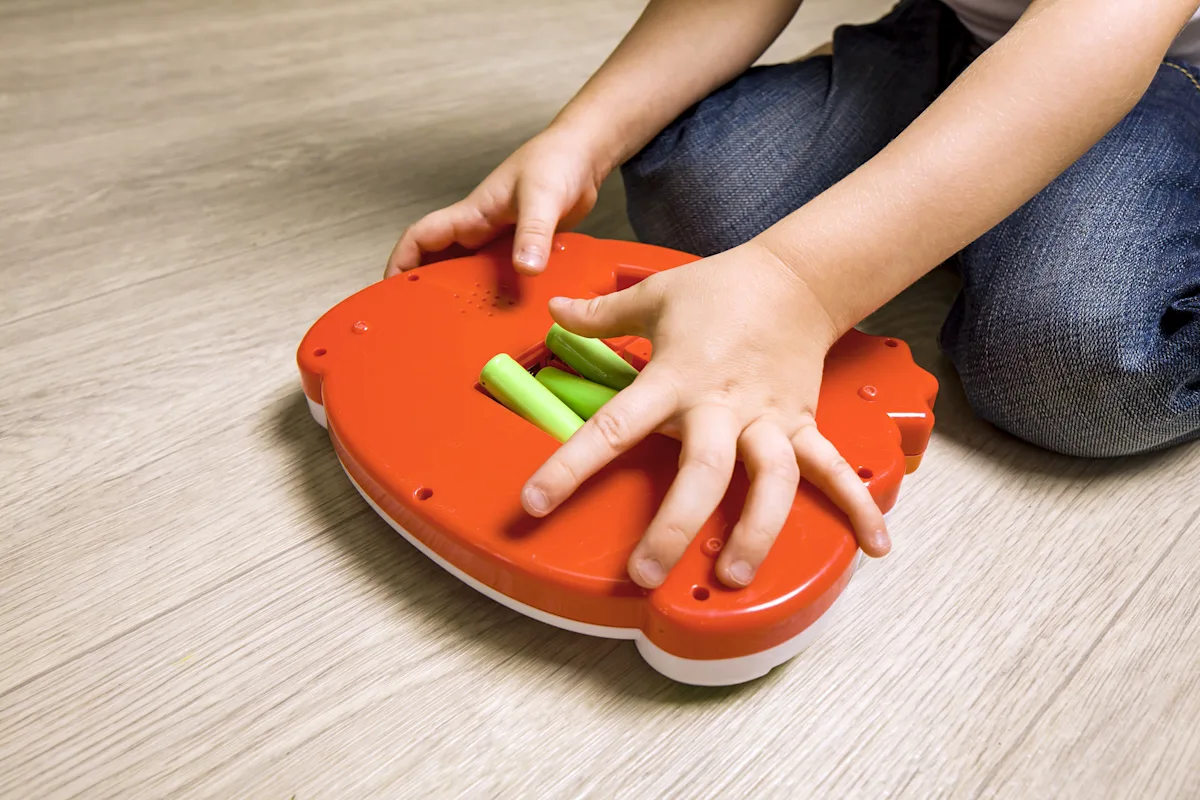
Battery swallowing vs choking
Our general choking advice still matters, but button batteries deserve extra urgency because the danger is not only blockage of the airway. A battery can cause severe internal burns even if your child is breathing normally.
- Choking risk: immediate breathing trouble.
- Button battery risk: internal chemical burn, sometimes with subtle early symptoms.
If your child is choking right now, follow choking first aid and call emergency services. If your child is not choking but may have swallowed a button battery, you still need emergency evaluation fast.
Quick checklist
- Battery might be swallowed? Assume emergency.
- Breathing trouble, drooling heavily, cannot swallow, blue color, stridor or wheezing? Call 911.
- Otherwise: Call Poison Control (US 1-800-222-1222) and go to the ER.
- Do not induce vomiting. Do not wait for symptoms.
- Honey may help only for children 12+ months, ingestion likely within 12 hours, able to swallow, and only while en route, per Poison Control guidance. Typical dosing is 10 mL every 10 minutes up to 6 doses.
When in doubt, get checked
I have talked to many parents who felt embarrassed coming in “just in case.” I have never, not once, been annoyed by a parent who came in quickly because a battery might be missing. That is exactly the kind of calm, protective decision we want you to make.
If you suspect a button battery ingestion, your job is not to diagnose. Your job is to get your child to the people who can find it fast and remove it safely.
Sources
- National Capital Poison Center. Button Battery Ingestion Triage and Treatment Guidelines. https://www.poison.org/battery (accessed 2026-04-05).
- American Academy of Pediatrics. Button battery injury prevention and guidance for families. https://www.healthychildren.org (search: “button battery”) (accessed 2026-04-05).
- European Society for Paediatric Gastroenterology Hepatology and Nutrition (ESPGHAN). Diagnosis, management, and prevention of button battery ingestion in children (clinical guidance). https://www.espghan.org (accessed 2026-04-05).