Croup in Babies: Stridor, Barky Cough, and When to Go In

Sarah Mitchell
Sarah Mitchell is a Registered Pediatric Nurse and a mother of three who has spent over a decade helping families navigate the beautiful, chaotic early years of childhood. She combines evidence-based medical knowledge with real-world parenting experience to offer practical, compassionate advice. At Awesome Parent, Sarah's mission is to help exhausted parents find solutions, trust their instincts, and finally get some sleep.
If your baby is making a high-pitched sound when breathing in, or they suddenly have that seal-like barky cough, your parent brain goes straight to: Is this an emergency? That reaction is completely normal. Croup can be dramatic, especially in babies and young infants, because their airways are tiny and do not have much “wiggle room” when inflammation shows up.
This page focuses on croup in babies and young infants, because the thresholds for getting urgent help are genuinely different than they are for toddlers. I am going to walk you through what the noises mean, how to tell croup vs bronchiolitis, and exactly when you should head in for urgent care or the ER.
Quick refresher: what croup is
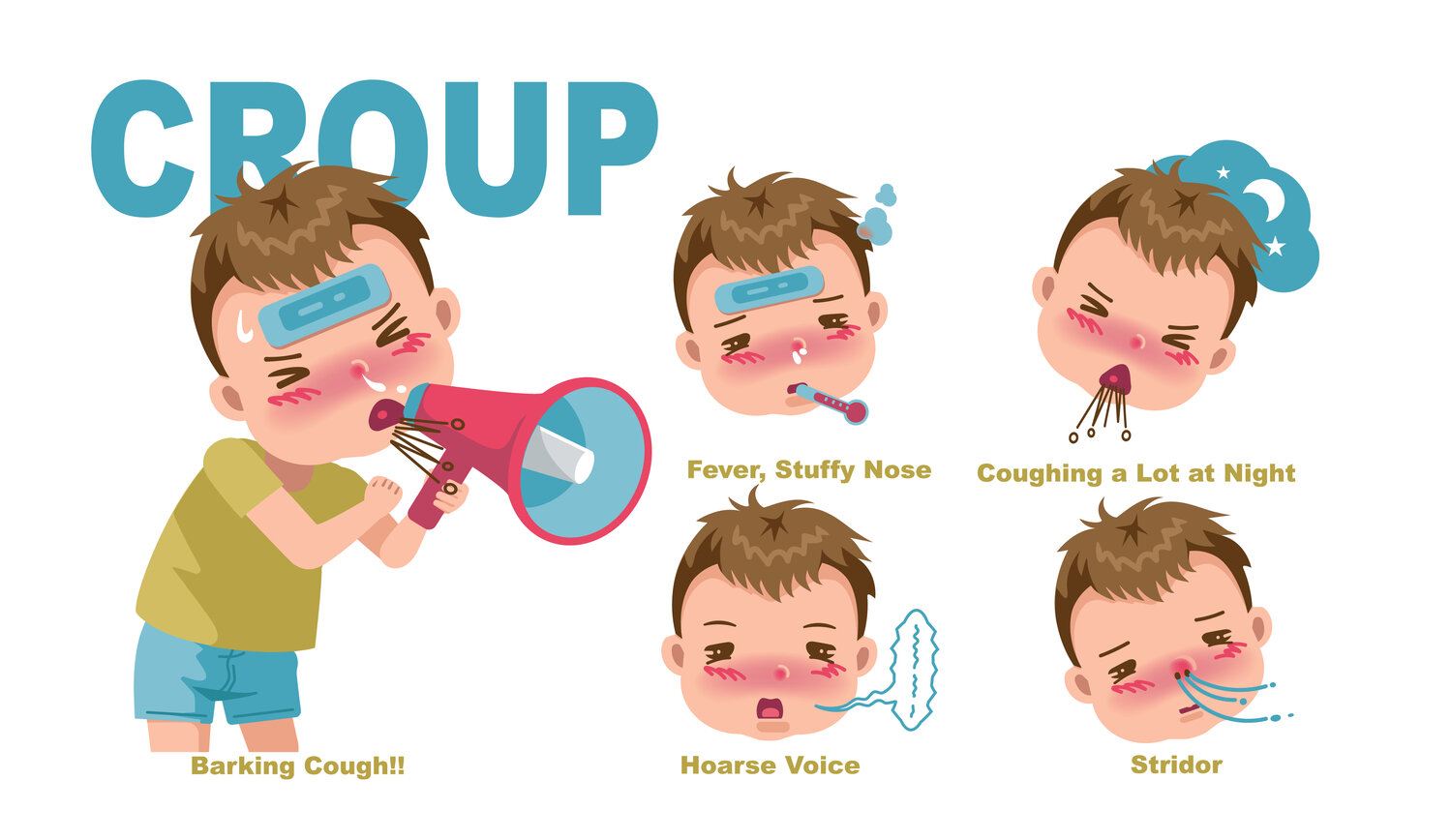
Croup is usually caused by a virus that triggers swelling around the voice box and windpipe. That swelling narrows the airway and creates two classic sounds:
- Barky cough (often worse at night)
- Stridor, a harsh, high-pitched sound most noticeable on breathing in
Croup is most common in kids roughly 6 months to 3 years. It can happen outside that range too, but when it shows up in very young babies, we take symptoms seriously sooner.
In toddlers, croup is common and many cases can be managed at home with guidance. In young babies, the same amount of swelling can cause more significant narrowing. That is why “mild” croup in a 2-year-old can feel much more intense in a 2-month-old.
Infant vs toddler croup
1) Age matters
Young infants have narrower airways and less respiratory reserve. They can tire out faster. That does not mean every baby with croup will need the ER, but it does mean we take certain signs more seriously, sooner.
2) Stridor at rest matters more
Many kids with croup will have stridor when they are crying, coughing, or worked up. That can still be uncomfortable and scary, but it is not automatically an emergency.
Stridor at rest means you can hear that harsh, squeaky sound when your baby is calm, not crying, and not actively coughing. In young infants, persistent stridor at rest is a strong signal that the airway narrowing is significant and needs prompt medical evaluation.
3) Overlap happens
In infants, viral illnesses can blur together. A baby can have croupy upper airway symptoms and also have lower airway involvement like bronchiolitis. Clinicians diagnose based on the full exam because overlap is common, and that overlap can change the risk and the plan.
What stridor sounds like
Parents often describe stridor as:
- High-pitched squeak or harsh “whistling” sound
- Loudest when breathing in
- Sometimes heard best at the base of the neck
Things that can sound “noisy” but are different:
- Wheezing: often on breathing out, more typical of bronchiolitis or asthma-like airway irritation. Wheeze can be hard to identify without a stethoscope, and many parents (smartly!) use “wheeze” to describe any noisy breathing.
- Congestion/snoring sounds: from mucus in the nose, often improves after saline and suction
- Periodic breathing (newborn pattern): brief pauses followed by faster breaths, without distress, color change, or persistent noisy inhale
Croup vs bronchiolitis in infants
This is one of the more important distinctions for babies under 12 months, even though overlap is common and a clinician often needs to listen and examine to sort it out.
Typical croup pattern
- Barky cough
- Hoarse cry or voice
- Stridor (especially with agitation)
- Often worse at night
- Fever can be present or absent
Typical bronchiolitis pattern (common in young infants)
- Lots of nasal congestion and runny nose
- Fast breathing
- Wheezing or crackles (often heard on exhale)
- Feeding less because breathing takes more effort
- Sometimes pauses in breathing (apnea) in very young infants
Important: if you notice pauses in breathing, treat that as an emergency sign and seek immediate care.
Why this matters: Croup is mainly an upper airway problem, and medications like dexamethasone (a steroid) can be very helpful. Bronchiolitis is a lower airway illness, and management focuses heavily on hydration, suctioning, and monitoring breathing and oxygen.
If your baby has a barky cough plus fast breathing, wheezing, or struggling to feed, it is reasonable to suspect overlap and have them assessed.
At-home care for mild croup
If your baby has a barky cough but is breathing comfortably and does not have stridor at rest, you can often do supportive care while you monitor closely.
What you can do now
- Keep your baby calm. Crying increases airway turbulence and can make stridor louder.
- Offer frequent feeds. Smaller, more frequent bottles or nursing sessions can help if they are a little stuffy or tired.
- Use nasal saline and gentle suction before feeds and sleep.
- Cool, comfortable air. Many families find that stepping into cool night air for a few minutes helps ease croupy breathing. Evidence is mixed, so do not worry if it does not help.
- Use fever relief if needed, following your pediatrician’s dosing instructions.
What to avoid
- Do not give over-the-counter cough medicines to babies.
- Do not force fluids if your baby is choking, gagging, or working hard to breathe.
- Do not rely on steam as your only plan if your baby is struggling. Humidifiers and steam have limited evidence, and if your baby has stridor at rest or distress, you need medical care, not a bathroom setup.
For many infants, the biggest risk is that symptoms can ramp up quickly at night. If you are seeing a trend toward more noise, more effort, or less feeding, trust that instinct and get help.
How to check for stridor at rest
Here is a simple way to assess at home:
- Settle your baby as much as possible, upright in your arms.
- Listen for 30 to 60 seconds when they are calm and not crying.
- Ask: Do I hear a harsh, high-pitched sound on the inhale?
If the answer is yes, and it is persistent, that is stridor at rest. In young infants, that generally calls for same-day urgent evaluation. If it is worsening, your baby looks like they are working hard to breathe, or you see any color change, that is ER-level.
Also look at the work of breathing. Stridor is a sound. Effort is what the body is doing to move air.
Go now: red flags
For young babies, I want you to have a low threshold. Get emergency care right away if you notice any of the following:
- Stridor at rest that is persistent or getting worse
- Retractions: skin pulling in between ribs, under ribs, or at the base of the neck with each breath
- Severe work of breathing: fast breathing with visible struggle, grunting, head bobbing, or your baby cannot settle
- Color changes: blue, gray, or very pale lips or face
- Drooling and trouble swallowing, or your baby looks like they cannot manage saliva
- Very sleepy, hard to wake, or “floppy”
- Pauses in breathing
- Dehydration signs: very few wet diapers, dry mouth, no tears when crying
- Fever in a baby under 3 months (especially 100.4°F/38°C or higher): this should be evaluated urgently
Call 911 vs drive
- Call 911 if your baby is blue or gray, has severe trouble breathing, has pauses in breathing, is limp, or is hard to wake.
- Drive to the ER if your baby is stable in color and responsiveness but has persistent stridor at rest, worsening breathing effort, or you are worried they are tiring out.
If you are debating whether it “counts,” that is often your answer. When babies struggle, they can compensate for a while and then tire. I would much rather you be told it is mild than stay home with a baby who is working hard.

Call today: pediatrician or urgent care
These situations usually deserve same-day advice or a visit, but not necessarily an ambulance:
- Barky cough with intermittent stridor when upset
- Your baby is feeding less than usual but still has wet diapers
- Fever with croup symptoms (especially in young babies)
- Symptoms are worsening over the evening, even if they are not yet severe
- You suspect bronchiolitis overlap (wheeze, fast breathing, trouble feeding)
What the ER may do
Knowing what to expect can help you feel less blindsided at 2 AM.
- Assessment: oxygen level, breathing effort, hydration status
- Steroid medication (often dexamethasone): helps reduce airway swelling and can improve symptoms over hours. A single dose is commonly used when a clinician feels croup is mild to moderate, because it can reduce worsening later.
- Nebulized epinephrine for more significant stridor: can reduce swelling quickly, but effects can wear off, so observation is important
- Monitoring: babies may be observed longer because symptoms can rebound
- Evaluation for look-alikes if symptoms are atypical (for example, sudden choking episode, drooling, very high fever, or poor response to typical therapy)
Most kids do not need imaging. The clinical picture and response to treatment usually guide care.
Could it be something else?
Most of the time, a barky cough and stridor are viral croup. But in young infants, we stay alert for other problems that can look similar.
Get urgent care for these patterns
- Sudden onset during eating or play: could be choking or inhaled object
- Drooling, muffled voice, tripod posture: could suggest a more serious throat issue
- High fever and very ill appearance
- Repeated episodes of stridor without clear viral symptoms: may need evaluation for airway anatomy issues or reflux-related irritation
How long it lasts
Croup often peaks over the first 1 to 2 nights, then gradually improves. The barky cough can linger longer than you expect, sometimes a week or so, even after the scary breathing noise is gone.
That said, if your baby is getting worse instead of better, or if stridor returns at rest after it seemed to improve, get reassessed.
Contagious and daycare
Croup is usually caused by the same common viruses that spread colds. Most kids are most contagious early on. A practical rule for childcare is: return when your child’s fever is gone (without fever medicine if your daycare requires that), breathing is comfortable, and they are well enough to participate. If your baby is very young or still has any stridor at rest, keep them home and check in with your clinician.
A 3 AM checklist
- Is my baby pink (normal color) and responsive?
- Can they feed at least some?
- Do I hear stridor at rest when they are calm?
- Do I see retractions or heavy effort with breathing?
- Is my baby under 3 months with fever or significant symptoms?
If you have stridor at rest, visible breathing struggle, pauses in breathing, or any color change, skip the internet spiral and go in.
My nurse-mom bottom line: A barky cough can often be managed at home if breathing is comfortable. Persistent stridor at rest in a young infant needs urgent, same-day evaluation, and it is ER-level if it is not settling, is worsening, or comes with work of breathing or color change.
When in doubt
You are not overreacting. Croup is loud and scary for a reason. If your baby’s breathing looks hard, if the noise is happening when they are calm, or if your gut says something is off, get medical help. Sleep deprived parents are allowed to choose the safest path.