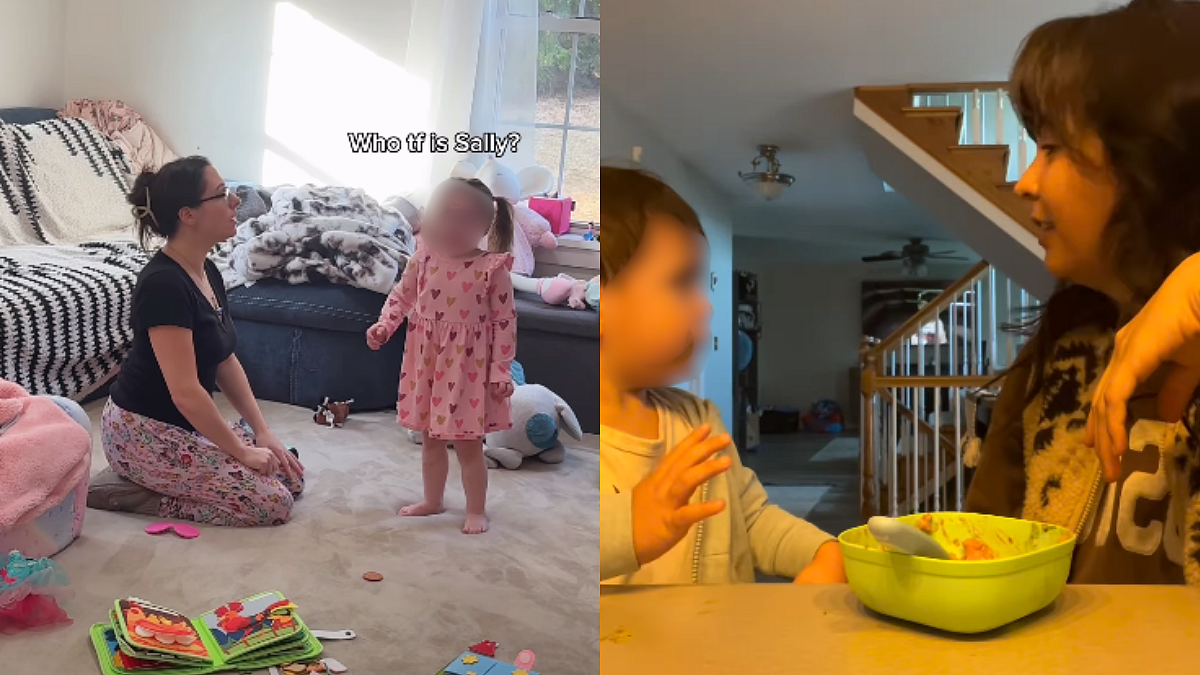
Speech milestones at 18–24 months, signs it may be more than a late talker, when to seek an evaluation, and practical at-home strategies you can start toda...
Expressive Language Delay in Toddlers

Sarah Mitchell
Sarah Mitchell is a Registered Pediatric Nurse and a mother of three who has spent over a decade helping families navigate the beautiful, chaotic early years of childhood. She combines evidence-based medical knowledge with real-world parenting experience to offer practical, compassionate advice. At Awesome Parent, Sarah's mission is to help exhausted parents find solutions, trust their instincts, and finally get some sleep.
If you have a toddler who understands everything but uses very few words, you have probably heard some version of: “Don’t worry, they’re just a late talker.” Sometimes that is true. But sometimes the gap between what your child knows and what they can say is big enough that it deserves a closer look.
As a pediatric nurse and a mom who has lived through the “Why won’t you just tell me what you want?” phase (many times), I want you to know two things upfront: you did not cause this, and you do not have to wait until kindergarten to get support.
Also, a quick reality check: online advice can get overwhelming fast. If your gut says “something is off,” an individualized evaluation is often the most calming next step.

Expressive vs receptive language
Language has two main sides:
- Receptive language is what your child understands. Think: listening and comprehension.
- Expressive language is what your child communicates. Think: words, phrases, gestures, signs, and later sentences.
A toddler can have delays in one area, the other, or both. That is why two kids with “speech delay” can look completely different in daily life.
What expressive delay can look like
Many toddlers with an expressive delay:
- Seem to understand you well (especially familiar routines).
- Follow directions like “Get your shoes” or “Put the cup in the sink.”
- Use few words for their age, or use words inconsistently.
- Rely heavily on pointing, pulling you by the hand, whining, or melting down when not understood.
- Use the same “all-purpose” word for many things (like “ba” for ball, bottle, bath).
What receptive delay can look like
Receptive delays can show up as:
- Not responding to their name consistently (after hearing issues are ruled out).
- Difficulty following simple directions, even with gestures.
- Not understanding common words like “cup,” “shoes,” “up,” or “bye-bye.”
- Seeming “in their own world,” especially in noisy or busy settings.
If you want to picture it: expressive is the “output,” receptive is the “input.” Both matter, and both can be supported.
Everyday milestones
Milestones vary, and there is a wide range of typical development. If you want a reference point, the CDC and ASHA both offer helpful milestone guides and are worth a look. The patterns below are meant to help you notice a possible communication gap, not to turn your child into a checklist.
By about 12 months
- Often seen: gestures like waving, pointing, reaching up, showing you objects, or shaking their head.
- Often seen: babbling that sounds speech-like, and sometimes 1+ simple word like “mama,” “dada,” or “uh-oh” (not always clear).
- Consider asking about it: very limited gestures and no attempts to communicate with sounds or word-like babble, especially if frustration is high.
By about 18 months
- Often seen: a growing set of words (many children have around 10 to 20+ words, but there is variation).
- Often seen: pointing to show you things and trying to label familiar people or items (even if imperfect).
- Consider asking about it: only a few words, rarely trying to imitate sounds or words, and mostly communicating by pulling, grunting, or crying.
By about 24 months
- Often seen: vocabulary growth and new words appearing quickly.
- Often seen: two-word combinations like “more milk” or “mommy up.”
- Often seen: asking for things with words and trying to name pictures in books.
- Consider asking about it: not combining words yet, vocabulary staying quite small, or frequent “stuck” moments where they give up and melt down.
By about 36 months
- Often seen: short sentences, simple stories, and lots of questions.
- Often seen: speech that is understood most of the time, including by people outside the family (even if some sounds are still developing).
- Consider asking about it: still using mostly single words, very limited sentences, or speech that is hard for others to understand most of the time.
A helpful gut-check: If your toddler understands your day-to-day language but cannot express basic needs without frequent frustration, that “communication gap” is often the part families feel the most.

More than “late talking”
Some children talk later and catch up beautifully with time and rich language exposure. Others benefit from earlier support. Consider an evaluation if you notice several of these together:
- Limited gestures (not pointing, waving, or showing) by about 12 to 15 months.
- Little interest in copying sounds or words, even when you model them playfully.
- Frequent communication breakdowns that lead to intense tantrums or withdrawal.
- Loss of words they used to say (regression).
- Family history of speech-language delays, learning differences, or hearing loss.
- Hearing concerns, frequent ear infections, or inconsistent response to sounds.
- Speech that is very hard to understand after age 2 to 3, especially if your child uses a very limited set of consonant sounds or leaves out most consonants across many words.
None of these mean you did anything wrong. They simply signal that your child may need a little extra help building the “spoken language tool kit.”
Delay vs stuttering
Parents often worry: “Is this a delay, or is my child stuttering?” They can overlap, but they are not the same.
Typical toddler disfluency
Many toddlers go through a normal phase of disfluency, especially during language growth spurts. You might hear:
- Repeating whole words or phrases: “I want, I want, I want it.”
- Starting over: “Can we, can we go outside?”
- Pauses while they plan the sentence.
When stuttering needs a look
- Sound prolongations: “sssssometimes.”
- Sound or syllable repetitions: “b-b-b-ball.”
- Visible tension, facial grimacing, or frustration while speaking.
- Stuttering that persists for months or worsens.
- A strong family history of stuttering.
Key difference: Expressive language delay is about what they can say (limited words, limited combinations, limited sentence building). Stuttering is about the flow of speech. A child can have one without the other.
Delay vs selective mutism
Selective mutism is an anxiety-related condition where a child can speak in some settings (often at home) but consistently does not speak in specific social settings (often preschool or around unfamiliar people).
Selective mutism can look like
- Talking normally at home with family.
- Freezing, whispering, or not speaking at school or with unfamiliar adults.
- Relying on nodding, pointing, or a parent “speaking for them” in certain settings.
Expressive delay more often looks like
- Limited words and short phrases across most settings, even at home.
- Difficulty forming sentences even when relaxed.
- Communication struggles that are not limited to social anxiety situations.
If your child talks at home but not at school, it still deserves support. Start by talking with your pediatrician. Many children benefit from a coordinated plan that can include speech-language support and anxiety-informed strategies.
Why it happens
Sometimes we find a clear contributing factor. Sometimes we do not. Common contributors include:
- Hearing issues (including fluid behind the eardrum, recurring ear infections, or permanent hearing loss).
- Speech sound disorders that make producing words hard.
- Developmental language disorder (persistent difficulty learning and using language).
- Autism spectrum disorder (communication differences are one possible feature, though not every child with language delay is autistic).
- Global developmental delays affecting multiple skill areas.
- Prematurity or certain medical histories.
- Bilingual language development (this does not cause delay by itself, but bilingual kids can distribute vocabulary across two languages and may appear “behind” if only one language is counted).
- Oral-structural or motor factors (for example, a history of cleft palate, significant oral-motor weakness, or other medical issues that impact speech). If you are wondering about tongue-tie, it is worth discussing with your pediatrician or SLP rather than trying to self-diagnose online.
Important: Being raised in a bilingual home does not “confuse” children. If you speak multiple languages at home, keep doing it. The goal is strong, warm language exposure, not perfection.
When to get evaluated
I am very comfortable saying this: if you are worried, it is reasonable to ask for help now. You are not “overreacting.” You are advocating for your child.
Consider an evaluation if
- Your child has no words or very few attempts to communicate by about 15 to 18 months.
- Your child has fewer than about 50 words or is not combining two words by around 24 months.
- Your child seems to understand well but cannot express needs without frequent distress.
- Your child lost words they previously used.
- Others who spend time with your child (caregivers, daycare teachers) share similar concerns.
Start here
- Your pediatrician: ask for a speech-language evaluation referral and a hearing screen.
- Audiology: hearing should be checked when speech is delayed, even if your child “seems fine.”
- Early Intervention (in the US, often birth to 3, varies by state/territory): families can often self-refer without waiting.
- Speech-language pathologist (SLP): evaluates expressive and receptive language, speech sounds, play skills, and social communication.
Early support is not about labeling. It is about giving your child more tools to communicate, and giving your home fewer daily blowups caused by “I can’t tell you what I need.”

What the evaluation is like
Most toddler evaluations look a lot like play. A good SLP will:
- Ask questions about pregnancy, birth, health history, and daily routines.
- Observe how your toddler plays, interacts, and tries to communicate.
- Check understanding (receptive skills) and expression (words, sounds, gestures).
- Listen to speech sound patterns and overall clarity.
- Offer a plan, which may include therapy, home strategies, or monitoring with a follow-up date.
If you leave thinking, “That was gentler than I expected,” you are not alone.
What you can do at home
Whether you are on a waitlist, deciding what to do, or already in therapy, these evidence-informed habits tend to help most toddlers with expressive delays.
Make language easy to copy
- Use short models: “More crackers?” “Blue car.” “Up, please.”
- Repeat key words during routines: “Bath time. Bath. Bath.”
- Pause and give them time to try. Silence can feel awkward. It is also powerful.
Follow their lead
- Talk about what they are already focused on, instead of redirecting.
- If they love trucks, you do not need flashcards. You need trucks and words like “go,” “stop,” “big,” “mine,” “help.”
Offer simple choices
- “Do you want milk or water?”
- Hold up the two items and wait.
- If they point, model: “Water.” Then give it. We want communication to work, not to become a power struggle.
Build in “help” moments
- Put a favorite toy in a clear container they cannot open.
- Wait for the look, the reach, or the sound, then model: “Help.”
Read the toddler way
- Use picture books and name what they point to.
- Do not worry about reading every word.
- Repeat favorite books. Repetition is how toddlers learn.
Use total communication
- Gestures, baby signs, pictures, and AAC (augmentative and alternative communication) can support language while speech develops.
- This is not “giving up on talking.” For many kids, it reduces frustration and can actually increase attempts to speak.
Check the screen-time balance
- This is not about blame. Many families use screens to survive the day.
- If screens are taking up a big chunk of time, swapping even a small portion for face-to-face play, songs, books, and routines can create more chances for your child to hear and practice words.
A gentle note: You do not need to turn every moment into a language lesson. Your child also needs you to just be their parent. Even small, consistent changes help.
Red flags to address quickly
Most expressive delays are not emergencies, but a few situations should move you to the front of the line:
- Any loss of language or social skills at any age.
- No response to loud sounds, or you strongly suspect hearing loss.
- Reduced social reciprocity along with language concerns (limited back-and-forth, limited shared enjoyment, limited eye contact, or rarely trying to engage you).
- Feeding or swallowing concerns plus speech concerns (coughing with liquids, frequent choking, poor growth).
If you are seeing these, call your pediatrician and describe exactly what you are noticing.
For the 3 AM worriers
Expressive language delay is common, and support can make a real difference. The goal is not to pressure your toddler into performing on demand. The goal is to help them communicate so daily life feels easier for everyone.
If you are stuck between “wait and see” and “something feels off,” you can choose a middle path: schedule a hearing check, request an SLP evaluation, and start a few simple home strategies now. That is not overreacting. That is good parenting.
Sarah Mitchell
Sarah Mitchell is a Registered Pediatric Nurse and a mother of three who has spent over a decade helping families navigate the beautiful, chaotic early years of childhood. She combines evidence-based medical knowledge with real-world parenting experience to offer practical, compassionate advice. At Awesome Parent, Sarah's mission is to help exhausted parents find solutions, trust their instincts, and finally get some sleep.