Flat Head Syndrome in Babies

Sarah Mitchell
Sarah Mitchell is a Registered Pediatric Nurse and a mother of three who has spent over a decade helping families navigate the beautiful, chaotic early years of childhood. She combines evidence-based medical knowledge with real-world parenting experience to offer practical, compassionate advice. At Awesome Parent, Sarah's mission is to help exhausted parents find solutions, trust their instincts, and finally get some sleep.
If you have noticed a flat spot on your baby’s head, take a breath. You are not alone, and in most cases this is a common, fixable issue called positional plagiocephaly, also known as “flat head syndrome.” In my years as a pediatric triage nurse and now as a mom of three, I have talked with a lot of worried parents who feel like they did something wrong. You didn’t. This usually happens because babies spend a lot of time on their backs, which is also exactly what we want for safe sleep.
This guide will walk you through what causes flat spots, what you can do at home, when helmets are considered, and when it is time to bring in a specialist. Timing matters, because the biggest gains usually happen in the first year. Improvement is still possible after that, but it often slows down as babies get closer to 12 months and beyond.
Quick note: This is general education and does not replace medical advice. If you are worried, your pediatrician can help you sort out what is normal, what needs monitoring, and what needs treatment.
What is flat head syndrome?
Positional plagiocephaly means the skull has developed a flattened area from repeated pressure in the same spot. Baby skull bones are soft and designed to shift and grow quickly, which is normal and helpful for birth and early brain growth. The downside is that a baby who consistently rests on one part of the head can develop flattening there.
You may also hear these related terms:
- Brachycephaly: flattening across the back of the head that can make the head look wider.
- Dolichocephaly (long, narrow head): can be positional (often in preterm babies), but a long, narrow shape can also be seen with sagittal craniosynostosis. If you are unsure, it is worth an evaluation.
Most flat head cases are positional and improve with time and simple changes. A smaller number are due to craniosynostosis, which is when one or more skull sutures fuse too early. That requires specialist evaluation, which we will cover in the “when to worry” section.
Why it happens (and why it’s more common now)
Since the “Back to Sleep” safe sleep recommendations became standard, we have seen fewer sleep-related infant deaths, which is wonderful. We also see more positional flattening, simply because babies spend more time on the back of their heads.
Common contributors include:
- Lots of time in one position: sleeping on the back (safe), plus time in swings, bouncers, car seats, and loungers.
- Preference to look one way: many babies naturally turn their head to the same side.
- Torticollis: tight neck muscles that make it hard for baby to turn the head both directions equally.
- Prematurity: preemies often have softer skulls and may spend more time positioned in one way early on.
- Twin or multiple pregnancy: less space in the womb can affect head shape.

What a flat spot can look like
Parents often notice flattening during bath time or when looking down at their baby’s head from above.
- Back of head flattening: one side may look flatter than the other.
- Ear shift: the ear on the flatter side may appear slightly pushed forward.
- Forehead prominence: the forehead on the same side as the flat spot may look a bit more prominent.
- Overall head shape change: in brachycephaly, the back can look more uniformly flat.
A quick, practical check you can do at home: take a photo from above when baby is calm, hair is dry, and the head is centered. Do this every 2 to 4 weeks. Small changes are hard to notice day to day, but photos can show progress.
Prevention and improvement
The goal is simple: reduce repeated pressure on the same spot while still following safe sleep rules. That means baby sleeps on their back, but during awake time we change positions often.
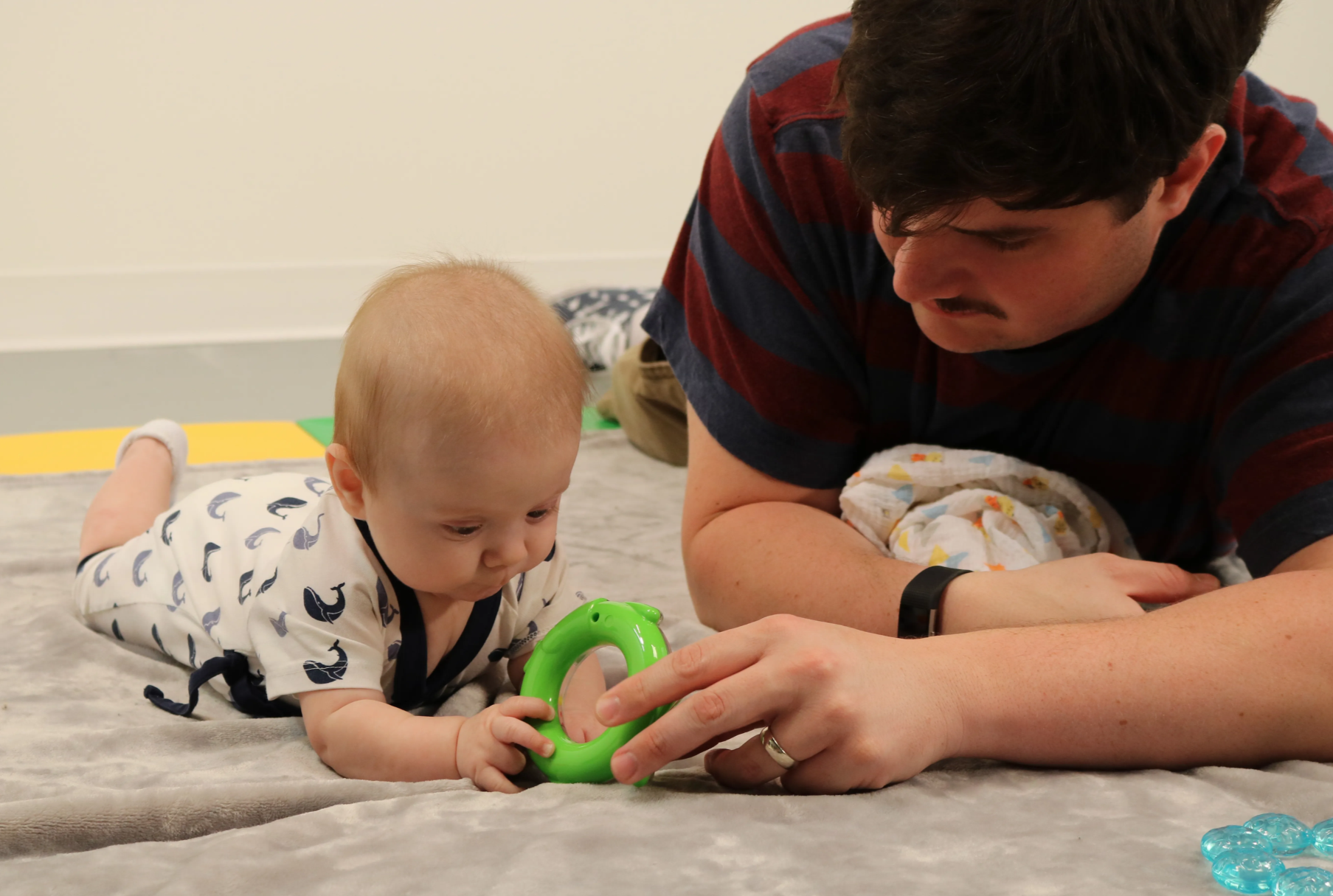
Tummy time (your best tool)
Tummy time helps in two big ways: it takes pressure off the back of the head and builds the neck, shoulder, and core strength babies need for rolling and crawling.
- Start early: as soon as your baby comes home, you can begin short, supervised tummy time sessions.
- Go for frequency, not perfection: many short sessions count more than one long, miserable one.
- Make it easier: try tummy time on your chest, across your lap, or with a small rolled towel under the chest (supervised).
If your baby screams the second they hit the mat, you are not failing. Start with 30 to 60 seconds, several times a day, and build from there. Most babies tolerate it better as their strength improves.
Repositioning during sleep (safe and simple)
You can reposition your baby’s head while they sleep without using wedges, positioners, or stuffed items in the crib. Keep the sleep space flat and empty.
- Alternate head direction: for one sleep, place baby with their head turned to the right. Next sleep, place baby with their head turned to the left. (If your baby turns their head back on their own, that is okay. We are aiming for gentle variety.)
- Switch which end of the crib baby’s head is on: many babies turn toward the room or toward you. Switching ends encourages turning the other way.
- Encourage looking the non-preferred way: place interesting things to the side you want baby to turn toward during awake time.
Limit “container time” when baby is awake
By “container time,” I mean time in devices where baby’s head rests against a surface, like car seats, swings, bouncers, and loungers. Car seats are for cars. Swings, bouncers, and loungers are fine in moderation, but if a baby spends hours a day in them, head flattening is more likely.
- Use the floor, play mat, or a baby carrier for awake time when possible.
- Try side-lying play (supervised) to take pressure off the flat area.
- Avoid letting baby nap in swings or car seats outside the car. If baby falls asleep in the car seat, move them to a safe sleep space when you can.
Check for torticollis
If your baby strongly prefers looking one way, seems uncomfortable turning the head, or always sleeps with the head turned to the same side, mention it to your pediatrician. Early referral to pediatric physical therapy can be a game changer.
A gentle heads up: stretches are very specific. It is best to get instructions from your pediatrician or a pediatric physical therapist rather than improvising at home.

Age-by-age guidance
Skull shape changes fastest early on. In general, the earlier you start repositioning and tummy time, the easier it is to see improvement.
0 to 4 months
- This is the prime prevention window. Start tummy time early and often.
- If you see flattening beginning, act now with repositioning and reduced container time.
- Ask about torticollis if head-turn preference is strong.
4 to 6 months
- Many babies start rolling around this time, which often helps naturally.
- If flattening is worsening or not improving with consistent repositioning, loop in your pediatrician.
- Physical therapy is very effective at this age if torticollis is present.
6 to 9 months
- Babies spend more time sitting and moving, so pressure on the back of the head often decreases.
- If there is moderate to severe asymmetry, this is a common time for specialist evaluation and, if needed, helmet discussion.
9 to 12 months
- There is still time for improvement, but changes happen more slowly.
- If a helmet is recommended, starting earlier in this window often leads to shorter treatment time.
12 months and beyond
- The skull bones are less moldable and the correction window continues to narrow.
- Helmets may still help some toddlers, but results are typically less dramatic and depend on the child and severity.
- If you have concerns at this point, do not wait it out. Get an evaluation so you have real options.
Does it affect brain development?
This is the question parents ask in a whisper at 3 AM. The reassuring answer is that positional plagiocephaly is mainly a cosmetic and mechanical issue, not a problem where the brain is being “squeezed.” The brain keeps growing, and the skull grows with it.
One important nuance: studies show an association between plagiocephaly and developmental delays, but that does not mean the flat spot causes the delay. Often, the same things that contribute to flattening (like torticollis, prematurity, or lots of time in containers) can also affect motor development. That is why pediatricians keep an eye on head shape and milestones.
When is a helmet needed?
A cranial remolding helmet may be considered when:
- Flattening is moderate to severe.
- There is little to no improvement after a solid trial of repositioning and tummy time.
- The baby is in an age window where helmet therapy is most effective, often between 4 and 8 months for many infants, though timing varies.
Helmet therapy is generally not painful, but it is a commitment. Some babies can develop hot spots, pressure points, or skin irritation, which is exactly why follow-up and proper fit checks matter.
Many babies wear the helmet about 23 hours a day, with breaks for bathing and cleaning, though schedules vary by provider and child. Total treatment length varies, commonly several months depending on age and severity.
Two important notes:
- Helmets do not replace tummy time or PT. If torticollis is part of the picture, neck therapy still matters.
- Not every flat spot needs a helmet. Many mild cases improve beautifully with conservative measures.

How severity is measured
When someone says “mild” or “moderate,” they are usually looking at more than a quick glance. Depending on the clinic, providers may:
- Measure head shape with a tape measure and specific landmarks.
- Use diagonal measurements to estimate asymmetry.
- Use 3D photos or scans to calculate numbers like cephalic index (more common when brachycephaly is suspected) or asymmetry indices (more common for plagiocephaly).
You do not need to memorize the numbers. The helpful part is asking: How severe is it, what are our options, and when should we recheck?
When to see a specialist
Start with your pediatrician if you are concerned. They can assess head shape, measure if needed, and check neck range of motion. You may be referred to:
- Pediatric physical therapy for torticollis and positioning strategies.
- Craniofacial specialist or pediatric neurosurgeon if there is concern for craniosynostosis or severe asymmetry.
- Orthotist for helmet assessment if appropriate.
Consider asking for an earlier evaluation if:
- The flat spot is noticeable by 2 to 3 months and seems to be getting worse.
- Your baby has a strong head-turn preference or limited neck motion.
- You have been repositioning consistently for 4 to 8 weeks with no improvement.
- You are approaching 6 months and feel like you are running out of time.
Red flags
Most flat spots are positional, but there are times when we want a closer look sooner rather than later.
- A hard ridge along a skull suture or an unusual, fixed skull shape that does not change with repositioning.
- Flattening present at birth that does not improve, especially with an unusual head shape pattern.
- Ear or facial asymmetry that seems significant or rapidly worsening.
- Fontanelle concerns such as a bulging soft spot when baby is calm, or a very early closing soft spot (bring this to your pediatrician).
- Developmental concerns such as significant motor delays, or baby seems unusually stiff or floppy.
If you are seeing red flags, or your gut is telling you something is off, trust that instinct and call your pediatrician. That is exactly what they are there for.
Safe sleep reminder
One of the hardest parenting paradoxes is that the same back-sleeping that keeps babies safer can also contribute to flat spots. The answer is not putting baby on the tummy to sleep, and it is not adding positioners or pillows to the crib.
- Always place baby on their back for sleep.
- Use a firm, flat sleep surface.
- Keep the crib or bassinet empty of pillows, wedges, and loose blankets.
- Do your head-shape work during awake, supervised time with tummy time and varied positions.
What not to do
- Do not use sleep positioners, wedges, or special pillows in the crib.
- Do not rely on “cranial shaping” gadgets or unproven manipulation claims as a replacement for medical care.
- Do not let baby spend long stretches sleeping in swings, bouncers, or car seats outside the car.
- Do not force stretches. If torticollis is suspected, get guidance from your pediatrician or pediatric PT.
A simple daily plan
- After every diaper change: 30 to 60 seconds of tummy time.
- Twice a day: 5 to 10 minutes of floor play with toys placed on the non-preferred side.
- Once a day: a baby carrier walk or upright cuddle time instead of a swing.
- At bedtime: alternate which direction baby’s head faces and swap the head end of the crib every few nights.
Consistency beats intensity. Small changes, repeated often, are what reshape a head over time.
Frequently asked questions
Will my baby’s hair cover it?
Sometimes, but hair does not fix the underlying shape. Mild flattening often improves on its own with growth and movement, especially once babies are rolling and sitting.
My baby hates tummy time. Should I keep trying?
Yes, gently. Start with tiny, tolerable amounts and build up. Chest-to-chest tummy time counts. So does a few minutes spread across the day.
Can I use a special pillow to round out the head?
I know they are tempting, especially when you are tired and want an easy fix. But pillows and positioners are not recommended in a crib due to safety risks. Stick with safe sleep and focus on repositioning during awake time.
When in doubt, get the quick check
If you are feeling anxious, bring it up at your baby’s next visit, or message sooner if the flattening is noticeable and progressing. Most of the time, the plan is simple: more tummy time, less container time, address torticollis early, and monitor progress. And if your baby needs extra support like physical therapy or a helmet, you will be right on time when you act within that first-year window.
You are not behind. You are paying attention. That is good parenting.