
A calm, practical guide to tell normal spit-up from reflux or milk protein allergy, plus feeding tweaks, red flags, and when to ask your pediatrician about d...
How to Burp a Baby

Sarah Mitchell
Sarah Mitchell is a Registered Pediatric Nurse and a mother of three who has spent over a decade helping families navigate the beautiful, chaotic early years of childhood. She combines evidence-based medical knowledge with real-world parenting experience to offer practical, compassionate advice. At Awesome Parent, Sarah's mission is to help exhausted parents find solutions, trust their instincts, and finally get some sleep.
If you have ever found yourself at 3 AM gently patting a tiny back like you are trying to coax a stubborn bubble out of a soda bottle, welcome. Burping is one of those baby-care skills that seems simple until you are doing it with a sleepy newborn, a leaky onesie, and a clock that refuses to move forward.
The good news: most babies do not need a “perfect” burp technique. They need a safe position, a little time, and a caregiver who is not panicking. Let’s walk through the most effective burping positions, when to burp (especially for reflux-prone babies), and how to tell normal spit-up from “call your pediatrician.”

Why babies burp (and why it can be hard)
Babies swallow air while they feed. Some swallow more than others depending on their latch, bottle flow, how fast they eat, and how worked up they are. That air can sit in the stomach and make them feel uncomfortable, squirmy, or quick to spit up.
Burping helps release that trapped air. It can also make feeding more comfortable and reduce big post-feed spit-ups for some babies. But it is also normal for a baby to not burp every time. Some babies are just not big air-swallowers.
Babies who often need more burp breaks
- Newborns and young infants who are still figuring out coordination
- Babies who bottle-feed with a fast-flow nipple
- Babies who gulp or feed quickly
- Babies who cry hard before feeding (they swallow air while crying)
- Babies with reflux symptoms (frequent spit-up, arching, discomfort with feeds)
- Breastfed babies with a strong letdown or oversupply (more gulping can mean more air)
When to burp
There is no single schedule that fits every baby, but these guidelines work well for most families.
During feeds
- Breastfed babies: Try burping when you switch sides, or anytime your baby pulls off and fusses. Some breastfed babies barely need burping. Others benefit from a quick pause, especially with a fast letdown.
- Bottle-fed babies: Many families try a burp break about halfway through the bottle, or every couple of ounces for younger babies. If your baby is very gassy or reflux-prone, smaller and more frequent pauses can help, like every ounce or two, or simply every few minutes.
After feeds
Many babies burp within 30 to 60 seconds. If you want a reasonable window, try up to 5 to 10 minutes total (including switching positions once) and then reassess. If nothing happens and your baby seems comfortable, you can stop. You are not failing at burping. You are simply done.
Signs it is time for a burp break
- Squirming or stiffening mid-feed
- Pulling away from the nipple/bottle and relatching repeatedly
- Fussing or crying after a few swallows
- Gulping sounds or frequent clicking while feeding
Quick reassurance: If your baby falls asleep eating and you are terrified to move them, you can try a gentle seated burp (more on that below). If they stay asleep and do not burp, that is often fine.
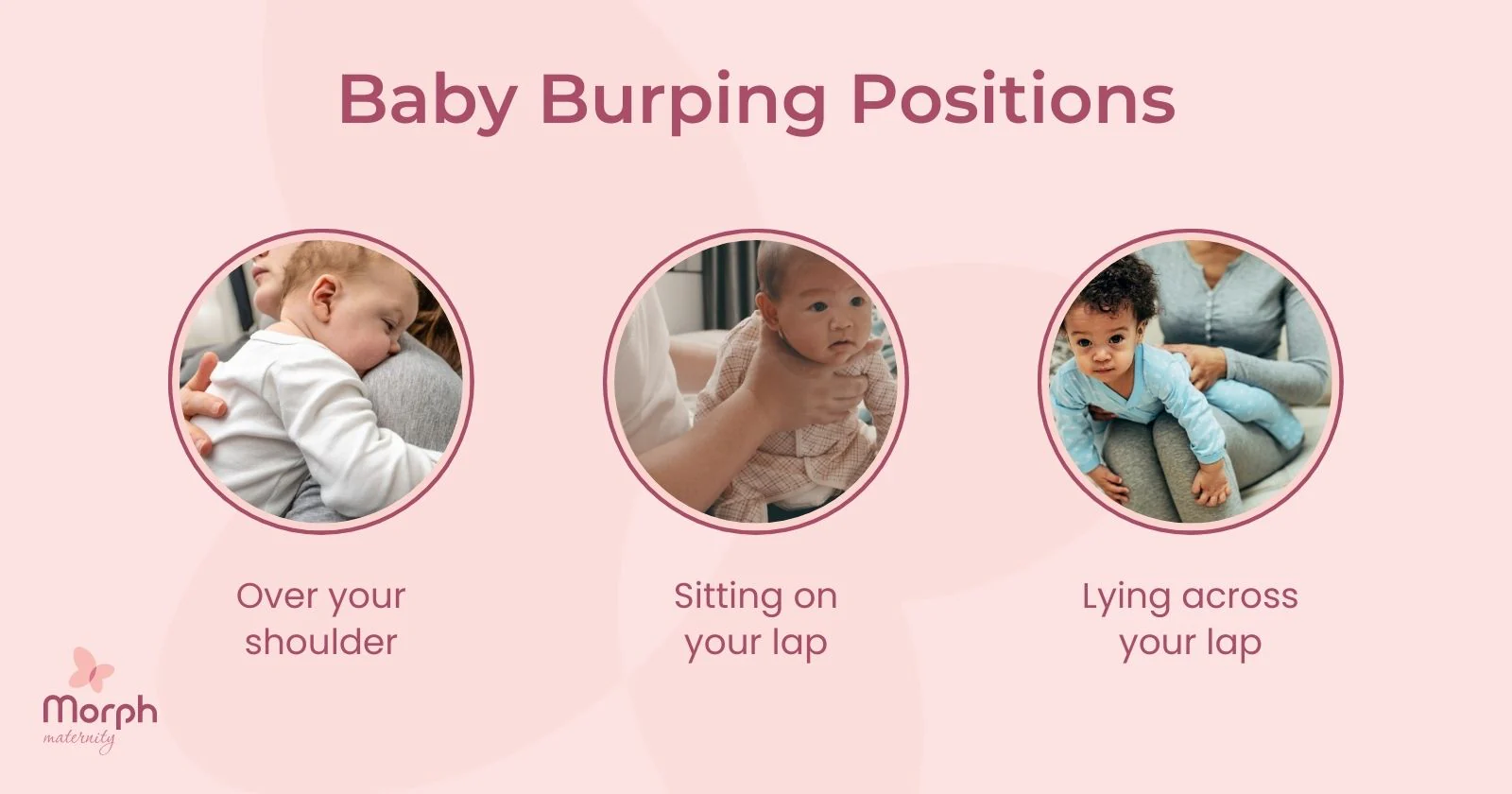
3 burping positions
All three of these are safe and effective when you support baby’s head and neck. Pick the one your baby tolerates best. Some babies have a clear preference.
1) Over-the-shoulder
This is the classic. It uses gentle pressure from your shoulder and helps many babies burp quickly.
- Hold baby upright against your chest with their chin resting just above your shoulder.
- Support their bottom with one hand and their head and neck with the other.
- Pat or rub their back in slow, steady motions.
- Use a burp cloth because gravity is not always your friend.

2) Seated (supported chin and chest)
This is my go-to for sleepy babies and reflux-prone babies because it keeps them upright without compressing the belly too much.
- Sit baby on your lap facing sideways or forward.
- Lean them slightly forward.
- Support their chest and jaw with your hand: your palm on their chest, your fingers supporting the jawline (not pushing on the throat).
- With your other hand, gently pat or rub their back.
Safety note: Support the jaw and chest, not the soft tissue of the neck.

3) Across the lap (tummy-down)
This can be very effective for stubborn bubbles, but use gentle pressure and strong head support.
- Lay baby across your lap tummy-down.
- Turn their head to one side and make sure their airway is clear.
- Support the head and neck with your hand or forearm.
- Pat or rub the back in slow circles.
If your baby has a very full belly or tends to spit up a lot, you may find this position triggers more spit-up. If so, switch to upright seated burping.
Pat vs rub
Both are fine. For many babies, a firm-but-gentle rub upward on the back works better than rapid pats. Think “calm and steady,” not “trying to start a campfire.”
Tips for reflux-prone babies
If your baby spits up frequently or seems uncomfortable during feeds, the goal is to reduce air swallowing and keep milk down with smart pacing.
Try paced feeding (especially with bottles)
- Use a slow-flow nipple (often labeled newborn or size 0 to 1).
- Hold baby more upright, around a 45-degree angle.
- Keep the bottle more horizontal so milk flows slowly.
- Offer short breaks: every 10 to 20 sucks, tip the bottle down briefly or remove it for a breath.
- Try to keep the nipple fully filled with milk to reduce swallowed air.
Burp smaller, more often
Instead of waiting until the end, pause for 30 to 60 seconds multiple times. Many reflux-prone babies do best with frequent, low-drama burp breaks.
Keep baby upright after feeding
Holding your baby upright for 15 to 30 minutes after feeds may help some babies spit up less.
Important safety note: Upright time should be supervised holding or babywearing. Do not let your baby sleep in a swing, bouncer, or car seat to manage reflux. For sleep, follow safe sleep guidance and place baby flat on their back on a firm, empty sleep surface.
Avoid extra belly pressure right after feeds
- Skip tight waistbands
- Try to delay tummy time until later
- Be gentle with bouncing and big position changes
One more reality check: Some spit-up is still normal even with perfect pacing and burping. Baby stomachs are small, their valves are immature, and laundry is eternal.
What is normal spit-up?
Spit-up looks dramatic, but most of the time it is harmless. A helpful distinction: spit-up is usually effortless (it kind of slips out), while vomiting is forceful and looks like active heaving.
Spit-up often peaks around 3 to 4 months and improves as babies sit up more and their digestive system matures, commonly by 6 to 12 months.
Normal spit-up usually looks like
- A small to moderate amount of milk dribbling out of the mouth
- Milk that looks curdled or cottage-cheese-like (stomach acid does that)
- Baby is otherwise comfortable or quickly settles
- Baby has wet diapers and is gaining weight
Spit-up that feels like “too much” but often is not
Spit-up can spread. A tablespoon can cover half a burp cloth. If your baby is happy and growing, the volume is less important than how your baby is doing overall.
When to worry
This is the part I wish every sleep-deprived parent had taped to the fridge. Most spit-up is normal, but some patterns deserve a call. Trust your gut and reach out if something feels off for your baby.
Call your pediatrician soon (same day or within 24 hours) if:
- Poor weight gain or weight loss
- Fewer wet diapers than expected for age (a key sign of dehydration)
- Feeding refusal or significant pain with feeds (arching, crying, pulling off consistently)
- Spit-up that is getting worse and baby seems increasingly uncomfortable
- Blood in spit-up or black, coffee-ground-looking material
- Green (bilious) vomit, which can signal an intestinal blockage
Get urgent care or emergency help now if:
- Repeated forceful vomiting that shoots outward (often several inches or more), especially in young infants. This warrants prompt evaluation because conditions like pyloric stenosis need medical care.
- Signs of dehydration: very dry mouth, significantly fewer wet diapers, sunken soft spot, unusual sleepiness. (Note: newborns may have few or no tears even when well, so diapers and behavior matter more.)
- Trouble breathing, choking, turning blue, or persistent coughing with feeds
- Severe lethargy or your baby is difficult to wake
- Fever in a young infant (follow your pediatrician’s guidance, and for babies under 3 months, fever can require urgent evaluation)
About “projectile” vomiting: Parents often use “projectile” to mean “a lot.” Clinically, it means forceful vomiting that shoots out. If you are not sure, it is absolutely okay to call and describe what you are seeing.
Common questions
How long should I try?
Usually 5 to 10 minutes max is plenty, and many babies burp much sooner. If you have tried a couple of positions and your baby is calm, you can stop.
Do I need to burp after every feed?
Not always. Many breastfed babies, and some bottle-fed babies, do fine without frequent burping. Let your baby guide you: if they are comfortable and not spitting up excessively, you can be flexible.
My baby falls asleep while burping. Should I keep going?
If they are asleep and relaxed, you can give it another minute or two and then place them down safely on their back to sleep. If they wake and fuss as soon as you set them down, try a seated burp for a minute before attempting again.
What about hiccups?
Hiccups are extremely common in newborns and are usually harmless. You do not have to keep burping until they stop. If your baby seems annoyed, a brief upright cuddle or a few gentle burp attempts can help, but hiccups often fade on their own.
Can burping make spit-up worse?
Sometimes. Patting too vigorously or using the across-the-lap position right after a big feed can bring milk back up. Try gentler rubbing and a more upright position.
When can we stop burping?
Many babies need less burping around 4 to 6 months as they get better head control, spend more time upright, and swallow less air. Some still benefit from it longer. There is no prize for stopping early.
A simple routine
If you want a no-brainer plan, here is a solid starting point:
- Feed in a slightly upright position.
- Pause partway through (or after an ounce or two for bottles, especially for younger babies).
- Do a 30 to 60 second seated burp.
- Finish the feed.
- Try over-the-shoulder burping for a few minutes.
- Hold upright 15 to 20 minutes if reflux is an issue (supervised, and not for sleep).
And if none of that produces a burp but your baby is calm, warm, and drifting off? Let it be a victory. Your job is not to win the burp. Your job is to care for your baby, and you are doing that.
Quick safety reminders
- Always support baby’s head and neck during burping, especially for newborns and preterm babies.
- Never shake your baby to “get the burp out.”
- For sleep, place baby on their back on a firm, flat surface with no loose bedding, even if they spit up.
- If your baby is vomiting forcefully, seems ill, or is not gaining weight, contact your pediatrician.
A good rule of thumb: If your gut says “this isn’t normal for my baby,” you are allowed to call. You do not need to apologize for being concerned.
Sarah Mitchell
Sarah Mitchell is a Registered Pediatric Nurse and a mother of three who has spent over a decade helping families navigate the beautiful, chaotic early years of childhood. She combines evidence-based medical knowledge with real-world parenting experience to offer practical, compassionate advice. At Awesome Parent, Sarah's mission is to help exhausted parents find solutions, trust their instincts, and finally get some sleep.