How to Clear a Baby’s Stuffy Nose

Sarah Mitchell
Sarah Mitchell is a Registered Pediatric Nurse and a mother of three who has spent over a decade helping families navigate the beautiful, chaotic early years of childhood. She combines evidence-based medical knowledge with real-world parenting experience to offer practical, compassionate advice. At Awesome Parent, Sarah's mission is to help exhausted parents find solutions, trust their instincts, and finally get some sleep.
A stuffy nose in a baby feels unfair. They cannot blow, they cannot sleep, and somehow they always get congested right when you finally get them drowsy. The good news is that most baby congestion is mild and you can make a real difference at home with a few safe tools and the right timing.
As a pediatric nurse and a mom of three, here is my calm, no-drama approach to clearing a baby’s stuffy nose, plus exactly when congestion might be something more serious.

First, a quick reality check
Most babies get congested from:
- Common colds (especially in daycare seasons)
- Dry air (winter heating, air conditioning)
- Normal newborn nasal narrowness (tiny passages clog easily)
- Irritants like smoke, strong fragrance, dust
- Reflux or frequent spit-up that may irritate the upper airway in some babies
Young infants prefer nose breathing and are not great at switching to mouth breathing when they are stuffed up. So even mild congestion can look and sound dramatic.
The best order of operations
If you only remember one thing, make it this: moisten first, then suction, then soothe. Here is the routine that works best for most families.
Step 1: Saline drops or saline mist
Saline is simply saltwater. It helps loosen sticky mucus so it can come out more easily. For babies, it is one of the safest and most effective first steps.
- What to use: Sterile saline drops or a gentle saline mist labeled for infants.
- How much: Usually 1 to 2 drops (or a brief mist) in each nostril.
- When: Before feeds, before sleep, and before suctioning.
Positioning tip: Lay baby on their back, turn their head slightly to one side, and place the drop just inside the nostril. You are not trying to “flush” the nose. A little goes a long way.
Tip from triage: If mucus is thick and dry, give the saline 30 to 60 seconds to work before you suction.
Step 2: Suction (bulb vs NoseFrida style)
Suction can be helpful, but more is not better. Over-suctioning can irritate the nasal lining and cause swelling, which can make congestion worse.

Bulb syringe
- Pros: Cheap, easy to find, no assembly.
- Cons: Harder to control suction strength, can be tricky to clean thoroughly.
How to use it:
- Squeeze the bulb first (before it goes near the nose).
- Gently place the tip just inside the nostril, not deep.
- Release slowly to pull mucus out.
- Empty onto a tissue and repeat as needed.
NoseFrida style (mouth-powered aspirator)
- Pros: Better control, often removes more mucus, generally easier to clean because it comes apart.
- Cons: Some parents need a minute to get comfortable with it.
Common worry: “Can mucus get in my mouth?” With proper use and the filter in place, no.
How often is safe? Try to limit suctioning. Many clinicians suggest keeping it to just a few times a day and focusing on the moments it matters most: before feeding and before sleep.
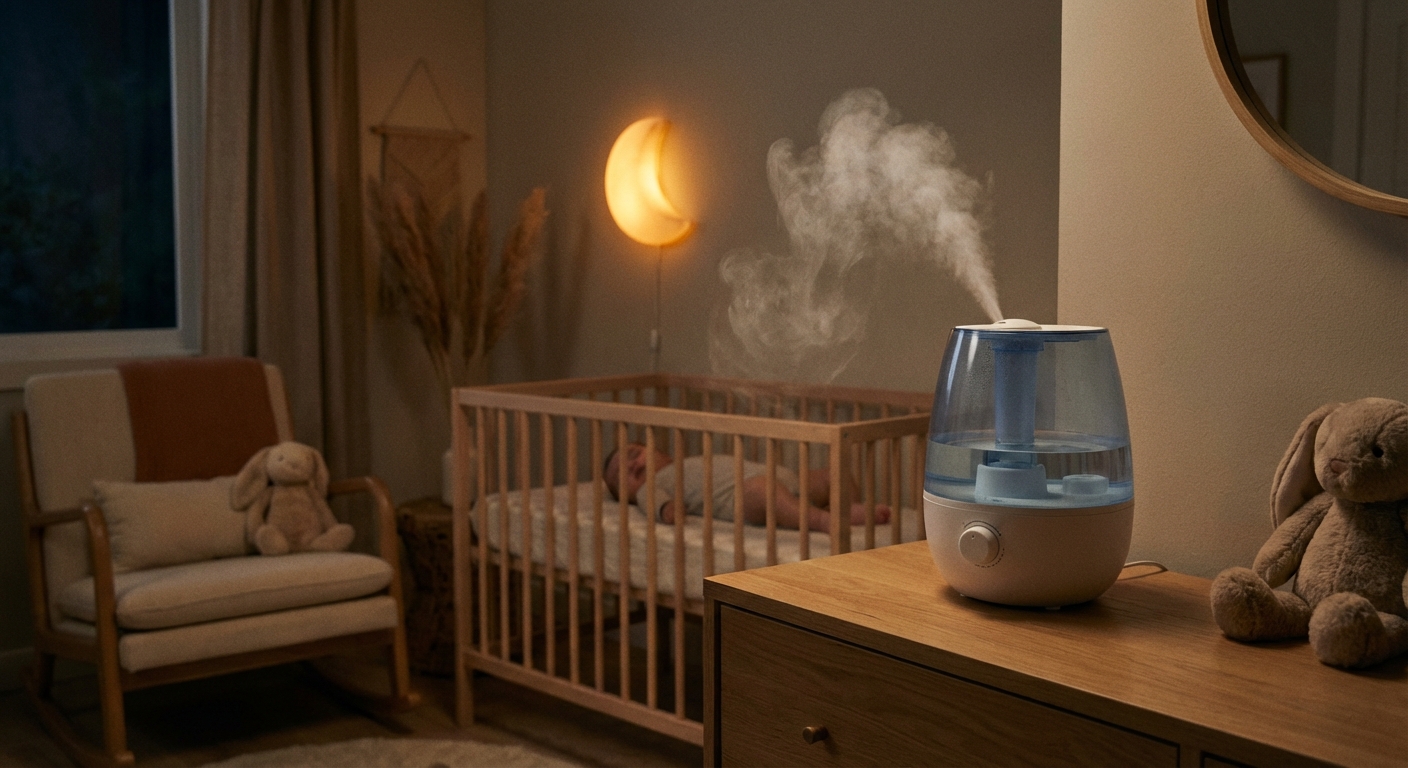
Step 3: Humidify the air
Dry air makes mucus thicker and harder to move. Adding moisture helps keep nasal passages comfortable.
- Best choice: A cool-mist humidifier in the room where baby sleeps.
- Helpful target: Aim for indoor humidity around 40 to 50% if you have a hygrometer. Too much humidity can invite mold.
- Water tip: Use distilled water if your manufacturer recommends it (it can reduce mineral buildup and “white dust”).
- Cleaning matters: Empty daily, dry the tank, and clean per manufacturer instructions to prevent mold.
Shower steam for quick relief
Warm, steamy air can temporarily loosen congestion, especially right before bedtime.
How to do it safely:
- Run a hot shower with the bathroom door closed for a few minutes.
- Turn the shower off or step well away from the stream, then sit in the steamy bathroom with baby 10 to 15 minutes.
- Keep baby far from hot water and hot surfaces, and watch for overheating. If you feel too warm, baby is too warm.
Think “spa waiting room,” not “steam room.” Comfort is the goal, not heat.

Feeding and sleep
Make feeding easier
When babies are congested, feeding can be harder. Swallowing extra mucus and breathing through a stuffy nose is a lot of work.
- Offer smaller, more frequent feeds if baby is struggling.
- Take breaks to let baby breathe.
- Hold baby upright for 15 to 20 minutes after feeding if reflux seems to be adding to the problem.
About elevated sleep
This is a big one, because the internet loves to suggest elevating the crib mattress. Here is the evidence-based guidance:
- Safest sleep is flat and on the back on a firm, empty sleep surface (crib, bassinet, or play yard).
- Do not place pillows, wedges, or rolled towels under or around baby.
- Do not incline the sleep surface unless your pediatrician gives a specific medical plan. Inclines can increase risk if baby slides or ends up chin-to-chest.
What you can do instead: If baby will only rest while being held, you can do a short, supervised upright cuddle while you are fully awake. When it is time for real sleep, place baby back flat on their back.
What to avoid
- No honey for babies under 12 months.
- No over-the-counter cold medications for young children unless specifically directed by your clinician. They can be harmful and do not help much.
- No menthol rubs directly under the nose and avoid strong scents around babies. Some products are not recommended under age 2. If you use any vapor rub, confirm it is labeled for your child’s age and keep it away from the face and hands.
- No essential oils in a diffuser around infants unless your pediatrician specifically okays it. Babies’ airways are sensitive and reactions happen.
- No aggressive suctioning all day long. More suction can mean more swelling.
- No cotton swabs or anything inserted into the nose beyond the very tip of a suction device.
Age-based options
Newborns (0 to 3 months)
- Saline drops plus gentle suction before feeds
- Cool-mist humidifier
- Shower steam session
- Extra upright snuggles while awake
Newborns can get dehydrated and tired faster, so keep a close eye on feeding and wet diapers.
Babies (4 to 12 months)
- All of the above
- Offer feeds more frequently (breastmilk or formula)
- If baby is around 6 months or older and your pediatrician has already okayed water, you can offer small sips from an open cup or straw cup. Milk or formula is still the main hydration.
Toddlers (12 months and up)
- Saline mist and teaching gentle blowing (it takes time)
- Humidifier and steam
- Honey can be used for cough if over 12 months (not for nasal congestion itself, but it can help sleep when a cold includes coughing)
When it might be allergies
True seasonal allergies are less common in very young babies. If your child is older, has persistent clear runny nose, sneezing, itchy eyes, or symptoms that flare with dust, pets, or outdoor pollen, talk with your pediatrician about allergy-safe next steps. Either way, start with the basics: smoke-free air, fragrance-free products, and regular dust control.
When to worry
Most stuffy noses are just that. But there are times when I want you to trust your gut and escalate.
Call your pediatrician (same day) if:
- Baby is under 3 months with any cold symptoms and you are worried
- Congestion is making it hard to feed and baby is taking significantly less than normal
- You notice fewer wet diapers (a sign of dehydration)
- Fever that meets your clinic’s threshold, especially any fever in a baby under 3 months (often defined as 100.4°F or 38°C rectal, but follow your pediatrician’s guidance)
- Symptoms are not improving by about 10 days, are worsening after initially improving, or persist beyond about 2 weeks
- Thick nasal drainage with significant ear tugging, new irritability, or sleep disruption that makes you suspect an ear infection
Seek urgent or emergency care now if you see:
- Breathing trouble: fast breathing, grunting, flaring nostrils, ribs pulling in (retractions), head bobbing, or breathing that clearly looks like hard work
- Color changes: lips or face looking blue, gray, or very pale
- Pauses in breathing, extreme sleepiness, or difficulty waking
- Signs of dehydration: very dry mouth, no tears when crying, or very few wet diapers
- Stridor (a harsh, high-pitched sound when breathing in) or a barking cough that is getting worse
If you are staring at your baby at 2 AM thinking, “This does not feel right,” you do not need to win an argument with yourself first. Call.
A 5-minute bedtime routine
If nights are the hardest, try this quick sequence:
- Humidifier on (start it 30 to 60 minutes before bedtime if possible)
- Saline drops in each nostril
- Wait 30 to 60 seconds
- Suction (only if baby sounds blocked or is struggling to feed or settle)
- Feed, taking breaks as needed
- Back to sleep, flat on a firm surface
Will it prevent every wake-up? No. Will it give you the best odds of a more comfortable stretch? Usually, yes.
FAQs
How do I know if baby’s nose is “too stuffy”?
If baby cannot feed comfortably, is waking repeatedly because they cannot breathe through their nose, or you hear constant noisy breathing that does not improve with saline and humidity, it is worth a call to your pediatrician.
Green mucus means antibiotics, right?
Not necessarily. Mucus can turn yellow or green as a cold progresses and the immune system does its job. Antibiotics are only helpful for bacterial infections, not routine viral colds. If symptoms are lasting longer than expected, baby seems worse, or there is a high fever, check in with your clinician.
Can I use saline all the time?
Saline is generally safe and can be used as needed. If you find yourself needing it constantly for weeks, talk with your pediatrician about triggers like dry air, irritants, or reflux. In older babies and toddlers, allergies can sometimes be part of the picture.
One last nurse-mom note
Congestion is one of those parenting problems that feels small until you are living it at night. You are not doing anything wrong. Focus on what matters most: help baby breathe well enough to eat and sleep, keep the air comfortably moist, and know your red flags.
And if you want permission to stop doom-scrolling and just do saline plus suction plus humidifier, here it is.