How to Transition from Bottle to Sippy Cup

Sarah Mitchell
Sarah Mitchell is a Registered Pediatric Nurse and a mother of three who has spent over a decade helping families navigate the beautiful, chaotic early years of childhood. She combines evidence-based medical knowledge with real-world parenting experience to offer practical, compassionate advice. At Awesome Parent, Sarah's mission is to help exhausted parents find solutions, trust their instincts, and finally get some sleep.
If you are staring at a cabinet full of cups thinking, “Which one am I supposed to buy, and how do I convince my tiny boss to use it?”, take a breath. The bottle-to-sippy-cup transition is less about one magic cup and more about timing, practice, and a plan that does not turn every drink into a power struggle.
As a pediatric nurse and a mom who has cleaned up more spilled milk than I care to admit, here is what actually works for most families: start cup practice around 6 to 9 months, build the skill slowly, then work toward being fully off bottles around 12 to 15 months (with 18 months as a reasonable outer limit for many kids).
Quick note: This is general educational information, not medical advice. If your child has feeding or swallowing concerns, check in with your pediatrician for individualized guidance.
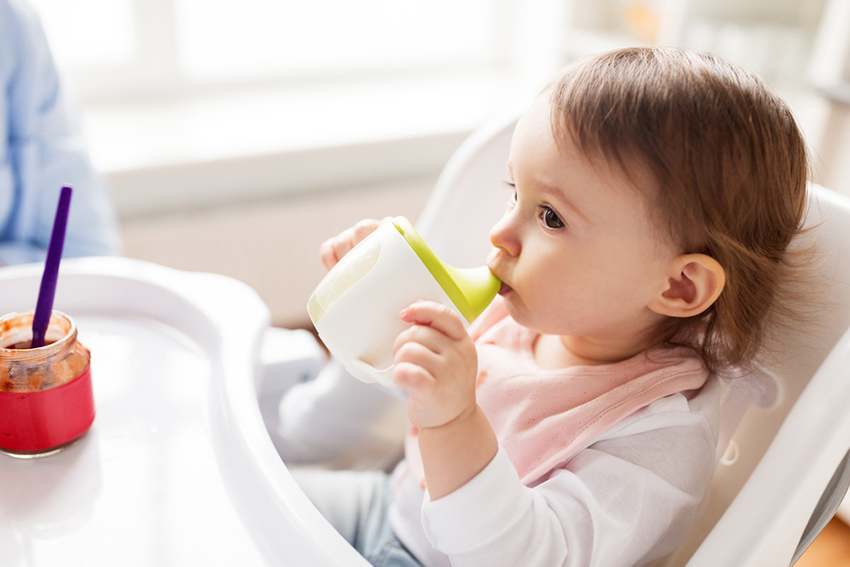
At a glance
- 6 to 9 months: start practicing with a cup (tiny amounts, low pressure).
- Before 12 months: breast milk or formula is still the main drink. Use the cup mostly for practice with small sips of water at meals.
- Around 12 months: begin replacing bottles one at a time.
- Goal: aim to be done with bottles by 12 to 15 months when possible, and by 18 months at the latest for most families.
When to introduce a sippy cup
Most babies are ready to start practicing with a cup around 6 to 9 months. This is when many babies can sit with support, bring objects to their mouth, and are already learning how to eat solids, which makes cup practice feel more natural.
Signs your baby is ready
- Sits upright with minimal support
- Grabs and holds objects, brings them to their mouth
- Shows interest when you drink from a cup
- Is eating some solids and managing thicker textures
Even if your baby is not “good” at it right away, that is the point. Cup skills are learned, and early practice usually makes moving away from bottles easier later.
Breastfed babies
If you are breastfeeding, cup practice still fits. Many breastfed babies do not take many bottles, but the cup is a great skill to build for water at meals, daycare, and that eventual shift to milk with meals after age one.
Why the transition matters
Many pediatric and dental sources (including the American Academy of Pediatrics and the American Dental Association) encourage beginning cup practice in the second half of the first year and working toward weaning off bottles around the first birthday (often by 12 to 15 months, and by 18 months at the latest). There are a few reasons we care about this timeline:
- Dental health: Frequent sipping from bottles, especially milk or juice, can increase the risk of tooth decay.
- Iron and appetite: Toddlers who fill up on milk may eat fewer iron-rich foods, which can contribute to iron deficiency.
- Oral motor development: Learning to drink from a cup supports different mouth skills than a bottle.
- Sleep associations: Bottles at bedtime can become a very stubborn comfort habit.
None of this means you have “ruined anything” if your 15-month-old still wants a bottle. It just means we make a plan and move forward without panic.
What to put in the cup
Before 12 months
- Breast milk or formula: still the primary source of nutrition and hydration.
- Water: small amounts with meals for practice (think 1 to 2 ounces at a time, unless your pediatrician advises otherwise).
- Juice: best skipped for everyday hydration.
After 12 months
- Water: main drink between meals.
- Milk: often works best with meals and snacks. If you want a number to discuss with your pediatrician, many families aim for roughly 16 to 24 ounces per day to support appetite for iron-rich foods (individual needs vary).
Choosing a starter cup
There is no single perfect cup. The best beginner cup is the one your baby will practice with consistently and that fits your goals.
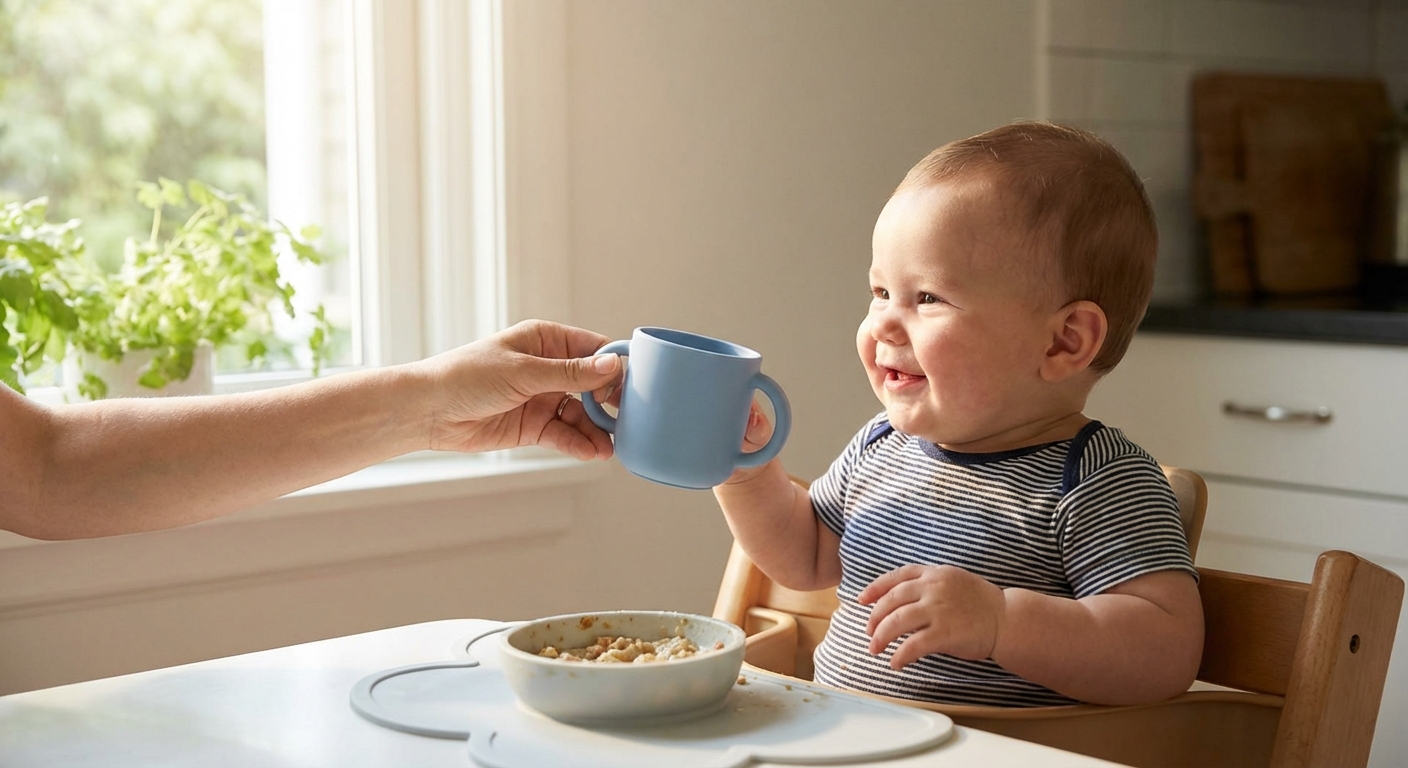
Good options for beginners
- Straw cup: Often the easiest for many babies to learn quickly. Look for a soft straw and a spill-resistant lid. Great for on the go.
- Soft spout sippy cup: Can feel familiar for bottle-loving babies. Helpful as a bridge, but many families move on from spouts fairly quickly.
- Open cup trainer: A small open cup or a tiny training cup helps babies learn real sipping. Expect mess. The mess is the curriculum.
What to look for
- Easy to clean, minimal parts you can lose
- Appropriate flow, not so fast that it causes coughing
- Size that fits little hands, usually 4 to 6 ounces at first
- Leak-resistant for outings, but not so “no flow” that it frustrates your baby
A note on “no-spill” valve cups
They can be very convenient, but some are hard to suck from, which can frustrate babies. If your baby seems angry at the cup, try removing the valve (if the brand allows it), switching to a straw cup, or practicing with water in a low-stakes setting.
Cleaning tip: check for hidden mold
Straws and valves can hide gunk in places you cannot see. Do a quick daily check (especially inside the straw and under any valve), and use tiny straw brushes or detail brushes to clean every piece. If you ever notice a musty smell or dark spots that do not scrub off, replace the parts.
A gradual transition plan
The goal is to build a new skill without yanking away a comfort habit overnight. Here is a gentle step-by-step plan you can start around 6 to 9 months and build on as your baby approaches the first birthday.
Step 1: One daily “practice sip”
- Offer the cup once a day with 1 to 2 ounces of water during a meal.
- Keep the bottle routine the same for now.
- Let your baby explore. Chewing the spout or straw counts as practice.
Step 2: Add a second cup opportunity
- Once it feels less stressful, add a second offering, usually at another meal.
- Continue using water to reduce pressure. Milk can come later.
Step 3: Put milk in the cup for one feeding
- Pick the easiest feeding first, often a midday bottle rather than morning or bedtime.
- Start by offering a small amount of milk in the cup, then finish the rest by bottle if needed.
- Over several days, increase cup volume and decrease bottle volume.
Step 4: Replace bottles one at a time
A common order that minimizes drama is:
- Midday bottle
- Morning bottle
- Bedtime bottle (last, because feelings)
Step 5: Keep the timeline simple
By around 12 months, many toddlers can get most drinks from cups, with bottles fading out. Aim to be fully done with bottles by 12 to 15 months when possible, and treat the 12- to 18-month window as the broader range you may see depending on temperament, childcare, and life.
Handling resistance
Resistance is normal. Your child is not being “stubborn.” They are protecting a familiar routine. Here are the most effective, low-drama strategies.
Make the cup predictable
- Offer the same cup for a week or two before switching.
- Practice at meals, when your child is already seated and calm.
- Let them hold the cup, even if you expect spills.
Use tiny amounts
For brand-new cup drinkers, fill it with just an ounce or two. A full cup can feel heavy and can spill fast, which makes some kids avoid it.
Model it
Babies and toddlers learn by copying. Take a sip from your own cup, then offer theirs. You will feel a little silly. It works anyway.
Try the two-cup trick
Offer an open cup with a tiny amount of water and a straw cup with water. Some kids prefer one immediately. You are not spoiling them. You are gathering data.
If your child only wants bottles
- Keep bottles in a specific location instead of carrying them around.
- To reduce grazing and tooth exposure, try to avoid bottles as an all-day accessory (like in the car or while wandering the house).
- Stop offering bottles as a first response to fussiness. Offer comfort first, then a cup with water if appropriate.
- Use consistent language: “Milk is in the cup now. Bottle is all done.”
If you make the cup optional forever, many toddlers will happily choose bottles forever. Gentle boundaries are kind boundaries.
How to drop bottles completely
If your child is approaching one year and bottles are still the main event, you are not behind. You just need a clearer endpoint. Here is a simple approach I used with my own kids and recommended countless times in clinic.
Pick a realistic timeline
- Two to four weeks works well for many families.
- Avoid starting during travel, a new daycare transition, or right after an illness if you can.
Set bottle rules that reduce grazing
- Bottles only at set times, not throughout the day.
- If your toddler is older than 12 months, aim to move milk to meals and snacks, and water between.
Make bedtime bottle the final step
For many toddlers, the bedtime bottle is half hunger and half routine. Try this progression:
- Move the bottle earlier in the bedtime routine (before pajamas and brushing teeth).
- Brush teeth after milk, every night.
- Switch to milk in a cup, offered in the kitchen or at the table, not in bed.
- Replace with a predictable comfort routine: books, cuddles, song.
Common problems and quick fixes
My baby coughs or sputters with the cup
- Try a slower-flow cup or a straw with a valve designed for beginners.
- Offer smaller sips, less liquid in the cup.
- Practice when your baby is calm, not very hungry.
My baby refuses milk from the cup but drinks water
- Keep water practice going. For some families, an optional trick is to start with a splash of milk in water and gradually increase. If you prefer not to dilute milk, you can skip this and simply keep offering milk separately in the cup at a consistent time.
- Offer milk in a cup at one consistent time daily, then allow bottle after if needed while transitioning.
My toddler throws the cup
- Keep drinks at the table. If thrown, calmly remove: “Cup is for drinking. All done.”
- Offer again later, without a lecture.
My child takes a bottle at daycare or only at home
Pick one setting to lead the change, usually the one with the most consistent routine. Communicate a simple plan with caregivers so your child gets the same message in both places.
Safety and health notes
- Avoid juice in cups for everyday hydration. Water is best between meals.
- Avoid bottles (or any caloric drinks) at bedtime. If milk happens in the evening, do it earlier in the routine and brush teeth after.
- Watch for dehydration during transitions, especially during illness. Wet diapers, tears, and energy level matter.
- If your child has feeding or swallowing concerns, recurrent coughing with liquids, or poor weight gain, check in with your pediatrician for individualized guidance.
A one-week starter plan
If you want a concrete place to begin, try this:
- Days 1 to 2: Cup with 1 to 2 ounces of water at one meal daily.
- Days 3 to 4: Cup with water at two meals daily.
- Days 5 to 6: Add 1 to 2 ounces of milk in the cup at one meal or snack, bottle still available after.
- Day 7: Keep two daily cup practices and repeat the milk-in-cup once.
Then keep going, replacing one bottle at a time. Small, steady change beats one epic battle every time.
Bottom line
Start cup practice around 6 to 9 months, keep it low pressure, and gradually shift milk and comfort routines away from bottles so you can be fully done by 12 to 15 months when possible (and by 18 months at the latest for most kids). Expect spills, expect opinions from your child, and expect progress to look like two steps forward and one step sideways.
And if you need permission to take the easy win: it is okay to try two different cup styles. Your job is not to pick the “perfect” cup. Your job is to help your baby learn a new skill, one sip at a time.