Grunting, wheezing, retractions, and nasal flaring can be scary. Here’s what’s normal in newborns, what warning signs look like, and clear ER thresholds.
Laryngomalacia: Noisy Breathing in Newborns

Sarah Mitchell
Sarah Mitchell is a Registered Pediatric Nurse and a mother of three who has spent over a decade helping families navigate the beautiful, chaotic early years of childhood. She combines evidence-based medical knowledge with real-world parenting experience to offer practical, compassionate advice. At Awesome Parent, Sarah's mission is to help exhausted parents find solutions, trust their instincts, and finally get some sleep.
If your newborn makes a high-pitched squeaky sound when they breathe in, you are not alone. As a pediatric nurse and a mom who has done plenty of 3 AM "is this normal?" listening sessions, I can tell you this: noisy breathing can look dramatic and still be harmless.
One of the most common reasons for persistent noisy breathing in young babies is laryngomalacia. It sounds scary because it has a long name, but in many cases it is a benign, self-limited condition that babies outgrow.

Let’s break down what laryngomalacia sounds like, what tends to make it better or worse, how it differs from colds and croup, how it is diagnosed, and exactly when noisy breathing needs urgent care.
What it is (plain English)
Laryngomalacia means the tissues above the vocal cords are a bit softer and floppier than usual. When your baby breathes in, that tissue can briefly fall inward, creating a high-pitched sound on inhalation called inspiratory stridor.
Key points parents should know:
- It is the most common cause of stridor in infants.
- Symptoms often start in the first few weeks of life (and sometimes are noticed earlier).
- Noisy breathing often becomes louder over the first several months, commonly peaking around 4 to 8 months.
- Most babies improve gradually and outgrow it by about 12 to 18 months, though some take closer to 24 months.
Most cases are mild. A smaller group of babies have more significant symptoms and need closer follow-up or treatment.
What it sounds like
Laryngomalacia typically causes a high-pitched squeak, whistle, or fluttery sound when your baby breathes in. Parents often notice it most when baby is:
- On their back
- Crying or upset
- Excited or active (even newborns can get wiggly)
- Feeding
- Congested (even mild stuffiness can amplify the sound)
It may get quieter when baby is calm, upright, or sleeping. Some babies are noisy enough that you can hear them across the room, yet they look comfortable and feed well. That combination is often reassuring.

How it is diagnosed
Your pediatrician will start with the basics: listening, watching your baby breathe, checking oxygen if needed, and asking about feeding and weight gain.
If laryngomalacia is suspected, many babies are referred to an ENT specialist. ENT can often confirm it with a flexible laryngoscopy, a tiny camera used to look at the upper airway. For many infants, this is a brief in-office exam, but if symptoms are severe or the story is atypical, additional testing may be recommended.
This matters because other (less common) causes of stridor can sound similar, and your clinician may want to rule them out. Examples include vocal cord motion problems, subglottic narrowing, airway hemangioma, or (depending on age and situation) an inhaled foreign body.
Laryngomalacia vs. other common noises
Parents hear a lot of different baby sounds, and the internet loves to panic about all of them. Here is a practical way to tell the most common possibilities apart.
Laryngomalacia vs. a cold
- Laryngomalacia: high-pitched sound mainly on inhalation. Often worse lying flat, crying, feeding.
- Cold congestion: sounds more like snorting, stuffiness, wet gurgling in the nose. Often improves after saline and suction.
Helpful tip: If the sound changes dramatically after you clear the nose, it was probably mostly congestion.
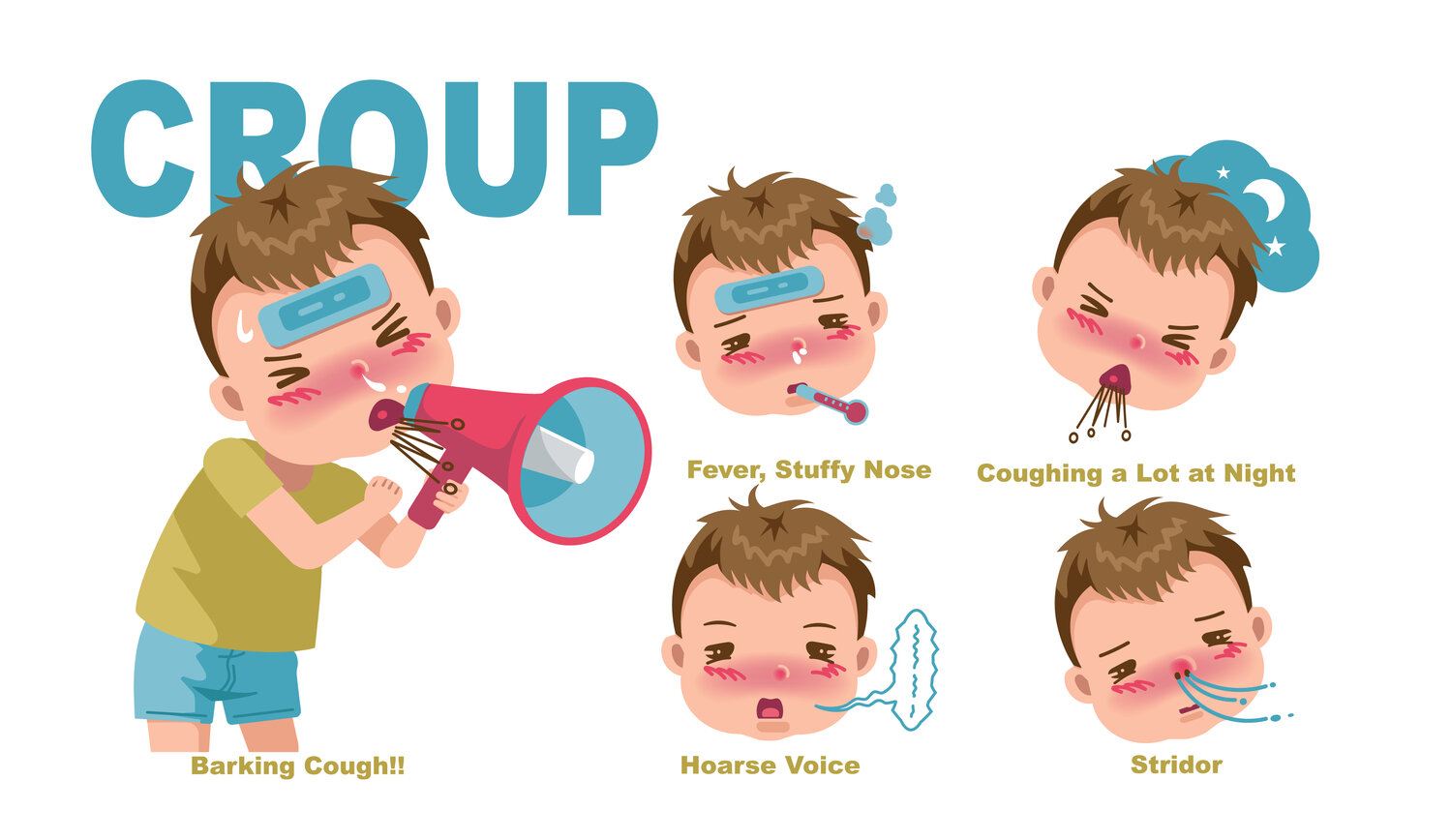
Laryngomalacia vs. croup
Croup is usually a viral illness that causes swelling around the voice box and windpipe.
- Laryngomalacia: present for weeks or months, often since early infancy. No fever required. Cry may be normal.
- Croup: tends to be sudden and comes with a barking cough and often a hoarse voice. Stridor may happen at rest when more severe. It is more common after about 6 months, but can occur earlier.
If your baby is a newborn with noisy breathing since early life, croup is much less likely. If your child develops a barky cough and hoarseness, think croup and get guidance the same day.
Laryngomalacia vs. wheezing
- Stridor (laryngomalacia): higher-pitched, mainly on in, coming from the upper airway.
- Wheezing: often a musical whistle on exhale, coming from the lungs. May come with fast breathing or belly pulling in.
Parents often describe both as "whistling," so if you are unsure, record a 10 to 15 second video of the breathing and share it with your pediatrician.
Laryngomalacia and reflux
Reflux and laryngomalacia often co-exist. Some babies have more noisy breathing when reflux is flaring, likely due to irritation in the upper airway. That said, reflux is not always the main driver of symptoms, and treating reflux does not reliably make laryngomalacia disappear.
- Reflux clues: frequent spit-ups, discomfort after feeds, arching, coughing or gagging with feeds, chronic congestion, poor sleep.
- Laryngomalacia clues: classic inspiratory squeak that varies with position and activity.
What to watch for at home
Mild laryngomalacia often looks like this:
- Baby has normal skin color and is alert when awake
- Breathing is noisy but not hard (no persistent chest tugging)
- Baby feeds well overall and has steady weight gain
- Diapers are normal and baby seems comfortable between feeds
- No repeated long pauses in breathing
If this sounds like your baby, your pediatrician will often monitor symptoms at regular checkups and may refer to an ENT specialist if needed.
Comfort measures that help
You cannot "train" laryngomalacia away, but you can often make your baby more comfortable and reduce flare-ups.
Positioning
- Hold baby upright for 20 to 30 minutes after feeds.
- During awake time, supervised upright positions (carrier, held upright) often reduce noise.
- For sleep: follow safe sleep guidelines. Baby should sleep flat on their back on a firm surface with no inclined sleepers, wedges, or pillows. (I know this is the part parents wish I could bend. I cannot. Incline products are not safe.)
Feeding tweaks
- Smaller, more frequent feeds can reduce reflux and breathlessness.
- Slow the flow if bottle-feeding by using an age-appropriate slower nipple.
- Paced bottle-feeding can help babies coordinate suck, swallow, breathe.
- If breastfeeding and baby coughs or gulps a lot, try a more laid-back position and talk with a lactation consultant.
Clear the nose
- Use saline drops and gentle suction when needed, especially before feeds and sleep.
- Consider a cool-mist humidifier in the room.
Reduce reflux triggers
- Avoid overfeeding if baby is spitting up frequently.
- Burp gently during and after feeds.
- Keep clothing and diapers not too tight around the belly.

When to call your pediatrician
Even if laryngomalacia is usually benign, your pediatrician should be in the loop, especially if this is new or worsening. Call within 24 hours, or sooner if your instinct says something is off, if you notice:
- Noisy breathing that is getting louder quickly or changing character
- Feeding struggles: coughing, choking, frequent gagging, taking much longer than usual to feed
- Poor weight gain or fewer wet diapers
- Frequent pulling in at the ribs or base of the neck (retractions)
- Breathing or color changes during feeds (coughing fits, turning dusky, needing frequent breaks)
- Recurrent pauses in breathing, even if brief
Your clinician may listen, observe a feeding, check weight trends, and decide whether an ENT evaluation is needed.
Go to the ER now
This is the part I want you to read once, then bookmark. Stridor can be benign, but if your baby looks like they are struggling to breathe, do not watch-and-wait.
- Blue, gray, or very pale color around lips or face
- Stridor at rest that is severe or suddenly worse, especially if baby looks distressed
- Hard breathing: deep chest retractions, nostril flaring, head bobbing, grunting
- Pauses in breathing, limpness, or difficulty waking
- Drooling and trouble swallowing (especially if sudden) or a muffled voice or cry
- Signs of dehydration: very dry mouth, markedly fewer wet diapers, sunken soft spot (fontanelle), unusual sleepiness
- Choking episode with persistent noisy breathing afterward
If you are ever thinking, "I do not like how this looks," trust that feeling and get seen urgently. You do not need to be 100 percent sure to seek help.
Does it need treatment?
Most babies only need time and monitoring. Treatment depends on severity and on how well your baby is feeding, breathing, and growing.
Mild cases
- Reassurance and follow-up
- Supportive care: feeding strategies, reflux management, nasal care
Moderate cases
- Closer monitoring of growth and feeding
- Evaluation for reflux and aspiration risk if feeding is difficult
- Possible referral to ENT and sometimes a feeding specialist
Severe cases
If a baby is not gaining weight, has significant retractions, oxygen drops, or frequent apnea or cyanosis, ENT may recommend a procedure called supraglottoplasty to reduce the tissue collapse. That decision is individualized and based on your baby’s symptoms and exam.
Quick FAQs
Can my baby still sleep on their back?
Yes. Even with laryngomalacia, the safest sleep position is on the back on a flat, firm surface. If your baby seems significantly worse when lying flat, talk with your pediatrician promptly. Do not use wedges or inclined sleepers.
Will my baby outgrow it?
Most babies do. Symptoms often get louder for a while, then gradually improve. Many resolve by 12 to 18 months, though some take closer to 24 months.
Is the noise harming my baby?
The sound itself is not the danger. What matters is whether your baby is working hard to breathe or not feeding and growing well. Noisy and comfortable is very different from noisy and struggling.
Should I record the sound?
Absolutely. A short video of the breathing and a second clip during a feed can be incredibly helpful for your pediatrician or ENT.
The bottom line
Laryngomalacia is a common reason newborns and young infants have a high-pitched squeak on inhalation. It is often benign and improves with time, but it deserves attention, especially if it affects feeding, growth, or comfortable breathing.
If your baby looks comfortable most of the time and is feeding and growing, this is often something you can monitor with your pediatrician. If you see blue color, significant retractions, apnea, sudden worsening, or your gut is waving a big red flag, get urgent care right away.
Medical note: This article is for education and does not replace medical care. When it comes to baby breathing, you are allowed to be cautious.
You are not overreacting. You are parenting. And noisy newborn breathing can make even the calmest parent stare at the monitor like it is a reality show. I see you.
Sarah Mitchell
Sarah Mitchell is a Registered Pediatric Nurse and a mother of three who has spent over a decade helping families navigate the beautiful, chaotic early years of childhood. She combines evidence-based medical knowledge with real-world parenting experience to offer practical, compassionate advice. At Awesome Parent, Sarah's mission is to help exhausted parents find solutions, trust their instincts, and finally get some sleep.