CMPA can look like reflux, eczema, or blood in stool. Learn IgE vs non-IgE symptoms, how it differs from lactose intolerance, formula choices, breastfeeding ...
Mucus and Stringy Baby Poop: What It Means

Sarah Mitchell
Sarah Mitchell is a Registered Pediatric Nurse and a mother of three who has spent over a decade helping families navigate the beautiful, chaotic early years of childhood. She combines evidence-based medical knowledge with real-world parenting experience to offer practical, compassionate advice. At Awesome Parent, Sarah's mission is to help exhausted parents find solutions, trust their instincts, and finally get some sleep.
If you have ever opened a diaper and thought, “Why is my baby’s poop… slimy?” you are in very good company. As a pediatric nurse and a mom of three, I can tell you mucus and stringy baby poop are one of the most common panic-Googles I fielded in clinic, usually at 2 AM.
Most of the time, a little mucus is your baby’s gut doing a normal protective response of the gut lining, especially during a cold. But there are a few patterns that matter a lot, like mucus with blood, mucus with signs of dehydration, or mucus that keeps coming back along with feeding issues.
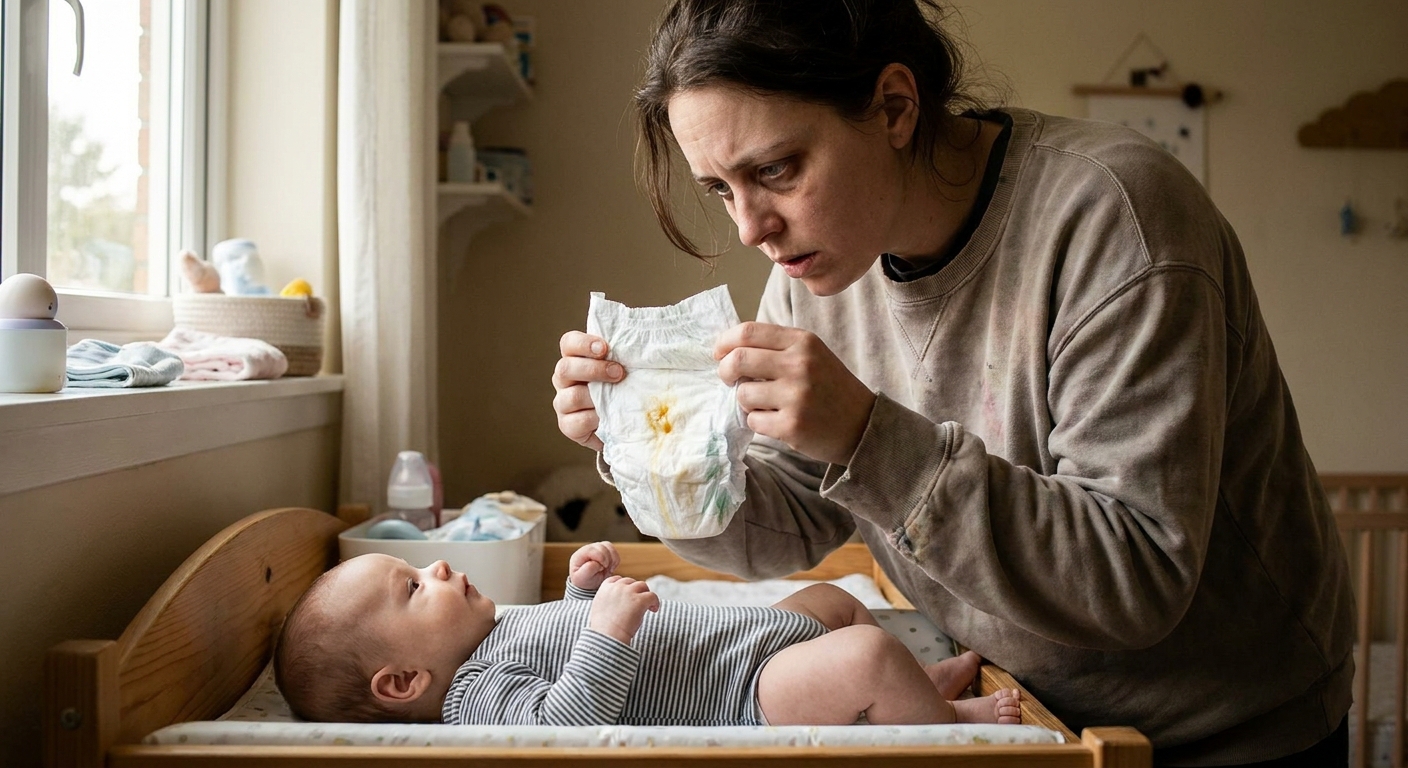
Let’s walk through what mucus can mean, what clues to look for, and when it is time to call your pediatrician.
What counts as mucus?
Mucus looks like clear, white, or yellowish slime. In a diaper it can show up as:
- Stringy strands mixed into the poop
- Shiny, gel-like streaks on the outside of the stool
- Jelly-like blobs in looser poop
A small amount once in a while can be normal, especially in babies who swallow extra saliva during teething or a cold.
One important caveat: the “mucus look” can be subjective. Some stools look ropy because of undigested food fibers or looser stool mixed with normal secretions. That is why the pattern over time and your baby’s overall symptoms matter more than a single diaper.
If your main concern is color, head over to our poop color resource: Baby Poop Color Chart . This article focuses on the texture clue of mucus and stringiness.
Common causes
1) Cold and post-nasal drip
This is a very common cause I see. When babies have a cold, they swallow mucus from the back of the throat. That mucus has to go somewhere, and it can show up in the diaper, especially when stools are already a bit looser than usual.
Clues it is a viral situation:
- Runny or stuffy nose, cough, watery eyes
- Mild fever or just “off” behavior
- Poop may be a bit looser and more frequent for a few days
- Baby is still peeing normally and drinking okay
What to do: Focus on hydration, keep feeds frequent, and use saline and suction for congestion if needed. Mucus usually improves as the cold resolves.
2) Mild stomach bug
Viruses that hit the gut can irritate the intestines and lead to mucus, looser stool, and a sour smell. Some babies also get diaper rash quickly because the stool is more acidic.
Clues:
- Watery poop, more frequent stools
- Fussiness and gas
- Sometimes vomiting
- Often there is a household contact who is also sick
What to do: Hydration is the priority. If your baby is under 3 months, call your pediatrician early for guidance since little babies can dehydrate quickly. Ask if an oral rehydration solution is appropriate for your baby’s age and situation. Avoid giving plain water to young infants unless your pediatrician tells you to.
3) Food changes
When you introduce solids, it is common for stool texture to change. Some foods can make poop look stringy or mucousy simply because bits of fiber do not break down fully.
Examples that can sometimes look ropy or stringy in stool:
- Banana
- Oats
- Sweet potato
- Green beans
- Foods with skins or “strings,” like peas
Clues it is a food transition:
- Baby seems well otherwise
- No fever
- The change shows up after a new food, then fades
What to do: Keep a simple food log for a week. If one food repeatedly lines up with mucus and discomfort, pause it and discuss with your pediatrician.
4) Cow’s milk protein allergy (CMPA) and other food protein reactions
This is the cause parents worry about most, and it is important to take seriously, especially when mucus is frequent or paired with blood.
In young infants, the mucus plus blood pattern is often a non-IgE-mediated reaction (many clinicians call this allergic proctocolitis). It can irritate the lining of the intestines and cause mucus and small streaks or flecks of blood. Some babies are also very fussy, have reflux-like symptoms, or struggle with weight gain.
Clues that point toward a milk protein issue:
- Persistent mucus across many diapers, not just one random day
- Blood-streaked mucus or flecks of blood (even small amounts matter)
- Ongoing fussiness, arching, or feeding refusal
- Eczema or persistent skin rashes (not always, but common)
- Poor weight gain or very frequent stools
If you want a deeper dive on the allergy patterns and what elimination looks like for breastfeeding and formula-fed babies, see: Milk Protein Allergy in Babies .
Important note: Try not to self-diagnose or do big diet or formula changes without a plan. Do not switch formulas repeatedly or cut major food groups without guidance. It can backfire, and it makes it harder to identify what is truly helping. Your pediatrician can guide whether a trial of extensively hydrolyzed or amino-acid formula is appropriate, or what a structured elimination trial looks like if you are breastfeeding.
5) Antibiotics (sometimes)
If your baby is taking antibiotics (or you are taking them while breastfeeding), stool can become looser and more frequent, and it can look mucousy. This does not automatically mean something dangerous, but it is worth a quick call if you see blood, dehydration signs, significant diarrhea, or your baby seems unwell.
6) Bacterial infection or parasite (less common, more urgent)
Bacterial infections can inflame the gut and cause mucus, sometimes with blood, fever, and a very ill-appearing baby. Parasites are uncommon in young infants, but risk can be higher with exposures like contaminated water, travel, daycare outbreaks, or immunocompromise. Evaluation and testing should be clinician-led.
Clues that raise concern for infection:
- Fever, especially with a sick-looking baby
- Blood and mucus together
- Significant diarrhea (many watery stools)
- Severe belly pain, persistent crying, or pulling legs up
- Dehydration signs
If you see this pattern, call your pediatrician the same day. Your child may need a stool test and a hydration plan.
Mucus with blood
Let’s be very clear and calm here: a tiny streak of blood can still be from something simple, like a small anal fissure from passing a firm stool. But mucus plus blood also appears with milk protein reactions and some infections.
Common reasons you may see blood with mucus:
- Anal fissure: usually a small bright red streak on the outside of a harder stool
- Milk protein reaction: mucus with small blood streaks or flecks, often in a baby with frequent stools or fussiness
- Infection: diarrhea, fever, sick appearance, sometimes more blood
Call your pediatrician promptly if blood appears more than once, if there is mucus plus blood, or if your baby is under 12 weeks. If your baby looks unwell, go in urgently.
Hydration check
Mucus itself is usually not dangerous. Dehydration can be.
Signs your baby is well hydrated:
- Regular wet diapers (many babies have about 6 or more a day after the newborn period, but it varies by age)
- Moist mouth and tears when crying (tears develop over time, so newborns may have fewer tears)
- Alert periods between naps
Red flags for dehydration:
- Fewer wet diapers than usual or a clear drop from your baby’s baseline
- Very dark urine or strong smell
- Dry mouth, no saliva, cracked lips
- Sunken soft spot (fontanelle) or sunken eyes
- Baby is unusually sleepy, hard to wake, or weak
If you are seeing mucus with diarrhea, track wet diapers for a full day and call your pediatrician if output drops.

Newborn note
Newborn poop can be confusing. Breastfed newborn stools are often loose, seedy, and can look shiny or “mucousy” even when everything is normal. That said, very young babies can get sick and dehydrate quickly, so call sooner for:
- Poor feeding
- Fewer wet diapers
- Fever (follow your pediatrician’s fever instructions)
- Blood in stool
When to call
Call within 24 hours if:
- Mucus shows up in many diapers for more than 48 hours
- Your baby has diarrhea plus mucus
- Your baby is refusing feeds or seems in pain
- You see any blood, even a small amount, especially if it repeats
- You suspect a milk protein reaction (mucus patterns plus fussiness, eczema, or poor growth)
- Your baby has mucus stools while on antibiotics, especially with worsening diarrhea, diaper rash, or blood
Go now if:
- Your baby is under 3 months with a fever (follow your pediatrician’s fever instructions)
- Signs of dehydration (very few wet diapers, lethargy, sunken soft spot)
- Large amounts of blood, black tarry stool, or red jelly-like stool (this can be a sign of an emergency bowel issue such as intussusception)
- Severe belly pain, bloated abdomen, or inconsolable crying
- Sudden episodes of intense crying with leg pulling, vomiting, unusual sleepiness, or limpness (also concerning for intussusception)
- Breathing difficulty or your baby looks seriously ill
What to do at home
If your baby seems well
- Keep feeding: breast milk or formula as usual, smaller amounts more frequently if needed
- Watch the trend: one weird diaper is less important than a repeating pattern
- Support a cold: saline drops and gentle suction before feeds if congestion is making feeding harder
- Protect the skin: diarrhea plus mucus can cause fast diaper rash, so use a thick barrier cream
If you suspect a food trigger
- Pause the newest food for a few days
- Reintroduce once when baby is well, not during a cold
- Bring a short log to your pediatrician if it keeps happening
If you suspect CMPA
- Do not panic-switch formulas multiple times
- Call your pediatrician to discuss a structured trial and what to watch for
- Take pictures of a few diapers if you can, it is genuinely helpful in clinic
Quick pattern guide
| What you see | More likely | What to do |
|---|---|---|
| Mucus once or twice, baby well | Normal variation, saliva, mild irritation | Monitor and hydrate |
| Mucus during a cold with runny nose | Swallowed post-nasal drip | Treat congestion, monitor |
| Mucus with watery diarrhea | Viral gastroenteritis | Hydration focus, call if worsening |
| Mucus after a new solid food | Food transition, undigested fiber | Pause newest food, keep a short log |
| Mucus that keeps returning, plus eczema or feeding fussiness | Food protein reaction (often milk) | Call pediatrician for evaluation |
| Mucus plus poor weight gain or persistent vomiting | Needs medical evaluation (possible allergy, infection, or other issue) | Call pediatrician promptly |
| Mucus plus blood | Fissure, CMPA, or infection | Call promptly, urgent if baby looks ill |
Bottom line
Mucus and stringy baby poop are usually a sign of an irritated or mucus-rich gut, often from a cold or a short-lived virus. The extra clues that matter most are blood, signs of dehydration, and a persistent pattern that suggests allergy or infection.
If you are unsure, trust your instincts and call. You are not overreacting. You are doing exactly what good parents do: noticing, tracking, and keeping your baby safe.