
A calm, parent-friendly guide to timing your baby’s first dental appointment, what the exam includes (and when X-rays might be needed), and simple ways to ...
Natal Teeth: Baby Born With Teeth

Sarah Mitchell
Sarah Mitchell is a Registered Pediatric Nurse and a mother of three who has spent over a decade helping families navigate the beautiful, chaotic early years of childhood. She combines evidence-based medical knowledge with real-world parenting experience to offer practical, compassionate advice. At Awesome Parent, Sarah's mission is to help exhausted parents find solutions, trust their instincts, and finally get some sleep.
If your newborn opens wide and you spot a tiny tooth, you are not imagining things. Some babies really are born with teeth. As a pediatric nurse and a mom, I can tell you this is one of those “rare but usually okay” surprises that can make an already emotional first week feel extra intense.
The good news: in many cases, natal teeth are benign. What matters is how stable the tooth is , whether it is causing feeding problems, and whether it is irritating your baby’s tongue or your nipples. It is worth having your pediatrician or a pediatric dentist take a look so you know exactly what you are dealing with.
How rare is it? Estimates vary, but natal teeth are often cited around 1 in 2,000 to 1 in 3,000 births (numbers vary by study).

Natal vs neonatal teeth
These two terms sound almost identical, and at 3 AM they might as well be. Here is the simple difference:
- Natal teeth are present at birth.
- Neonatal teeth erupt within the first 30 days of life.
Most often, the teeth involved are the lower front teeth. In many babies, these are actually early-erupting primary (baby) teeth , not “extra” teeth. Occasionally, a newborn tooth can be supernumerary, meaning an extra tooth, which is one reason dentists like to take a careful look.
What it may look like
Natal and neonatal teeth can look a little different from the teeth that erupt later. They may be:
- Small or conical (pointier than you expect)
- More yellow or uneven if the enamel is underdeveloped
- Wiggly because roots may be shorter or not fully formed yet
All of this is exactly why stability and soft tissue checks matter more than how “weird” it looks.
Why some babies are born with teeth
In most cases, we never find a dramatic reason. It can be related to where the tooth sits in the gum and how quickly it moves upward.
Sometimes natal or neonatal teeth run in families. Rarely, they can be seen along with certain medical conditions, but if your baby is otherwise healthy and your pediatrician is not concerned, it is usually just an odd little early arrival. Your clinician will look for any other signs that would suggest a broader issue.
Common problems: feeding and irritation
The biggest day-to-day issues tend to show up during feeding, plus occasional rubbing on the tongue or lip.
Breastfeeding challenges
Some babies with natal teeth breastfeed with zero issues. Others can have:
- Nipple pain or cracking from rubbing or a shallow latch
- Clicking and slipping at the breast if baby keeps repositioning to avoid the tooth
- Short, frustrated feeds if baby is uncomfortable
What often helps:
- Latch support: Aim for a deeper latch with more areola in the mouth. If you can, ask for a lactation consult early.
- Try different positions: Side-lying or laid-back breastfeeding sometimes changes how the tooth contacts you.
- Nipple care: Use whatever your clinician recommends for healing, and address latch first so you are not treating the symptom while the underlying cause continues.
Bottle-feeding considerations
If you are bottle-feeding, a natal tooth can still cause trouble, just in different ways:
- Nipple/teat damage (tears or faster wear)
- More gulping air if the seal keeps breaking
- Tongue irritation if baby braces the tongue against the tooth while feeding
If bottles suddenly feel harder than they did yesterday, it is not in your head. A small change in the mouth can change the whole feeding experience.
Tongue or lip injury (Riga-Fede)
A natal tooth can rub the underside of the tongue and cause a sore spot. Clinicians may call this Riga-Fede disease or a Riga-Fede ulcer, which is a traumatic ulcer caused by repetitive rubbing (often on the ventral surface of the tongue).
Signs to watch for:
- A persistent sore or ulcer under the tongue
- Baby fussing during feeds or refusing to latch
- Increased drooling or crying when the tongue moves

The key safety issue: a loose tooth
If there is one thing I want you to remember, it is this: looseness matters. Some natal teeth have short roots and can be surprisingly wiggly.
A very loose tooth can create a choking or aspiration risk if it dislodges. That is why clinicians take mobility seriously, even if everything else seems fine.
Loose tooth precautions at home
- Do not try to wiggle it to “check” it repeatedly.
- Avoid hard rubbing on the tooth when cleaning gums.
- Call your pediatrician promptly if the tooth looks more mobile, seems to be shifting, or if baby has coughing or gagging episodes not explained by normal spit-up.
When to see a pediatric dentist
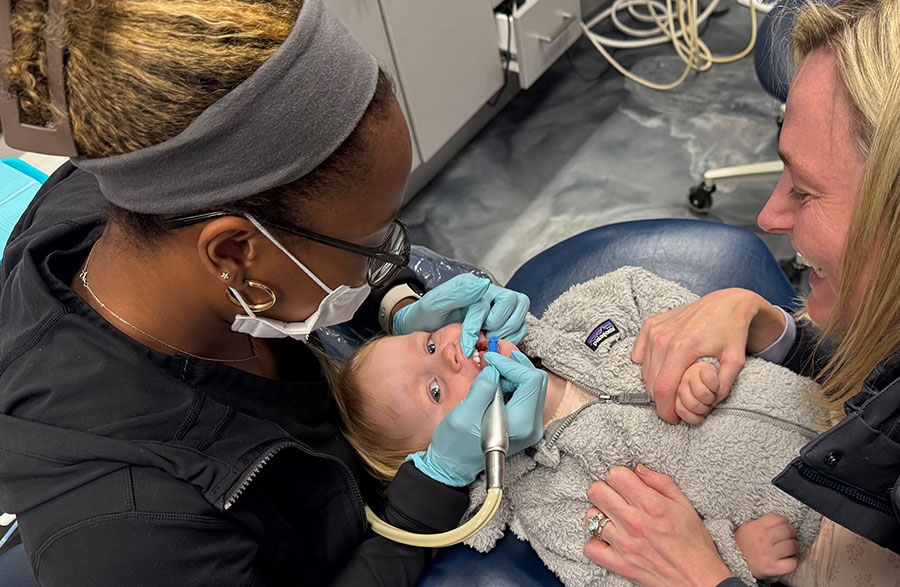
In many cases, your pediatrician will recommend a pediatric dental evaluation in the newborn period, especially if the tooth is present at birth, appears loose, or feeding is painful.
At the visit, the dentist typically checks:
- Stability of the tooth (how mobile it is)
- Whether it is a normal baby tooth or possibly an extra tooth
- Soft tissue health of the tongue and lips
- Feeding impact and any injury to parent or baby
Sometimes a dentist may recommend an X-ray, but with newborns that decision is individualized. Often, a careful exam and history go a long way.
What dentists usually recommend
Most natal and neonatal teeth are managed with a “watch and protect” approach. Recommendations depend on the tooth’s stability and whether it is causing harm.
1) Leave it and monitor
If the tooth is stable and not causing injury, many dentists recommend leaving it alone. Some babies keep the tooth and it becomes part of their normal primary set.
2) Smooth or cover sharp edges
If the tooth is stable but sharp, a dentist may be able to gently smooth the edge to reduce tongue and nipple trauma. In certain cases, they may discuss a protective coating. The goal is simple: reduce friction while keeping the tooth if it is safe to keep.
3) Support feeding while everyone heals
When nipples are damaged or baby’s tongue is sore, a short-term plan might include lactation support, adjusted positioning, and sometimes temporary pumping while healing, depending on your situation and your clinician’s advice.
When removal is considered
Extraction is not the default, but it does come up in specific scenarios. Dentists typically consider removing a natal or neonatal tooth when:
- The tooth is very loose and poses a safety risk
- It is causing ongoing tongue injury that does not improve with smoothing or conservative steps
- Feeding is significantly affected and other measures have not worked
- The tooth appears to be extra (supernumerary) and could interfere with normal teeth later
If extraction is recommended, your dentist will walk you through pain control, bleeding precautions, and aftercare.
One practical detail: because very young infants can have bleeding risk if they did not receive vitamin K at birth, clinicians often confirm your baby’s vitamin K status and overall bleeding risk before removing a tooth. Many babies receive vitamin K routinely, but not all do.
Gentle mouth care
You do not need to scrub a newborn tooth. For most babies, simple is best:
- Wipe the gums and tooth gently with a clean, damp gauze or soft cloth once a day or after messy feeds.
- Avoid aggressive brushing or firm rubbing over a tooth that might be mobile.
- If milk residue builds up, a gentle wipe is enough. If you notice redness, swelling, or a worsening sore, call your clinician.
What you can do right now
- Take a clear photo of the tooth in good light to track changes.
- Check for sores under the tongue once a day, gently, without rubbing.
- Get feeding help early if nursing hurts. Pain is information, not a parenting grade.
- Schedule evaluation with your pediatrician and ask if a pediatric dentist visit is recommended this week.
When to call urgently
Seek urgent medical guidance if you notice any of the following:
- The tooth becomes much looser or looks like it could fall out
- Baby has choking, gagging, or coughing episodes that worry you
- There is bleeding from the gum that does not stop
- Baby is not feeding well, has fewer wet diapers, or seems unusually sleepy
- A mouth sore is getting worse or baby seems in significant pain
If you are sitting there thinking, “I cannot tell if this is a big deal,” that is exactly when to call. You deserve a calm, clear answer from someone who can see your baby in person.
The bottom line
Natal teeth look dramatic, but most of the time they are a manageable early milestone, not an emergency. The key steps are to protect feeding, watch for traumatic tongue injury, and take looseness seriously. With a quick pediatric and dental check, most families can move from “What on earth?” to “Okay, we have a plan” in a matter of days.
Note: This article is for education and cannot replace medical advice for your child. If you are concerned, call your pediatrician.