Newborn Jaundice: Signs, Causes, and When to Worry

Sarah Mitchell
Sarah Mitchell is a Registered Pediatric Nurse and a mother of three who has spent over a decade helping families navigate the beautiful, chaotic early years of childhood. She combines evidence-based medical knowledge with real-world parenting experience to offer practical, compassionate advice. At Awesome Parent, Sarah's mission is to help exhausted parents find solutions, trust their instincts, and finally get some sleep.
Newborn jaundice can be one of those “Is this normal?” moments that hits hardest at 2 or 3 AM, when your baby looks a little more yellow under the lamp and your brain starts writing disaster stories.
Take a breath with me. Jaundice is extremely common, especially in the first week of life. Most of the time it is temporary and harmless. That said, there are situations where jaundice needs quick medical attention. This guide will help you spot it, understand why it happens, and know exactly when to call your baby’s clinician.

What is newborn jaundice?
Jaundice is the yellow coloring of a baby’s skin and the whites of the eyes caused by a buildup of bilirubin. Bilirubin is made when the body breaks down old red blood cells. The liver processes bilirubin and sends it into bile, which moves into the intestine and is removed mostly in stool (and a little in urine). Newborns, especially in the first days of life, are still ramping up that system.
So jaundice is not an infection, and it is not something you “caught.” It is a sign that bilirubin is higher than usual.
What causes jaundice in newborns?
1) Normal physiological jaundice
This is the most common type. It happens because newborns:
- Have more red blood cells to break down after birth
- Have an immature liver that clears bilirubin more slowly
- May poop less in the first days, so bilirubin leaves the body more slowly
Typical timing: starts after the first 24 hours of life, peaks around days 3 to 5, then gradually improves.
2) Breastfeeding jaundice (early feeding jaundice)
This isn’t about breast milk being “bad.” It usually means baby is not yet taking in enough milk volume in the first days, which can lead to fewer stools and less bilirubin leaving the body.
Typical timing: days 2 to 5, often improving quickly once feeding and milk transfer improve.
3) Breast milk jaundice
This is a different pattern. Some breastfed babies have mild jaundice that lasts longer. The exact “why” is not fully settled, but suspected mechanisms include a bit more bilirubin being reabsorbed from the intestines (increased enterohepatic circulation) and slightly slower bilirubin processing in the liver. Babies otherwise look well and feed well.
Typical timing: begins later (often after day 4 or 5), can linger for a few weeks, and is usually harmless, but should still be monitored by your clinician.
4) Blood type incompatibility or increased red blood cell breakdown
Sometimes babies break down red blood cells faster than usual, which raises bilirubin. Common examples include:
- ABO incompatibility (mom is type O and baby is A or B)
- Rh incompatibility (much less common now with prevention during pregnancy)
- G6PD deficiency (more common in certain families and backgrounds)
- Bruising or cephalohematoma (a scalp bruise from delivery can increase bilirubin as blood breaks down)
5) Less common medical causes
These are rarer, but important, especially if jaundice is early, severe, or persistent:
- Infection
- Thyroid issues
- Liver or bile flow problems (cholestasis), including biliary atresia
Signs of newborn jaundice
Jaundice often shows up first on the face and then can move down the body as bilirubin rises.
What you might notice
- Yellow tint to the skin, especially on the face or chest
- Yellowing in the whites of the eyes
- Baby is sleepier than usual or harder to wake for feeds
- Poor feeding or fewer wet diapers
Many newborns are sleepy in general, so the bigger clue is a change from their usual pattern, like suddenly too sleepy to eat well.

How to check for jaundice at home
Home checks are helpful, but they do not replace bilirubin testing when it is needed. Visual checks can be misleading, especially under indoor lights or with different skin tones. Testing is the only way to know the level.
Try this simple skin check
- Use natural daylight near a window if possible.
- Gently press a fingertip on your baby’s forehead or nose for a second, then release.
- If the blanched skin looks yellow (not just pink), that can suggest jaundice.
Look at the whole baby, not just the face
Some babies look a bit yellow on their face but are fine overall. If you notice yellowing spreading down toward the belly, thighs, or legs, let your clinician know. It can correlate with higher bilirubin, but it is not a reliable “number,” so a bilirubin check may be needed.
Watch output and feeding
These two details matter a lot because low intake and dehydration can raise bilirubin.
- Wet diapers: by day 4 to 5, many babies have about 6 or more wet diapers in 24 hours.
- Stools: stools should transition from black meconium to greener stools, then to yellow seedy stools in many breastfed babies.
- Feeding: your newborn should be waking to feed regularly and actively sucking and swallowing.
If your baby is consistently too sleepy to feed well, that is a “call today” situation.
Normal vs concerning jaundice
Here is the practical way I explain it in clinic: timing and how your baby is acting matter as much as the color.
More likely to be normal
- Yellowing starts after the first 24 hours
- Baby feeds well and has appropriate wet and dirty diapers
- Baby is alert at least some of the time and can be woken for feeds
- Your clinician is following bilirubin levels when needed
More concerning
- Yellowing appears in the first 24 hours
- Baby is very sleepy, difficult to wake, or not feeding well
- Jaundice is spreading quickly or looks deep yellow or orange
- Baby has fewer wet diapers or signs of dehydration (very dry mouth, markedly decreased wet diapers, sunken soft spot)
- Baby seems ill: fever, breathing trouble, persistent vomiting, unusual limpness
When to call and when to go now
If you remember nothing else, remember this: jaundice is common, but it is also time-sensitive. It is always okay to call for reassurance and a bilirubin check.
Call your baby’s clinician today if:
- Yellowing is getting worse or moving down the body
- Your baby is not feeding well or you cannot keep them awake to feed
- Your baby has fewer wet diapers than expected for age
- Jaundice is still noticeable beyond 2 weeks in a full-term baby (ask if a direct or conjugated bilirubin level should be checked)
- You were told baby has risk factors (prematurity, significant bruising, blood type incompatibility, sibling who needed treatment, family history of G6PD deficiency)
Seek urgent care now if:
- Your baby is hard to wake, very floppy, or not responding normally
- Your baby has a fever (for babies under 3 months, many clinics use 100.4°F or 38°C measured rectally as a threshold to seek immediate guidance)
- Your baby has breathing difficulty, persistent vomiting, or looks acutely ill
- Your baby has a high-pitched, unusual cry, a very weak or poor suck, arching of the back or neck, or abnormal movements
These symptoms are not typical “just jaundice” findings and should be evaluated promptly.
How jaundice is diagnosed
Many babies have bilirubin screening around the time of hospital discharge. If you go home early, your baby may need an earlier follow-up check. This timing matters because bilirubin often peaks around days 3 to 5.
Clinicians can estimate bilirubin with a device placed on the skin (a transcutaneous bilirubin check), but if the number is high or close to treatment level, they usually confirm with a blood test.
Whether a bilirubin level is “too high” depends on your baby’s:
- Age in hours (not days)
- Gestational age (preterm vs full-term)
- Risk factors (like blood incompatibility or G6PD deficiency)
That is why two babies can have the same number but different recommendations. Clinicians use AAP age-in-hours charts to guide follow-up and phototherapy decisions.
Treatment options
Feeding support
For many babies, the best first step is improving intake:
- Feed frequently, often 8 to 12 times in 24 hours in the early days
- Get hands-on lactation support if breastfeeding is painful or baby seems ineffective
- Discuss supplementation with your clinician if baby is not transferring milk well or weight loss is concerning
Phototherapy
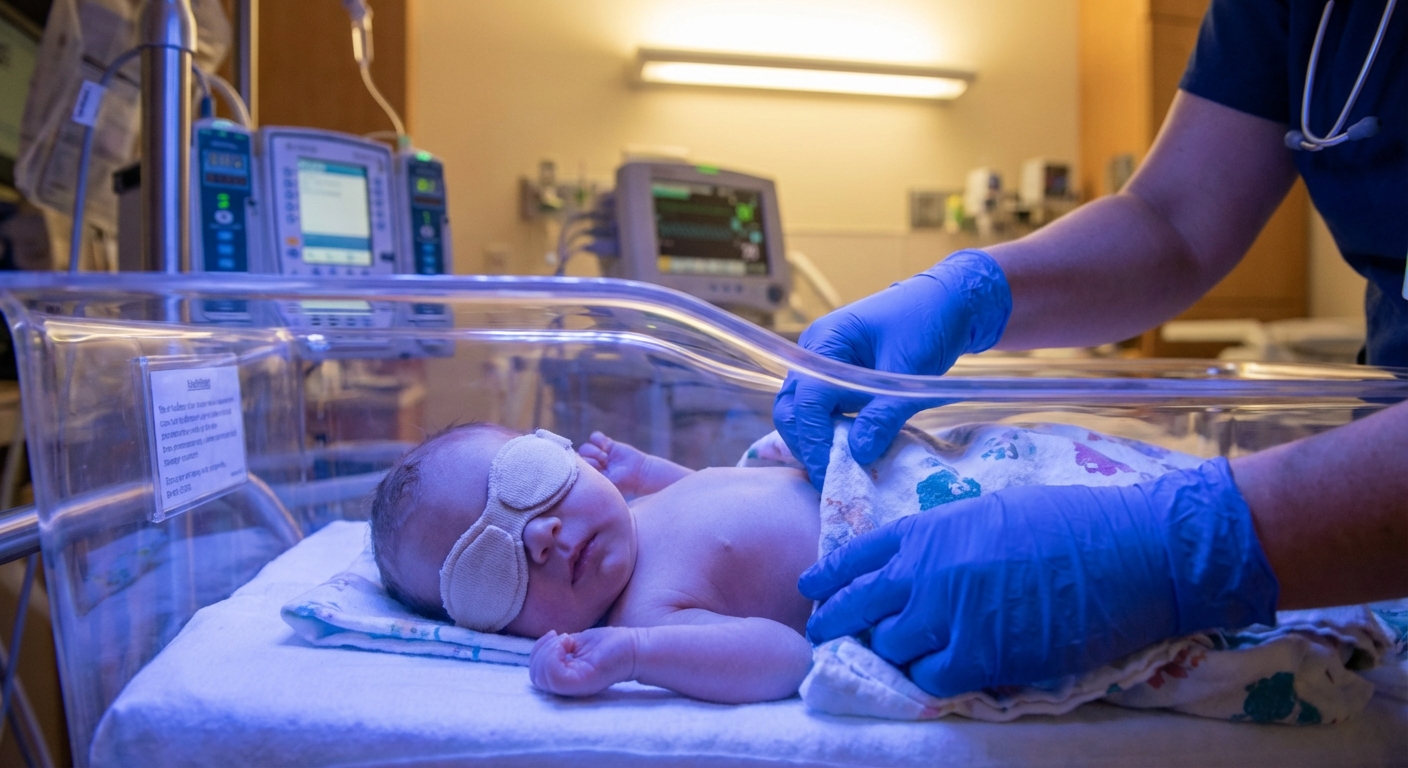
If bilirubin reaches treatment thresholds, your baby may need phototherapy. This is a special blue light that helps break down bilirubin so the body can get rid of it more easily.
Phototherapy can be done:
- In the hospital
- Sometimes at home with clinician guidance and the right equipment
About sunlight
You may hear, “Put the baby in sunlight.” There is a kernel of truth here: light can help break down bilirubin. But direct sun exposure is not a safe or reliable treatment plan for newborns.
What I recommend instead
- Do not place your newborn in direct sun outdoors. Sunburn and overheating can happen quickly.
- If your clinician says your baby’s jaundice is mild and you are monitoring at home, you can use indirect daylight indoors. For example, sitting near a bright window while baby is clothed and comfortable.
- Most importantly, focus on feeding and following up as directed. If bilirubin needs treatment, phototherapy is the proven option.
Risk factors
Some babies are more likely to develop higher bilirubin levels. Let your clinician know if any of these apply:
- Born before 38 weeks
- Jaundice in the first 24 hours
- Significant bruising or a scalp bump from delivery
- Exclusive breastfeeding with early feeding difficulties
- A sibling who needed phototherapy
- Family history of G6PD deficiency
Special warning signs
Most jaundice is the common newborn kind. But I always want parents to know the signs that point to a different problem, especially if jaundice is lasting.
Call today if you notice:
- Pale, chalky, or white stools
- Very dark urine (not just a darker yellow diaper, but urine that looks tea-colored)
- Jaundice that is not improving, especially beyond 2 weeks in a full-term baby
These can be signs of cholestasis (a bile flow problem). This is one of those times where asking, “Did we check a direct or conjugated bilirubin?” is exactly the right question.
Quick home checklist
- Color: Does yellowing seem to be spreading beyond the face?
- Feeding: Can you wake baby enough to feed effectively?
- Diapers: Are wet diapers increasing day by day?
- Behavior: Does baby seem unusually sleepy, floppy, or unwell?
- Timing: Did yellowing start before 24 hours, or is it lasting beyond 2 weeks?
If any of those answers worry you, call your baby’s clinician. You are not “overreacting.” You are doing what good parents do: noticing patterns and getting help early.
Frequently asked questions
Is jaundice painful?
Jaundice itself is not painful. But if bilirubin gets very high, it can be dangerous, which is why monitoring and timely treatment matter.
Can jaundice cause brain damage?
Severe, untreated high bilirubin can lead to a rare but serious condition. The good news is that with modern screening, follow-up, and treatment, this outcome is uncommon. The key is not ignoring worsening jaundice or a baby who is too sleepy to eat.
My baby looks yellow under certain lights only. Does that count?
Indoor lighting can play tricks. Check near a window in natural light, and pay attention to feeding and diaper output. If you are unsure, a quick bilirubin check is often reassuring and sometimes essential.
How long does newborn jaundice last?
Physiological jaundice often improves over 1 to 2 weeks. Breast milk jaundice can last longer, sometimes several weeks, while the baby otherwise thrives. Any jaundice lasting beyond 2 weeks in a full-term baby should be discussed with your clinician, and it is reasonable to ask whether a direct or conjugated bilirubin was checked.
A final word from a pediatric nurse mom
If your newborn has jaundice, you did not cause it. And you do not have to “wait and see” alone in your living room, squinting at your baby’s skin and trying to decide if it is lemony or just the lamp.
Call your baby’s clinician if you are worried. This is one of those newborn issues where a simple check and a clear plan can give you back something you desperately need in the early days: peace of mind.