
A “refer” result is not a diagnosis. Here’s why newborn hearing screens flag babies, what repeat tests and diagnostic ABR involve, and how to support d...
Preauricular Pits and Ear Tags in Newborns

Sarah Mitchell
Sarah Mitchell is a Registered Pediatric Nurse and a mother of three who has spent over a decade helping families navigate the beautiful, chaotic early years of childhood. She combines evidence-based medical knowledge with real-world parenting experience to offer practical, compassionate advice. At Awesome Parent, Sarah's mission is to help exhausted parents find solutions, trust their instincts, and finally get some sleep.
There are few things that can spike a brand-new parent’s anxiety faster than finding a tiny “hole” near your baby’s ear or a little flap of skin that looks like it “shouldn’t be there.” Then Grandma leans in, squints, and says something like, “Oh wow, what is that?” And suddenly you’re mentally drafting a late-night search query.
Take a breath. In most cases, preauricular pits and ear tags are common, harmless variations in how the ear formed during early pregnancy. They are usually a cosmetic finding, not an emergency. Below is what they are, how to keep the area clean, the infection signs we actually worry about in clinic, and when pediatricians decide to check anything extra.
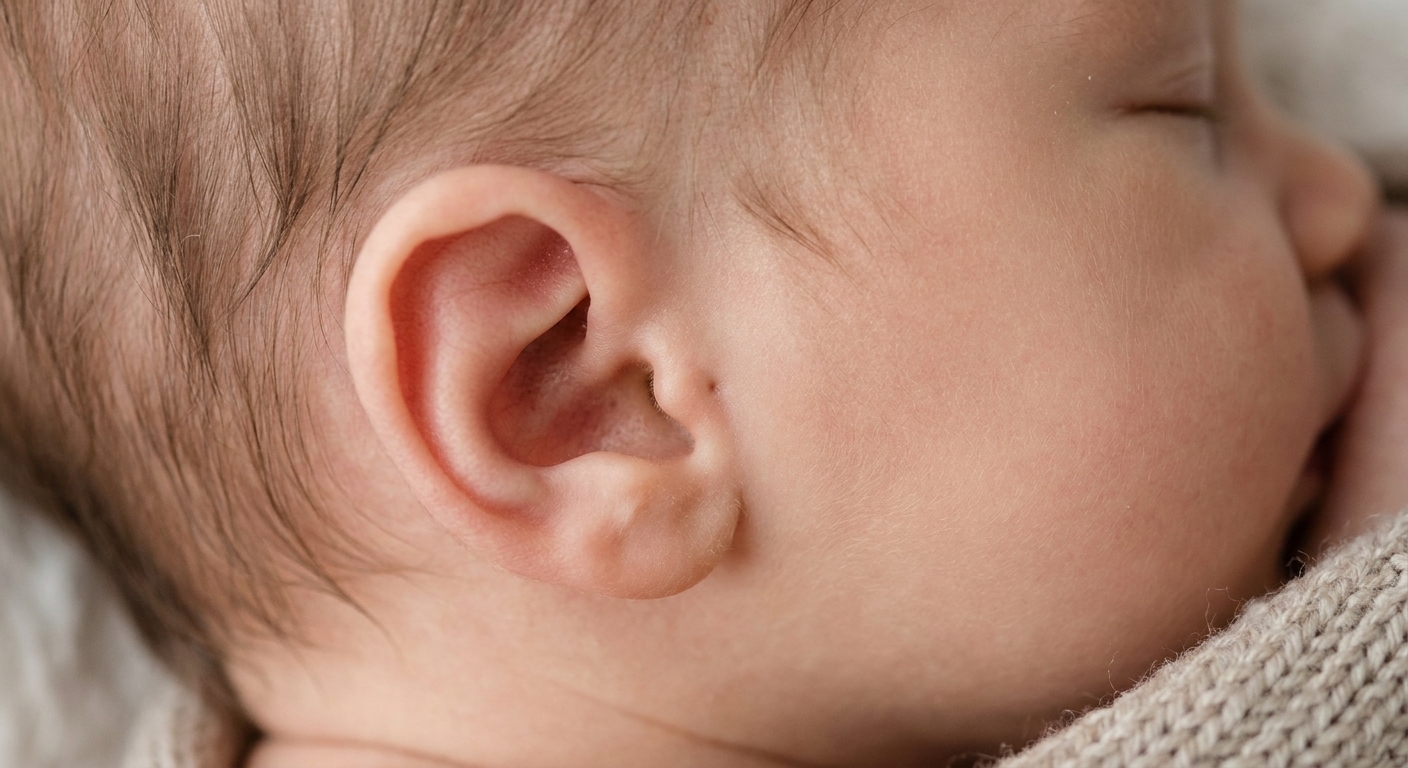
What are preauricular pits?
A preauricular pit is a small indentation or pinpoint opening in the skin just in front of the ear, often near where the upper ear meets the face (near the root of the helix). Some look like a tiny dimple. Some look like a little “pore.”
Preauricular pits happen when the ear structures are forming in early development and a small tract (a narrow tunnel under the skin) remains. Many children never notice it again after the newborn stage.
What it can look like
- A tiny dot or dimple in front of one ear
- Sometimes on both sides (bilateral)
- Usually not red, not swollen, and not tender
- Sometimes you can see a little dried skin or lint collect in the crease nearby
What are ear tags?
An ear tag (also called an accessory tragus by some clinicians) is a small piece of skin, sometimes with a bit of cartilage inside, located near the front of the ear or along the cheek close to the ear. Think: a tiny, soft bump or flap that can look like a mini “extra piece” of ear.
Ear tags are also usually benign and mainly cosmetic. Some families choose removal later for appearance or to avoid repeated irritation from rubbing or clothing, but many leave them alone.

Do you need to clean them?
Routine gentle cleaning is enough. You do not need special solutions, and you do not need to “open” anything up.
Simple cleaning
- During baths: Wash around the outer ear with warm water and a mild baby cleanser.
- Rinse and pat dry: Moisture trapped in skin folds can irritate sensitive skin.
- For visible crust: Use a soft, damp washcloth to wipe the area.
What not to do
- Do not dig into the pit with a cotton swab, fingernail, or tool. If there is a tract under the skin, poking can irritate it and raise infection risk.
- Do not squeeze to “see if anything comes out.” (Yes, the temptation is real.)
- Avoid alcohol or hydrogen peroxide unless your pediatrician specifically recommends it for a short period. These can be harsh and delay healing if the skin gets irritated.
If you cannot clean it by gently wiping what you can see on the surface, it does not need to be cleaned more aggressively. “Less is more” is the rule here.
Normal vs infection signs
Most pits and tags never cause a problem. The main concern with a preauricular pit is that the small tract under the skin can occasionally get infected, similar to how a pierced ear or an ingrown hair can get irritated.
Normal
- No redness
- No swelling
- Baby does not react when you touch nearby skin
- The area looks the same day to day
Call your pediatrician if
- Redness spreading around the pit or along the front of the ear
- Swelling or a new lump near the pit
- Warmth of the skin compared with the other side
- Tenderness (baby cries when you touch the area)
- Drainage that is yellow, green, thick, or foul-smelling
- Recurrent crusting that keeps coming back with redness
Get urgent care today if
- Any fever in a young infant (many practices treat 100.4°F / 38°C or higher in babies under 3 months as urgent, follow your pediatrician’s guidance)
- Rapidly increasing swelling, or the ear or face looks noticeably asymmetric
- Baby is very fussy, not feeding well, or seems unusually sleepy
- You see redness that is quickly spreading
Infections are treatable. Depending on what the area looks like, your clinician may recommend warm compresses, an oral antibiotic, and close follow-up. If there is fluctuance or an abscess (a pocket of pus), drainage and ENT involvement are sometimes needed.
What doctors check
In the newborn period and early well-child visits, your pediatric clinician is doing a head-to-toe exam, including:
- Ear shape and placement
- Skin findings like pits or tags
- Hearing screening results (most babies have newborn hearing screening in the hospital or shortly after)
- Overall growth and physical exam for any other findings that would change next steps
What parents often do not see is the decision-making happening quietly in the background. If your baby has an isolated pit or tag and everything else looks typical, the plan is usually simple: document it, watch for infection, and move on with life.
Do they mean something else?
Most of the time, no. Isolated preauricular pits and tags are common and benign.
That said, because ears develop around the same time as a few other body systems, clinicians are trained to look for patterns. This does not mean your baby has a syndrome. It means we do a careful exam and ask a few questions, especially if there are other facial or craniofacial differences noted on exam.
Hearing
Nearly all newborns receive a routine newborn hearing screen. If your baby passed and has an isolated pit or tag, many clinicians do not do anything additional beyond routine hearing and speech-language surveillance at well visits.
If your baby did not pass the newborn hearing screen, has bilateral ear findings, a family history of childhood hearing loss, or other facial differences, your pediatrician may recommend repeat testing or referral to audiology.
Kidneys
You may hear, “Ear pits mean kidney problems.” Here’s the calmer, more accurate version: in certain situations, ear anomalies can be associated with kidney differences, and clinicians consider whether a renal ultrasound is appropriate.
In many guidelines and common practice patterns, a baby with an isolated preauricular pit or small ear tag and an otherwise normal exam does not need routine kidney imaging.
Your pediatrician is more likely to consider additional evaluation if there are red flags such as:
- Other congenital differences noted on exam
- A family history of congenital hearing loss or kidney anomalies
- Multiple ear anomalies or unusual ear shape or position
- Concerns found on prenatal ultrasound
If you are unsure whether your baby’s finding is “isolated,” ask at the next visit: “Does this look like a simple isolated pit or tag to you, or do you recommend any additional screening?”
If it drains
Some preauricular pits occasionally produce a small amount of clear or whitish material. That can be normal, especially if there is trapped skin debris in the tract. The key is the whole picture.
Even if your baby seems fine, check in with your pediatrician if you see:
- New or recurring drainage
- Any odor
- Any redness or swelling
Do not apply topical antibiotic ointment into the pit unless your clinician recommends it. The opening is tiny, and we do not want to irritate the skin or trap moisture.
Will it go away?
Preauricular pits
The pit itself usually stays. Most children never need any treatment. If a pit becomes repeatedly infected, an ENT specialist may recommend surgical removal of the pit and tract once the infection is fully resolved.
Ear tags
Ear tags do not typically disappear on their own. If families choose removal, it is often for cosmetic reasons or because the tag catches on clothing or gets irritated. The timing and method depend on size, whether cartilage is present, and your clinician’s recommendation. This is generally not urgent.
The big picture is reassuring: most kids with pits or tags do just fine, and these findings do not affect growth or development.
Talking to family
If you have a well-meaning relative spiraling, here are a few phrases that can help keep the temperature down:
- “The pediatrician says it’s a common normal variant. We’re just watching for redness or swelling.”
- “Baby passed the newborn hearing screen, and everything else looks great.”
- “If it ever looks infected, we’ll call right away. Otherwise it’s just part of their ear.”
And if you want a little gentle humor: “They came out with a bonus feature.”
Quick checklist
- Clean gently with water during baths, then pat dry.
- Do not poke or squeeze a preauricular pit.
- Watch for infection: redness, swelling, warmth, tenderness, or pus-like drainage.
- Ask at well visits if it looks isolated and whether any extra hearing follow-up is needed.
- Seek urgent care for fever in a young infant or rapidly spreading redness or swelling.
If you are worried, call your baby’s pediatrician and describe your baby’s age, whether there is redness, swelling, or drainage, and how your baby is acting and feeding. They can tell you whether it can wait for a routine visit or needs same-day care.
Sarah Mitchell
Sarah Mitchell is a Registered Pediatric Nurse and a mother of three who has spent over a decade helping families navigate the beautiful, chaotic early years of childhood. She combines evidence-based medical knowledge with real-world parenting experience to offer practical, compassionate advice. At Awesome Parent, Sarah's mission is to help exhausted parents find solutions, trust their instincts, and finally get some sleep.