Signs of Lazy Eye in a Toddler

Sarah Mitchell
Sarah Mitchell is a Registered Pediatric Nurse and a mother of three who has spent over a decade helping families navigate the beautiful, chaotic early years of childhood. She combines evidence-based medical knowledge with real-world parenting experience to offer practical, compassionate advice. At Awesome Parent, Sarah's mission is to help exhausted parents find solutions, trust their instincts, and finally get some sleep.
If you are here because something about your toddler’s eyes feels “off,” take a breath. You are not overreacting, and you are not alone. In pediatrics, parents bring up eye concerns all the time because the signs can be subtle, and toddlers are not exactly known for sitting still for a vision test.
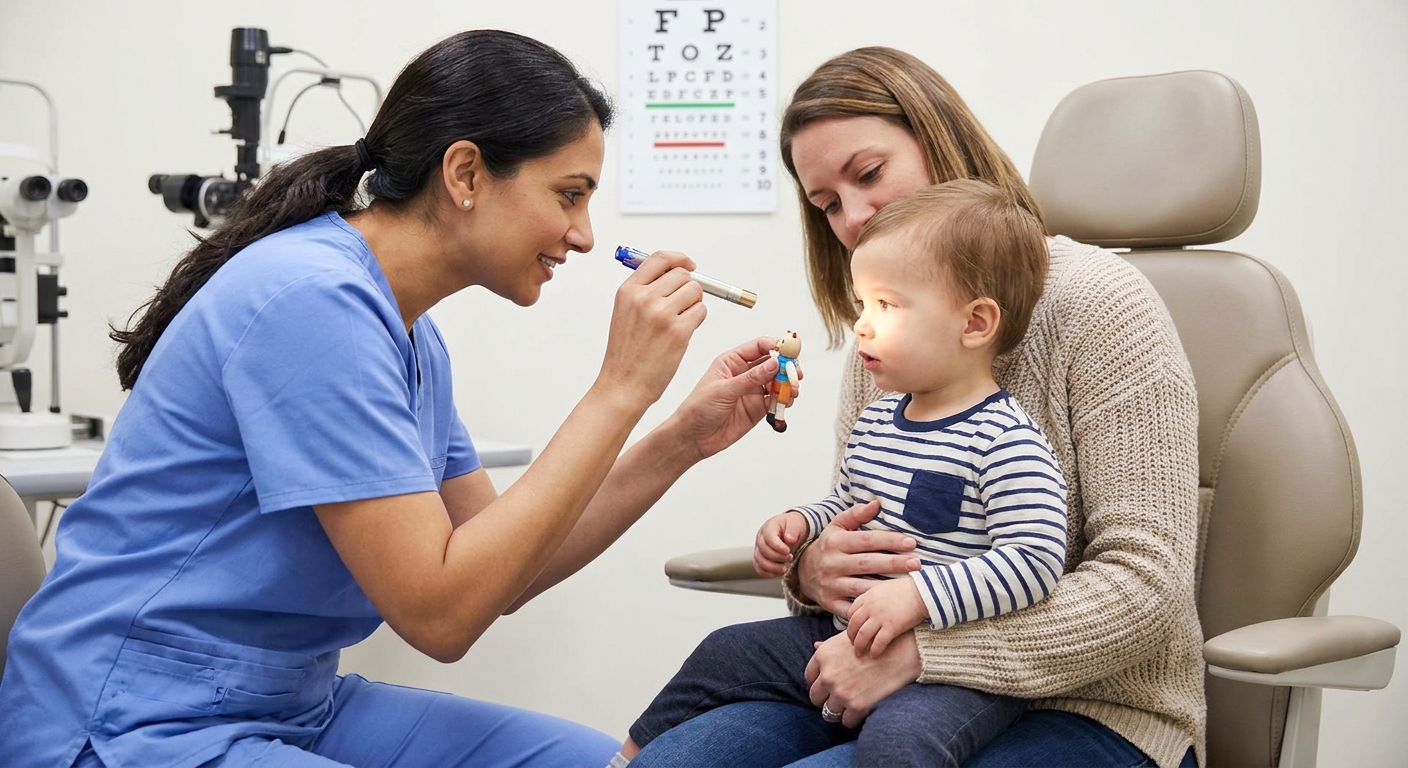
“Lazy eye” is the common term for amblyopia. It means one eye is not developing normal vision because the brain is favoring the other eye. The good news is that amblyopia is often very treatable, especially when caught early.
What “lazy eye” really means
Lazy eye is not usually a problem with the eye itself being “weak.” It is a visual development issue, meaning the brain is not processing input equally from both eyes.
If the brain receives a blurrier image from one eye, or if the eyes are not aligned, it may start ignoring the input from that eye. Over time, that eye’s vision development falls behind.
Amblyopia often develops because of one of these:
- Eye turn (strabismus): one eye drifts in, out, up, or down.
- Different prescription between eyes (anisometropia): one eye is more farsighted, nearsighted, or has more astigmatism.
- Something blocking vision: a droopy eyelid, cataract, or other issue that keeps a clear image from forming.
Quick clarity: strabismus (an eye turn) can cause amblyopia, but not every eye turn means amblyopia is present. And amblyopia can exist even when the eyes look straight.
Signs of lazy eye (amblyopia) in toddlers
Some toddlers with amblyopia show clear signs. Others compensate so well that the only clue is a failed vision screening. Here are the signs worth paying attention to.
1) One eye that drifts or crosses
If you notice an eye turning in or out, even sometimes, it is worth discussing with your pediatrician or a pediatric eye doctor. Intermittent drifting can be more noticeable when your child is tired, sick, or daydreaming.
2) Head tilt or face turn
Toddlers are brilliant little problem-solvers. If turning their head helps them see more clearly, they will do it.
A consistent head tilt, chin up or down posture, or always looking from one side can be a sign of an eye alignment issue or a vision difference between eyes.
3) Squinting, closing one eye, or covering an eye
If your toddler closes one eye in bright light, while focusing on something, or when watching TV, they may be trying to reduce double vision or blur.
4) Frequently bumping into things on one side
This one is not always vision, because toddlers are basically tiny motion machines, but a pattern matters. If your child regularly misjudges steps or doorways, or reaches for objects and misses, vision deserves a look.
5) Poor depth perception
Depth perception relies on both eyes working together. If your toddler seems unusually hesitant on stairs, frequently spills when trying to place a cup on a table, or struggles with simple catch and throw beyond what feels typical for their age, it can be a clue.
6) Eye strain behaviors
Toddlers cannot tell you, “My left eye is blurry,” but they can show you by:
- Rubbing eyes often (especially during close-up play)
- Getting irritable with puzzles, books, or coloring
- Short attention span for visual tasks that used to be fine
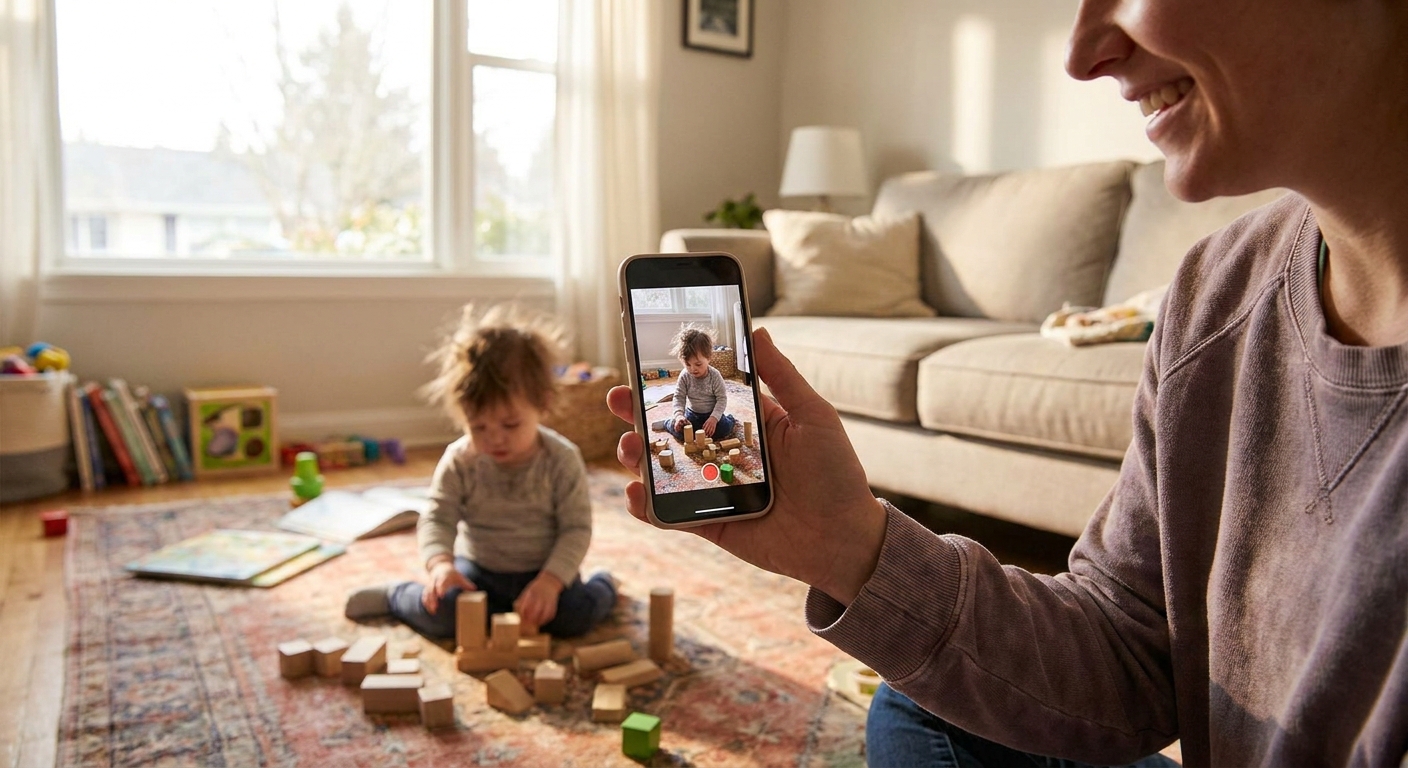
7) A noticeable difference in photos
Parents often notice something first in pictures. Watch for:
- One eye that looks consistently off-center
- Different sized pupils (needs prompt evaluation)
- Uneven “red reflex” in flash photos, where one eye reflects differently
Important note: flash photos are not a diagnosis tool, but consistent differences are a reason to get checked.
What is normal at this age?
Newborns can look a little cross-eyed at times, and mild misalignment can be normal in early infancy.
By around 4 to 6 months, the eyes are typically aligned most of the time. If you are seeing frequent drifting in a toddler, a consistent head tilt, or other signs above, it is not something to “wait out” until kindergarten. Early evaluation is the safest move.
At-home checks (not a diagnosis)
You do not need fancy tools to gather helpful information for your pediatrician or eye doctor. Keep it low-pressure and playful.
Try a simple cover test game
While your toddler looks at a favorite sticker or toy across the room:
- Cover one eye for 2 to 3 seconds, then uncover.
- Repeat on the other side.
What you are watching for: if the uncovered eye “jumps” to refocus, that may suggest the eyes are not aligned.
What you are watching for emotionally: if covering one eye causes a big protest, especially consistently when covering the same eye, it can suggest the uncovered eye does not see as well because your child suddenly has to rely on it.
Small caution: toddler behavior can be inconsistent, and this is not diagnostic. It is simply a way to notice patterns to share with your clinician.
Look at old photos
Scroll through pictures from the last few months. Do you notice a consistent eye turn, head tilt, or one eye that looks different in multiple settings? Patterns help clinicians.
If anything worries you, jot down notes and bring them to the appointment. You are not being “extra.” You are being thorough.
When to call
If you notice any of the following, schedule an evaluation soon:
- An eye that turns in or out regularly, even if it comes and goes
- Frequent squinting, closing one eye, or head tilting
- Concern about vision or depth perception compared with peers
- A failed vision screening at daycare or the pediatrician’s office
Get urgent care the same day if you notice:
- A white or gray reflection in the pupil (leukocoria), in photos or in person
- Sudden eye crossing or a sudden change in eye position
- Eye pain, severe light sensitivity, or a very red eye
- Droopy eyelid that is new or worsening
Those signs are not “typical lazy eye” and need prompt medical attention. Leukocoria, for example, can be linked to conditions like cataract or other rare but serious eye problems that should be ruled out quickly.
What happens at the eye appointment
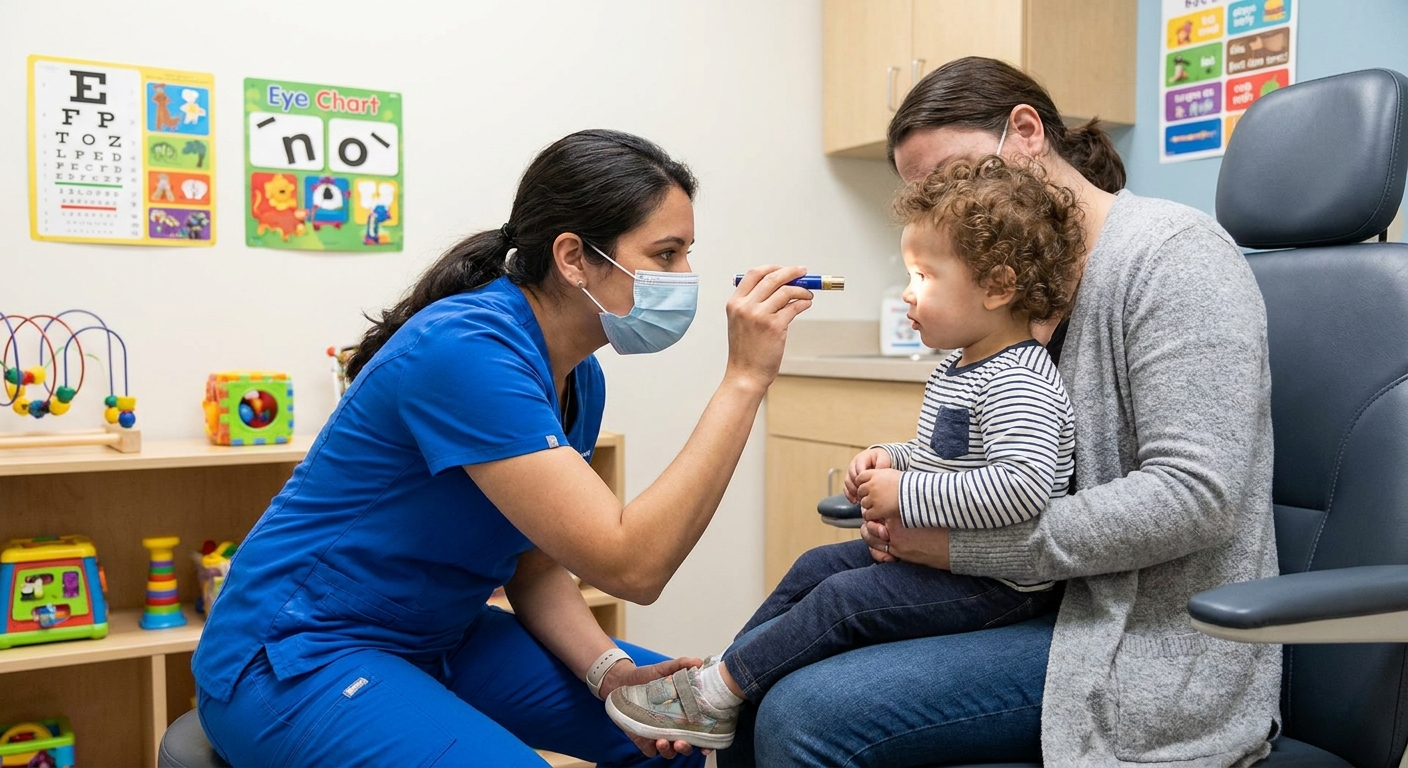
Most parents worry their toddler will not cooperate. Pediatric eye teams are extremely good at toddler-level communication, which mostly means quick games, bright targets, and a lot of patience.
Common parts of the visit include:
- Vision testing using pictures or matching games
- Alignment check (how the eyes work together)
- Refraction (checking for glasses needs), often after dilating drops
- Eye health exam to rule out anything blocking vision
Why early treatment matters
Toddlers’ brains are still building the “wiring” for vision. That flexibility is a huge advantage.
If amblyopia is treated early, the weaker eye often has a better chance to catch up because the brain is still learning how to use input from both eyes. This is also why doctors do not usually recommend a wait-and-see approach if there are ongoing signs.
Treatment options
Treatment depends on the cause, but the goal is the same: get the brain using both eyes properly and safely.
Glasses
If one eye is blurrier due to a prescription difference, glasses may be the first and sometimes the only step needed.
Patching
If the brain is strongly favoring one eye, the doctor may recommend covering the stronger eye for a set amount of time per day. This encourages the brain to use the weaker eye and build those visual pathways.
Atropine drops
Sometimes, a drop is used in the stronger eye to blur it temporarily, again encouraging use of the weaker eye. This can be an option for some families when patching is a battle.
Treating an underlying issue
If something is blocking vision, like a significant droopy lid or cataract, treatment focuses on fixing that problem first.
How long does treatment take?
It varies a lot. Some children improve with glasses alone over months. Others need patching or atropine for longer. Follow-ups are common because the plan is adjusted based on progress.
Patching and atropine should be used exactly as prescribed and monitored by the eye specialist. More is not always better, and your clinician will help you find the safest effective dose.
A gentle pep talk: patching can be emotionally intense for toddlers. It is also very normal for parents to feel guilty or overwhelmed. You are not harming your child by following a treatment plan. You are giving their vision the best chance to develop while the brain is still flexible.
Does lazy eye go away on its own?
Usually, no. Amblyopia is a development issue, and the brain tends to keep favoring the stronger eye unless we intervene. That is why early screening and early treatment are such a big deal.
Many children improve significantly with the right plan and consistent follow-through, even if progress is gradual.
FAQ parents ask at 3 AM
Can too much screen time cause lazy eye?
Screen time does not directly cause amblyopia. Lazy eye is typically related to alignment, focusing differences, or something blocking vision.
That said, heavy near work is more associated with myopia (nearsightedness) progression in some kids. And lots of close-up screen use can make existing focusing or eye teaming issues more noticeable.
If my toddler’s eye turns only when they are tired, is it still a problem?
It can be. Intermittent eye turns still deserve evaluation because they can affect how the brain uses each eye over time.
What if my pediatrician says it looks fine but I still feel worried?
Trust your instincts. Pediatricians do routine screening, but a pediatric optometrist or pediatric ophthalmologist has specialized tools for subtle issues. It is okay to ask for a referral or self-refer depending on your insurance.
Takeaway
If you suspect a lazy eye, you do not need to diagnose it at home. Your job is to notice patterns and get the right eyes on the problem, literally. Early evaluation is not alarmist. It is proactive, and it can make treatment simpler.
If you want a quick next step: call your pediatrician, ask about vision screening results, and request a referral to a pediatric eye specialist if you have any ongoing concern.
Medical note: This article is for general education and is not a substitute for medical advice. If you are worried about your child’s vision or eye appearance, contact your pediatrician or a pediatric eye care professional.