Signs of Lazy Eye in Toddlers

Sarah Mitchell
Sarah Mitchell is a Registered Pediatric Nurse and a mother of three who has spent over a decade helping families navigate the beautiful, chaotic early years of childhood. She combines evidence-based medical knowledge with real-world parenting experience to offer practical, compassionate advice. At Awesome Parent, Sarah's mission is to help exhausted parents find solutions, trust their instincts, and finally get some sleep.
If you have ever looked at your toddler and thought, “Wait, are their eyes lining up the same way?” you are not alone. In clinic, I saw plenty of parents who noticed something tiny on a photo or during story time and then spent the whole night spiraling on the internet. Let’s swap that spiral for a plan.
“Lazy eye” is the common term for amblyopia, which means reduced vision in one (or sometimes both) eyes because the brain and eyes did not build strong vision together during early childhood. The tricky part is that toddlers rarely complain because, to them, their vision feels normal. That is why spotting signs early matters so much.
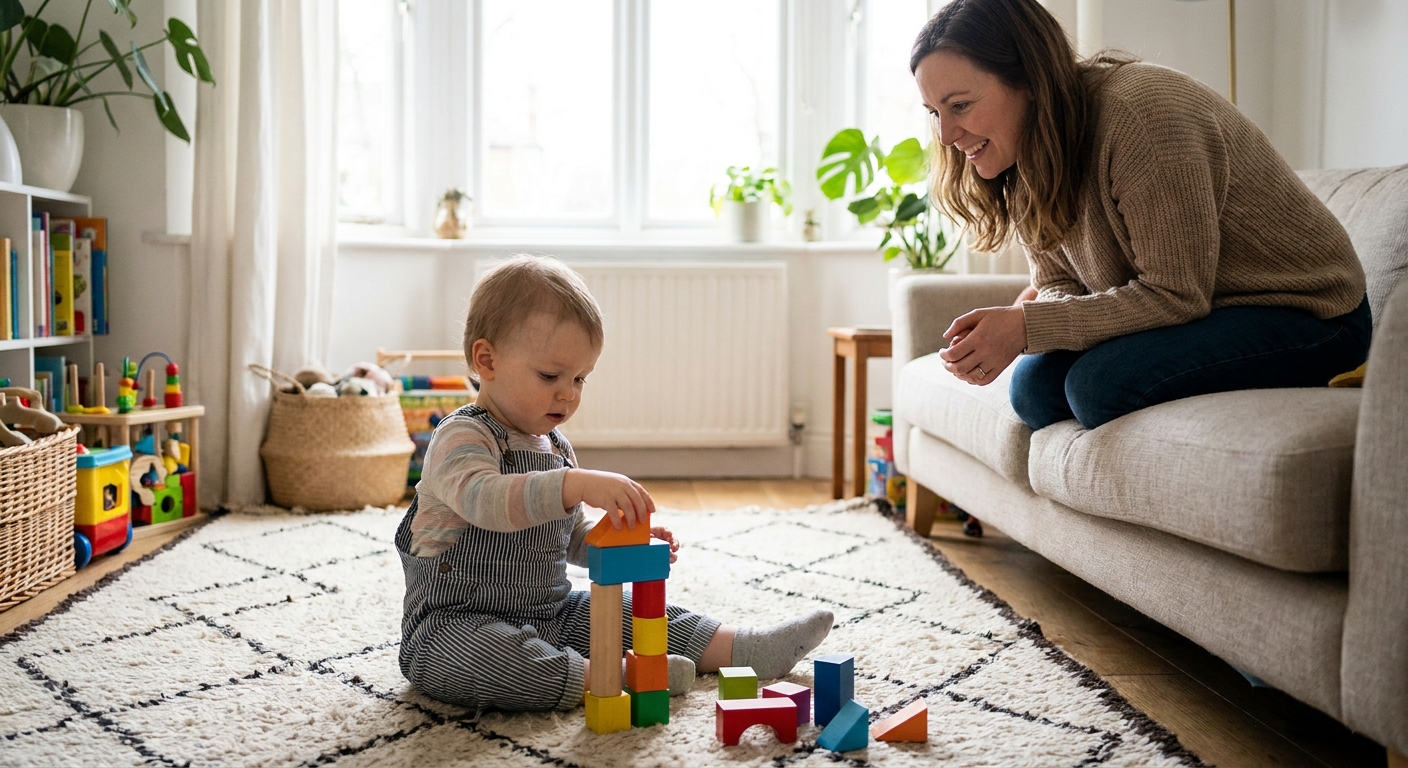
What “lazy eye” really means
Lazy eye is not usually an “eye muscle is lazy” problem. It is more of a brain-vision teamwork problem. If the brain gets a blurrier image from one eye, or the eyes are not aiming together, it may start ignoring the weaker or misaligned eye. Over time, that eye can fall further behind.
Amblyopia often happens because of one of these issues:
- Eyes that do not line up the same way (strabismus). One eye may turn in, out, up, or down.
- A big difference in prescription between eyes (anisometropia). One eye may be much more farsighted, nearsighted, or have more astigmatism.
- A high prescription in both eyes (sometimes called isoametropia). Even without a big left-right difference, both eyes can be blurry enough that vision does not develop well.
- Something blocking vision in one eye (less common), like a droopy eyelid (ptosis) or a cataract.
All of these can lead the brain to prefer one eye. And yes, it can happen even if your toddler’s eyes look “fine” at a quick glance.
Common signs of lazy eye in toddlers
Here are the most common clues parents notice at home. One sign alone does not confirm amblyopia, but patterns are worth checking out.
1) An eye that turns sometimes or often
You might notice one eye drifting inward or outward, especially when your child is tired, sick, or staring at something far away. Some toddlers have an intermittent eye turn that comes and goes. If you are seeing an eye drift after infancy (often after about 4 to 6 months of age), it is worth bringing up.
2) Frequent squinting, closing one eye, or tilting the head
If your toddler closes one eye in bright light, covers one eye to look at books, or consistently tilts their head to see, they may be trying to line things up to get a clearer picture.
3) Bumping into things on one side
Depth-perception issues can show up as extra clumsiness, misjudging steps, or difficulty catching a ball. Toddlers are clumsy by nature, so look for a noticeable pattern compared to their usual.
4) Complaints that are vague but consistent
Toddlers may not say “I can’t see,” but they may say things like:
- “My eye hurts” or “My head hurts,” especially after focusing
- “It’s blurry” or “I can’t see that”
- They lose interest quickly in puzzles, books, or drawing
These symptoms can have many causes. They are most meaningful when they show up alongside other vision signs on this list.
5) One eye looks different in photos
Parents often notice that the light reflection in one eye looks “off” in pictures, or one pupil looks white instead of red. Sometimes this can be a camera angle or lighting artifact. But a repeated white, gray, or yellow reflection (especially in multiple photos, or in person) should be checked promptly to rule out causes like cataract and, rarely, retinoblastoma.
6) Poor tracking or trouble focusing up close
If your toddler seems to lose their place easily when following moving objects, or struggles to locate small items on the floor, it can be a clue. This is especially relevant if it is new or clearly one-sided.
Signs that can look like lazy eye but are not
Two very common situations can fool even attentive parents:
Pseudostrabismus
Some toddlers look cross-eyed because of a wide, flat nasal bridge or prominent eyelid folds. The eyes are actually aligned, but the skin shape makes it look otherwise. A simple eye exam can tell the difference.
Occasional eye wandering in babies
In early infancy, brief eye drifting can be normal. Misalignment that is persistent or frequently recurring after about 4 to 6 months is worth evaluating.
Quick at-home checks
These are gentle, low-stress things you can try to gather observations for your pediatrician or eye doctor. They are not a diagnosis, and they are not a replacement for an exam.
Watch the light reflection
In a well-lit room, stand a few feet away and hold a small light (a phone flashlight on the lowest setting works) so it shines toward your child’s face. Look at where the tiny reflection lands on each eye. They should look similar side-to-side.
Safety note: keep it brief, avoid very bright settings, and do not shine the light for long.
Notice what happens when one eye is covered
While your child is looking at a favorite picture or toy, gently cover one eye for a second or two, then switch. If your toddler strongly objects to covering one eye but not the other, it can suggest the uncovered eye is doing most of the work. Keep it brief and playful.
Track patterns, not one-off moments
Write down what you see for a few days:
- Which eye drifts, and when
- Head tilt direction
- Any squinting in bright light
- Clumsiness changes
This kind of simple “parent data” is surprisingly useful in an exam room.
When to call the doctor
Trust your gut here. If you are seeing repeated signs, it is appropriate to ask for an eye evaluation.
It also helps to know that your pediatrician is already screening. Many offices do baseline vision screening at well-child visits, often using instrument-based photo-screeners in toddlers who cannot read letters yet. Those checkups matter. And even with a normal screening, a parent concern is still a good reason to ask for a referral.
Make an appointment soon if you notice:
- An eye turn that is frequent, worsening, or present most of the time
- Consistent head tilt or closing one eye
- Ongoing squinting or trouble focusing
- A strong preference for using one eye
Seek urgent evaluation if you notice:
- A white, gray, or yellow reflection in the pupil in person or repeatedly in photos
- A sudden new eye turn, especially with illness, a drooping eyelid, or behavior changes
- Eye pain with redness, vomiting, or severe light sensitivity
- Vision loss concerns, like your child suddenly cannot find objects or seems unable to see on one side
If you are not sure whether it is urgent, your pediatrician’s nurse line can help you decide the next step.
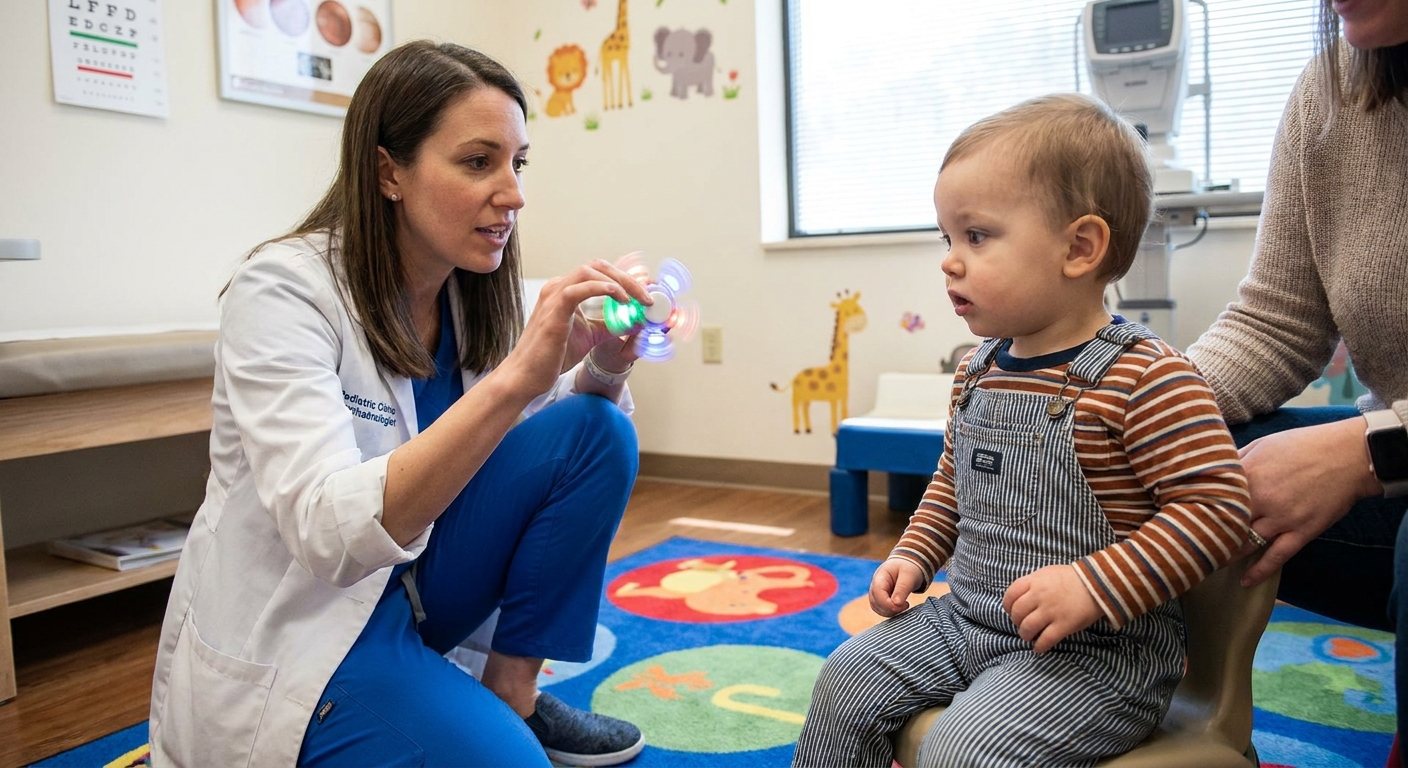
Who evaluates lazy eye
Both can help, but here is a simple way to think about it:
- Pediatric optometrist: diagnoses vision issues, prescribes glasses, and manages many amblyopia treatment plans. Many also incorporate vision therapy when appropriate.
- Pediatric ophthalmologist: a medical doctor (MD or DO) who evaluates everything above plus medical and surgical causes, like significant strabismus, cataracts, or droopy eyelids.
If your pediatrician suspects strabismus, an abnormal red reflex, or something more complex, they may recommend a pediatric ophthalmologist.
What treatment looks like
The good news: when lazy eye is found early, treatment can be very effective. The exact plan depends on the cause, and follow-up really matters.
Glasses
If one or both eyes are blurrier because of refractive error, glasses may be the first step. Sometimes glasses alone improve vision dramatically.
Patching
Patching the stronger eye encourages the brain to use the weaker eye. This can feel like a battle at first. You are not failing if your toddler protests. That is normal.
Atropine drops
Some children use drops in the stronger eye to blur it temporarily, which also pushes the weaker eye to work harder. Your eye doctor will decide if this is a good fit.
Vision therapy
Some pediatric optometrists use guided eye exercises (vision therapy) alongside glasses and patching or drops. It is not the right tool for every cause of amblyopia, but in the right situation it can help support skills like focusing, teaming, and tracking.
Strabismus surgery (sometimes)
If eye misalignment is significant, surgery may be considered to help the eyes line up. Even when surgery is needed, glasses and patching may still be part of the overall plan.
Important: Treatment works best during early childhood because the brain’s vision system is still developing. That is why we take concerns seriously, even when a child seems totally fine.
Patching help
Here are strategies I have seen work in real families:
- Start with a routine: patch at the same time each day, like after breakfast.
- Use “high-value” activities: screen time, coloring, stickers, play dough, and books during patch time can make the weaker eye practice more effective.
- Keep skin comfortable: choose the right patch size, remove slowly, and consider a little barrier film if your eye doctor approves.
- Offer choices: “Do you want the patch before or after snack?” Small control helps.
- Expect feelings: validate, then keep going. “Yep, you do not love it. We still need to do it, and I will help you through it.”
Risk factors
Any toddler can develop amblyopia, but risk is higher if your child has:
- A parent or sibling with lazy eye or strabismus
- Premature birth
- Developmental delays
- A history of eye injury or eye surgery
- Noticeable droopy eyelid
If any of these apply, ask your pediatrician about earlier or more frequent vision screening and whether a pediatric eye specialist should be involved.
Parent questions
Can toddlers “grow out of” lazy eye?
They can sometimes grow out of the appearance of misalignment if it is pseudostrabismus. True amblyopia does not typically resolve on its own. Waiting can mean the weaker eye falls further behind.
Will my toddler fail a vision screening if they have lazy eye?
Not always. Screenings are helpful, but not perfect. If you notice signs, it is okay to ask for a referral even if a screening was “normal.”
Does too much screen time cause lazy eye?
Screen time does not cause amblyopia. That said, a lot of close-up screen use can contribute to eye strain, and more outdoor time is associated with a lower risk of myopia (nearsightedness). Lazy eye is usually about alignment, unequal focus between eyes, or something blocking vision.
A calm next step
If you are worried, take a few photos in good lighting, jot down what you are noticing, and call your pediatrician. You are not being dramatic. You are being observant.
And if you needed permission to stop doom-scrolling at 3 AM: you have it. Lazy eye is treatable, and you are already doing the most important thing by paying attention.
Educational note: This article is general information, not a diagnosis. If you notice urgent warning signs (like a repeated white pupil reflection, sudden eye turning, or severe eye pain), seek prompt professional evaluation.