Strep Throat in Kids: Symptoms, Treatment, and When to See a Doctor

Sarah Mitchell
Sarah Mitchell is a Registered Pediatric Nurse and a mother of three who has spent over a decade helping families navigate the beautiful, chaotic early years of childhood. She combines evidence-based medical knowledge with real-world parenting experience to offer practical, compassionate advice. At Awesome Parent, Sarah's mission is to help exhausted parents find solutions, trust their instincts, and finally get some sleep.
It is 2 a.m., your child is crying, swallowing hurts, and your brain is doing that exhausting parenting math: Is this just a cold, or is it strep? Let’s make this simple and calm. Strep throat is a bacterial infection caused by group A strep. It usually takes a throat swab test to confirm, and antibiotics are used for confirmed strep (not for most sore throats, which are viral). The good news is that many kids feel noticeably better within a day or two after starting treatment, though throat pain can linger a few days.

What strep is (and why it matters)
Strep throat is caused by group A Streptococcus bacteria. In school-age kids, it is a common cause of sore throat and fever. In toddlers, it is less common and can look different, which is why a clinician’s exam and targeted testing are so helpful.
We treat confirmed strep with antibiotics because they:
- Help prevent complications (like rheumatic fever, which is rare but serious).
- Shorten symptoms a bit and reduce contagious spread.
- Lower the risk of certain local complications (like an abscess around the tonsil).
Strep symptoms by age
Kids do not read medical textbooks, so symptoms can vary. Here is what to look for in real life.
Toddlers (1 to 3 years)
True strep throat is less common under age 3, and toddlers often cannot clearly describe throat pain. Instead, you might notice:
- Fever
- Irritability or more crying than usual
- Decreased appetite or refusing to eat because swallowing hurts
- Drooling (sometimes from throat pain, but can also be a red flag if severe)
- Swollen neck glands
- Runny nose or thicker nasal drainage (toddlers commonly have viral symptoms at the same time, which can muddy the picture)
- Stomach pain, nausea, or vomiting
What is tricky: toddlers get lots of viral sore throats and colds. Cough and a runny nose still usually point to a virus at any age, and routine strep testing under 3 is generally discouraged unless there is a known exposure, an outbreak, or a clinician is concerned for complications.
Preschoolers and early elementary (3 to 7 years)
This is the age where classic strep shows up more often. Common signs include:
- Sore throat that comes on fairly suddenly
- Fever (often 101 to 104°F)
- No cough or only a mild cough
- Swollen tonsils and sometimes white patches or streaks
- Red spots on the roof of the mouth (tiny pinpoint spots)
- Swollen, tender lymph nodes in the front of the neck
- Headache or body aches
- Stomach pain, nausea, or vomiting
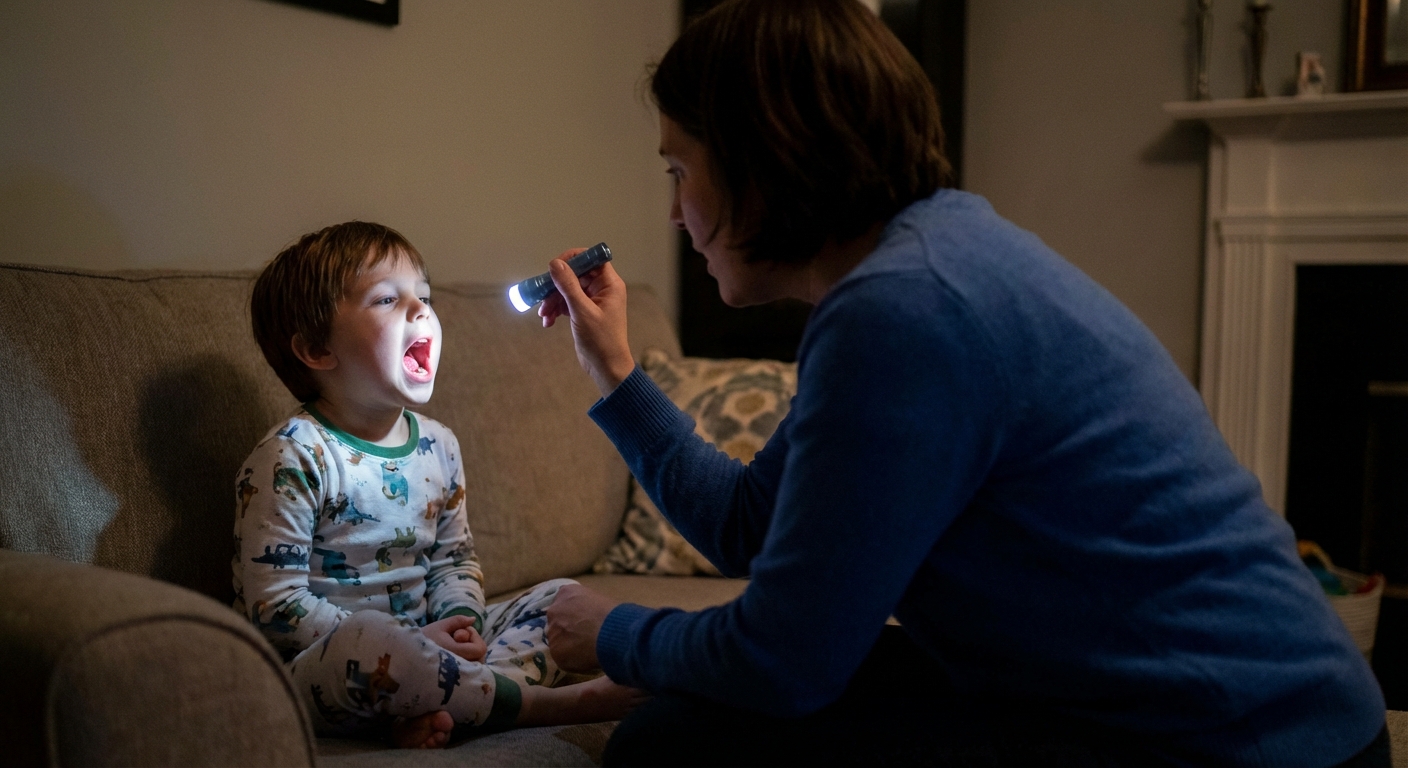
Scarlet fever rash (strep with a rash)
Some kids with strep develop a rash called scarlet fever. It can look scary but is treatable. Watch for:
- A fine, sandpaper-like rash often starting on the chest or trunk
- Brighter red skin in creases (armpits, groin, elbow bends)
- A strawberry-looking tongue (red, bumpy)
Strep vs viral sore throat
Here is the practical rule of thumb I used constantly in triage: cough and runny nose usually point to a virus, while fever plus sore throat without cough raises suspicion for strep, especially in kids over 3.
More suggestive of strep
- Sore throat with fever
- No cough
- Tender swollen neck nodes (especially the front of the neck)
- Tonsillar swelling with possible white patches
- Stomach pain, nausea, vomiting
- Known close contact with confirmed strep
More suggestive of viral illness
- Cough
- Runny nose
- Hoarse voice
- Pink eye
- Mouth sores (more typical with certain viruses)
One important note: you cannot diagnose strep by looking. White patches can happen with viruses too. That is why testing matters.
When to get a strep test
If your child has symptoms that fit strep, your pediatrician will usually do a rapid strep test (a quick throat swab). Results often come back in minutes.
- Kids age 3 and up with strep-like symptoms generally should be tested.
- Toddlers under 3 are tested more selectively, often when there is a known exposure, an outbreak, significant symptoms, or concern for complications.
If the rapid test is negative
In many pediatric practices, a negative rapid antigen test in a child with strong strep symptoms is followed by a confirmatory throat culture or a more sensitive molecular test. Some clinics use a highly sensitive rapid molecular test up front, and in that case a backup culture may not be needed. Your clinician can tell you which test they use.
If your clinician says, “The rapid is negative but we are sending a culture,” ask:
- When will results be ready?
- Should my child stay home from school or daycare until we know?
- What symptoms should prompt a call back sooner?
A helpful reassurance if you are waiting on a culture: starting antibiotics within about 9 days of symptom onset still prevents rheumatic fever, which is one reason clinicians can safely wait for confirmatory results when needed.
Treatment and what to expect
Confirmed strep throat is treated with antibiotics. The exact choice depends on your child’s age, allergies, and local practice patterns, but common options include penicillin or amoxicillin. If your child is allergic, there are alternatives your clinician can prescribe.
How fast antibiotics help
- Many kids start to feel better within 24 to 48 hours.
- Fever often improves within a day after starting antibiotics.
- The throat may stay sore a bit longer, especially if your child is dehydrated or not eating much.
How long strep is contagious
Most children are considered much less contagious after they have been on antibiotics for about 24 hours and their fever is improving. Follow your school or daycare policy, but the usual return-to-school rule is:
- At least 24 hours of antibiotics
- Fever-free (without fever medicine)
- Feeling well enough to participate
Finish the full course
Even if your child bounces back fast, complete the antibiotic course exactly as prescribed. Stopping early can increase the chance symptoms return and may not fully prevent complications.
Home comfort measures
Antibiotics treat the bacteria, but comfort care is what gets everyone through bedtime.
- Fluids first: cold water, ice chips (if age-appropriate), popsicles, diluted juice, warm broth. Hydration is often the difference between “manageable sore throat” and “absolute misery.”
- Soft foods: yogurt, applesauce, oatmeal, mashed potatoes, smoothies.
- Honey for kids over 1 year: a teaspoon of honey can soothe the throat. Do not give honey under 12 months.
- Warm saltwater gargles: for kids old enough to gargle and spit (usually school-age).
- Humidifier: cool-mist humidifier at night can reduce throat dryness.
- Pain and fever relief: use acetaminophen or ibuprofen if your child can take them. Follow dosing by weight and your pediatrician’s guidance.
Skip these:
- Aspirin in children and teens (risk of Reye syndrome).
- Leftover antibiotics or someone else’s prescription.
- Over-the-counter throat sprays or lozenges for young children who might choke or get numbness that makes swallowing harder.

When to call the pediatrician
Call your child’s clinician for same-day advice or an appointment if your child has:
- Sore throat plus fever and no cough
- White patches on tonsils or very swollen tonsils
- Stomach pain, vomiting, or headache with a sore throat
- A sandpaper-like rash
- Known exposure to someone with confirmed strep and new symptoms
- Symptoms that are not improving after 48 hours, or worsening at any point
If your child is already on antibiotics
Check back in if:
- Fever persists beyond 48 hours after starting antibiotics
- Throat pain is getting worse instead of better
- Your child cannot drink enough to stay hydrated
- A new rash appears (some rashes are part of strep, and some can be medication-related, so it is worth a call)
Go to the ER now
Most strep throat can be handled with a regular pediatric visit. But these symptoms need urgent evaluation:
- Trouble breathing, noisy breathing, or struggling to swallow saliva
- Drooling with inability to swallow
- Signs of dehydration: very dry mouth, no tears, significantly decreased urination (for many kids, no pee in 8 to 12 hours), extreme lethargy
- Stiff neck, severe headache, confusion, or unusual sleepiness
- Severe one-sided throat pain, muffled “hot potato” voice, or jaw or neck swelling (possible abscess or deeper infection)
- Blue lips or any appearance that your child is seriously unwell
- Any fever in an infant under 3 months (call urgently)
Some of these red flags can overlap with serious conditions like deep neck infections, and in rare cases epiglottitis. Trust your instincts here. If you are worried your child cannot breathe comfortably or cannot swallow, do not wait it out.
Preventing spread at home
Strep spreads through respiratory droplets and close contact. Practical steps that help:
- Handwashing for 20 seconds, especially after wiping noses and before eating.
- No sharing cups, utensils, or toothbrushes.
- Toothbrush: some clinicians recommend replacing it after 24 to 48 hours of antibiotics (or once your child is improving). Reinfection from toothbrushes seems uncommon, so do not panic if you forget.
- Cover coughs and sneezes, then wash hands.
- Wipe high-touch surfaces like doorknobs and faucet handles.

Common parent questions
Can my child have strep without a fever?
Yes. Fever is common but not required. A sore throat without cough, plus swollen tonsils or tender neck glands, can still be strep.
Can strep cause belly pain?
Absolutely. Strep can present with stomach pain, nausea, or vomiting, especially in preschoolers.
If my child has a cough, does that rule out strep?
Not completely, but a prominent cough makes a viral cause more likely. If your child has key strep signs plus cough, your clinician may still test.
Do we need to test the whole family?
Usually no. Most practices test household members only if they have symptoms. If strep keeps circulating in your home, your pediatrician may have a different plan.
What if it keeps coming back?
Recurrent sore throats can be due to repeat infections, exposure at school, or sometimes a child who is a strep carrier plus frequent viral illnesses. If your child has repeated confirmed strep infections, talk with your pediatrician about next steps.
Could it be mono instead?
In older kids and teens, mono (infectious mononucleosis) can look a lot like strep, with severe sore throat, fatigue, and swollen lymph nodes (often more toward the back of the neck). Testing and an exam help sort this out.
Takeaway for tired parents
- Strep often looks like: sore throat + fever + no cough, and sometimes stomach pain or a sandpaper rash.
- Viral illness often looks like: cough and runny nose, sometimes with hoarseness or pink eye.
- Testing matters because you cannot reliably diagnose strep by looking.
- Antibiotics help for confirmed strep, and many kids improve within 24 to 48 hours.
- ER red flags include trouble breathing, drooling with trouble swallowing, dehydration, and severe worsening symptoms.
If you are stuck in that spiral of “Is this serious?”, you are not overreacting. You are doing the job. When in doubt, call your pediatrician’s nurse line and let someone help you sort it out.