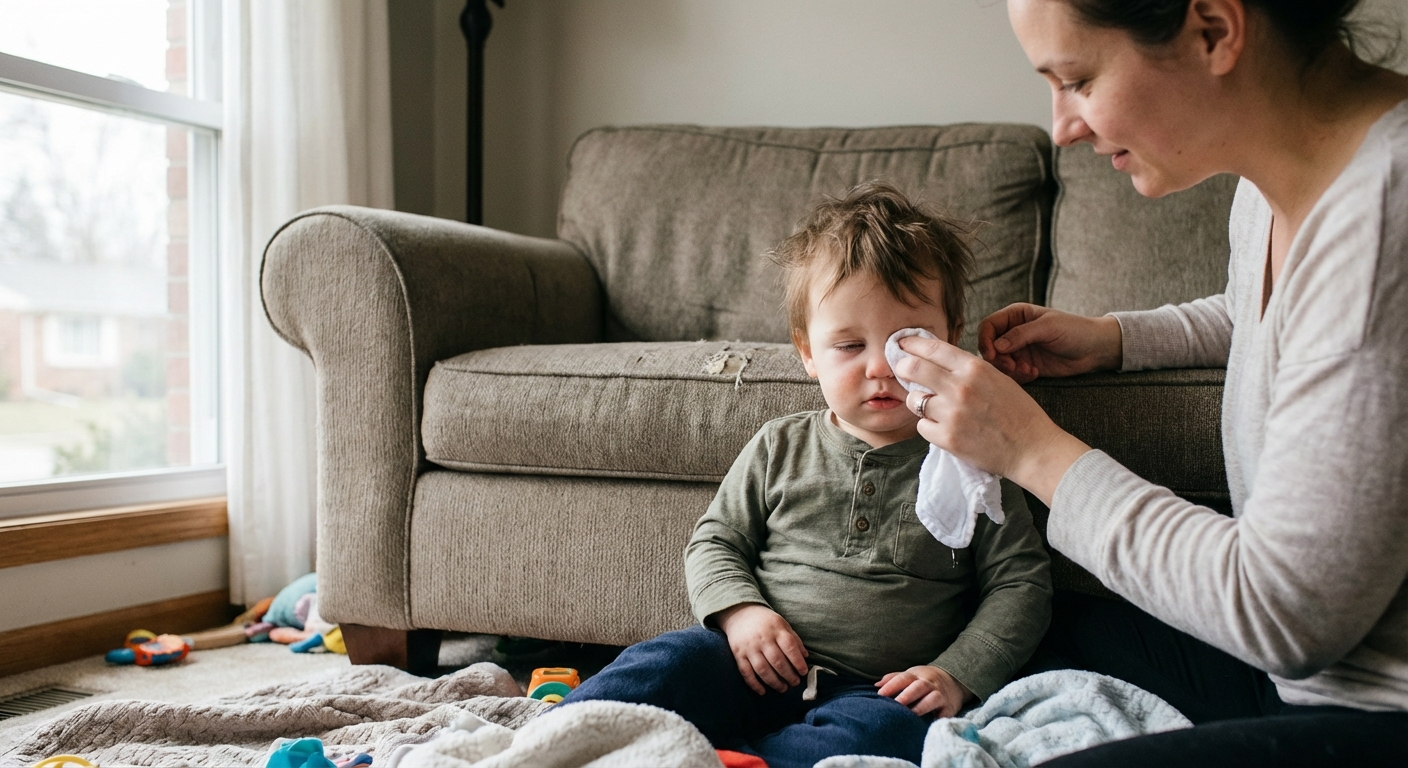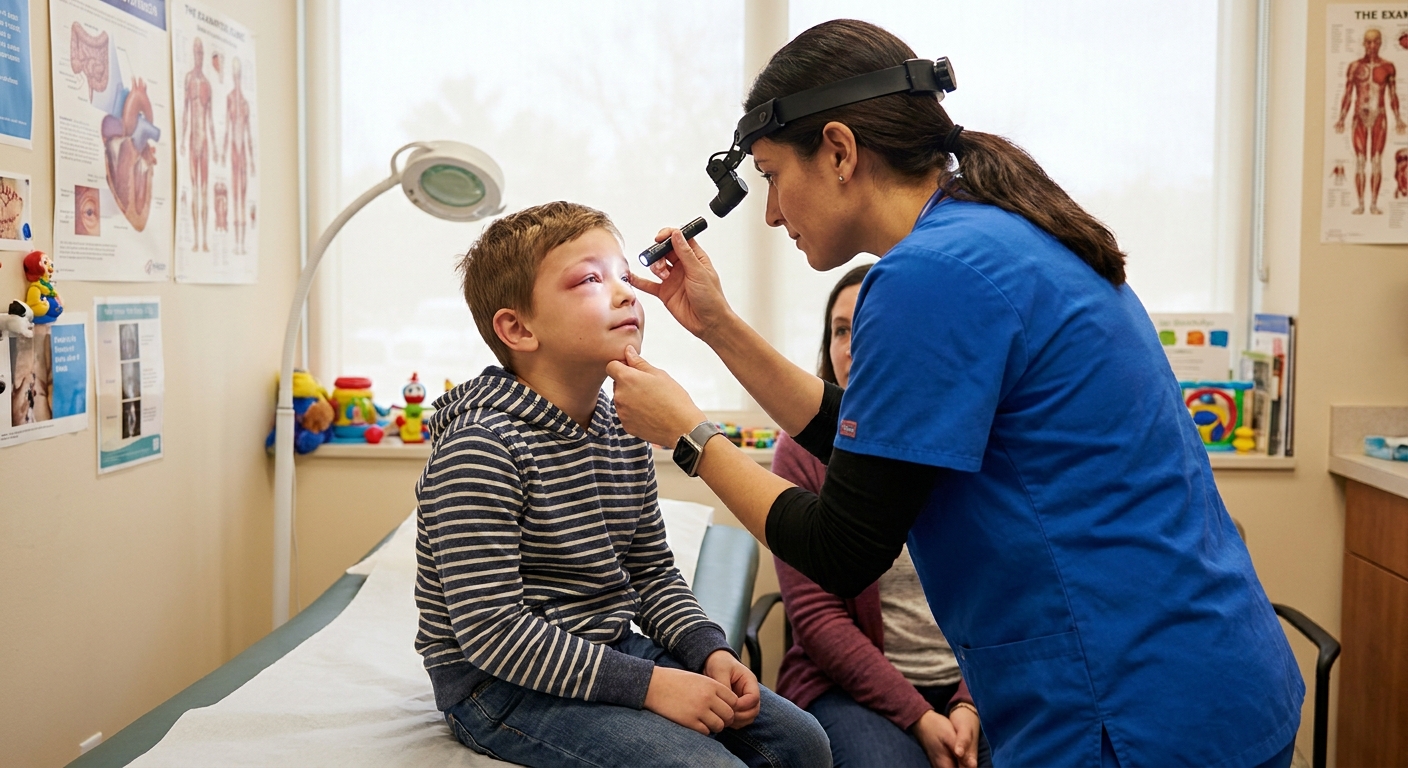
Eye pokes can cause corneal scratches that look scary and feel worse. Here is how to tell a scratch from pink eye, what to do at home, and when to get urgent...
Subconjunctival Hemorrhage in Babies and Toddlers

Sarah Mitchell
Sarah Mitchell is a Registered Pediatric Nurse and a mother of three who has spent over a decade helping families navigate the beautiful, chaotic early years of childhood. She combines evidence-based medical knowledge with real-world parenting experience to offer practical, compassionate advice. At Awesome Parent, Sarah's mission is to help exhausted parents find solutions, trust their instincts, and finally get some sleep.
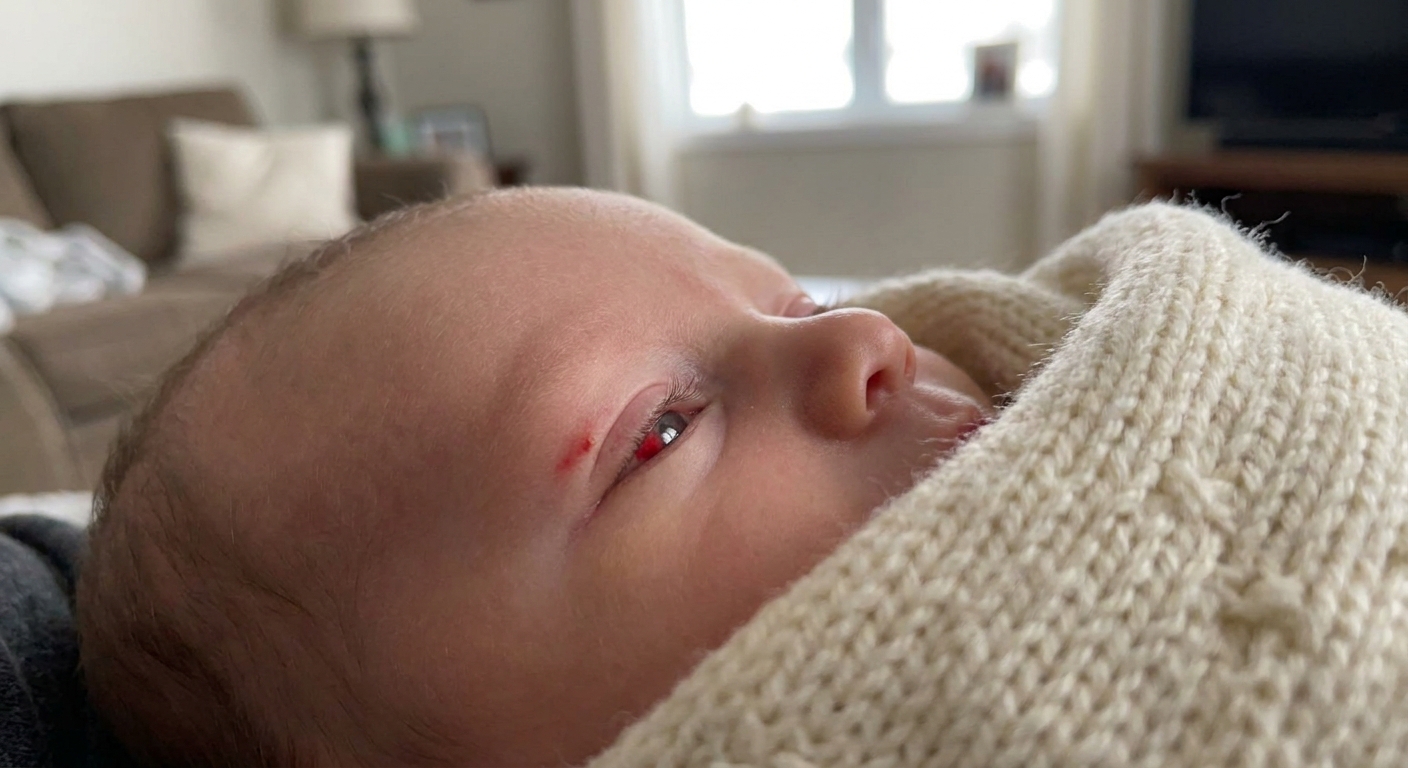
Seeing a bold red patch on your baby or toddler’s eye can stop you in your tracks. It looks dramatic, like something must really hurt. The good news is that most of the time, this is a subconjunctival hemorrhage, which is basically a tiny broken blood vessel on the surface of the eye. It is usually painless and harmless, even when it looks startling.
Let’s walk through what it is, why it happens after birth or after a big sneeze or crying session, what to expect as it fades, and the specific signs that mean you should get your child checked right away.
What it is
A subconjunctival hemorrhage happens when a tiny blood vessel breaks under the thin, clear membrane that covers the white part of the eye (the conjunctiva). The blood gets trapped between that clear layer and the white of the eye, so you see a flat, sharply defined red patch.
Typical features
- Bright red patch on the white of the eye (sometimes it can spread out and look larger over the first day).
- No pain (most kids act totally normal).
- No significant swelling or bulging of the eye (the eyeball should not look pushed forward).
- No change in vision in older kids who can tell you.
- No discharge like you would see with pink eye.
It looks alarming because the eye is a high-contrast area and even a small amount of blood is very visible. But it is on the surface, not inside the eye.
Common causes in newborns
In newborns, the most common reason is simple: pressure during birth. During a vaginal delivery, there can be brief increases in pressure on a baby’s head and face as they move through the birth canal. That pressure can pop a tiny surface vessel in the eye.
This can also be seen after:
- Strong crying soon after birth
- Coughing or vomiting
- Constipation and straining
Babies can also have a subconjunctival hemorrhage after assisted delivery (vacuum or forceps) because there can be more pressure around the face. Even then, it is often still a superficial, self-limited finding, but it is worth mentioning to your pediatrician so they can document it and examine the eye.

Common causes in babies and toddlers
In older babies and toddlers, the usual triggers are anything that causes a quick spike in pressure in the small blood vessels of the face, including:
- Sneezing
- Coughing (especially with colds)
- Vomiting
- Hard crying (the end-of-the-day “I am exhausted” cry can be surprisingly forceful)
- Straining with constipation
- Eye rubbing (can be associated, especially if the eye is already irritated)
Sometimes it also happens after a minor bump to the face. If there is any chance of a significant injury, we treat it differently and you should get your child evaluated.
How long it lasts
Most subconjunctival hemorrhages clear on their own. The body slowly reabsorbs the blood, similar to how a bruise fades.
Typical timeline
- Most cases: improve over about 1 to 3 weeks.
- Larger spots: can take longer, occasionally up to 3 to 4 weeks.
Color changes can happen
It may go from bright red to darker red, then look a little brownish or yellowish at the edges as it resolves. That is usually normal.
Can it spread?
Yes, it can look bigger over the first 24 hours as the blood settles under the surface layer. That can be startling, but it can still be normal as long as your child is comfortable and there are no red flags (we will cover those below).
What you can do at home
Most of the time, the best “treatment” is time.
- Do not use antibiotic eye drops unless your clinician specifically recommends them. This is not an infection.
- Avoid eye rubbing if possible. For toddlers, trimming nails and offering a distraction can help.
- Artificial tears (preservative-free) can be used if your child seems mildly irritated or you suspect dryness, but many kids do not need anything.
- Take a photo in good light. It can help you track improvement and can be useful if you call your pediatrician.
If your baby is a newborn, make sure they are otherwise feeding well, waking appropriately, and acting like themselves. The eye finding alone is rarely a problem.
Broken vessel vs. pink eye
Parents often search “red eye” and end up in pink-eye territory. These are usually different.
More likely a subconjunctival hemorrhage
- A solid red patch on the white of the eye
- Little to no irritation (child seems comfortable)
- No crusting sealing the eye shut
- Usually no discharge
More likely conjunctivitis (pink eye)
- Diffuse redness across the white of the eye, not a single sharp patch
- Irritation (itching, burning, gritty feeling, frequent rubbing)
- Discharge that can be watery (common with viral or allergic conjunctivitis) or thick (more common with bacterial)
- Crusting on lashes, especially after sleep
It is possible to have both at once, but a classic subconjunctival hemorrhage is usually a clean-looking red patch without much irritation.
When it could be something else
Most red patches are benign. But there are a few eye problems that can look similar from across the room and need prompt care.
Conditions we worry about
- Corneal abrasion (a scratch on the clear front surface of the eye). This is usually painful with tearing and sensitivity to light.
- Hyphema (blood inside the front chamber of the eye, behind the cornea and in front of the iris). This is typically related to trauma and can look like a fluid level or pooling inside the eye.
- Serious eye injury after trauma (especially if something hit the eye directly).
- Bleeding or clotting issues (rare, but consider if there are frequent unexplained bruises, nosebleeds, or recurrent eye hemorrhages).
- Foreign body or chemical irritation (more relevant for older toddlers and kids). This often comes with significant irritation, tearing, and rubbing.

When to seek urgent care
If you remember nothing else, remember this: subconjunctival hemorrhage is usually painless. Pain or behavior changes are what move this from “watch and wait” to “please get checked.”
- Eye pain, significant fussiness, or your child will not let you near the eye
- Light sensitivity (squinting, crying in bright light, keeping the eye closed)
- Vision changes (in older kids) or a new lazy eye appearance
- Cloudy or gray-looking cornea (the clear front part should look clear)
- Blood looks inside the eye or you see a level line of blood (possible hyphema)
- Thick discharge, significant eyelid swelling, or fever with a very red eye
- History of eye trauma, especially from a fall onto an object, a thrown toy, or anything sharp
- Your baby is very young (especially under 1 month) and you are unsure what you are seeing
- The red area keeps getting larger after 24 hours or does not begin to improve over 1 to 2 weeks
- Recurrent episodes without a clear trigger
- No clear explanation in an infant, or any concern for injury or possible abuse. This should be evaluated promptly.
What to expect at the visit
If you come into clinic, we typically:
- Ask about birth history (for newborns), recent coughing or vomiting, constipation, eye rubbing, possible foreign body exposure, or any injury
- Check for discharge, lid swelling, and whether the child seems comfortable
- Examine the eye with a light to be sure the cornea is clear and there are no signs of deeper bleeding
- Sometimes use a special dye and blue light if we suspect a corneal abrasion
- If there are recurrent episodes or other bleeding signs, consider next steps such as checking blood pressure (in older children) and, if indicated, screening for bleeding disorders
Most families leave with reassurance and a plan to observe.
FAQ
Can sneezing or crying really do this?
Yes. A forceful sneeze or intense crying can briefly raise pressure in tiny surface blood vessels. In some kids, one of those little vessels breaks and causes the bright red patch.
Is it contagious?
No. A subconjunctival hemorrhage is not an infection and cannot be spread to others.
Does it hurt?
Typically, no. If your child seems in pain, rubbing constantly, tearing a lot, or avoiding light, get them checked because that suggests something else (like a scratch or a foreign body).
Will it affect vision?
A simple subconjunctival hemorrhage on the white of the eye does not affect vision. Vision concerns are a reason to seek care promptly.
The bottom line
A subconjunctival hemorrhage can look dramatic, especially in a tiny newborn face, but it is usually a superficial, painless broken blood vessel that fades over about 1 to 3 weeks. Birth pressure, coughing, vomiting, sneezing, crying, and straining are common triggers.
If there is pain, light sensitivity, discharge, trauma, blood inside the eye, no clear explanation in a young infant, or behavior changes, do not wait it out. Trust your instincts and get your child evaluated.
If you are reading this at 3 AM with one eye open and your other eye on the baby monitor, take a breath. A red patch on the white of the eye is often one of those “looks terrifying, acts benign” parenting moments.
Sarah Mitchell
Sarah Mitchell is a Registered Pediatric Nurse and a mother of three who has spent over a decade helping families navigate the beautiful, chaotic early years of childhood. She combines evidence-based medical knowledge with real-world parenting experience to offer practical, compassionate advice. At Awesome Parent, Sarah's mission is to help exhausted parents find solutions, trust their instincts, and finally get some sleep.