Teaching Your Toddler to Share: What to Expect by Age

Sarah Mitchell
Sarah Mitchell is a Registered Pediatric Nurse and a mother of three who has spent over a decade helping families navigate the beautiful, chaotic early years of childhood. She combines evidence-based medical knowledge with real-world parenting experience to offer practical, compassionate advice. At Awesome Parent, Sarah's mission is to help exhausted parents find solutions, trust their instincts, and finally get some sleep.
If you have ever watched two toddlers lock eyes over one plastic truck like it is the last lifeboat on the Titanic, welcome. Sharing is one of the most common toddler issues parents ask about for a reason: it is stressful, it feels personal, and everyone has an opinion.
Here is the calm truth from a pediatric nurse who has also broken up approximately nine million sibling disputes in her own living room: toddlers struggle with sharing because their brains are still building the skills required to do it. Possessiveness is developmentally normal. Sharing is taught and practiced over time, not enforced in a single awkward playdate.
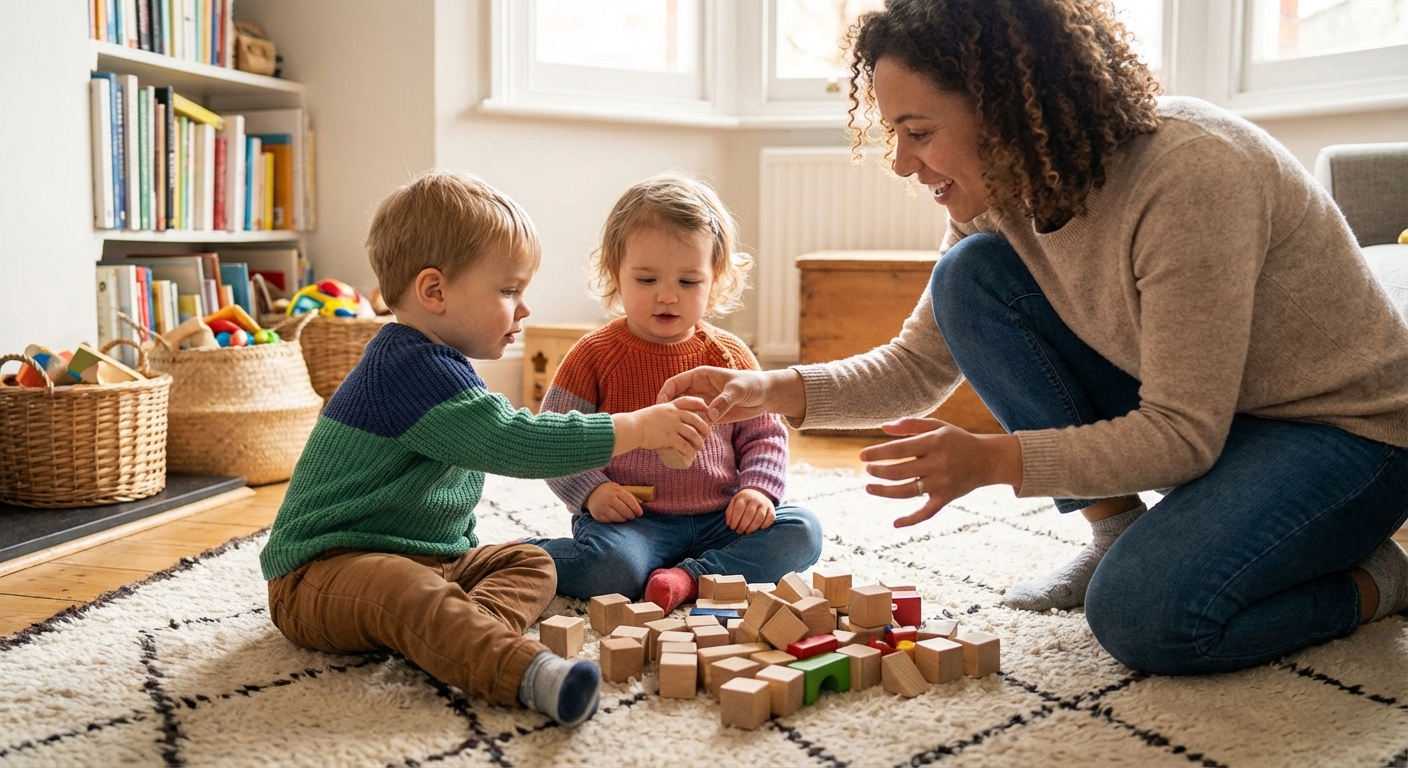
Why sharing is hard
When adults say “just share,” we are usually picturing a whole chain of skills that toddlers are still developing.
- Impulse control is immature. The skills that help kids pause and choose (executive function) develop steadily into the school-age years. In the moment, the urge is: grab it.
- They live in the “now.” Waiting for a turn feels endless to a toddler. “In two minutes” can sound like “never.”
- Ownership feels big. Toddlers are learning boundaries and identity. “Mine” is not greed. It is practice at autonomy.
- Empathy is emerging. They can care, but imagining what another child feels is a skill that grows gradually.
- Language may not keep up with emotions. When they cannot say “I am using that,” hands do the talking.
So if your toddler is clutching a toy and yelling “MINE,” it does not mean you are raising a future terrible roommate. It means your toddler is two.
Sharing by age
Every child develops at their own pace. Use these as general expectations, not a scoreboard.
12 to 18 months: Parallel play
Most kids this age play next to other children, not with them. They may hand something to a friend and then immediately take it back. That is not manipulation. It is experimentation.
- What to expect: Grabbing, mouthing toys, short attention spans, intense interest in what the other child has.
- Your goal: Keep it safe. Model gentle hands. Offer duplicates if possible.
18 to 24 months: “Mine” phase
This is the classic possessive season. Many toddlers can tolerate very short turns if an adult helps, but “sharing because it is nice” is not really driving the bus yet.
- What to expect: Protests when a toy is taken, pushing or pulling, difficulty waiting.
- Your goal: Teach turn-taking with lots of support and very short waits.
2 to 3 years: Turns with help
Many 2 to 3 year olds can begin to understand “my turn, your turn,” especially with a visual aid like a timer. They may share when it benefits them, like trading.
- What to expect: Some cooperative play, but sharing still breaks down when tired, hungry, or overstimulated.
- Your goal: Practice scripts, praise efforts, and step in early during conflicts.
3 to 4 years: More flexible
Many three year olds show real progress. They can wait longer, negotiate, and understand simple fairness. Big feelings still happen, especially with favorite items.
- What to expect: Increased cooperative play, beginning empathy, occasional backslides.
- Your goal: Coach problem-solving and repair, not perfection.
4 to 5 years: More consistent
Many preschoolers can share as part of playing together, follow simple game rules, and take turns without constant adult direction.
- What to expect: Better self-control, more “you can use it after me,” but strong reactions may still pop up.
- Your goal: Encourage independence while staying nearby for tricky moments.
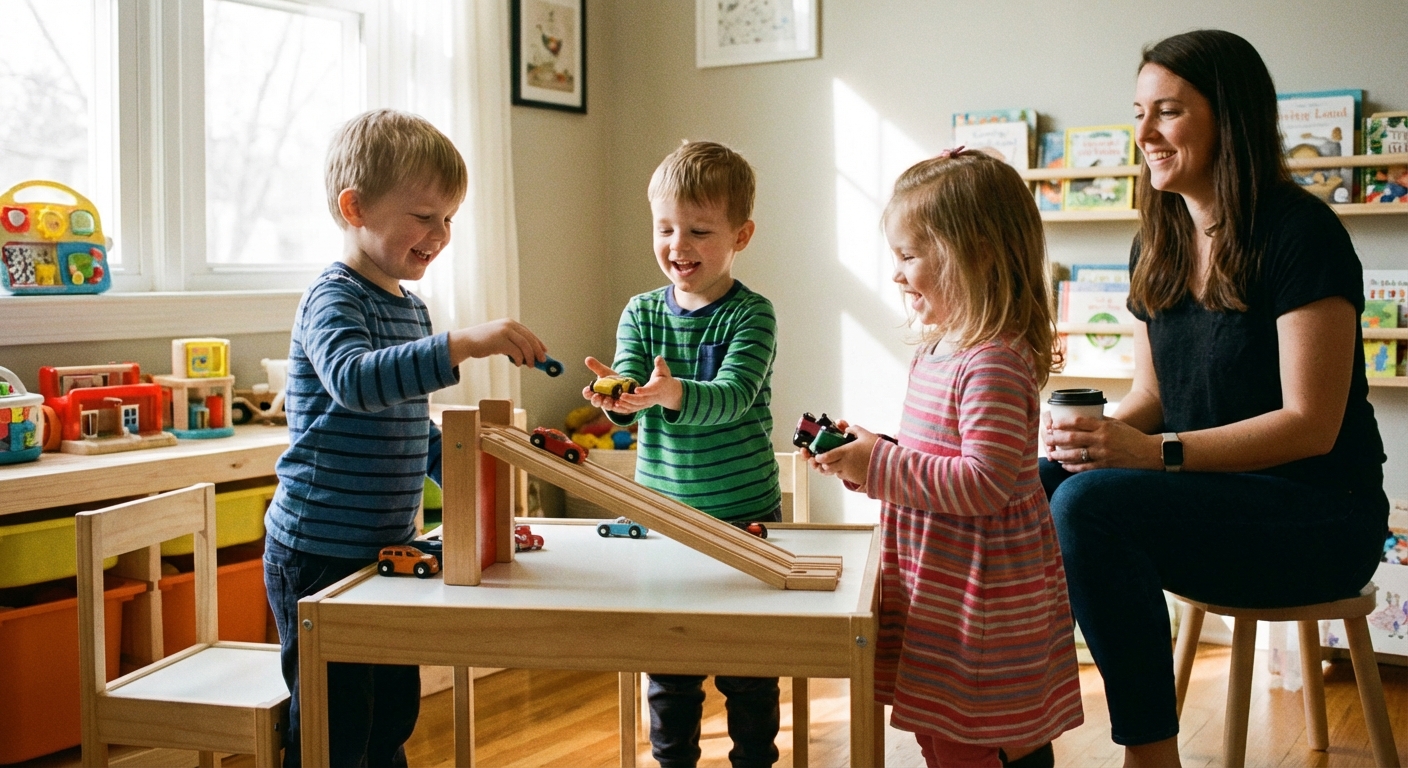
Sharing vs taking turns
In most toddler situations, the skill you are actually teaching is turn-taking, not “give it away.” That difference matters.
- Sharing can mean offering part of something: snacks, art supplies, space on the couch.
- Turn-taking is: one person uses the toy, then the other person uses it.
For toddlers, turn-taking is more concrete and more achievable. It is also kinder. It respects that they are in the middle of play, not holding a community resource.
What can be shared
It helps to be clear about which “sharing rules” you are teaching, because not everything has to follow the same script.
- Community items: Toys at daycare, the library play area, playground equipment. These usually follow turn-taking rules.
- Home play toys: Many families treat most of these as “for everyone,” especially during playdates, with adult coaching.
- Special items: Comfort objects, loveys, a brand-new birthday gift, or a favorite collectible. It is okay to protect these and keep them put away when friends are over.
You can be both kind and realistic: “Some toys are for everyone. Some toys are just for you.”
Strategies that teach sharing
1) Practice when calm
The best time to teach is when nobody is visiting and nobody is hungry.
- Use a fun, neutral toy, like blocks or a ball.
- Keep turns short: 10 to 30 seconds at first.
- Make it playful: “Ready, set, go, my turn. Now your turn!”
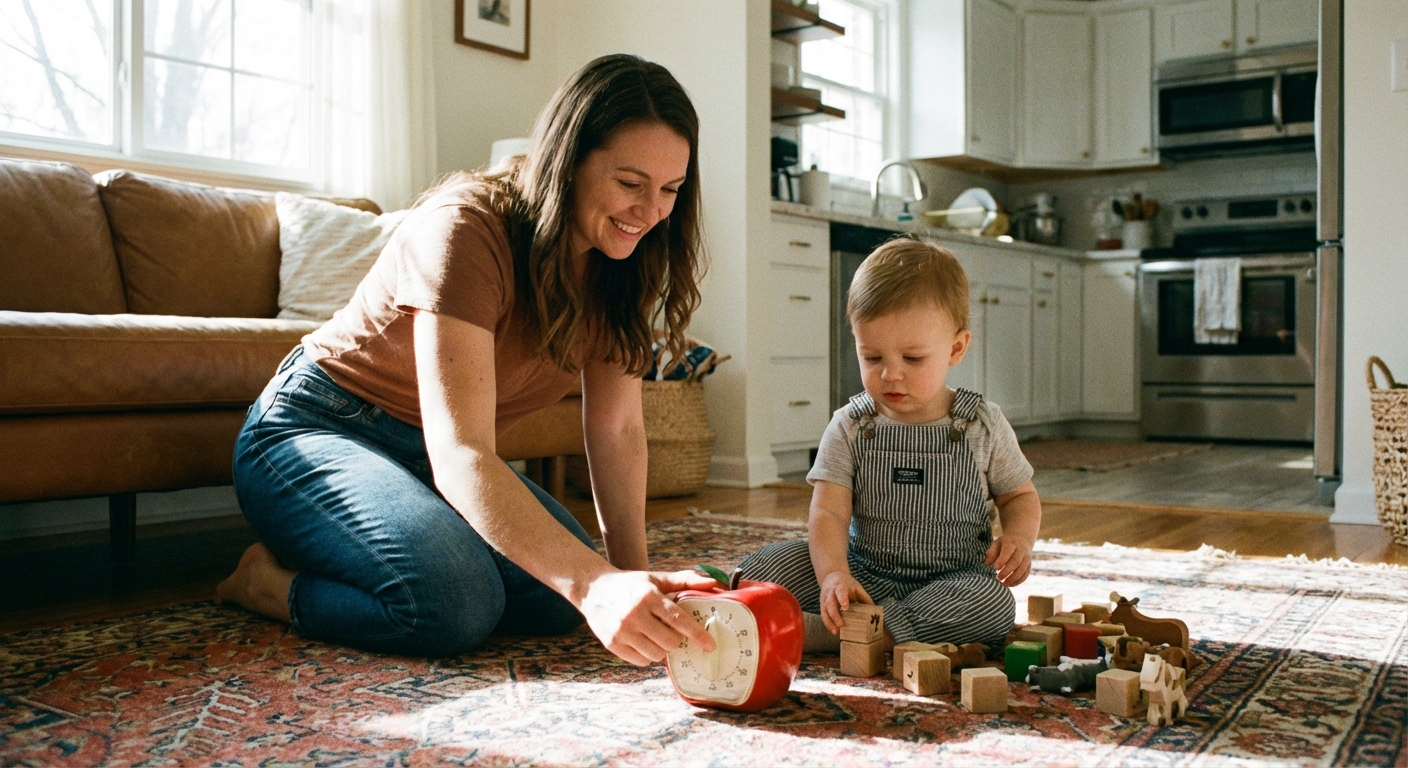
2) Use a timer
Timers work because they make waiting predictable. For toddlers, predictability is calming.
- Set a short timer (1 to 2 minutes to start).
- Use consistent language: “When the timer beeps, it is Sam’s turn.”
- Help with the handoff: “Beep. Time to pass it. I will help.”
Tip: If the timer causes meltdowns every time, shorten the turn and stay physically close for the transition.
3) Choices within boundaries
Choices reduce power struggles while keeping limits firm.
- “Do you want to give it to Maya or should I help you?”
- “Two more pushes, then we switch. Do you want to count them or should I?”
4) Simple scripts
Toddlers often want to do the right thing but do not have the words yet. Give them a script that fits in their mouth.
- “My turn.”
- “Turn please.”
- “Wait.”
- “All done.”
- “Help.”
Practice during calm moments, not mid-screaming.
5) Praise effort
You are building habits. Notice the attempt.
- “You waited. That was hard.”
- “You gave him a turn. Kind choice.”
- “You used your words. I love that.”
6) Use duplicates and manage favorites
This is not cheating. This is strategy.
- If siblings constantly fight over one truck, consider two similar trucks for a while.
- For playdates, put away the handful of “top five” toys your child is most territorial about.
7) Model it out loud
Toddlers learn a lot by watching you “share” in real time.
- “I am using the marker. When I am done, I will pass it to you.”
- “You can have the blue cup. I will take the green one.”
During a conflict
When conflict hits, your job is referee and translator, not judge. Here is a simple approach: Stop, Name, Set the limit, Teach the next step.
Step 1: Stop it
If hands are grabbing, hitting, or biting, move in close. Safety first.
- “I can’t let you grab.”
- “I won’t let you hit.”
- “I’m going to move your bodies apart so everyone stays safe.”
- “I’m going to hold the toy for a moment.”
Step 2: Name it
This lowers the temperature and helps kids learn emotional language.
- “You really want the fire truck.”
- “You were using it and you’re upset it got taken.”
Step 3: Set a limit
Keep it short. Toddlers cannot process speeches mid-meltdown.
- “We use gentle hands.”
- “We don’t take from hands.”
Step 4: Teach the next step
- “Say, ‘turn please.’”
- “You can wait or choose a different toy.”
- “We can use the timer for turns.”
Important: You do not have to force your child to hand over a toy on demand to teach kindness. Forced sharing can backfire for some kids and lead to more guarding and more meltdowns. Focus on turn-taking, boundaries, and repair.
Playdate prep
Set expectations
Right before a friend arrives, toddlers can handle a quick, concrete preview.
- “When friends come, we take turns. If you need help, you say ‘help.’”
- “Some toys are staying in your room today. The rest are for everyone.”
Plan an easy activity
Free-for-all toy piles can be tough. Structured options help and prevent a lot of battles.
- Bubbles (naturally turns-based)
- Sidewalk chalk (lots of pieces)
- Playdough with separate balls and shared tools
- Snack time (everyone gets their own portion)
Keep it short
Especially for younger toddlers, a 45 to 90 minute playdate is often the sweet spot. Long playdates are where good intentions fall apart.
What not to do
- Don’t label your child. Avoid “You’re so selfish” or “You never share.” Labels stick.
- Don’t shame. Shame may stop behavior in the moment, but it does not teach the skill.
- Don’t demand instant compliance. “Give it to her right now” often escalates. Use turns, choices, and support.
- Don’t over-apologize for normal toddler behavior. You can acknowledge it without acting like your child is a menace to society.
Helpful scripts
If your child is holding it
- “You’re using it. When you’re done, it’s Ben’s turn.”
- “Do you want one more minute or two more minutes?”
- “Timer says switch. I’ll help you pass it.”
If your child grabs
- “I can’t let you take from her hands. Say, ‘turn please.’”
- “We wait. Waiting is hard. I’m here.”
If another child grabs
- To your child: “You were using that. It’s okay to say, ‘my turn.’”
- To the other child (calmly): “He’s still using it. You can have a turn when he’s done.”
If everyone melts down
- “We’re taking a little break. Toys need a rest and so do our bodies.”
- “Let’s do bubbles for a minute.”
Special situations
Siblings
Siblings often fight more because they feel safe enough to fully lose it. A few sanity savers:
- Use turn rules that are predictable (timer, counting, one song).
- Give each child protected items that do not have to be shared.
- Do short “sharing reps” daily when calm, like passing a ball back and forth.
Speech delays or neurodivergent kids
Sharing and turn-taking can be harder when communication and flexibility are challenging. Support is not babying, it is accessibility.
- Use visuals (timer, simple “my turn” gesture).
- Keep turns very short and predictable.
- Model scripts and step in early before frustration explodes.
If you are worried about your child’s communication, social engagement, or frequent aggressive conflicts, it is always okay to ask your pediatrician about a speech-language evaluation or early intervention resources.
When to call the pediatrician
Most sharing struggles are normal. Consider getting extra support if you notice:
- Frequent, intense aggression (biting, hitting) that is escalating rather than improving with supervision and coaching
- Conflicts that happen in nearly every social situation, even with adult help
- Your child rarely engages with peers at all, or seems consistently distressed around other children
- Concerns about language delay, hearing issues, or sensory sensitivities that make play very hard
Also call promptly if a fight results in a serious injury, a deep bite that breaks skin, or signs of infection.
Bottom line
Sharing is not a toddler setting you forgot to turn on. It is a skill built slowly with brain development, repetition, and a lot of calm adult coaching.
A realistic goal is not “my child shares perfectly.” A realistic goal is: my child is learning to wait, take turns, and recover after conflict. That is social growth. And yes, it counts even if it is messy.