Toddler Cough at Night: Causes, Home Remedies, and When to See a Doctor

Sarah Mitchell
Sarah Mitchell is a Registered Pediatric Nurse and a mother of three who has spent over a decade helping families navigate the beautiful, chaotic early years of childhood. She combines evidence-based medical knowledge with real-world parenting experience to offer practical, compassionate advice. At Awesome Parent, Sarah's mission is to help exhausted parents find solutions, trust their instincts, and finally get some sleep.
If your toddler coughs the second their head hits the pillow, you are not alone. Nighttime coughing is a common reason parents reach out to their pediatrician after bedtime, and it can sound a lot scarier in the dark.
The good news is that most nighttime coughs are caused by everyday things like a viral cold with postnasal drip or dry air. The not-so-fun news is that some cough patterns are a clue you need medical help sooner rather than later.
Let’s walk through the most common causes, what you can do tonight, and how to decide when to call the doctor versus when to go straight to the ER.
Quick note: This is general education, not medical advice for your specific child. If you are worried about your child’s breathing, trust your gut and seek urgent care.

Why coughs get worse at night
Nighttime makes coughs louder and more frequent for a few simple reasons:
- Gravity changes. When your child lies down, mucus can drain toward the back of the throat (postnasal drip) and trigger coughing.
- Air is drier. Heated or air-conditioned rooms can dry out airways, depending on your climate and home humidity.
- Less distraction. During the day, toddlers swallow more, drink more, and stay upright. At night, every little tickle gets center stage.
Common causes
1) Postnasal drip (cold or allergies)
This is the big one. With viral infections (including common colds) or allergies, mucus can drip down the back of the throat, irritate the airway, and trigger a cough, especially after lying flat.
Clues it is postnasal drip:
- Runny or stuffy nose
- Cough is worse when lying down
- Throat clearing or a “wet” sounding cough
- More coughing in the early morning hours
What to know: A viral cough can linger for 2 to 3 weeks and sometimes up to 3 to 4 weeks, even when your child seems fine otherwise. That can be normal if they are breathing comfortably and improving overall.
2) Dry air or irritation
Dry air can make the throat and upper airway feel scratchy, which triggers a dry, repetitive cough at night.
Clues it is dry air or irritation:
- Cough is mostly dry
- More coughing in heated rooms or after the heat turns on
- No fever or only mild cold symptoms
3) Croup
Croup is a viral illness that causes swelling around the voice box and upper airway. It often shows up suddenly at night and can be very dramatic.
Clues it is croup:
- Barking cough that sounds like a seal
- Hoarse voice
- Noisy breathing when breathing in (stridor), especially when upset
- Often worse at night
Important: Many cases of croup are mild, but breathing trouble can escalate quickly in toddlers.
4) Asthma or reactive airway
Some toddlers cough at night because their lower airways are sensitive and tighten up. Sometimes the main symptom is cough, not wheezing (often called cough-variant asthma).
Clues it could be asthma or reactive airway:
- Cough is worse at night or with exercise and laughter
- Recurring cough with colds that lasts longer than expected
- Wheezing, chest tightness, or fast breathing (sometimes subtle)
- History of eczema, allergies, or family history of asthma
Note: If your toddler has a prescribed rescue inhaler (like albuterol), follow your asthma action plan. If you do not have a plan and nighttime cough keeps happening, it is worth discussing with your pediatrician.
Other causes to keep in mind
- Reflux: Some kids cough more when lying down, especially if they have sour breath, discomfort after meals, or symptoms that predictably worsen after eating.
- Secondhand smoke, vaping aerosols, or strong scents: Smoke, fireplaces, fragrances, and essential oil diffusers can irritate airways.
- Foreign body (something inhaled): If the cough started suddenly during eating or play and never really improved, call your clinician. This can be easy to miss.
- Pertussis (whooping cough): Consider this if you see coughing fits in bursts, a “whoop,” or vomiting after coughing, especially if the cough lasts more than 2 weeks or you are unsure about vaccination status. Call your clinician promptly.
What to try tonight
These are safe, practical steps that help many toddlers feel better quickly. You do not need to do all of them. Pick the ones that match your child’s symptoms.
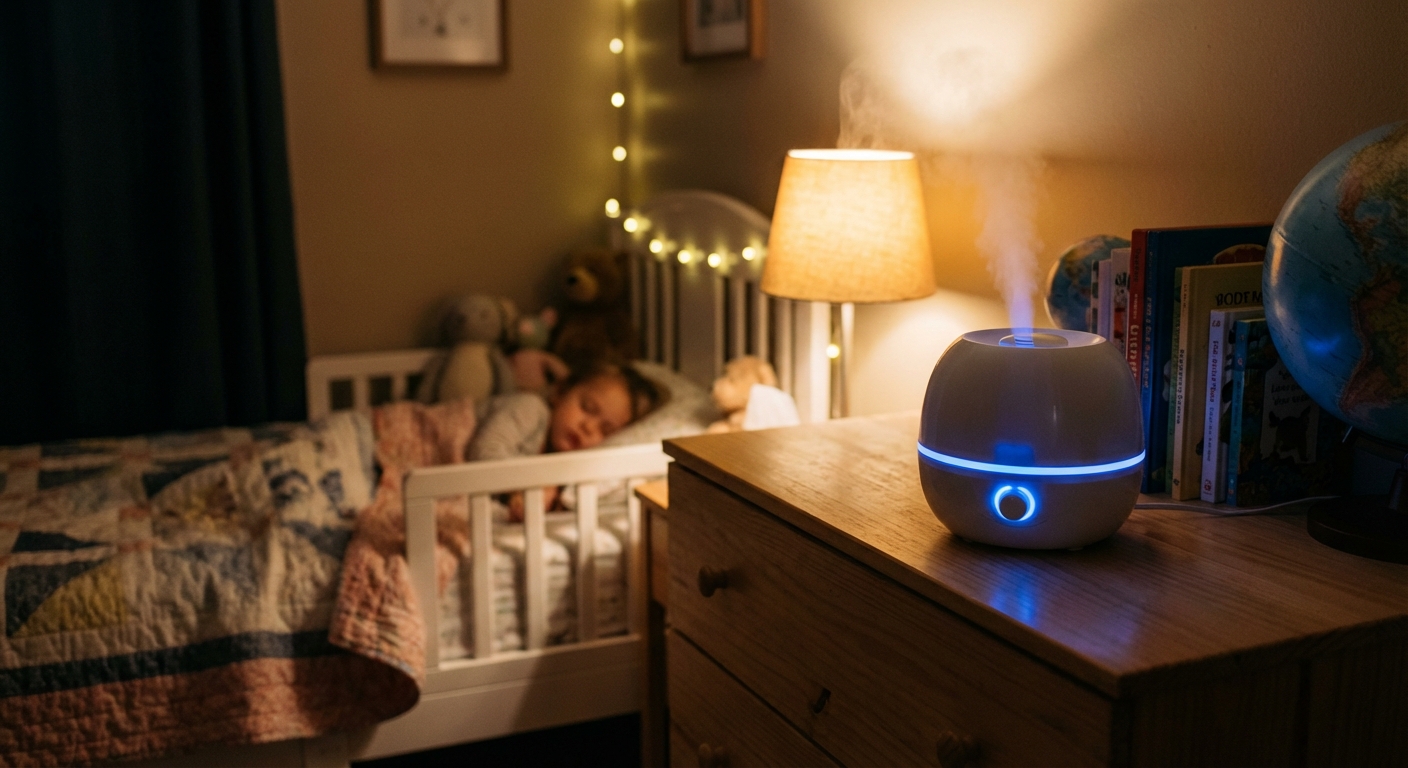
Cool-mist humidifier
- Place it a few feet from the bed for comfort and safety.
- Use cool-mist to avoid burn risks.
- To reduce mold risk: follow the manufacturer instructions. In general, empty and dry it daily and clean it regularly as directed.
Honey (age 1 and up)
Honey can soothe the throat and reduce cough frequency at night.
- Age rule: Only for children 12 months and older.
- How much: About 1/2 to 1 teaspoon, given about 20 to 30 minutes before bedtime. If you want exact dosing for your child, check with your clinician.
- You can offer a few sips of water afterward if your child wants.
Do not give honey to babies under 1 year due to botulism risk.
Elevate safely
Keeping mucus from pooling in the throat can reduce coughing.
- For toddlers in a bed: You can slightly elevate the head of the mattress by placing a towel under the mattress (not loose pillows in the bed).
- For kids still in a crib: Follow safe sleep guidance. Do not add pillows, wedges, or rolled blankets into the crib.
Saline and suction
- Saline spray or drops can loosen mucus.
- Gentle suction (especially before bed) can help younger toddlers who cannot blow their nose well yet.
Warm fluids
Warm water, caffeine-free tea, or warm broth can soothe irritation and thin mucus. If your toddler will accept it, this is one of the easiest wins.
For croup comfort
If your child has a barking cough or mild stridor, calming them is step one. Crying can make symptoms worse.
- Sitting in a steamy bathroom for 10 to 15 minutes may help some children.
- Or stepping outside into cool night air for a few minutes, bundled appropriately, may help some children.
If stridor is present at rest (noisy breathing even when calm), skip home experiments and get urgent care guidance.
Skip OTC cough and cold meds
Most over-the-counter cough and cold medicines are not recommended for young children because they do not work well and can cause side effects. If you are unsure what is safe for your child’s age, ask your pediatrician or pharmacist.
If your child seems uncomfortable from fever or body aches, ask your clinician about the right option and dose for your child (acetaminophen or ibuprofen are commonly used, depending on age and medical history).

When to call the doctor
If you are debating whether to call, you are not being dramatic. Night cough can be miserable, and you deserve clear guardrails.
Call within 24 hours if:
- Your toddler’s cough is keeping them from sleeping night after night
- The cough lasts more than 10 to 14 days without improvement
- You hear wheezing or suspect asthma, especially if it keeps happening with colds
- Your child has fever for more than 3 days, or fever returns after improving
- They have ear pain or thick nasal discharge that is worsening, or symptoms that are not improving after about 10 days
- Your toddler is vomiting from coughing repeatedly or cannot keep fluids down
- You suspect reflux or the cough is consistently worse after meals and when lying down
- There is a barking cough and symptoms are not improving after 2 to 3 days, or are worsening
- You are concerned about pertussis (coughing fits, post-cough vomiting, cough lasting over 2 weeks)
Call same day (urgent) if:
- Your child is working harder to breathe but is still stable (see ER signs below for what “not stable” looks like)
- They have croup symptoms and you hear stridor when they are calm
- Your toddler is under 2 years and the cough is worsening quickly
- Your child has a chronic medical condition (prematurity history, heart or lung disease) and symptoms are escalating
- Your child has fever plus fast breathing, persistent belly breathing, or you are worried about pneumonia or bronchiolitis
When to go to the ER
These are the signs that tell me, as a triage nurse, “Do not wait and see.” Trust your gut here.
Go to the ER or call emergency services if your toddler:
- Has trouble breathing, including fast breathing, obvious belly breathing, ribs pulling in, or head bobbing
- Has blue or gray lips or looks dusky
- Cannot speak or cry normally because of breathing difficulty
- Has stridor at rest (high-pitched noisy breathing in when calm), especially with croup
- Is unusually sleepy, hard to wake, or seems confused
- Is drooling and cannot swallow, or has a sudden severe sore throat and muffled voice
- May have inhaled something (sudden coughing or choking episode, then persistent coughing or one-sided wheeze)
- Shows signs of dehydration (very dry mouth, no tears, significantly fewer wet diapers or pees)
If your toddler is breathing comfortably between coughs, drinking some fluids, and has normal color, it is usually safe to try home comfort measures while you monitor. If their breathing looks “off,” that is an ER problem, not a bedtime problem.
Middle-of-night guide
Wet cough, worse lying down
- Think: postnasal drip
- Try: saline, suction or nose blowing, humidifier, honey (1+), fluids, gentle elevation
- Call the doctor: if no improvement in 10 to 14 days, fever persists, or symptoms worsen
Dry cough, dry room
- Think: dry air or irritation
- Try: cool-mist humidifier, fluids, honey (1+), reduce irritants (smoke, fragrance, essential oils)
- Call the doctor: if cough is recurrent, persistent, or affecting sleep consistently
Barking cough
- Think: croup
- Try: calm your child, steamy bathroom or cool night air (may help)
- Urgent care: stridor when calm, symptoms worsening, or not improving after 2 to 3 days
- ER now: breathing difficulty, stridor at rest, blue lips
Mostly night cough that keeps coming back
- Think: asthma or reactive airway
- Try: follow your asthma plan if you have one
- Call the doctor: to discuss evaluation and a plan, especially if there is wheeze or exercise-triggered coughing
Help them sleep
- Do a nose reset before bed: saline, gentle suction or nose blowing, then fluids.
- Run the humidifier: start 30 minutes before sleep.
- Honey (1+): right before teeth brushing, then brush teeth afterward to protect against cavities.
- Keep the room cool: many kids cough more in overheated rooms.
- Stay calm and boring: comfort them, but keep lights low and the routine simple so they can settle back down.
FAQ
Is it normal to cough only at night?
It can be, especially with postnasal drip from a viral infection or allergies, dry air, or asthma. The pattern matters. If it happens for many nights in a row or keeps recurring with colds, check in with your pediatrician.
Can I give my toddler cough medicine?
Most OTC cough and cold medicines are not recommended for young children. For many toddlers, honey (if 1+) plus humidified air and nasal care work better and more safely. When in doubt, ask your clinician.
How long is too long for a barking cough?
Croup often peaks over 1 to 2 nights and then improves, but the cough can linger. If the barking cough or noisy breathing is worsening or is not improving after 2 to 3 days, call your pediatrician. Go to the ER sooner if there are breathing difficulties or stridor at rest.
Should I let my toddler sleep if they are coughing?
If your child is breathing comfortably, has normal color, and is rousable, sleep is helpful. If you see breathing distress, blue lips, or unusual sleepiness, seek emergency care.
A reminder from a pediatric nurse mom
You do not need to diagnose the exact cause at 2:17 AM to be a good parent. Focus on two things: comfort and breathing. Comfort measures can usually wait. Breathing concerns should not.
If you are unsure, call your pediatrician’s after-hours line. That is exactly what it is there for, and you are not bothering anyone.