Toddler Hitting and Pushing: Why It Happens and How to Respond

Sarah Mitchell
Sarah Mitchell is a Registered Pediatric Nurse and a mother of three who has spent over a decade helping families navigate the beautiful, chaotic early years of childhood. She combines evidence-based medical knowledge with real-world parenting experience to offer practical, compassionate advice. At Awesome Parent, Sarah's mission is to help exhausted parents find solutions, trust their instincts, and finally get some sleep.
If your toddler has ever shoved a friend at the park or smacked you when you said “no,” you are in very good company. Working as a nurse in pediatric emergency and urgent care triage, I saw panicked parents come in thinking their child was “aggressive” or “mean.” Then I had my own toddlers, and wow, did real life humble me.
Most toddler hitting and pushing is not a character flaw. It is usually a mash-up of big feelings, tiny impulse control, and a brain that is still learning how to use words instead of hands. The good news is that you can respond in a way that keeps everyone safe and actually teaches the skill your child is missing.
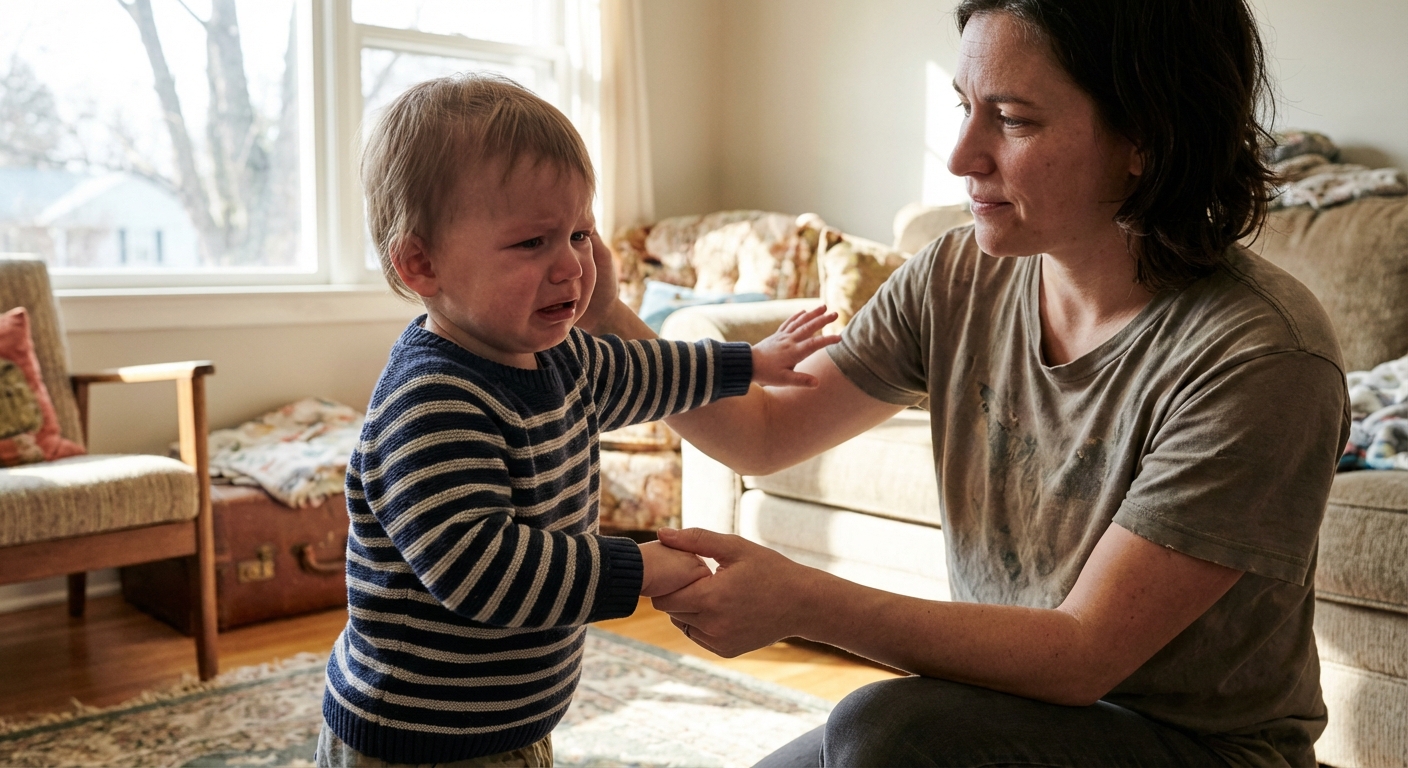
Why toddlers hit and push
Toddlers are not tiny adults with bad manners. Their brains are under construction. Here are the most common reasons hitting and pushing show up between ages 1 and 4.
Impulse control is still developing
The skills responsible for pausing, thinking, and stopping an impulse are still developing in toddlerhood. Your child can know “no hitting” and still hit because the feeling arrives faster than the brakes.
Communication frustration
Many toddlers have more to say than they can express. When they cannot find the words for “Move,” “Mine,” “Stop,” “I’m overwhelmed,” or “That hurt,” their body does the talking.
Big feelings in a small body
Toddlers feel anger, jealousy, excitement, and disappointment intensely, and they do not yet have reliable tools to regulate. Hitting can be an unskilled attempt to release tension.
Sensory overload or physical needs
Hitting and pushing can spike when kids are hungry, tired, overstimulated, or coming down with an illness. In my own triage experience, I cannot count how many “sudden behavior problems” were actually “missed nap plus a kid who was getting sick,” like an ear infection.
Testing boundaries and cause-and-effect
Toddlers are scientists. They test: “What happens if I push?” If the result is a big reaction, that information can make the behavior more likely to repeat.
Copying what they see
Siblings, older kids, and even cartoons can model physical reactions. Copying is not the same as being “bad.” It means you will need to be extra consistent with coaching and supervision.
Common triggers to watch for
Finding patterns helps you prevent a lot of incidents before they happen. Ask yourself, “When is this most likely?”
- Transitions: leaving the playground, getting into the car seat, bedtime, stopping screen time
- Sharing pressure: another child reaches for a toy, especially a favorite or new one
- Close quarters: crowded playgroups, lines, small living rooms with multiple kids
- Competition for attention: you are holding the baby, on a phone call, cooking dinner
- Touch and personal space: some toddlers push because someone is too close
- Fatigue and hunger: late afternoon is a common danger zone for many kids

How to respond in the moment
In the moment, your job is safety first, teaching second. Lectures do not land when a toddler is dysregulated. Think: short, clear, consistent.
Quick note: If you need to stop hands from hurting, do it gently, briefly, and only for safety. Stay close and calm.
Step 1: Block and separate
Move close. Gently block the hit or hold your toddler’s hands at their sides if needed. If another child is involved, calmly create space between them.
What to say: “I won’t let you hit.” Or “Hands are not for pushing.”
Step 2: Help the child who was hurt
This matters for two reasons. It supports the child who was hurt, and it helps you avoid accidentally reinforcing the behavior with intense attention focused on the hitter.
What to say: “Are you okay? That hurt. I’m here.”
Step 3: Name the feeling and set the limit
Keep it simple. You are giving their brain the words it does not have yet.
What to say: “You’re mad. Hitting is not okay.”
Step 4: Offer a safer replacement
Offer one or two options, not ten.
- “You can say, ‘Move please.’”
- “You can stomp your feet.”
- “You can hit this pillow.”
- “You can ask for help.”
Step 5: Do a short reset if needed
If your toddler tries again, it is okay to end the activity or remove them from the situation for a short, boring, supervised reset. A reset is not a punishment. It is a regulation break and a safety plan.
What to say: “We’re taking a break. I’ll stay with you. We can try again when your body is calm.”
One of the biggest mindset shifts: you are not trying to “make them sorry” in the moment. You are helping their brain practice what to do instead next time.
What not to do
- Do not hit back. It teaches that hitting is an acceptable tool when you are bigger or in charge.
- Do not demand a forced apology. A toddler can parrot “sorry” without learning the skill. Focus on repair: checking on the hurt person, gentle touch, helping retrieve a toy, or giving space.
- Do not give a long lecture. If they are escalated, their brain is not available for a speech.
- Do not label your child. “You’re a bully” or “You’re mean” tends to create shame, not skill.
- Do not ignore unsafe behavior. Some approaches emphasize ignoring for attention-seeking, but physical aggression needs immediate, calm intervention.
Strategies that reduce hitting
Toddler discipline is mostly about teaching and preventing. You are building habits through repetition, not one perfect consequence.
Teach the rule when calm
Pick one short phrase and repeat it often: “Gentle hands.” “Hands are for helping.” “We keep bodies safe.”
Practice with play: have stuffed animals “get mad” and show them how to ask for space.
Coach the words they need
- “Stop.”
- “My turn.”
- “Help please.”
- “No thank you.”
- “I’m mad.”
For late talkers, add a simple hand signal (like an open palm for “stop”) or a basic sign for “help.”
Use natural, immediate consequences
The best consequences are connected and fast.
- If they hit during play: play stops, and you move them a few feet away with you for a reset.
- If they push at the playground: you leave that area for a reset.
- If they hit to get a toy: the toy is moved out of reach briefly while you supervise and coach.
Catch them doing it right
This is not “rewarding with bribery.” It is strengthening the behavior you want to see.
Say: “You were mad and you used your words. That kept everyone safe.”
Build regulation into the day
Many toddlers need daily physical outlets and predictable rhythms.
- Outdoor time or gross motor play
- Snack before errands
- Earlier bedtime during rough phases
- Quiet decompression after daycare
Prep before high-risk moments
Give a short expectation right before the moment you usually see pushing or hitting.
Example: “We’re going inside. If you’re mad, you can stomp. I won’t let you hit.”
Get caregivers on the same page
If multiple adults care for your child, agree on one simple script and one consistent follow-through plan. Toddlers learn faster when the response is predictable.
Quick scripts by situation
Your toddler hits you
What to do: Block, step back slightly, keep your face calm.
What to say: “I won’t let you hit me. You can be mad. You can say, ‘No!’”
If it is happening during caregiving (diaper, teeth, hair brushing), pause if you can safely. Offer a small choice: “Do you want to hold the toothbrush first or should I?”
Your toddler hits over a toy
What to do: Separate, comfort the other child, then coach your toddler.
What to say: “Hitting hurts. If you want a turn, say ‘My turn please’ or ask me for help.”
Then actively help them practice: “Let’s use a timer” or “Let’s pick a different toy while we wait.”
Your toddler pushes in line
What to do: Move them behind you or into a stroller/cart if needed.
What to say: “People need space. Hands down. Hold my hand.”
Siblings hit each other
What to do: Separate first, then address both kids. Many sibling hits are about access to you or to space.
What to say: “I won’t let you hurt each other. You two need space. Here’s what you can do instead.”

Time-out or time-in?
Time-out can work for some families, but with toddlers it often works best as a time-in: a brief, supervised calming pause with you nearby. The goal is to reset the body, not to create isolation or shame.
- Keep it short: as a starting point, 1 to 3 minutes is plenty for many toddlers.
- Stay neutral: minimal talking until calm.
- Re-teach after: “Next time, you can say ‘stop’ or come to me.”
If time-out becomes a wrestling match or escalates your child, switch to a simpler approach: remove your child from the situation and do a calm reset together. If you are following a specific parenting program or your pediatrician’s guidance, use their structure.
How to prevent it
You cannot prevent all of it, and you are not supposed to. But you can lower the frequency.
Stay close in high-risk moments
At playdates or parks, stay within arm’s reach if your child is in a hitting phase. This is temporary and it is protective, not helicoptering.
Make playdates easier
- Keep them shorter during a hitting phase
- Choose bigger spaces when you can
- Do one main activity at a time (bubbles, play dough, water table)
- Have enough “hot” items to go around (one ball per child, or bring duplicates)
Adjust expectations for sharing
Consistent, voluntary sharing is more common in the preschool years. Toddlers usually need help with turn-taking. Bring duplicates when possible and avoid high-stakes toys in crowded settings.
Give daily power in safe ways
A lot of toddler aggression is about control. Offer small choices:
- “Blue cup or green cup?”
- “Walk to the car or hop like a bunny?”
- “Do you want to push the elevator button?”
Model gentle touch
Narrate your own actions: “I’m moving past you gently.” “I’m using soft hands with the cat.” Toddlers learn through repetition and watching you.
What is normal by age
Kids develop at different speeds, but this can help you sanity-check what you are seeing:
- 12 to 24 months: more grabbing, pushing, and hitting when frustrated is common. They need you very close and very consistent.
- 2 to 3 years: you often see more big feelings and more boundary testing, but also more ability to learn simple scripts like “stop” and “help.”
- 3 to 4 years: with coaching, you should generally see gradual improvement in impulse control and more use of words. Many kids still have rough moments, especially when tired or overstimulated.
When it could be more
Most hitting and pushing in toddlers is common and improves with consistent coaching. But sometimes it is a sign your child needs extra support. Consider talking with your pediatrician if:
- The aggression is frequent and intense (multiple times a day) and not improving over time with consistent responses.
- Your child seems unable to calm even with help, or the episodes last a long time.
- There is serious injury risk or your child targets the face, eyes, or uses objects to hurt.
- You see loss of skills (speech, social interaction) or a major developmental concern.
- Your child has limited communication and frequent frustration that leads to aggression.
- There are major stressors at home (new baby, separation, housing changes) and the behavior is escalating.
Your pediatrician may screen for things like speech delays, sensory processing differences, anxiety, sleep problems, or other developmental needs. Early support can make a huge difference, and it is not a label. It is a toolbox.
When to get urgent help
Seek immediate help if your child is at risk of harming themselves or others, you cannot keep people safe at home, or the aggression is accompanied by concerning symptoms like sudden confusion, extreme lethargy, or a significant change from their usual behavior.
A realistic timeline
Even with the best response, toddler behavior changes through repetition. Many families often start to see improvement over a few weeks when they:
- Respond the same way every time
- Block and reset quickly
- Teach replacement skills when calm
- Reduce triggers like hunger, exhaustion, and chaos
How fast this changes varies by child, temperament, language skills, and what else is going on in life. There will still be bad days. That does not mean you failed. It means your toddler is a toddler.
One last thing
If you feel embarrassed, angry, or totally tapped out, you are not alone. Hitting and pushing hit a special nerve because it feels so public and so personal. But your toddler is not giving you a moral report card. They are showing you a skill gap.
Keep it simple: stop the hit, name the feeling, teach the next move, repeat. You are building a future kid who can handle frustration without using their hands, one very ordinary hard moment at a time.