A calm, step-by-step guide for household chemical and medication ingestions: do and do not, when to call Poison Control, what info to have ready, plus button...
Toddler Swallowed a Magnet? Why It Can Be an Emergency

Sarah Mitchell
Sarah Mitchell is a Registered Pediatric Nurse and a mother of three who has spent over a decade helping families navigate the beautiful, chaotic early years of childhood. She combines evidence-based medical knowledge with real-world parenting experience to offer practical, compassionate advice. At Awesome Parent, Sarah's mission is to help exhausted parents find solutions, trust their instincts, and finally get some sleep.
If you are reading this with a sinking feeling because your toddler just swallowed a magnet, take a breath and stay with me. I have triaged this exact call more times than I can count, and the reason we take it so seriously is simple: magnets can hurt from the inside in a way that looks deceptively mild on the outside.
A single small magnet may pass like a coin would. But it is not something to shrug off. It is very easy to be wrong about the count, and high-powered magnets change the risk. You still need medical guidance to confirm it is truly only one and that it is moving safely.
The real danger is when more than one magnet is swallowed, or when a magnet is swallowed with a magnetic (ferromagnetic) metal object. That combination can turn into a true surgical emergency.

Why magnets are different
Most small objects that toddlers swallow are basically along for the ride. They move through the stomach and intestines and come out the other end with very little drama.
Magnets play by different rules. If a child swallows two or more magnets, they can attract each other through loops of intestine. Think of it like two strong little hands clapping together with your child’s bowel caught in between.
What can happen inside the belly
- Pinching and pressure: The magnets squeeze tissue, cutting off blood flow.
- Ulcers and tissue death: That constant pressure can damage the intestinal wall.
- Perforation (a hole): The bowel can tear, leaking contents into the abdomen.
- Fistula: Two parts of intestine can abnormally connect where magnets clamp them together.
- Infection: Perforation can lead to serious infection and sepsis.
This is why you will hear clinicians say: multiple magnets are not a “wait and see” situation.
It’s not just multiple magnets
Parents are often told magnets are dangerous in pairs, and that is true. But there is another scenario that can be very concerning: a magnet plus a ferromagnetic metal object (a metal that a magnet can actually stick to).
Not all metals are magnetic. Some coins and jewelry parts are not strongly attracted to magnets. But you cannot safely “guess” at home, and high-powered magnets can latch onto more than you’d expect.
Examples to mention to the medical team include:
- A magnet swallowed with a small metal ball from a toy
- A magnet swallowed with a coin (some are more magnetic than others)
- A magnet swallowed with jewelry parts, a metal fastener, or a small screw
- A magnet swallowed when you suspect another small metal object was swallowed too (even if you are not sure what it was)
The same “pinch” mechanism can happen if the magnet latches onto a magnetic metal piece across a fold of bowel.

Symptoms can be subtle
This is the part that makes my nurse-brain anxious: kids can have significant internal injury while looking only mildly unwell early on.
Possible early signs
- Mild belly discomfort or belly pain that comes and goes
- Nausea
- Decreased appetite
- Drooling or gagging (more common right after swallowing)
Red flags that need urgent care now
- Vomiting, especially repeated vomiting
- Persistent or worsening belly pain
- Fever
- Bloated or hard belly
- Severe sleepiness, weakness, or acting very ill
- Blood in stool (or black, tarry stool)
If your child has any red flags, treat it like an emergency and go in immediately.
Why urgent X-rays matter
With magnets, we are not only asking “Did they swallow something?” We are asking: How many? and Where are they?
That is why clinicians usually want prompt imaging, most commonly X-rays. X-rays help determine:
- Whether there is one magnet or more than one
- If magnets are stuck together in a suspicious way
- If objects are moving along over time or staying put
Important nuance: magnets can look like one object on a single view. Two magnets can snap together so perfectly that they look like a single “thicker” piece. If someone tells you, “It looked unusually thick,” or you are not 100 percent sure it was only one, assume multiple until proven otherwise.
This is why medical teams often order more than one X-ray view and may repeat imaging to track movement.
Bottom line: if there is any chance your child swallowed more than one magnet, the number is unknown, or it came from a high-powered set, imaging usually should not wait until tomorrow. Poison Control or your clinician can help you decide the right level of urgency for your exact situation, but don’t self-triage this at home.
What to do before the ER
If you suspect magnet ingestion, here are the steps I recommend as both a pediatric nurse and a mom who has had to make urgent decisions while running on fumes.
Do this
- Assume it could be more than one unless you are truly certain.
- Remove other magnets and metal objects from your child’s reach right away (siblings love to “help” by bringing you the rest of the set).
- Call Poison Control for guidance while you are on the way or getting ready. In the US, that is 1-800-222-1222. They can coordinate recommendations based on your child’s age, symptoms, and what was swallowed.
- Bring the packaging or a photo of the magnet set if you have it. High-powered magnet sets matter because they are much stronger than typical fridge magnets.
- Go in for urgent evaluation if more than one magnet is possible, the number is unknown, symptoms are present, or the magnet came from a high-power set.
Don’t do this
- Don’t induce vomiting.
- Don’t give laxatives, fiber, or “flush it out” remedies unless a clinician specifically tells you to.
- Don’t let your child eat or drink anything. In many cases, the team needs to keep your child strictly NPO (nothing by mouth) in case urgent sedation is needed for endoscopy or surgery. Even a small snack or drink can delay safe sedation.
- Don’t wait for pain. Waiting for obvious symptoms can allow more damage to occur.
- Don’t rely on watching stools as proof it passed. Depending on the situation, clinicians may recommend follow-up imaging instead.

What the ER may do
Knowing what may happen can make the experience a little less scary.
- History and exam: What was swallowed, how many, when, and any symptoms.
- X-rays: Often multiple views. Sometimes repeated imaging over time.
- Consults: The team may call pediatric gastroenterology or pediatric surgery early if multiple magnets are suspected.
- Removal: If magnets are in the esophagus or stomach, they may be removed with an endoscopy (a camera tool) depending on timing and risk.
- Surgery: If magnets have moved beyond the stomach and are stuck, not progressing, or there are signs of injury, surgery may be needed to prevent or repair damage.
I know the word “surgery” can feel terrifying. The goal of urgent evaluation is to catch the problem before the bowel is harmed, or before small harm becomes big harm.
Prevention: where magnets come from
In real life, magnet ingestions rarely happen because a parent was careless. They happen because toddlers are fast, curious, and weirdly talented at finding the one unsafe thing in a clean room.
Common sources
- High-powered magnet sets: Small shiny balls or discs marketed as desk toys for adults.
- Magnetic building sets: Pieces can break or detach.
- Magnetic earrings or nose rings used as pretend jewelry.
- Refrigerator and whiteboard magnets that chip or crack.
- Magnetic clasps on purses, phone cases, or bracelets.
- Older toys with loose internal magnets.
Practical steps that actually work
- Do a magnet sweep at toddler height: Under couches, near desks, around older siblings’ rooms, and in the car.
- Keep adult magnet sets out of the home while you have toddlers. I know that sounds dramatic. It is also the simplest prevention.
- Check toys regularly for cracks, loose parts, or exposed magnets.
- Teach older kids that magnets are not mouth toys and not “science experiments” for their little sibling.
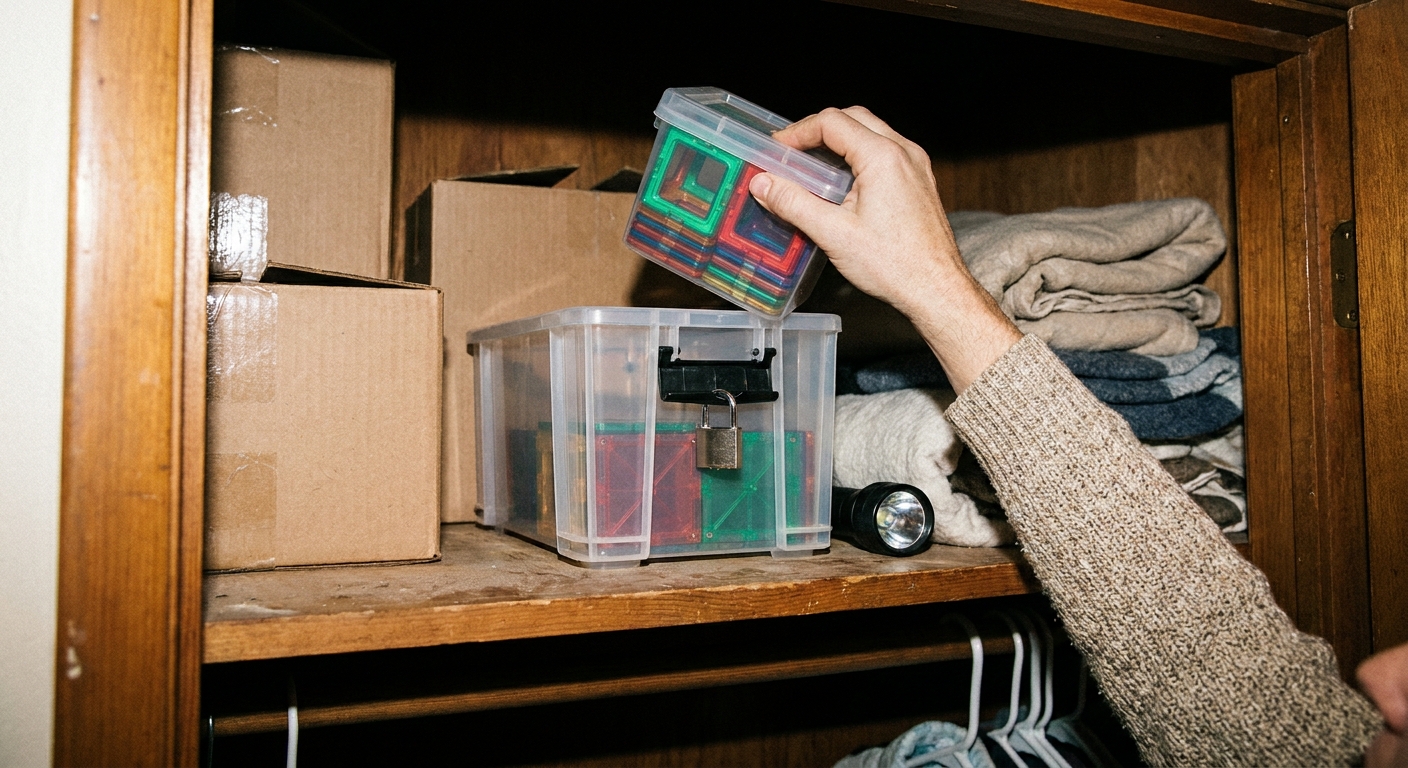
- Use a small-parts container for anything magnetic that must exist in your home, stored high and locked if possible.
Magnets vs button batteries
Many parents have heard about the danger of button batteries, and that awareness is so important. Magnets deserve the same level of respect, but for a different reason.
- Button batteries: Can cause rapid caustic injury because they generate an electrical current that creates a strong alkaline burn, especially if stuck in the esophagus.
- Magnets: Cause damage by trapping and crushing tissue between magnetic pieces, often deeper in the intestines.
Both can be emergencies. Both deserve urgent evaluation. The key difference is that magnet injuries often depend on more than one piece, and symptoms can be quieter at first.
When to call 911
Go to the nearest emergency department right away. Call 911 if your child has:
- Trouble breathing
- Severe lethargy or is hard to wake
- Signs of shock like extreme weakness, pale or clammy skin, or fainting
- Severe, worsening belly pain with a hard, distended belly
Quick checklist
- If multiple magnets are possible, treat it as urgent.
- If the number is unknown, assume more than one.
- Don’t induce vomiting or try home “clean out” remedies.
- Don’t let your child eat or drink anything on the way in.
- Call Poison Control (US: 1-800-222-1222) and head in for evaluation.
- Bring the magnet packaging or a photo if you can.
You are not overreacting. You are responding to a real risk with calm, smart action. That is exactly what your child needs.