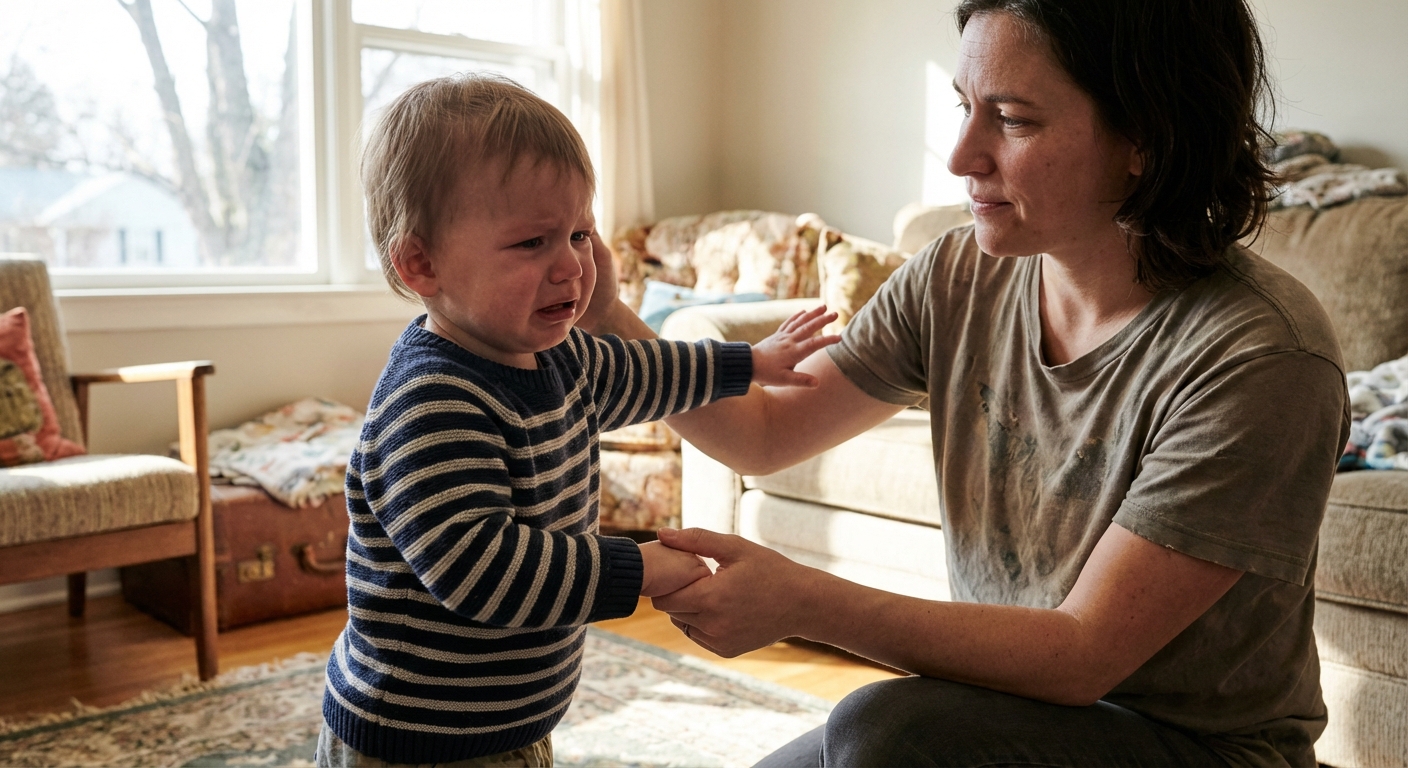
A calm, evidence-informed plan for public toddler tantrums: what to say, what to do with your body, and how to get through the moment without escalating.
Toddler Whining: Why It Happens and What to Say

Sarah Mitchell
Sarah Mitchell is a Registered Pediatric Nurse and a mother of three who has spent over a decade helping families navigate the beautiful, chaotic early years of childhood. She combines evidence-based medical knowledge with real-world parenting experience to offer practical, compassionate advice. At Awesome Parent, Sarah's mission is to help exhausted parents find solutions, trust their instincts, and finally get some sleep.
If toddler whining had a volume knob, I would have turned it down sometime around my first child’s second birthday. As a pediatric triage nurse, I could stay calm through fevers and rashes, but the long, nasal “Moooommmmmyyyyy” at 6:12 a.m. had a special talent for finding my last nerve.
Here’s the reassuring truth: whining is usually not defiance. It is a communication habit that shows up when toddlers are tired, hungry, overstimulated, or simply unsure how to ask for what they need in a calm, clear way. Your job is not to shame it out of them. Your job is to coach them through it, one short moment at a time.
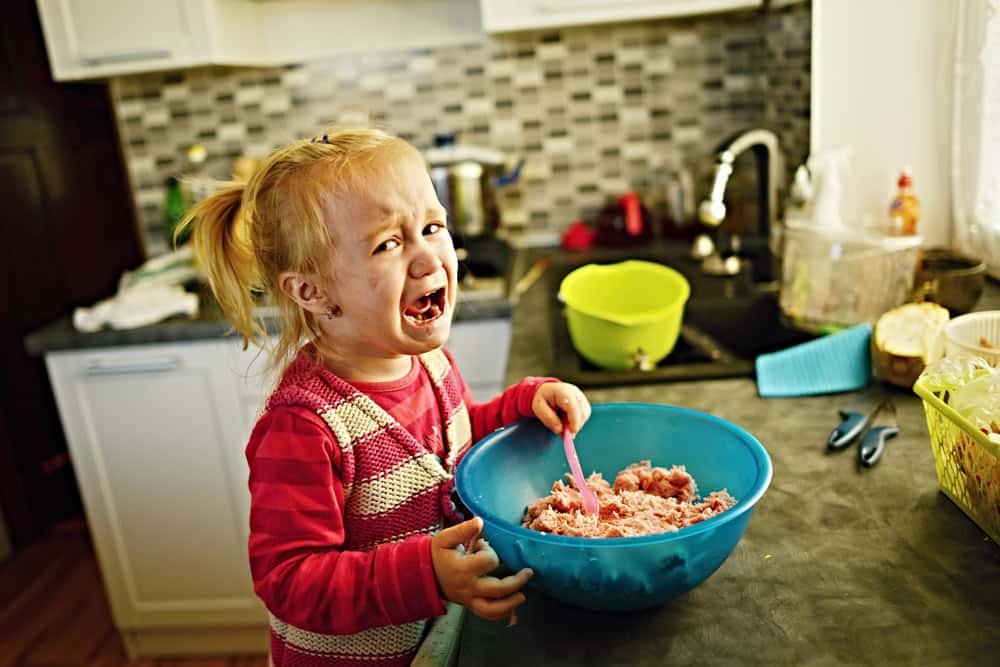
Why toddlers whine
Whining is a shortcut. It is what happens when your toddler has a big feeling and a small set of tools to express it. In the clinic, I used to tell parents: the behavior is the tip of the iceberg. Underneath is usually a need, a skill gap, or a nervous system that is running hot.
Common reasons it shows up
- It works. If whining has gotten a faster response in the past (even a frustrated one), it is likely to stick around.
- Your toddler is dysregulated. Tired, hungry, overstimulated, transitions, crowded spaces, and too much stimulation or too long of a day all raise the odds.
- Language is still catching up. Many toddlers can label objects (“truck”) before they can clearly request solutions (“I need help opening the cap”).
- They want connection. Sometimes whining is less about the snack and more about, “Are you with me right now?”
- They feel powerless. Toddlers get told “no” a lot. Whining can be a clumsy attempt to negotiate.
Also important: whining tends to spike during developmental leaps, new childcare routines, travel, sleep regressions, and after illness. Even adults get a little whiny when we are running on fumes. Toddlers just do it out loud.
Whining vs. crying vs. tantrums
It helps to name what you are dealing with, because the best response depends on the behavior.
- Whining is usually a “complaining” tone with some control still present. Your child can often repeat themselves more clearly with coaching.
- Crying is an emotional release. You can still guide language, but your first job is comfort and regulation.
- Tantrums are full-body overwhelm. They can look like screaming, dropping to the floor, throwing, or pushing away help. Reasoning and coaching come later, after your child is calm.
This article focuses on whining and the words to use in the moment. If your child is already in a full meltdown, you are not failing. You are just in a different lane.
What to say (simple scripts)
When you are exhausted, you need phrases you can say on autopilot. Aim for three steps: connect, set the boundary, then coach the skill.
1) The calm re-do
Say: “I want to help. Try that again in your strong voice.”
Strong voice means calm and clear words, not louder.
Then pause. Give your child a beat to switch gears. A lot of kids truly can, if the request is short and consistent.
2) The one-sentence prompt
Say: “Tell me what you need. Use words like ‘Help please’.”
If your toddler is younger or struggles with speech, you can offer two choices: “Do you need help, or do you need a hug?”
3) The boundary plus help
Say: “I can listen to your words, not whining. When you’re ready, I’m right here.”
This works best when you truly mean it. You are not ignoring your child. You are refusing the delivery method while staying available.
4) The empathy line
Say: “It’s hard to wait. You really want it.”
Then follow with the coaching: “Ask me with your strong voice.”
5) The public whisper
Say quietly: “I can’t understand whining. Put your hand on my arm and say, ‘Excuse me, help please’.”
Giving them a physical cue (hand on arm) is a game-changer in public because it replaces the whining with an action they can do.

Teach a stronger voice
Many kids hear “Stop whining” all day long and learn exactly nothing about what to do instead. Coaching works better than criticism. You are building a skill, not correcting a personality.
One helpful mindset shift: do not punish the feeling. Limit the behavior, and teach a better way to say the same thing.
Swap “don’t” for “do”
- Instead of: “Stop whining.”
- Try: “Use your calm voice.”
Teach a tiny script
Toddlers love predictable language. Pick one phrase and stick with it for a couple of weeks.
- “Help please.”
- “More please.”
- “I’m frustrated.”
- “Can you play with me?”
Praise the re-do
Say: “That was a strong voice. Thank you for trying again.”
Notice the effort. The point is not a perfectly cheerful tone. The point is clear communication.
Practice when calm
Do a 30-second “strong voice” game during a calm time.
- You whisper-whine: “I want waaaterrrr.”
- Your toddler laughs and says: “Water please!”
- You cheerfully: “Yes, that voice!”
This kind of silly practice lowers the shame factor and makes the new habit easier to access when emotions run high.
Consistency helps
One of the fastest ways to stretch out a whining phase is inconsistency. If one caregiver responds to whining with a quick yes and another caregiver responds with a boundary, your toddler learns to keep trying the strategy longer.
Pick one or two phrases you can all use, then stick to them:
- “Strong voice, then I can help.”
- “Try again with calm, clear words.”
- “Hand on my arm, then ask.”
When whining is a need
If whining feels constant, treat it like a clue. In triage nursing, we always asked: what changed? At home, the same idea helps. A sudden spike in whining often means your toddler is struggling with one of the basics.
Quick checklist: HALT
HALT is a simple parent mnemonic, not a medical diagnosis. It just helps you check the basics fast.
- Hungry: Whining ramps up fast when they have not eaten in a while. Try a snack with protein or fat plus a carb.
- Angry or anxious: Big feelings, tiny coping skills. Offer connection first, then words.
- Lonely: Low on connection can sound a lot like whining. Ten minutes of focused attention can reduce it more than a lecture.
- Tired: Sleep debt makes everything louder and harder, including voices.
Missing skills that sound like whining
- Transition skills: They melt when you change activities because they do not know what comes next. Visual routines and warnings help.
- Waiting skills: They whine because waiting feels like forever. Teach “first, then” language.
- Problem-solving: They want something open, built, poured, or fixed. They need the words “Help please” and the patience to try.
- Sensory overload: Bright lights, loud places, scratchy clothes, too many people. Their voice becomes the alarm.

Neurodiversity and speech
Some kids whine more because communicating is genuinely harder for them. Speech delays, apraxia, autism, ADHD, and sensory processing differences can all make it tougher to find the right words or regulate tone under stress.
If whining comes with limited language for age, frequent communication breakdowns, or intense distress that does not improve with coaching and routine support, it is worth talking with your pediatrician. Asking about a speech-language evaluation or an early intervention assessment is not “labeling” your child. It is getting them more tools.
When you’re about to lose it
I have absolutely had the moment where a child whines and I can feel my nervous system flaring right back. Your calm is a tool, not a personality trait. Use supports.
Try this 10-second reset
- Lower your voice. Quiet voices tend to pull kids in.
- Drop your shoulders. It tells your body you are safe.
- Say one line. “Strong voice, then I can help.”
Give yourself a script too
Say: “I’m feeling overwhelmed. I’m going to take three breaths, then I’ll help.”
This is not over-sharing. It is modeling. You are showing them what to do with big feelings.
Prevention that works
Whining is easier to reduce when you lower the number of times your toddler has to resort to it. Think routines, connection, and realistic expectations.
Front-load attention
Ten minutes of “I am fully with you” time, no phone, can dramatically cut down on attention-seeking whining later.
Use predictable language
- “First shoes, then outside.”
- “I hear you. After I finish this, I can help.”
- “Show me with your finger.”
Make the day snack-friendly
If your child’s whining peaks late morning or late afternoon, experiment with earlier snacks and water breaks. Many toddlers act “emotionally dramatic” when they are simply running low on fuel.
Offer small choices
Choices reduce power struggles, which reduces whining.
- “Do you want the red cup or the blue cup?”
- “Do you want to hop to the bath or walk to the bath?”
When to worry
Most whining is developmental. But as a nurse, I always want parents to trust the pattern change. If your child is suddenly much whinier than usual, look for signs that they feel unwell or uncomfortable.
Consider a basic health check if it is new
- Fever or a child who feels warm and is not acting like themselves
- Ear pain signs like tugging ears, poor sleep, increased irritability, or crying when lying down
- Sore throat or mouth pain with reduced eating or drooling
- Constipation like hard stools, belly pain, or avoiding the toilet
- Teething (yes, even after age 2, molars can be miserable)
- Sleep disruption from illness, nightmares, or changes in schedule
Call your pediatrician or seek urgent care if
- Your gut says your child is sick and the behavior change is significant
- Whining comes with lethargy, trouble breathing, signs of dehydration (much fewer wet diapers than usual, very dark urine, dry mouth, no tears when crying), or severe pain
- Your child has a fever and seems unusually irritable, inconsolable, or weak
If you are unsure, you are not “overreacting.” This is exactly what pediatric nurse lines and clinics are for.
Troubleshooting
Whining while you’re busy
Say: “I hear you. Put your hand on my arm. I can help in two minutes.”
Then follow through. If two minutes becomes twenty, your toddler will go right back to what works.
Whining after you said no
Say: “My answer is no. You can be mad. If you want something else, ask in your strong voice.”
Key: do not negotiate with whining. If you change your mind because of the tone, the tone gets stronger next time.
Whining you cannot understand
Say: “I can’t understand. Show me.”
Then offer two likely options: “Do you mean water or milk?” This reduces frustration for kids with developing speech skills.
Whining that ends with you snapping
Say: “I’m sorry I yelled. I got overwhelmed. Let’s try again. Use your strong voice.”
Repair matters. You are teaching that families can reset after hard moments.
FAQ
Should I ignore whining?
Not entirely. I prefer selective attention: you stay emotionally available, but you do not reward the whining with a big reaction or a quick yes. You respond warmly the moment your child shifts to a clearer voice.
Is whining normal at age 3 or 4?
Yes. It often improves as language, impulse control, and frustration tolerance grow. Many 3 to 4 year olds still whine when tired, hungry, or overstimulated. Consistent coaching helps.
What if my toddler says, “But I am using my nice voice”?
You can stay playful and specific: “Try your calm voice, like this.” Then model one simple sentence. Some kids genuinely do not hear their own tone yet.
What if it is constant no matter what I do?
Look for patterns: time of day, before meals, after daycare, during transitions, around screens, or when you are busy. If it feels relentless for weeks or your child seems unusually irritable, it is reasonable to check in with your pediatrician to rule out sleep problems, constipation, ear issues, or other discomfort. If communication seems hard for your child, ask about a speech-language evaluation too.
Takeaway
Whining is information. Your toddler is telling you, “I can’t do this the calm way yet.” Meet the need when you can, hold the boundary when you must, and coach the stronger voice every time.
If you want one sentence to keep in your pocket, make it this: “I want to help. Try again in your strong voice.”
Sarah Mitchell
Sarah Mitchell is a Registered Pediatric Nurse and a mother of three who has spent over a decade helping families navigate the beautiful, chaotic early years of childhood. She combines evidence-based medical knowledge with real-world parenting experience to offer practical, compassionate advice. At Awesome Parent, Sarah's mission is to help exhausted parents find solutions, trust their instincts, and finally get some sleep.