Toddler Won’t Take Medicine: Tricks That Actually Work

Sarah Mitchell
Sarah Mitchell is a Registered Pediatric Nurse and a mother of three who has spent over a decade helping families navigate the beautiful, chaotic early years of childhood. She combines evidence-based medical knowledge with real-world parenting experience to offer practical, compassionate advice. At Awesome Parent, Sarah's mission is to help exhausted parents find solutions, trust their instincts, and finally get some sleep.
If you have ever tried to give medicine to a toddler who suddenly develops the strength and stubbornness of a tiny Olympic wrestler, welcome. You are not failing. You are parenting a completely normal toddler with excellent survival instincts and very strong opinions about cherry flavor.
As a pediatric nurse and a mom of three, I can tell you two things are true at the same time: medicine matters, and forcing it in a scary way can backfire fast. The goal is simple: get the right dose in as calmly and safely as possible, with the least drama you can manage on zero sleep.
Safety first (quick but important)
- Avoid mixing medicine into a full bottle or big cup. If they do not finish it, you cannot know the dose they got. If you must mix, use a small, measured amount of food or drink instead (think 1 to 2 teaspoons).
- Use only the dosing device that came with the medicine (or a pharmacy oral syringe). Kitchen teaspoons are often inaccurate.
- Measure in mL and double-check the concentration. Infant and children’s versions can differ. When in doubt, ask your pharmacist to confirm the dose in mL.
- Check the expiration date and storage instructions. Some antibiotics expire quickly once mixed.
- Do not crush or open pills unless your pharmacist or pediatrician says it is OK. Some are extended-release or coated for a reason.
- Do not give honey to children under 12 months.
- Avoid numbing sprays or gels to “help them swallow” unless specifically prescribed. Anything that numbs the mouth can interfere with normal gag and swallow protection.
- If they vomit right away, call your pharmacist or pediatrician for guidance on whether to repeat the dose. The answer depends on the medication and timing.
- If they spit out some and you are not sure how much they swallowed, do not automatically re-dose. Call your pharmacist or pediatrician for guidance.
- Lock up medications immediately after use. Flavoring helps, but it can also make medicine more tempting. Put it away right after you measure the dose.
Start with the easiest win: make it taste less awful
Ask the pharmacy to flavor it
If your child’s medicine is from a pharmacy (antibiotics are the big one), ask about flavoring. Many pharmacies can add kid-friendly flavors or adjust bitterness. It is not magic, but it can move you from “absolutely not” to “begrudgingly fine.”
Chill it (when allowed)
Cold temperatures can dull taste. If the label says refrigerate, great. If it does not, you can still ask your pharmacist whether chilling is OK. Do not freeze medication.
Offer a “chaser”
For kids over 1, a strong-flavored chaser can help: a sip of water, milk, juice, or a bite of something like yogurt or applesauce right after. If your child is taking an antibiotic or another prescription, check with your pharmacist about food and drink pairing (some medicines do not play nicely with dairy or certain juices).

The technique that changes everything for liquid medicine
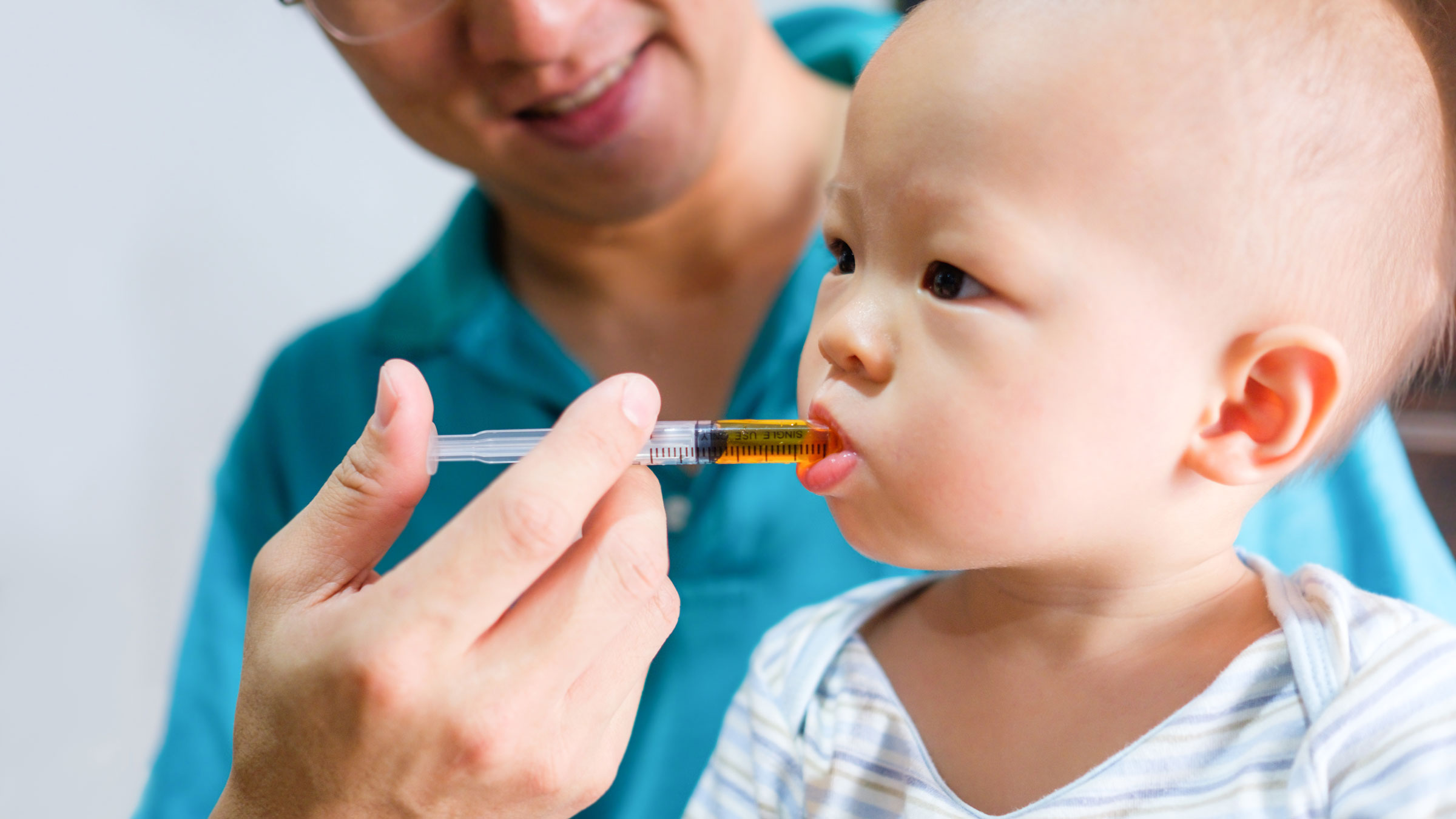
Most medicine battles are not about the medicine. They are about the delivery. The goal is to aim for the cheek pocket, not straight down the throat.
Step-by-step syringe method
- Sit them upright. On your lap facing sideways works well. Avoid giving medicine lying down.
- Insert the syringe along the inside of the cheek toward the back molar area (the “cheek pocket”).
- Give small squirts and let them swallow between. For bigger doses, you are working in a few steady pushes, not one big blast.
- Keep the chin neutral or slightly down. A chin-up position can increase gagging.
- Pause if they’re crying hard. Big sobbing breaths make swallowing harder.
Why this works: It avoids triggering the gag reflex and reduces the chance of coughing or choking.
The “two-person helper” hold (when needed)
If you need backup, one adult can cuddle-hold gently while the other administers. You are not pinning them down. You are keeping them safe and steady. If your child is escalating into panic or someone might get hurt, stop, reset, and try again later or call for help.
- Adult 1: toddler on lap, arms hugged in, legs between your legs.
- Adult 2: syringe into cheek pocket, slow dosing.
If your toddler is extremely distressed, it is okay to take a short break and try again with a calmer reset.
Mixing medicine with food: what works
Mixing can be a lifesaver, as long as you do it safely and strategically.
Rules for safe mixing
- Use a tiny amount of food or drink, like 1 to 2 teaspoons, so you know they finished it.
- Choose something strong-flavored and familiar (yogurt, pudding, applesauce, chocolate syrup, smoothie spoonful).
- Confirm with the pharmacist if you are unsure. A few medications should not be taken with certain foods or drinks.
Best “hider” foods for many toddlers
- Applesauce or fruit puree
- Yogurt (especially vanilla)
- Pudding
- Jam or jelly (tiny amount)
- Nut butter for kids who already eat it safely (tiny amount on a spoon)
Common mixing mistakes
- Putting it in a full sippy cup and praying. If they refuse halfway, you are stuck.
- Mixing into a favorite comfort food they eat when sick. If they detect the medicine, you may ruin that food for months. Pick a “medicine-only” food.
- Using too much liquid. More volume means more time to notice the taste.
- Using hot food or drinks. Heat can affect some medications. Ask your pharmacist first.

Chewable medicine: making it doable
Chewables can be easier than liquid for some kids, but only if they will actually chew and swallow.
Do a “practice chew” first
Try a quick dry run with something safe and familiar, like a small bite of a chewy food your child already eats well (for example, a gummy-texture fruit snack for older kids who already handle that texture safely, a piece of bread, or a bite of banana). Avoid comparing medicine to candy or calling it candy. Poison prevention experts recommend keeping a clear boundary so kids are less likely to seek out medicine later.
(If your child is under 4 or tends to swallow without chewing, skip this and ask your pediatrician what is safest.)
Offer choices that do not change the dose
- “Do you want the chewable with water or with yogurt?”
- “Do you want to chew it on this side or that side?”
- “Do you want to take it before or after we put on pajamas?”
If they hate the texture
Ask the pharmacist if the chewable can be crushed and mixed into a small spoonful of food. Some can, some should not. Always check first.
The gentle puff trick (sometimes works)
This is an old clinic trick that can help a toddler swallow when they are holding medicine in their mouth like a tiny camel. It does not work for every child, and it should never feel scary.
How to try it
- Place the medicine in the cheek pocket with the syringe.
- If they pause and refuse to swallow, gently blow a quick puff of air toward their face (around the nose and upper lip area).
- In some kids, it can trigger a swallow.
Skip this trick if: your child is fearful of it, is in respiratory distress, is coughing or choking, or you are worried about aspiration. When in doubt, use the slower cheek-pocket method and call your pediatrician if you cannot get the dose in.
Make it routine, not a negotiation
Toddlers pick up on our energy fast. A calm, confident routine often works better than a long explanation.
A simple script you can borrow
“This medicine helps your body feel better. You do not have to like it. Then we are all done and we can pick a book.”
Use a tiny reward right after
This is not bribery, it is reinforcement. Think immediate and small:
- A sticker
- Choosing the bedtime story
- Two minutes of a favorite song
- A high five and a big “You did it”
Try not to offer the reward as a threat or bargaining chip. Give it as the predictable next step after medicine.
Ask about a different form
If you have tried good technique and your toddler still cannot take it, you have options. Call your pediatrician or pharmacist and ask what else is available.
Options that may exist
- Different flavors or a different brand
- Smaller volume, higher concentration so there is less to swallow (only if prescribed and dosed correctly)
- Chewable tablets
- Orally dissolving tablets
- Rectal acetaminophen may be an option in some countries or settings for fever or pain when oral dosing is not possible (ask your pediatrician)
- In-office dose or a different antibiotic if the current one is not workable
Please do not change the dose, concentration, or schedule on your own. Dosing errors happen easily when you are exhausted.
What not to do
- Do not hold their nose closed to force swallowing.
- Do not squirt liquid straight to the back of the throat. It increases choking and vomiting risk.
- Do not threaten (“If you do not take it, we are going to the hospital”). Medicine time should feel steady and safe.
- Do not double dose because you are unsure how much went in. Call for guidance.
- Do not call medicine “candy.” Keep language clear and boring: medicine is medicine.
When refusal is urgent
Sometimes the medicine matters enough that we need help quickly.
Call your pediatrician same day if:
- Your child is refusing an antibiotic completely or repeatedly vomiting doses
- Your child needs medication for breathing issues, seizures, or another serious condition and you cannot get it in
- Your child is in significant pain and cannot keep pain medicine down
Seek urgent care now if:
- There are signs of dehydration (very dry mouth, no tears when crying, significantly fewer wet diapers or urination)
- Your child is very sleepy, hard to wake, or has worsening symptoms
- You suspect your child received the wrong medicine or wrong dose
If you suspect a dosing error or your child got into medicine, call your local poison center for immediate guidance. In the US, Poison Control is 1-800-222-1222 (or poisonhelp.org). If your child is having trouble breathing, collapses, or is having a seizure, call emergency services.
Quick troubleshooting
If they spit it out
- Try smaller squirts into the cheek pocket.
- Offer a chaser immediately after (and check food interactions if this is a prescription).
- Consider mixing into a tiny spoonful of yogurt or applesauce (if allowed).
- If you are not sure how much stayed in, do not automatically re-dose. Call your pharmacist or pediatrician.
If they clamp their mouth shut
- Try offering control: “You can hold the syringe.”
- Use the “medicine sandwich”: sip of drink, medicine, sip of drink.
- If needed, gently aim for the corner of the mouth and cheek pocket when they open to protest.
If they vomit every time
- Ask about flavoring or a different formulation.
- Give slowly, with pauses.
- Talk to your pediatrician before repeating doses.

One last thing from a nurse-mom
If medicine time is a mess in your house, you are in very good company. Pick two strategies from this list and try them consistently for 24 to 48 hours. Most families find their groove once the toddler realizes the routine is calm, brief, and predictable.
And if you need permission to call your pediatrician and say, “We cannot do this medicine,” you have it. There are almost always options, and you do not have to white-knuckle it alone.