Tummy Time Tips for Newborns Who Hate It

Sarah Mitchell
Sarah Mitchell is a Registered Pediatric Nurse and a mother of three who has spent over a decade helping families navigate the beautiful, chaotic early years of childhood. She combines evidence-based medical knowledge with real-world parenting experience to offer practical, compassionate advice. At Awesome Parent, Sarah's mission is to help exhausted parents find solutions, trust their instincts, and finally get some sleep.
If tummy time feels like an instant “why are you doing this to me?” protest, you are not alone. In the clinic, I saw parents feel guilty about it every single day. And at home, I had one baby who tolerated it and one who acted like I was casting him for a dramatic, very loud role.
The good news: tummy time does not have to look like a calm baby on a blanket for 20 minutes straight. Some advice makes it sound like that is the goal, but for many newborns it is a bunch of short, creative little moments sprinkled through the day. That still counts. It still helps.

Why tummy time matters
Tummy time is simply time spent awake on your baby’s belly (with an adult watching closely). It helps build the muscles and coordination babies need for big milestones later.
- Neck and shoulder strength: lifting and turning the head is the first step toward rolling, sitting, and crawling.
- Core and upper body stability: pushing up through the arms helps develop the chest, back, and tummy muscles.
- Motor skills: babies learn to shift weight, reach, and eventually pivot.
- Head shape support: it reduces how much time the back of the head rests on a flat surface, which can help lower the risk of a flat spot.
It is also a small but meaningful way to balance modern safe sleep guidance. Babies should always sleep on their backs, but they also need awake time in different positions to build strength.
When to start tummy time
For most healthy newborns, you can start right away, as soon as you are home and your baby is awake and calm. Start very small, think 20 to 60 seconds, a couple times a day, then build from there. In real life, many families find it easiest to begin with chest-to-chest tummy time and then work down to the floor.
If your baby was born early, has medical issues, or you have been told to limit certain positions (for example after surgery or with certain airway concerns), check in with your pediatrician or therapist about timing and positioning.
How much tummy time by age
Think in total minutes per day, not one long session. These are realistic aim for ranges that match common pediatric guidance (and real-life baby tolerance). If your baby is doing less right now, you are not behind. Just keep offering opportunities and let it build.
| Age | Aim for (total per day) | What it often looks like |
|---|---|---|
| 0 to 2 weeks | 1 to 5 minutes | Chest-to-chest or on your lap; 20 to 60 seconds per attempt |
| 2 to 8 weeks | 10 to 30 minutes | Short sessions throughout the day; after diaper changes, a few minutes each |
| 2 to 3 months | 20 to 40 minutes | More comfortable forearm propping, longer stretches possible |
| 3 to 4 months | 30 to 60 minutes | Play-based tummy time, reaching, weight shifting, pivoting |
| 4 to 6 months | 45 to 90+ minutes | Lots of floor play, rolling in and out of tummy, pushing up stronger |
Important: If your baby screams at 30 seconds, start at 10 seconds. Truly. Ten seconds done consistently is more useful than 5 minutes that ends with everyone sweaty and upset.
Quick note on sources: You will see different minute goals depending on who you ask (AAP, NHS, pediatric PTs, and individual pediatricians). The trend is what matters: start early, go short, and gradually work up.
Safety basics
- Awake only: tummy time is for awake time, always supervised.
- Firm, safe surface: the floor on a blanket or play mat is usually best.
- Close supervision: supervised does not mean “I am in the next room.” Stay close enough to see your baby’s face and help quickly.
- Avoid soft or elevated spots: no unsupervised tummy time on beds, couches, pillows, or fluffy surfaces where babies can sink in or roll off.
- Back to sleep: if your baby gets drowsy, gently place them on their back in a safe sleep space.
- Comfort matters: avoid tummy time right after a big feeding if reflux is an issue. Try after a diaper change or after a short upright cuddle.
If your newborn cries, try this
Many babies cry because tummy time is hard work. They are lifting a head that feels enormous, pushing against gravity, and learning a brand-new skill. That does not mean you are doing it wrong.
1) Chest-to-chest tummy time
Lie back on the couch or bed (awake, alert, and not sleepy) and place your baby on your chest so their tummy is against you. Your body creates a gentle incline, and your face is the most interesting toy in the world.
- Start with 20 to 60 seconds.
- Talk, sing, or just breathe slowly. Babies pick up on our nervous energy.
- As they get stronger, recline a little less so they work a bit more.

2) Tummy time on your lap
Sit down and place your baby across your thighs on their tummy, with their head turned to one side. This counts as tummy time and often feels less overwhelming than the floor.
3) Rolled towel support (with supervision)
If your baby face-plants and gets furious, use a small tightly rolled towel or receiving blanket under the chest and armpits (not under the belly), with arms forward. This helps them lift their head and see the world without working quite as hard.
- Keep the roll small, especially for newborns.
- Avoid soft pillows or bulky props that let baby sink in.
- Stay close and watch their face and breathing.
- As strength improves, gradually reduce the support.

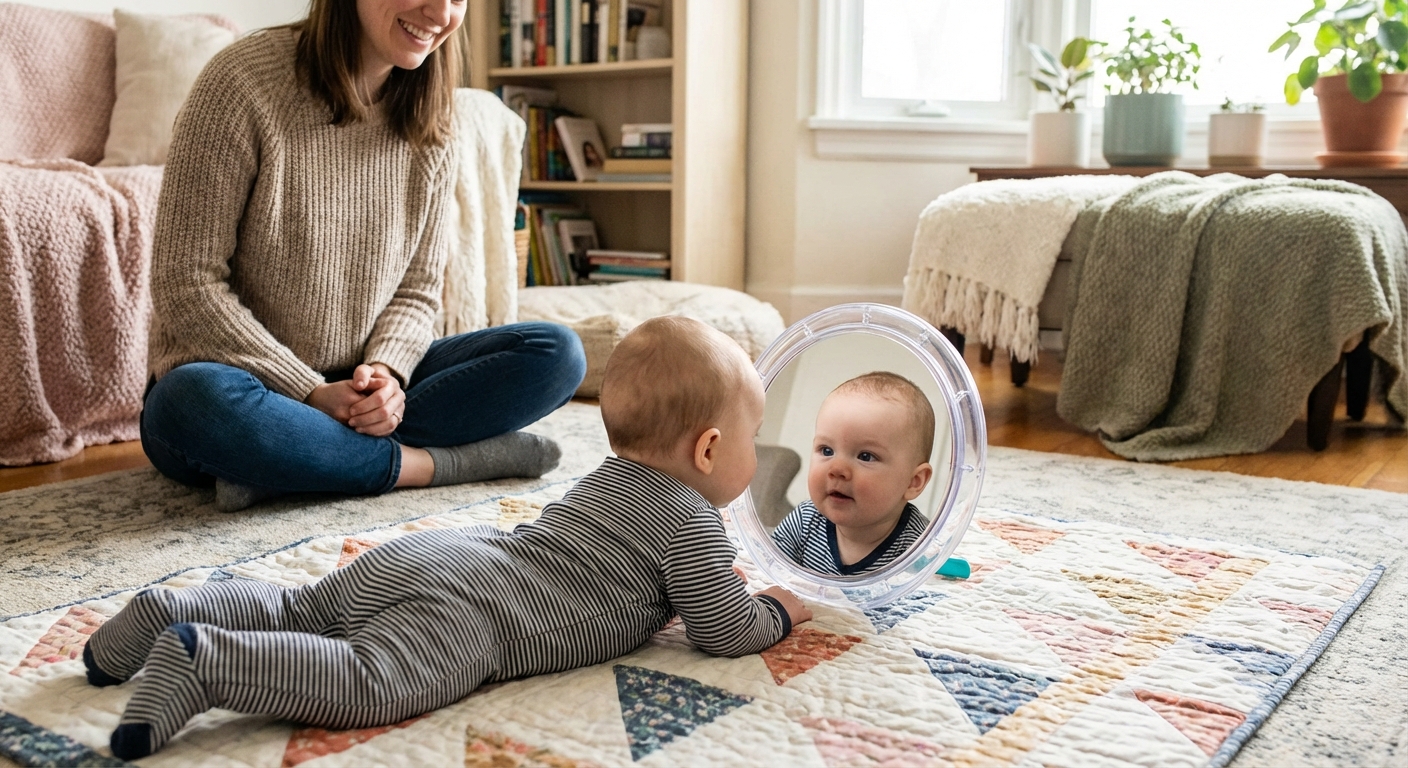
4) Mirror play
Place an unbreakable baby mirror in front of your baby during tummy time. Seeing a face looking back is surprisingly motivating. You can also get down at eye level and make silly expressions. This is one of my highest-yield “effort to reward” tricks.
5) Towel “sling” to help elbows under shoulders
If your baby is sliding and getting mad, place a small rolled washcloth or thin towel across the upper chest (right below the collarbones) like a little hammock, with the ends coming out near each armpit. Gently hold the ends to give a tiny bit of lift so your baby can bring elbows under shoulders and prop on forearms.
- Keep their nose and mouth clear. If their face is pressed down, reset the position or stop.
- Think “tiny assist,” not pulling. Your baby should still be doing the work.
6) Micro-sessions all day
Instead of “we must do tummy time at 2 PM,” attach it to things you already do:
- After each diaper change: 10 to 30 seconds
- After a nap: 20 to 60 seconds before feeding
- After a short upright cuddle: 1 to 2 minutes on the floor
7) Know when to stop
If your baby is crying hard, face planted, and escalating, take a break. Comfort them. Reset. Try again later. The goal is steady progress, not a daily struggle session.
What “progress” can look like
- Brief head lifts, then longer head lifts
- Turning the head both directions more easily
- Forearm propping (elbows under shoulders) for short stretches
- Less “face-plant,” more looking around
Flat head concerns
A flat spot (often called positional plagiocephaly) is common, especially since back-sleeping became standard for safe sleep. Tummy time helps by reducing pressure on the back of the head while building neck strength, which helps babies turn their heads more easily.
But tummy time is only one piece. These also help:
- Alternate head direction during sleep: you can vary which direction your baby naturally faces by switching the orientation of their feet and head in the crib. Keep baby on their back for sleep.
- Lots of “container-free” time: reduce long stretches in car seats, swings, and bouncers when you are home and awake.
- Carry your baby: babywearing and upright cuddles take pressure off the skull.
- Encourage looking both ways: place interesting things on the non-preferred side during awake time.
If you notice your baby strongly prefers looking one direction, seems uncomfortable turning their head, or the flat spot is getting more noticeable, bring it up at your next visit. Sometimes tight neck muscles (torticollis) need targeted stretches or physical therapy, and earlier support usually means faster improvement.
Common questions
My baby spits up during tummy time. Should I stop?
Some spit-up is normal. If your baby seems uncomfortable, try tummy time before a feeding or wait 20 to 30+ minutes after, or simply until your baby seems comfortable. Shorter, more frequent sessions can be easier on reflux. If your baby is choking, turning blue, having breathing trouble, or vomiting forcefully, stop and call your pediatrician.
Does tummy time have to be on the floor?
No. Chest-to-chest, lap time, and carrying positions all help build strength. Floor time becomes more important as babies get older and start pushing up, reaching, and pivoting.
What if my baby falls asleep on their tummy?
Gently move them to their back in a safe sleep space. Tummy time is for awake play only.
My baby hates it. Am I failing?
No. You have a normal baby with strong opinions. Your job is not to force long sessions. Your job is to keep offering safe opportunities in small doses, in ways your baby can tolerate, and to slowly build their endurance.
When to call the pediatrician
Reach out if you notice any of the following:
- Your baby always keeps their head turned to one side or has trouble turning both ways
- A flat spot that is worsening despite repositioning and tummy time
- Very stiff or very floppy muscle tone
- Not meeting expected motor milestones (your pediatrician can guide what is typical for your baby’s age)
- Breathing difficulty, color changes, or unusual distress during tummy time
A simple plan for this week
If you want something you can actually follow while sleep-deprived, try this:
- Days 1 to 2: 5 micro-sessions of 10 to 20 seconds (mostly chest-to-chest)
- Days 3 to 5: 5 micro-sessions of 20 to 40 seconds (add rolled towel support on the floor once or twice)
- Days 6 to 7: 6 micro-sessions of 30 to 60 seconds (add mirror play)
That is it. You are building a habit and your baby is building strength. Both take time.
If tummy time is going badly, aim for “a little bit better” not “perfect.” Parenting is long. Newborns are loud. You are doing fine.