When Do Babies Roll Over?

Sarah Mitchell
Sarah Mitchell is a Registered Pediatric Nurse and a mother of three who has spent over a decade helping families navigate the beautiful, chaotic early years of childhood. She combines evidence-based medical knowledge with real-world parenting experience to offer practical, compassionate advice. At Awesome Parent, Sarah's mission is to help exhausted parents find solutions, trust their instincts, and finally get some sleep.
Rolling over is one of those milestones that feels small until it suddenly is not. One day your baby is a sweet little potato, and the next you look away for two seconds and they have somehow rotated like a tiny, determined rotisserie chicken.
Most babies roll over sometime between 3 and 6 months, but there is a wide range of normal. Some babies roll early (often tummy to back), pause for a bit, then later master the other direction. Others take their time and then roll both ways in the same week. And yes, some healthy babies do not roll until closer to 7 to 8 months, especially if they prefer sitting practice, have less floor time, or are simply unbothered by getting from Point A to Point B.
Typical age range
Rolling usually develops in two directions, and they do not always happen in the order you expect.
Tummy to back
- Common age: around 3 to 5 months
- Why it can happen earlier: Some babies accidentally “roll” from tummy to back because their head is heavy and their weight shifts. That still counts as progress, even if it is not fully intentional yet.
Back to tummy
- Common age: around 4 to 7 months
- Why it can take longer: This direction requires more trunk strength and coordination, plus a little determination.
Keep in mind: Premature babies are often assessed by adjusted age (based on due date). If your baby was born early, it can be totally normal for rolling to show up a bit later on the calendar.
Signs baby is close
In clinic, I always told parents to look for patterns, not one dramatic moment. These are the common “I am gearing up” signs:
- Rocking side to side while on their back, especially with hips and legs leading the movement
- Rolling to the side and getting “stuck” there, looking very proud of themselves
- Feet-to-mouth play, which builds core strength and body awareness
- Pushing up on forearms during tummy time with a steady head
- Pivoting on the tummy or doing a little “swim” motion with arms and legs
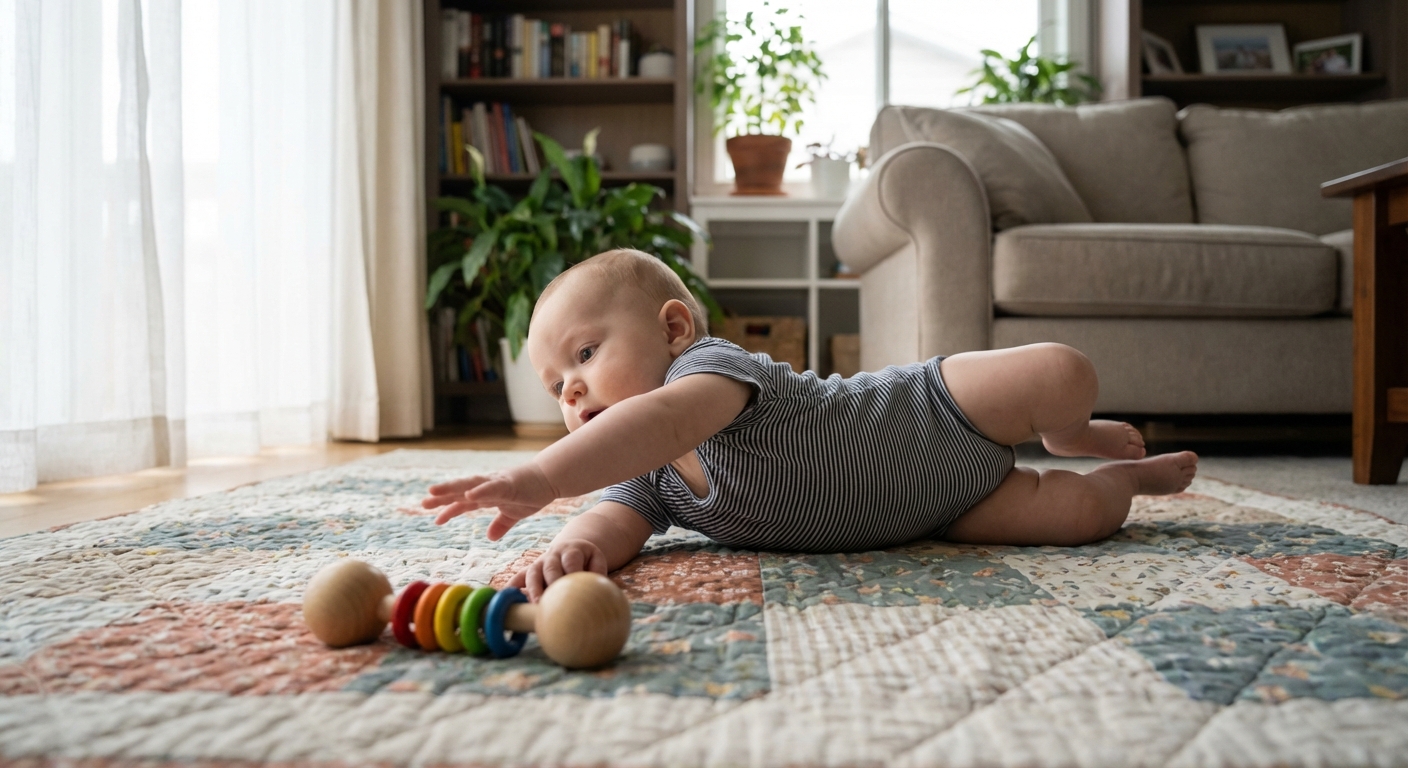
- Reaching across the body for toys (that cross-body reach often triggers a roll)
- Less tolerance for being placed down in one position, because they are trying to move
A quick extra sign to watch: If your baby consistently rolls or twists only to one side for weeks, or always arches hard and throws the head back, that is worth mentioning at a checkup. It can be nothing, or it can point to something fixable like torticollis, reflux-related positioning, or a strength imbalance.

How to encourage rolling
Your job is not to “teach” rolling as much as it is to set up the right opportunities for strength, practice, and motivation. Think: small daily reps, like brushing teeth.
1) Do tummy time
Tummy time is the engine behind rolling, sitting, and crawling. If your baby dislikes it, aim for many short sessions instead of one long battle.
- Start with 1 to 2 minutes, several times a day, and build up.
- Try tummy time on your chest, across your lap, or on a firm mat.
- Get down on the floor at eye level. Your face is premium entertainment.
2) Try the “toy to the side” trick
Place an interesting toy slightly to the side, not directly above. Encourage your baby to reach across their body. That cross-body reach is what gets the hips and shoulders to follow.
3) Practice side-lying play
Side-lying is an underrated bridge position. It helps babies learn how it feels to shift weight and engage the core.
- Lay your baby on their side with a rolled towel behind their back for support (only during supervised play).
- Offer a toy in front of them to reach for.
- Switch sides.
4) Help them feel the motion
During supervised play, you can guide a roll by moving the hips first, then letting the shoulders follow.
- From back: bring one knee across the body toward the opposite side.
- Pause, then let the body follow naturally.
- Keep it slow and playful. If your baby stiffens or fusses, take a break.
5) Give space and traction
- Use a firm, flat surface like a play mat on the floor.
- Avoid practicing rolling on soft beds or couches (unsafe and harder to push against).
- Limit time in containers (swings, bouncers, loungers) so baby has more floor time to move.
What not to do:
- Do not prop your baby in positions they cannot get into themselves for long periods.
- Skip using props to “hold” a baby on their side.
- Skip “walking” practice where you hold them upright and bounce. It is not needed for rolling and may be overstimulating for some babies.
Rolling in sleep
This is the part that wakes parents up at night, and I get it. Rolling is exciting until it happens at 2:13 AM and your brain starts writing a disaster screenplay. The goal here is simple: safe setup, consistent routine, and less midnight gymnastics for you.
Always start on the back
Follow safe sleep guidance: place your baby on their back for every sleep (naps and nighttime) on a firm, flat sleep surface.
If baby rolls in the crib
Once babies can roll and they do it on their own, most pediatric safe-sleep guidance is essentially: keep placing them on their back, but you do not need to flip them back over all night, as long as the sleep space is safe.
That safe setup matters a lot:
- The crib or bassinet is empty (no pillows, blankets, stuffed animals, bumpers).
- Your baby is not swaddled.
- The mattress is firm with a fitted sheet only.
- No sleep positioners, wedges, or “anti-roll” products.
- Avoid weighted sleep products unless your pediatrician has specifically advised otherwise.
If your baby rolls onto their tummy and gets upset because they cannot comfortably roll back yet, you can reposition for comfort when you notice. Think of it as a soothing choice, not a required all-night flipping mission.
Stop swaddling on time
Swaddling becomes unsafe once rolling is approaching. Many pediatric and safe-sleep organizations advise stopping swaddling at the first signs of rolling or by about 8 weeks, whichever comes first. Also follow your pediatrician’s advice and any product instructions for your specific swaddle.
- Switch to a sleep sack that allows free arm movement.
- Keep the crib clear so rolling does not introduce new hazards.
Crib checklist
- Lower the mattress if your baby is pushing up or getting higher on hands and knees.
- Remove mobiles that are within reach.
- Keep sleep surfaces separate from adult beds and couches.

Timeline: rolling to crawling
Milestones overlap and do not always come in a tidy order, but here is a realistic range many families see.
| Milestone | Typical range | What it often looks like first |
|---|---|---|
| Rolling tummy to back | 3 to 5 months | Weight shift, “accidental” roll, quick flip during tummy time |
| Rolling back to tummy | 4 to 7 months | Side-lying, legs swing over, shoulders follow |
| Sitting with support | 4 to 6 months | Tripod sit (hands on floor), brief upright time with help |
| Sitting independently | 6 to 9 months | Sits without toppling, can play with hands free |
| Crawling (varies a lot) | 6 to 12 months | Rocking on hands and knees, belly crawling, backward “crawling” first |
If your baby is rolling later but showing steady progress in head control, pushing up during tummy time, and reaching for toys, that is usually reassuring.
When to call the doctor
Every baby develops on their own schedule, and some healthy babies simply take the scenic route. That said, reach out to your pediatrician or a pediatric physical therapist if you notice any of the following:
- By about 6 months, your baby is not attempting to roll in either direction and dislikes tummy time intensely despite gradual practice.
- Your baby seems very stiff (arched back, rigid limbs) or very floppy with limited head control.
- You notice a strong preference for turning the head one way, a flat spot developing, or a consistent one-sided movement pattern (possible torticollis).
- Your baby rolls only to one side for a long stretch and cannot seem to access the other side.
- There is a loss of skills they previously had.
Trust your gut. If something feels off, you are not overreacting. You are paying attention, and that is good parenting.
Quick FAQs
Can babies roll at 2 months?
Occasionally, yes, especially tummy to back, but it is often more of a weight shift than a fully controlled roll. Either way, if your baby is showing signs, stop swaddling and keep sleep spaces clear.
Should I keep doing tummy time after rolling starts?
Yes. Rolling is just one step. Tummy time continues to build the strength needed for sitting and crawling.
My baby rolls to their tummy and screams. Normal?
Very normal. They got the “go” gear but not the “reverse” gear yet. Help them practice rolling back during the day, and offer breaks in tummy time so they do not get stuck in frustration mode.
Bottom line
Most babies roll over between 3 and 6 months, with tummy to back often coming first and back to tummy following as core strength grows. Some healthy babies roll later, and progress matters more than the calendar. Focus on daily tummy time, side-lying play, and lots of floor time. And once rolling starts, update your safe sleep plan: back to sleep, no swaddle, empty crib.
Note: This article is for general education and is not a substitute for medical advice. If you have concerns about your baby’s movement or sleep safety, check in with your pediatrician.
If you want more milestone help, you are in the right place. You bring the baby. I will bring the calm voice and the coffee.