When Do Babies Sleep Through the Night?

Sarah Mitchell
Sarah Mitchell is a Registered Pediatric Nurse and a mother of three who has spent over a decade helping families navigate the beautiful, chaotic early years of childhood. She combines evidence-based medical knowledge with real-world parenting experience to offer practical, compassionate advice. At Awesome Parent, Sarah's mission is to help exhausted parents find solutions, trust their instincts, and finally get some sleep.
If you have ever whispered, “When will my baby sleep through the night?” into a dark nursery at 3 AM, you are in very good company. As a pediatric nurse and a mom of three, I can tell you two things are true at the same time: night waking can be completely normal, and it can also be completely exhausting.
This page will give you the realistic answer, not the internet-myth answer. We will define what “sleeping through the night” actually means, what’s typical month by month, what influences it (feeding, sleep associations, temperament, and more), and when it is worth looping in your pediatrician.
Quick note: These ranges are general, not medical advice. Always follow your clinician’s guidance, especially if your baby was premature, has growth concerns, or has a medical condition.

What “sleeping through” means
Here is the first big plot twist: “sleeping through the night” does not mean what most sleep-deprived parents mean by it.
In research and many pediatric settings, it is often defined as:
- A 6 to 8 hour stretch without needing a caregiver.
- Sometimes one brief wake that baby settles from quickly is still considered “sleeping through” in practical terms.
Most parents, understandably, mean: “My baby goes down at bedtime and I do not see them again until morning.” That longer stretch is possible for many babies later in the first year, but it is not the standard at 8 weeks, and it is not a parenting failure if it is not happening yet.
Also important: babies still wake
Even great sleepers have partial arousals between sleep cycles. The difference is whether they can drift back off without a full “I need you” wake-up.
Timeline by month
Every baby is their own little person, so think of this as a set of common ranges, not a deadline. Premature babies often follow their own timeline based on adjusted age, and babies with reflux, feeding issues, or medical concerns may need more time and support.
Sleep also looks different across families and cultures. What matters most is that your baby is safe, thriving, and that your plan is sustainable for your home.
Newborn (0 to 4 weeks)
- Common range: 1.5 to 3 hour stretches, day and night.
- Why: Tiny stomachs, frequent feeding needs, immature circadian rhythm.
- Through the night: Not a thing yet, and that is normal.
1 to 2 months (4 to 8 weeks)
- Common range: 2 to 4 hour stretches, occasionally a longer one.
- Often looks like: One longer stretch early in the night, then more frequent waking.
- Focus: Start building gentle routines and strong day-night cues.
2 to 3 months (8 to 12 weeks)
- Common range: 3 to 5 hour stretches, some babies hit 6 hours.
- What may change: More predictable bedtime, longer first stretch.
- Still normal: 1 to 3 night feeds for many babies.
3 to 4 months
- Common range: Some babies can do a 6 to 8 hour stretch, many still wake more often.
- Why it can feel harder: Sleep matures and cycles become more adult-like. Babies who relied on certain conditions to fall asleep may look for those same conditions between cycles.
4 to 6 months
- Common range: Many babies can manage 6 to 8 hours, but plenty still need 1 to 2 feeds.
- Development: Self-soothing skills can start to emerge. Some families choose gentle sleep coaching here, others do not.
- Feeding note: Some breastfed babies continue to need night calories longer, and that can still be normal.
6 to 9 months
- What some babies can do: Many healthy, thriving babies are capable of 10 to 12 hours without feeding, but there is a wide range.
- Common disruptors: Teething, growth spurts, crawling, standing, separation anxiety.
- Reality check: “Capable of” and “currently doing” are not the same.
9 to 12 months
- Common pattern: Many babies can sleep 10 to 12 hours with no feeds, but some still wake.
- Common disruptors: Separation anxiety peaks for many, naps shift, big skill bursts.
- What helps: Consistency and a bedtime routine that does not depend on one specific parent action every single time.
12 months and beyond
- Common pattern: Sleeping through (10 to 12 hours) becomes more common, but illness, travel, and transitions can still cause night waking.
- If waking is frequent: It is worth looking at schedule, sleep associations, and possible medical causes.
Bottom line: Many babies first achieve a 6 to 8 hour stretch somewhere between 2 and 6 months. A full “bedtime to morning” night is often more realistic somewhere in the 6 to 12 month window, and sometimes later. Temperament, feeding needs, and how a baby falls asleep all play a role.
What affects longer sleep
If you are doing everything “right” and your baby still wakes, you are not alone. Sleep is biology plus temperament plus habit plus timing. Here are the biggest factors I see in clinic and in my own house.
Feeding needs (and growth)
- Newborns need to eat at night. It is protective and normal.
- Some babies need night calories longer. This can be especially true for breastfed babies, babies who are small for age, or babies who do not take big feeds during the day.
- Daytime intake matters. If a baby is a “snacker” all day, they may stay a snacker at night.
Sleep associations
A sleep association is anything your baby links with falling asleep. Some are perfectly fine. The question is whether the association is sustainable at 2 AM.
- Common associations: feeding to sleep, rocking to sleep, pacifier replacement, being held, specific sound or motion.
- Why it matters: If baby falls asleep one way and wakes between cycles in a different situation, they may fully wake and protest.
Temperament
Some babies are naturally flexible sleepers. Others are more alert, sensitive, or intense. This is not a reflection of your parenting. It is factory settings.
Schedule and timing
- Overtiredness can make settling harder and can increase night waking for many babies.
- Undertiredness can also increase waking because baby is not sleepy enough to stay asleep.
- Naps matter, but they are not “good” or “bad.” They are just part of the 24-hour sleep puzzle.
Environment
- Light exposure: Bright mornings help set the body clock. Dim evenings help melatonin.
- Noise: A steady fan or white noise can help some babies, especially in busy homes.
- Room sharing: The American Academy of Pediatrics (AAP) recommends room sharing (not bed sharing) for at least the first 6 months, and ideally up to 12 months, to reduce SIDS risk. Some babies wake more easily with parent sounds, so if you are room sharing and struggling, ask your pediatrician about safe setup adjustments.
Development, teething, illness
Skill bursts like rolling, crawling, and standing can temporarily scramble sleep. Teething may cause discomfort, but it is often blamed for weeks of wakeups that are actually schedule or association related. And of course, colds and ear infections are classic sleep wreckers.

Common myths
Myth 1: “My baby should sleep through by 8 weeks.”
Some babies do. Many do not. At 8 weeks, lots of babies still need 1 to 3 feeds overnight.
Myth 2: “If my baby wakes, I am creating bad habits.”
Night waking is normal infant biology. Habits come into play in how baby falls asleep and how you respond over time, but responding to your baby is not automatically “ruining sleep.”
Myth 3: “Starting solids makes babies sleep through.”
Sometimes solids help a tiny bit, sometimes they do nothing, and sometimes they worsen sleep temporarily due to digestion changes. Solids are not a reliable sleep strategy, and they should not be started early for sleep.
Myth 4: “A good parent has a baby who sleeps.”
Baby sleep is not a report card. You can be an excellent parent with a baby who wakes frequently. You just also deserve support and rest.
Encourage longer stretches
No magic tricks, but there are a few moves that consistently help families inch toward longer nights.
1) Make daytime clearly daytime
- Open curtains in the morning.
- Get outside for natural light when you can.
- Keep feeds and play in brighter rooms during the day.
2) Keep nights boring
- Dim lights.
- Quiet voices.
- Minimal interaction during feeds and diaper changes.
3) Keep a simple bedtime routine
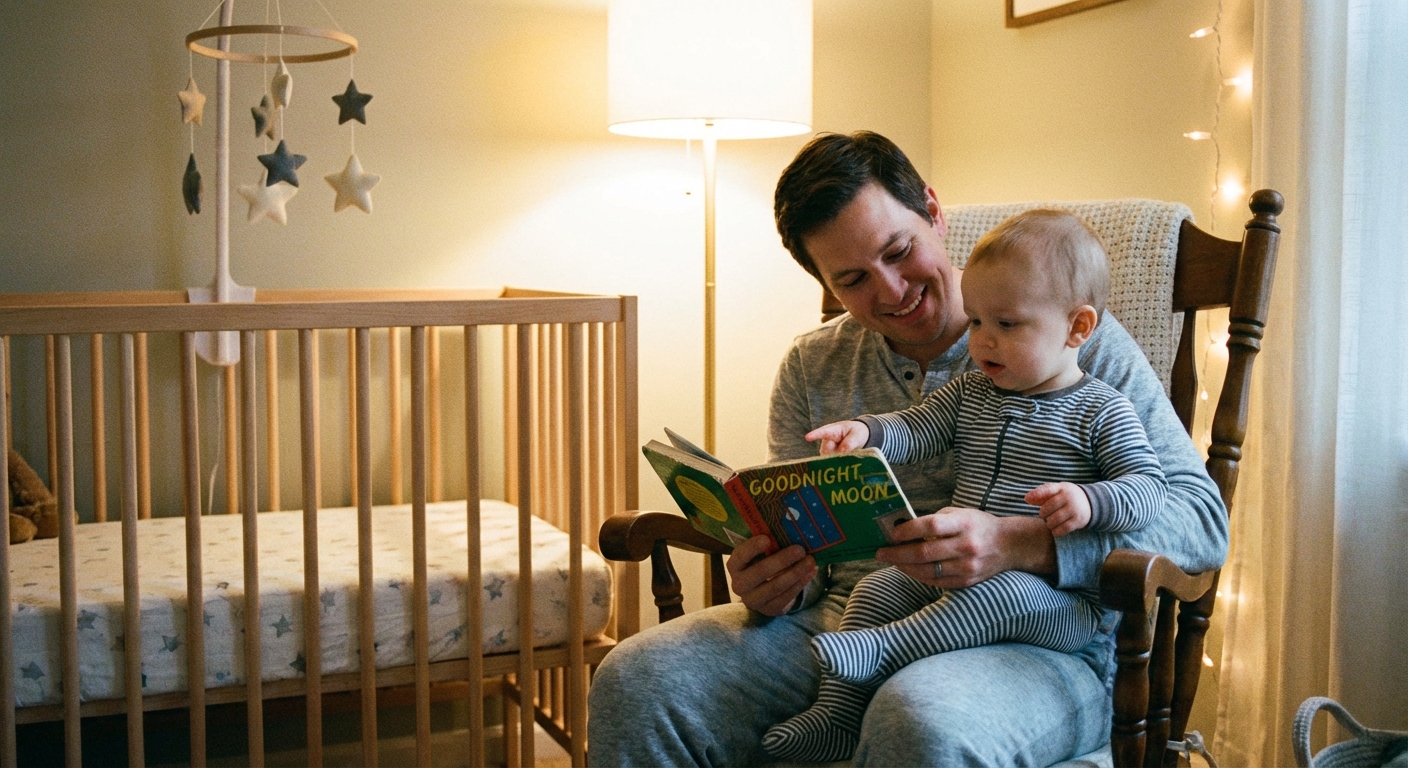
Think: feed, diaper, pajamas, book or song, into sleep space. Routines do not need to be long to be powerful.
4) Check the last wake window
One of the most common reasons for frequent waking is that bedtime is accidentally too late or the last wake window is too long for your baby’s age. If evenings are a meltdown and the first stretch is short, experiment with an earlier bedtime for a week.
5) Consider how baby falls asleep
If baby needs rocking, bouncing, or feeding to fully fall asleep every time, they may need the same help between sleep cycles. Some families are fine with that. If you are not fine with that, you can work on gradually changing the pattern in a way that fits your comfort level.
6) Protect safe sleep basics
- Back to sleep, on a firm flat surface.
- Nothing in the sleep space other than a fitted sheet.
- Follow your pediatrician’s guidance on swaddling and when to stop. A common rule is to stop at the first signs of rolling, which for many babies is around 8 weeks, but it varies.
Parental coping and safety
If you are in the thick of frequent wakes, you deserve a plan that keeps everyone safe.
- Take shifts when possible: Even a 3 to 4 hour protected block can make a difference.
- If you feel yourself dozing during a feed: Put baby back in their safe sleep space and set yourself up to stay awake (sit upright, turn on a dim light, sip water).
- Avoid couches and recliners with a baby: They are high-risk places for accidental suffocation if a parent falls asleep.
- Ask for help: A partner, friend, family member, postpartum doula, or your pediatrician can help you troubleshoot and get you rest.
When to call the pediatrician
Most night waking is normal. Still, you should absolutely reach out if something feels off or if sleep is collapsing your ability to function safely. In triage, I would rather talk to a worried parent early than have you white-knuckle it for months.
Call your pediatrician if:
- Your baby is not gaining weight well, seems dehydrated (very few wet diapers), or feeds poorly.
- Your baby has loud snoring, gasping, pauses in breathing, or labored breathing in sleep.
- There are signs of feeding-related distress or possible complications, such as poor weight gain, frequent choking with feeds, or blood in vomit or spit-up (this is a red flag and needs prompt medical evaluation).
- You suspect ear infection (fever, significant irritability, URI symptoms, and ear tugging plus notable pain or sudden sleep disruption).
- Your baby has eczema or itching that is clearly waking them often.
- Night waking is paired with unusual lethargy, persistent vomiting, or fever in a young infant.
- You are experiencing postpartum depression or anxiety, or you are so sleep-deprived you feel unsafe driving, feeding, or coping.
Night weaning note
Night weaning is different from sleeping through the night. Some babies stop needing calories overnight before they stop waking. Some truly need night feeds longer, including well into the 6 to 12 month range for some breastfed babies. Before you reduce night feeds, check with your pediatrician, especially if your baby was premature, is small for age, or has growth concerns.
Quick answers
How many hours counts as sleeping through?
In many studies and pediatric contexts, “sleeping through” is often a 6 to 8 hour stretch. Parents usually mean 10 to 12 hours, which becomes more common later in the first year.
Is it normal for a 3-month-old to wake up?
Yes. Very normal. Some 3-month-olds do long stretches, many still wake to eat.
Will formula make my baby sleep longer?
Sometimes it can, but not reliably, and it is not a guarantee. Many formula-fed babies still wake, and many breastfed babies do great stretches.
My baby used to sleep and now they are waking again. Did I break something?
Nope. Regressions, illness, teething, travel, and developmental bursts can all temporarily change sleep. You did not fail. You are just parenting a growing human.
A gentle perspective
If you take nothing else from this, take this: there is a wide range of normal. Your baby is not behind because they still wake, and you are not doing it wrong because you are tired.
Focus on what you can control: safe sleep, consistent routines, solid daytime feeding, and small sustainable changes. And if sleep is becoming a crisis in your home, that is not something you have to push through alone. Your pediatrician can help you sort out what is normal, what is fixable, and what needs a closer look.