When Do Babies Start Clapping?

Sarah Mitchell
Sarah Mitchell is a Registered Pediatric Nurse and a mother of three who has spent over a decade helping families navigate the beautiful, chaotic early years of childhood. She combines evidence-based medical knowledge with real-world parenting experience to offer practical, compassionate advice. At Awesome Parent, Sarah's mission is to help exhausted parents find solutions, trust their instincts, and finally get some sleep.
Clapping is one of those tiny milestones that feels weirdly huge. One day your baby is watching you sing “If You’re Happy and You Know It,” and the next day they’re bringing their hands together like a proud little audience member. It’s adorable, yes. It’s also a real developmental skill that blends hand coordination, timing, and social connection.
Let’s talk about when clapping typically starts, what it means, and how you can encourage it without turning your living room into a performance review.
Most babies clap around 9 to 12 months
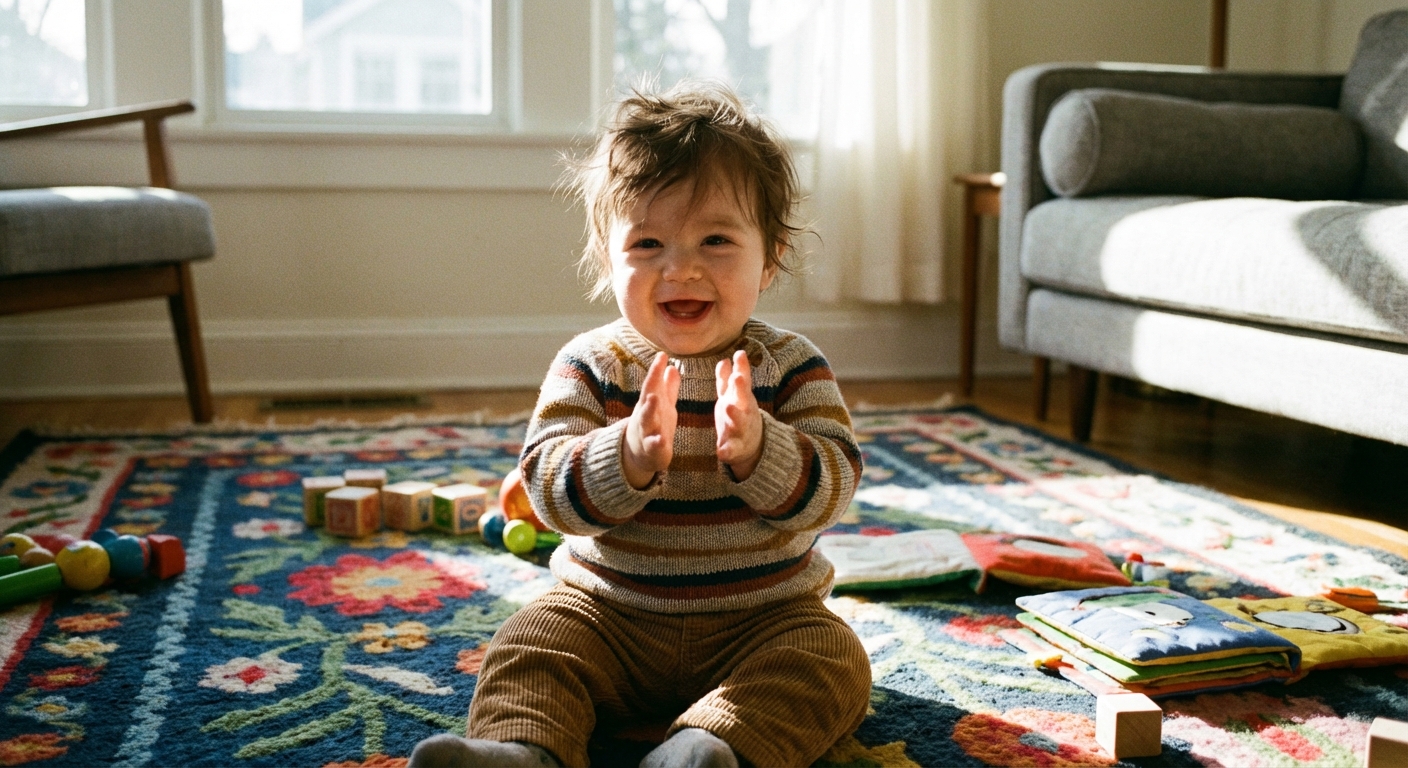
In many cases, babies begin clapping around 9 to 12 months. Some start a little earlier, around 8 months, especially if they love imitation games. Others take longer and may not clap consistently until closer to 12 to 15 months. Like most milestones, there’s a wide range, and the overall pattern matters more than any one skill.
Clapping is not just about “hands together.” It requires:
- Bilateral coordination (using both sides of the body together)
- Motor planning (figuring out how to make the movement happen)
- Imitation (watching you and copying)
- Social motivation (wanting to participate, get a reaction, or join the fun)
So if it feels like it pops up all at once, that’s because your baby has been building the skills underneath for months.
How clapping shows up
Babies rarely go from “zero” to perfect claps. And the steps can overlap, flip order, or get skipped altogether. Here’s the usual progression.
Early building blocks (4 to 8 months)
- Brings hands to midline (hands meet at the center of the body)
- Explores hands and fingers
- Bats at toys and reaches with more intention
- Starts banging objects on a surface
Getting closer (8 to 10 months)
- Imitates simple actions like waving, patting a table, or tapping a toy
- Brings hands together but may miss the “clap” timing
- May clap when excited but not on command
More consistent clapping (9 to 12 months)
- Claps during familiar songs or routines
- Claps to get your attention or celebrate
- Claps after watching others clap
By the time clapping is reliable, it often shows up alongside other social gestures like waving, pointing, and playing interactive games.
Why clapping matters
As a pediatric nurse, I love clapping because it’s both a fine motor and social communication milestone. It can tell us a lot about how a baby is putting skills together.
Fine motor and coordination
Clapping builds hand control and coordination. It’s part of the foundation for later skills like stacking blocks, feeding themselves, turning pages, and eventually scribbling.
Imitation and learning
Imitation is one of the main ways babies learn. When your baby copies your clap, they’re practicing “watch, process, do,” which is a big deal for brain development.
Social connection
Clapping is often one of the first “shared celebration” gestures. Your baby learns that they can join in, communicate excitement, and make you smile. That social back and forth is important.
Easy ways to encourage clapping
You don’t need flashcards. You need about 30 seconds of play, repeated often, with a baby who isn’t starving or seconds away from a nap. That’s the secret sauce.
1) Use familiar songs with a clear clap moment
- “If You’re Happy and You Know It”
- “Pat-a-Cake”
- “Twinkle, Twinkle” with a clap at the end
Pause right before the clap part and look at your baby like you’re letting them take the lead. Even if they don’t clap, that little pause invites participation.
2) Model it close to them
Babies learn best when they can see the movement clearly. Clap at your baby’s eye level, close enough that it’s easy to watch.
3) Help, then fade your help
If your baby tolerates it, you can gently bring their hands together once or twice, then stop and let them try. Think: quick coaching, not hand control for the whole song.
One important note: if they stiffen, pull away, or get upset, stop and switch to modeling instead. We want playful practice, not a power struggle.
4) Celebrate effort, not perfection
If their hands sort of bump together, treat it like a standing ovation. Babies repeat what gets a positive reaction.
5) Try “clap after” games
Do something fun, then clap. Examples:
- Roll a ball, then clap when it reaches you
- Stack two blocks, knock them down, then clap
- Blow bubbles, then clap when they pop
Why your baby might not clap yet
If your baby isn’t clapping at 9 or 10 months, it’s usually not a red flag by itself. Here are some common reasons clapping takes longer:
- They’re focused on other skills, like crawling, cruising, or learning to use a pincer grasp.
- They’re not big imitators yet. Some babies copy later, especially if they’re more observer than performer.
- Less exposure. If no one claps much at home, babies might not think to try it.
- Temperament. Some babies are simply less showy, even when they can do the skill.
Look for the bigger picture: is your baby learning new things overall, engaging with you, and using their hands in other coordinated ways?
When to talk to the pediatrician
Milestones live on a range, and one missing skill is rarely the whole story. That said, clapping is tied to imitation and social communication, so it’s worth mentioning at well visits if it’s not emerging.
Bring it up at the next visit if:
- Your baby is 12 months and not clapping and also not doing other gestures like waving, showing objects, or reaching to be picked up.
- Your baby doesn’t seem to imitate simple actions (like banging a toy, patting a surface, or copying facial expressions) by around 12 months.
- You notice a loss of skills they used to have (always worth calling sooner).
- You’re concerned about hearing (for example, not consistently responding to their name or not reliably turning toward sounds), since hearing supports social learning and imitation. Your pediatrician can help you decide if screening is needed.
Consider an earlier check-in if:
- Your baby has very limited eye contact or rarely seeks interaction
- Your gut says something is off and you can’t shake it
If you’re in the US, your pediatrician may suggest contacting Early Intervention for an evaluation. You don’t need to wait for things to get “bad.” Getting reassurance or support early is a win, not a label.
Nurse mom note: You’re not being “that parent” by asking. In triage, I talked to hundreds of parents who waited because they didn’t want to overreact. Asking early is one of the most protective things you can do.
What else to watch around 12 months
If clapping is late, I like to zoom out and look at the broader communication picture. Around this age, many babies are also starting to:
- Wave hi or bye
- Point to show interest
- Hold up or hand you objects to share
- Look back and forth between you and something they want (joint attention)
No single item on this list is a pass or fail. It just helps you and your pediatrician see the whole story.
Quick clapping FAQ
Can babies clap at 6 months?
Some babies can bring hands together at 6 months, but true intentional clapping is uncommon that early. Most are still working on the coordination piece.
Is clapping a fine motor milestone?
Yes, it’s a fine motor and coordination skill, but it also reflects social development because it’s often learned through imitation and used to interact.
What comes after clapping?
You may see more gestures like waving, pointing, blowing kisses, or doing actions to songs. You might also notice more purposeful communication, like handing you objects or making sounds to get your attention.
The bottom line
Most babies start clapping around 9 to 12 months. It’s a sweet milestone, but it’s also a meaningful sign that your baby is coordinating both hands, learning through imitation, and joining in socially.
If clapping isn’t happening by 12 months, especially if other gestures and imitation are also limited, it’s a good idea to mention it to your pediatrician. And if your baby is just not there yet but is growing, connecting, and learning in other ways, take a breath. Development isn’t a race, and your baby isn’t behind just because their applause is running on a different schedule.