When Do Babies Start Pointing?

Sarah Mitchell
Sarah Mitchell is a Registered Pediatric Nurse and a mother of three who has spent over a decade helping families navigate the beautiful, chaotic early years of childhood. She combines evidence-based medical knowledge with real-world parenting experience to offer practical, compassionate advice. At Awesome Parent, Sarah's mission is to help exhausted parents find solutions, trust their instincts, and finally get some sleep.
If you have ever found yourself staring at your baby’s tiny hand like it’s a crystal ball, waiting for that first “real” index-finger point, you’re not alone. Pointing is one of those deceptively small milestones that actually says a lot about how your baby is learning to communicate, share attention, and connect with you.
The good news: there’s a pretty wide range of normal. Many babies begin pointing somewhere between 9 and 14 months. Some start closer to 8 or 9 months, and some later, especially if they’re focused on other skills like crawling, cruising, or mastering the art of dropping snacks on purpose.
When do babies start pointing?
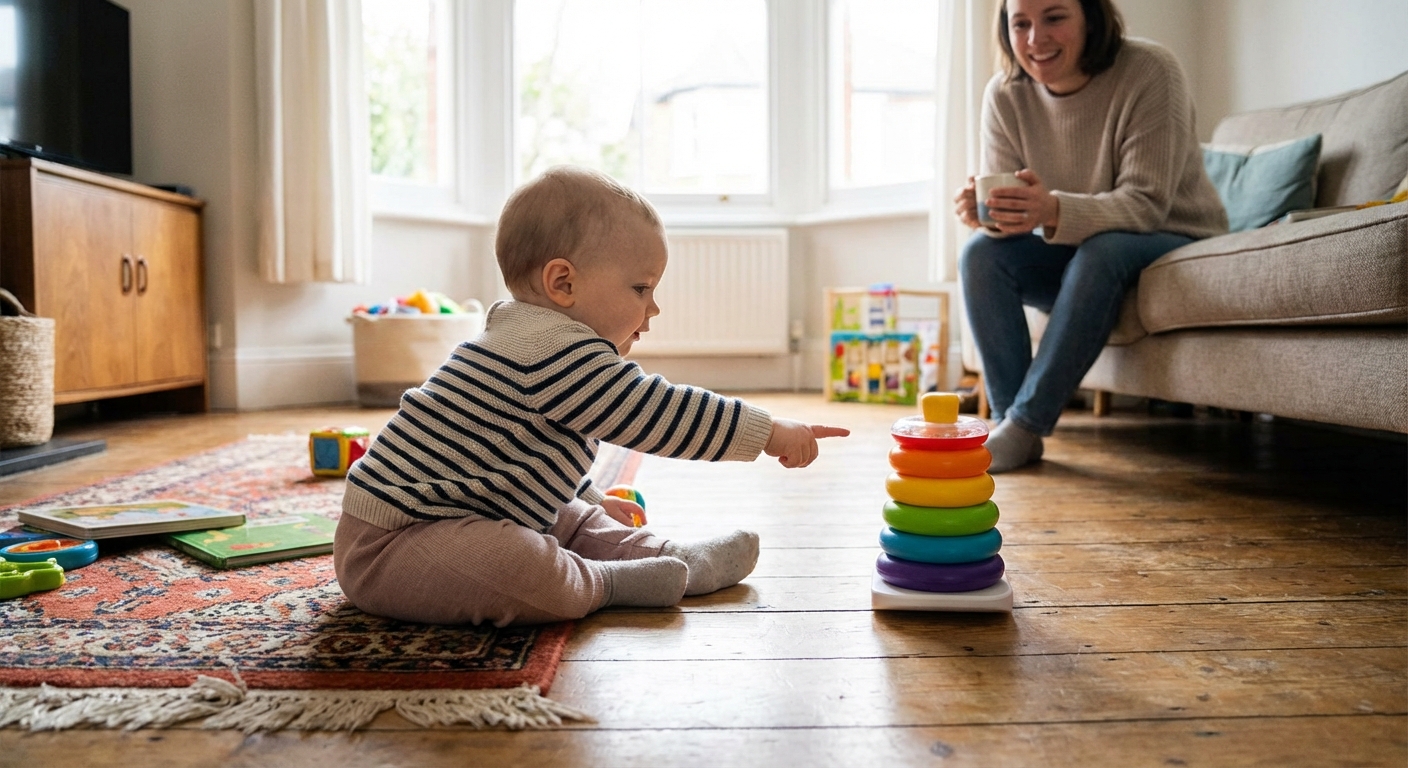
Most babies start pointing with one finger between 9 and 14 months. Some do it earlier, and some later. What matters most is not perfect form, but the intent to communicate and the back-and-forth with you.
If you’re looking for a practical benchmark, many developmental checklists expect pointing to be showing up around the end of the first year, and they’ll often flag no pointing by around 15 months as worth discussing with a clinician.
A typical timeline
- 6 to 9 months: Reaching with an open hand, grabbing, whole-arm gesturing toward objects, showing excitement. Babies may look from an object back to you, but they might not coordinate the look and the gesture yet.
- 9 to 12 months: Pointing often begins. Many babies start with a whole-hand point or a two-finger point, then refine into a clear index-finger point.
- 12 to 14 months: Pointing becomes more consistent and purposeful. Babies point to ask for things and to show you things, sometimes with a little sound like “eh!” or a proud grin.
- 15 to 18 months: Pointing is usually frequent and paired with other communication like bringing objects to show you, nodding, shaking their head, and early words.
Remember, “counts as pointing” can look a little different from baby to baby. Some point with their index finger. Some point with their whole hand at first. Some point while holding something. The big picture is that your baby is using a gesture to get your attention, share an idea, or ask for help.
What pointing really means
From a pediatric and language-development standpoint, pointing is exciting because it’s often a sign that your baby is developing joint attention, which is the ability to focus on something with you. It’s a big leap from “I want that” to “Hey, you and I are looking at the same thing together.”
That shared attention is a foundation for language. Babies learn words best when they connect:
- the object (dog).
- your attention (you see it too).
- your word for it (“Dog!”).
In other words, pointing is often part of the pathway that leads to more gestures, more understanding, and then more spoken words.
Types of pointing
Not all pointing is the same. Development experts often describe two early types of pointing, and both are important.
Proto-imperative: “Get that for me”
This is the “I want” point. Your baby points to request something they can’t reach or do on their own.
- Pointing to a cup on the counter.
- Pointing to the door to go outside.
- Pointing to a snack container because, clearly, you’re taking too long.
This kind of pointing shows your baby understands that you can help and that gestures can influence the world. That’s communication in action.
Proto-declarative: “Look at that!”
This is the “sharing” point. Your baby points to show you something interesting, surprising, or exciting, even if they don’t need anything from it.
- Pointing to an airplane in the sky.
- Pointing to a dog walking by.
- Pointing to a ceiling fan because it’s apparently the most fascinating object ever invented.
Proto-declarative pointing is especially tied to social connection and joint attention because the goal is to share an experience with you.

What counts as pointing?
Pointing rarely shows up out of nowhere. You’ll often see a “gesture ladder” first. Any of these can be normal stepping stones:
- Reaching with an open hand.
- Showing by holding an object up toward you.
- Giving an object to you, sometimes to share, sometimes to make it your problem.
- Waving, clapping, or lifting arms to be picked up.
- Looking back and forth between you and an object they want.
If your baby is doing several of these, they’re practicing the same core skill: using their body to communicate.
One more helpful nuance: clinicians often look for pointing plus eye gaze, meaning your baby points and then checks your face, or alternates looking between you and the thing they’re pointing at.
Why pointing matters
Parents often ask me, “Is pointing really a big deal?” In developmental screening, we do pay attention to it, not because we’re trying to nitpick, but because pointing can give us a quick snapshot of multiple skills at once.
Language
Pointing helps babies learn words faster because it creates a clear moment where you can label what they mean.
- Baby points, you say, “Ball.”
- Baby looks at you, you smile and respond.
- Baby learns, “When I do this, we connect and words happen.”
Social
When babies point to share, they’re practicing social back-and-forth, not just getting needs met.
Thinking skills
Pointing shows your baby is noticing the world, forming intentions, and figuring out how to communicate those intentions to another person.
How to encourage pointing
You don’t need flashcards or a “Pointing Bootcamp.” The best way to encourage pointing is to make everyday interactions playful and responsive.
Simple ways to help
- Model it: Point during routines. “Look, your shoes.” “See the bird?”
- Pause and wait: Hold a desired toy or snack where your baby can see it, then wait a few seconds. Give them a chance to gesture before you jump in.
- Offer choices: Hold up two items. “Banana or cracker?” Many babies point as they learn to choose.
- Play ‘where is it?’ games: “Where’s the puppy?” Then point to the picture.
- Label what they point at: If your baby points, treat it like a conversation starter. “Yes, the truck. Big truck.”
Quick note: if your baby points and you respond warmly and consistently, you’re doing the most important part. This milestone grows through connection.
When not pointing can be a concern
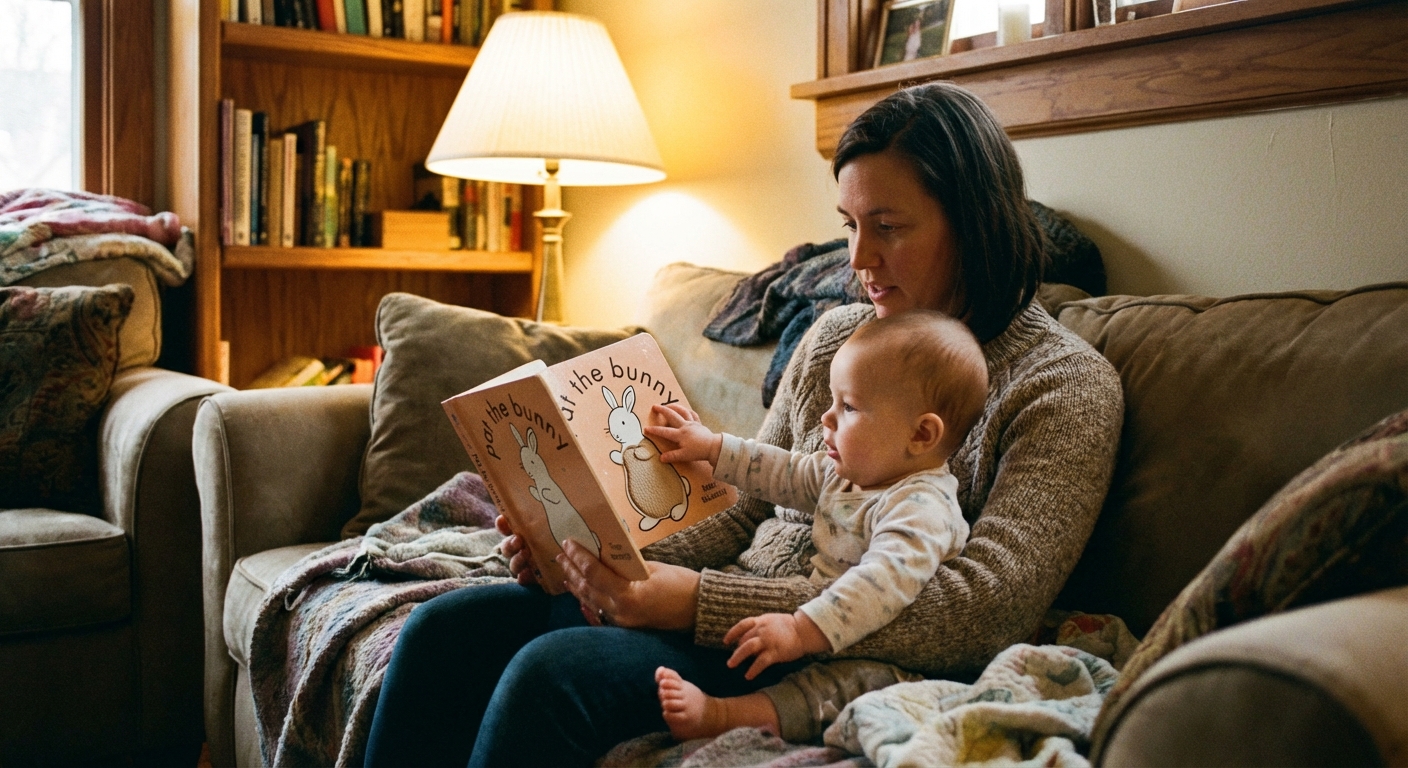
Every baby develops on their own schedule, and a single milestone rarely tells the whole story. That said, pediatricians and early childhood clinicians do screen for gestures like pointing because they’re useful indicators of early communication.
Bring it up if
- By 12 months, your baby isn’t using communicative gestures like pointing, showing, waving, or giving.
- By around 15 months, there’s still no clear pointing, especially if your baby also rarely tries to get your attention or share interest.
- Your baby doesn’t look back and forth between you and something they want or enjoy (limited joint attention).
- Your baby doesn’t respond to their name consistently by around 12 months, keeping in mind hearing, distraction, and temperament can affect this.
- Your baby loses skills they previously had, like gestures, babbling, or words. This is always worth discussing promptly.
It’s also appropriate to mention if you’re seeing a cluster of concerns, like limited eye contact, very few sounds or babbling, or very limited interest in social interaction. None of these automatically mean something is wrong, but they are good reasons to check in.
If you’re worried, you don’t need to “wait and see” alone. A quick conversation with your pediatrician can either reassure you or help you access an early intervention evaluation. That’s support, not a label.
Pointing and other gestures
My baby reaches but doesn’t point. Is that normal?
Yes, especially in the 7 to 10 month range. Reaching is often the warm-up skill. If your baby is reaching, showing, and making eye contact, pointing may be right around the corner.
Does pointing have to be with one finger?
No. Many babies start with a whole-hand point. Over time, it typically refines into a clearer index-finger point, but the communication intent matters more than perfect form.
My baby points to ask for things but not to “show” things. Should I worry?
Requesting (proto-imperative) often comes first. Sharing (proto-declarative) may develop a bit later as social attention skills strengthen. You can encourage it by pointing things out and being enthusiastic when your baby tries to share interest.
Can screen time affect pointing?
Babies learn gestures through real-time back-and-forth. High amounts of passive screen time may reduce opportunities to practice communication in daily interaction. If you use screens, focusing on shared, interactive moments matters more than perfection. Many families also follow pediatric guidance that discourages solo, passive screen time for very young toddlers and babies.
When to seek help sooner
Trust your gut. If something feels off, it’s always okay to ask. Reach out to your pediatrician promptly if:
- You suspect hearing issues (not startling to loud sounds, not turning toward voices, frequent ear infections with changes in responsiveness).
- There’s little to no babbling by around 9 to 10 months (for example, not much repetition of sounds like “ba,” “da,” “ma”).
- There’s loss of skills at any age.
- Your baby seems consistently disconnected from social interaction or rarely engages in back-and-forth play.
If you’re in the US, many families can self-refer for an early intervention evaluation (often free or low cost), even while waiting for a pediatrician visit. Your child doesn’t need a diagnosis to qualify for an evaluation.
Note: This article is for general information and isn’t a substitute for medical advice. If you’re concerned about your child’s development, your pediatrician is the best place to start.
Bottom line
Most babies start pointing sometime between 9 and 14 months, often with a whole-hand gesture before it becomes a clear index-finger point. Some point to request what they want, and some point to share what they see. Both are important, and both are signs that your baby is learning that communication is a two-person sport.
If your baby isn’t pointing yet, look at the bigger picture: are they using other gestures, making eye contact, and trying to get your attention? And if you’re worried, bring it up at your next well visit or sooner. You deserve clear answers, not another late-night spiral.