When Do Babies Start Talking?
Sarah Mitchell
Sarah Mitchell is a Registered Pediatric Nurse and a mother of three who has spent over a decade helping families navigate the beautiful, chaotic early years of childhood. She combines evidence-based medical knowledge with real-world parenting experience to offer practical, compassionate advice. At Awesome Parent, Sarah's mission is to help exhausted parents find solutions, trust their instincts, and finally get some sleep.
If you have ever found yourself whispering, “Was that ‘mama’ or was that just… noise?” at 2 a.m., welcome. Baby speech development is exciting, confusing, and wildly variable. Some babies chatter early. Others are quiet observers who save their big debut for later. Both can be completely normal.
What matters most is not hitting an exact date on the calendar. It is seeing a steady progression in how your baby communicates, including eye contact, gestures, babbling, and responding to you. Spoken words are the final act. The earlier scenes start months before the first real word.
Quick note if your baby was born early: for many milestones, your pediatrician may recommend using adjusted age (also called corrected age) until around age 2. If you are not sure which age to use, ask at your next visit.
Baby speech timeline
These ages are typical ranges. If your child is a little ahead or behind in one area but progressing overall, that is usually reassuring.
0 to 2 months
- Main sounds: crying, grunts, sighs, little “ooh” sounds
- What you might notice: different cries for hunger, discomfort, tiredness
- Milestone underneath it all: your baby starts recognizing your voice and calming to it
2 to 3 months
- Main sounds: coos like “oo,” “ah,” “eh”
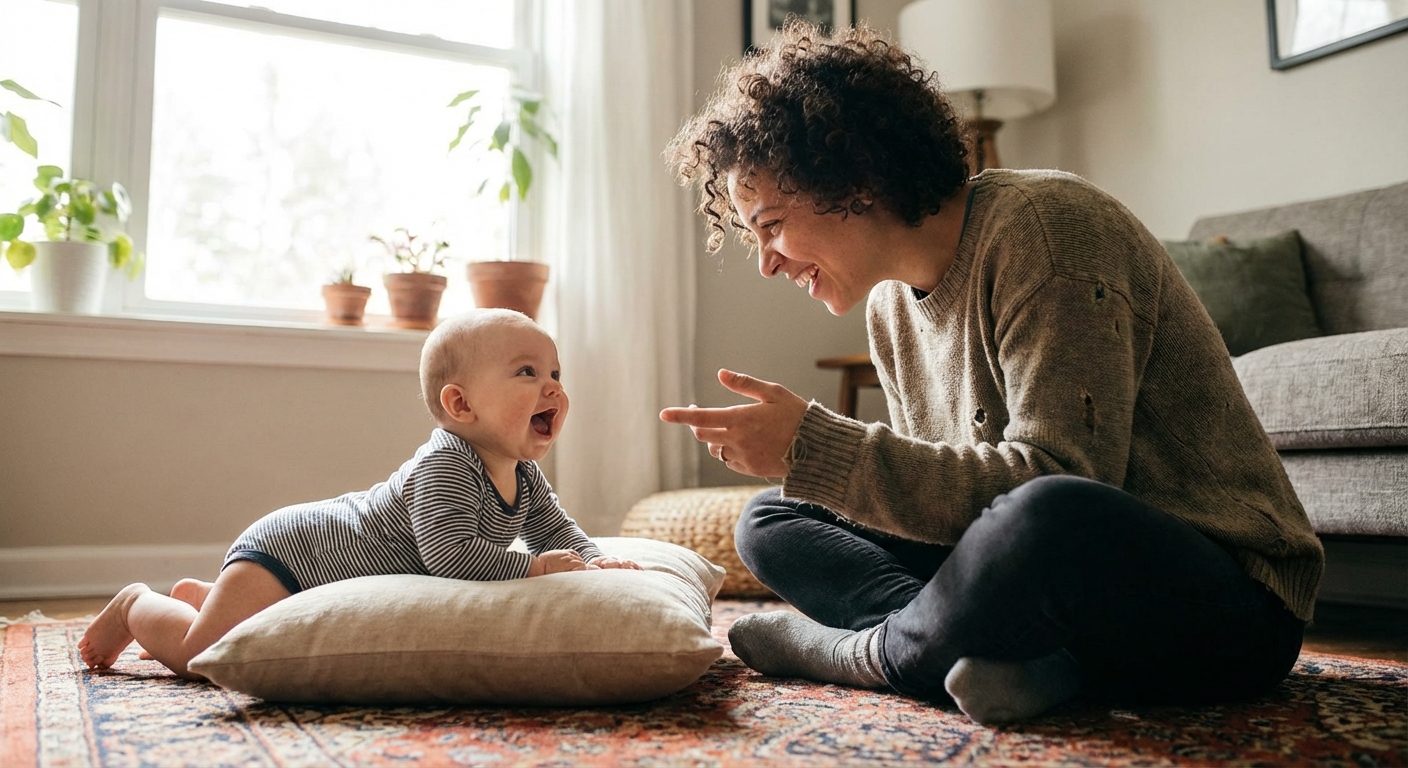
- What you might notice: smiling while cooing, cooing back when you talk
- Helpful skill: taking turns, even before they have words
4 to 6 months
- Main sounds: laughs, squeals, raspberries, early consonant sounds
- What you might notice: your baby plays with volume and pitch, watches your mouth when you speak
- Common question: “Is this babbling yet?” Sometimes it starts as short bursts and builds
6 to 9 months
- Main sounds: repeating syllables like “bababa,” “dadada,” “mamama”
- What you might notice: babbling during play, babbling to get attention, babbling with emotion
- Important note: “mamama” at this age is often just a sound pattern, not a true word yet
9 to 12 months
- Main sounds: varied babble, sound combinations, “jargon” that sounds like speech
- What you might notice: pointing, waving, shaking head, looking at what you name
- Language milestone: understanding simple words like their name, “no,” “bye-bye,” “milk”
Around 12 months
- Typical spoken words: often 1 to 5 words
- What counts as a first word: a sound your child uses consistently to mean something
- Common first words: mama, dada, hi, bye, ball, dog, more, up
- Reality check: some kids say a first word at 10 months, others at 15 months. Both can be normal.
12 to 18 months
- Typical growth: a slow build at first, then more words over time
- What you might notice: lots of pointing and bringing objects to you, attempts to imitate words
- Receptive language: understanding usually outpaces speaking
18 to 24 months
- Typical milestone: combining words like “more milk,” “mama up,” “bye dog”
- What you might notice: frustration may ease as they can communicate more clearly, or pop up during growth spurts
- By age 2: many toddlers have a growing vocabulary and can follow simple two-step directions
What counts as a word?
This one trips up a lot of families, especially when grandparents are keeping a “first word scoreboard.”
A true first word usually has three qualities:
- Consistency: your baby uses it the same way repeatedly
- Meaning: it refers to a person, object, action, or request
- Intent: they are trying to communicate, not just making random sounds
So if your baby says “ba” every time they see their bottle and looks at you expectantly, that can count. If they shout “mamamama” while chewing on a teether and staring at the ceiling fan, it is probably babbling.
Encourage language at home
You don't need flashcards, fancy apps, or a Pinterest-worthy sensory table. The most powerful language builders are already in your day.
Use short, real sentences
Narrate what you're doing, but keep it simple.
- “I'm washing your hands.”
- “Shoes on.”
- “All done milk.”
Repeat key words
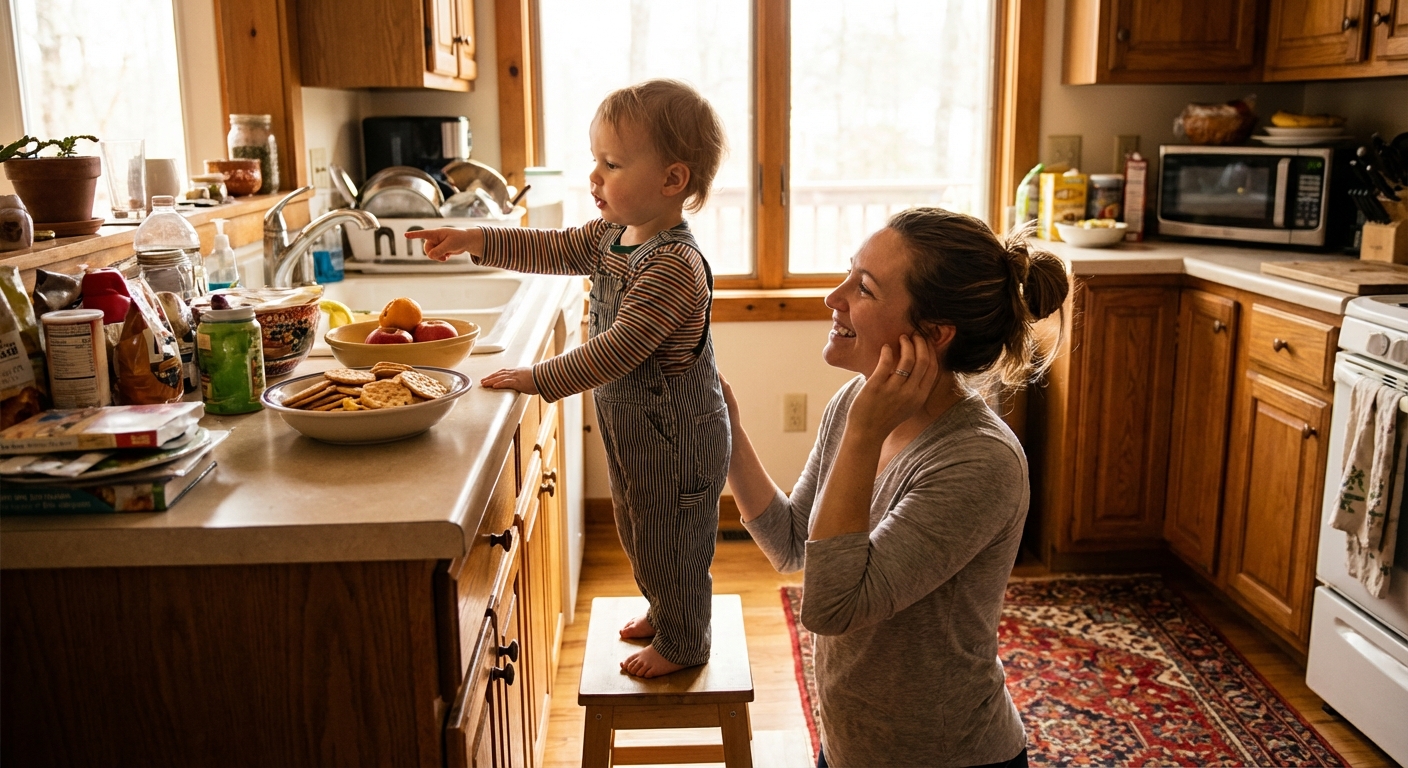
Babies learn through repetition. Pick a few everyday words and use them often: up, more, milk, ball, dog, bath, book.
Label what they're looking at
If they stare at the dog, that's your opening. “Dog. Doggie. Soft dog.” Following their attention works better than trying to redirect it.
Use serve-and-return
When your baby coos, babbles, points, or looks at you, respond like it's a conversation.
- Baby: “Ba!”
- You: “Ball! Yes, ball. Roll ball?”
This back-and-forth is a major driver of language development.
Read every day
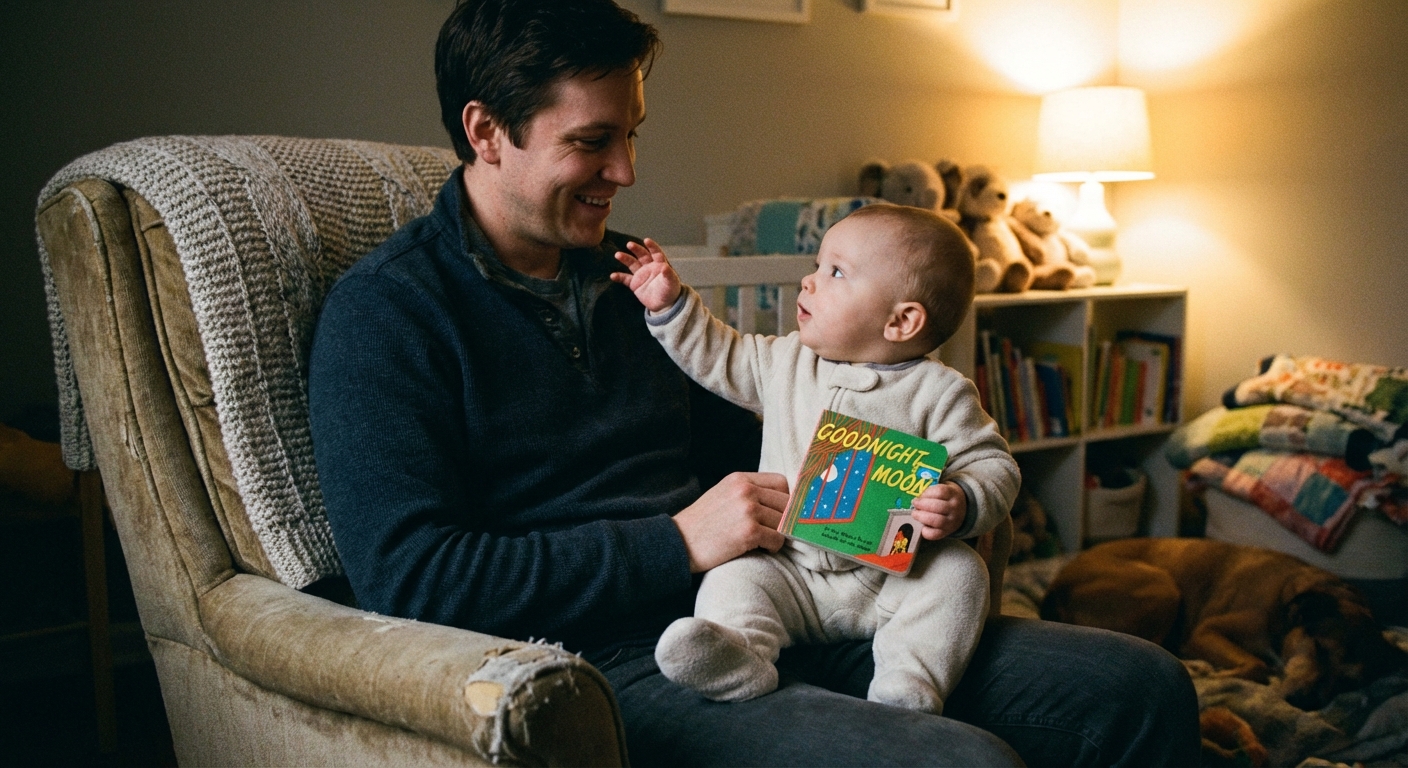
Board books are language gold. You can describe the pictures, name objects, and let your baby turn pages. Even if it's two pages, it counts.
Be mindful with screens
Babies learn language best from real, responsive interaction. Passive videos don't teach conversation the way a back-and-forth with you does. Video chat with loved ones can be a nice exception because it is interactive.
Best activities by age
0 to 6 months
- Face time: talk during diaper changes and feeds when your baby can see your mouth
- Copy sounds: mimic coos and wait for a response
- Sing: simple songs and repetitive rhymes help babies notice patterns
6 to 12 months
- Name routines: “bath,” “pajamas,” “night-night”
- Sound games: animal noises, vroom-vroom, beep-beep
- Practice gestures: wave, clap, point, blow kisses. Gestures support spoken language
12 to 24 months
- Offer choices: “Milk or water?” (show both)
- Expand what they say: Child: “Dog.” You: “Yes, big dog.”
- Turn-taking games: rolling a ball, stacking blocks, simple pretend play
Common worries
“My baby says ‘dada’ but not ‘mama.’ Did I do something wrong?”
Nope. Early “dada” is often just babbling, not a true label. And some children find certain sounds easier than others, so one pattern may show up first.
“My baby is quiet. Should I worry?”
Some babies are observers. Look for other communication signs: eye contact, smiling, reacting to sounds, taking turns, gesturing, and babbling progression over time.
“My baby used to babble and now they don't.”
This is one to take seriously. Temporary changes can happen with illness or big developmental leaps, but a clear regression or loss of skills is a reason to call your pediatrician.
“We're raising our baby bilingual. Will that delay speech?”
Bilingualism does not cause a language disorder. Some bilingual children may have fewer words in each language early on, but their total vocabulary across both languages is often similar to monolingual peers. Keep speaking the languages you use naturally and consistently.
Red flags
Trust your gut. You don't need to “wait and see” if something feels off, especially when early support can make a big difference.
Call your pediatrician if you notice:
- By 2 months: rarely reacts to loud sounds
- By 4 months: no cooing or social smiling
- By 6 months: limited sounds, little interest in people talking or interacting
- By 9 months: no back-and-forth babbling, limited eye contact or social engagement
- By 10 to 12 months: no clear, repetitive babbling (like “bababa” or “dadada”), does not respond to their name consistently, or no gestures like pointing or waving
- By 15 months: no true words
- By 18 months: fewer than about 10 to 20 words, or does not try to imitate sounds or words
- By 24 months: not combining two words, or speech is difficult to understand most of the time even for familiar caregivers
- Any age: loss of previously acquired speech, babbling, or social communication skills
Also consider hearing
Hearing issues are a common and fixable contributor to speech delays. Persistent fluid in the middle ear (especially if it keeps coming back) can make speech sound muffled to a baby, like listening underwater. If you're worried, ask about a formal hearing screen.
When to get help
If your baby is not meeting milestones, or you're worried even if they technically are, bring it up at your next visit. You can say something as simple as: “I'm concerned about my baby's communication and I'd like a hearing check and a referral for an evaluation.”
Depending on where you live, your pediatrician may refer you to:
- Early Intervention (often free or low-cost evaluations and therapy for children under 3)
- A speech-language pathologist
- Audiology for hearing testing
Good to know: in many regions, parents can self-refer to Early Intervention without waiting for a doctor. If you're not sure, ask your pediatrician's office or search your state or county Early Intervention program.
You'll also hear about routine developmental screening at well visits (often around 9, 18, and 24 or 30 months, with autism-specific screening commonly at 18 and 24 months). If you have concerns, you can ask for screening sooner.
My clinic take: You are not “overreacting” by asking. You're being the kind of parent who notices, follows up, and advocates. That is the job.
Quick cheat sheet
If you want the simplest possible overview, here it is:
- 2 to 3 months: cooing
- 4 to 6 months: vocal play, laughs, early babble
- 6 to 9 months: repetitive babbling (“bababa”)
- 9 to 12 months: gestures and understanding grow, babble sounds like “talking”
- Around 12 months: first true words
- 18 to 24 months: two-word phrases
Bottom line
Babies start “talking” long before they say words. Cooing becomes babbling. Babbling becomes meaning. Meaning becomes first words, then phrases. Your job is not to force it. Your job is to connect, respond, and make language feel safe and useful.
And if your baby is not following the typical path, you don't need to panic. You just need a plan. Reach out to your pediatrician, ask for a hearing check, and get an evaluation early. Support works best when it starts sooner rather than later.
Sources
- American Academy of Pediatrics (HealthyChildren.org): Language development and developmental milestones
- Centers for Disease Control and Prevention (CDC): Developmental Milestones and “Learn the Signs. Act Early.” resources
- American Speech-Language-Hearing Association (ASHA): Speech and language development guidance and warning signs