White Noise for Baby Sleep: Benefits, Risks, and Safe Use
Sarah Mitchell
Sarah Mitchell is a Registered Pediatric Nurse and a mother of three who has spent over a decade helping families navigate the beautiful, chaotic early years of childhood. She combines evidence-based medical knowledge with real-world parenting experience to offer practical, compassionate advice. At Awesome Parent, Sarah's mission is to help exhausted parents find solutions, trust their instincts, and finally get some sleep.
If you have ever found yourself bouncing a baby at 2:47 AM while whispering, “Please, just sleep,” you are not alone. White noise is one of the most popular tools I recommended as a pediatric triage nurse, and it is one of the tools I leaned on as a mom of three.
Used safely, white noise can help some babies fall asleep faster and wake less from normal household sounds. Used unsafely, it can be too loud, too close, or become a sleep association that is hard to drop later. Let’s walk through what it does, what the real risks are, and exactly how to set it up in a way that protects your baby’s ears and your sanity.
Why white noise helps babies sleep
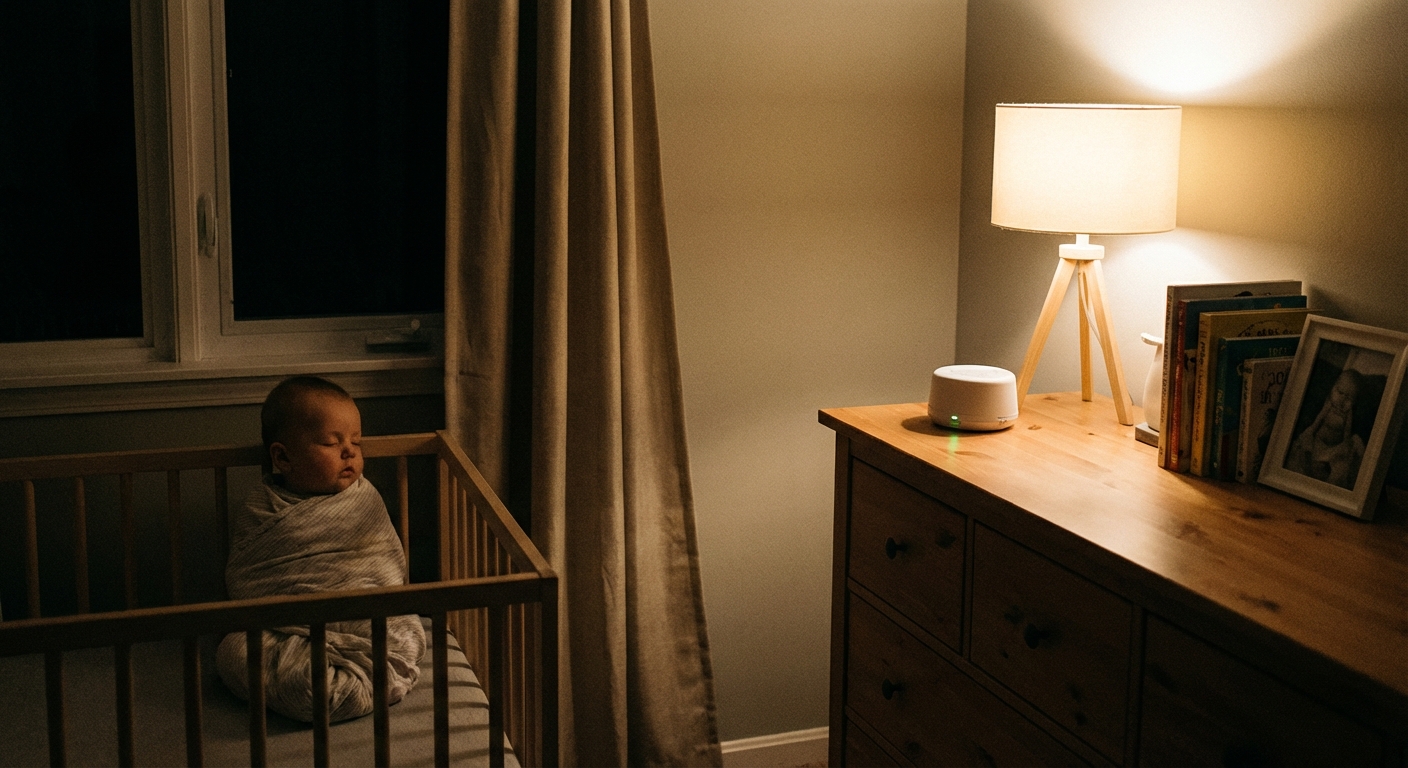
Babies are used to constant sound. The womb is not quiet. It is a steady mix of whooshing blood flow, digestion, and muffled voices. After birth, the sudden silence of a dark room can feel unfamiliar, and a random creak in the hallway can feel startling.
White noise helps by masking sudden changes in sound. Instead of your baby hearing a sharp dog bark or the refrigerator clicking on, they hear a consistent background sound that makes those spikes less noticeable. For many babies, that means:
- Falling asleep faster because the environment feels more consistent
- Staying asleep longer because household noises are less likely to wake them
- Easier transitions between sleep cycles, especially for light sleepers
Important note: white noise is not magic. If a baby is hungry, uncomfortable, sick, or going through a developmental leap, you may still see frequent wakeups. Think of white noise as a supportive tool, not a fix for every night.
White vs pink vs brown noise
These names sound like paint samples, but they describe how sound energy is distributed across frequencies.
White noise
White noise has equal intensity across frequencies, which many people perceive as a steady “shhh” or static. It can be effective at masking a wide range of sounds, but some adults find it a bit sharp.
Pink noise
Pink noise has more energy in lower frequencies and less in higher ones. Many parents describe it as softer and more natural, like steady rainfall. It still masks noise well and can feel less harsh.
Brown noise (red noise)
Brown noise emphasizes even lower frequencies. People often compare it to a low rumble, like distant thunder or a strong fan. It can be soothing, but in some rooms it may feel “heavy” if played loudly.
Which one is best? There is no single best choice. If white noise feels too bright, try pink. If you want something deeper, try brown. The safety rules are the same: keep it low and keep it far.
How loud should it be?
This is the part I care about most as a nurse: volume.
You will often see a conservative target of about 50 decibels (dB) or lower at your baby’s sleeping position. This guideline is commonly cited in pediatric hearing safety conversations and in coverage of research on infant sound machines. It is not a magic number, but it is a practical, “err on the safe side” target for overnight, continuous sound.
To give you a feel for it, ~50 dB is roughly like a quiet conversation at a distance or gentle background office noise.
Why volume matters
Babies’ ears are still developing, and prolonged exposure to loud sound can increase the risk of hearing damage. Risk is highest when a machine is:
- Too loud
- Too close to the crib
- Running for long periods at a high volume
How to check dB at the crib
- Use a decibel meter app on your phone as a rough guide. Phone microphones vary, and apps can be off by several dB, especially with phone cases. Still, it is better than guessing.
- Measure where your baby’s head rests (at mattress height, inside the crib or bassinet).
- Start low and increase only if you truly need to. Most families are surprised by how little volume is actually required.
If your machine only has a few volume settings, use distance as your second safety control. Move it farther away and still aim for good airflow and easy monitoring of your baby.
Example setup
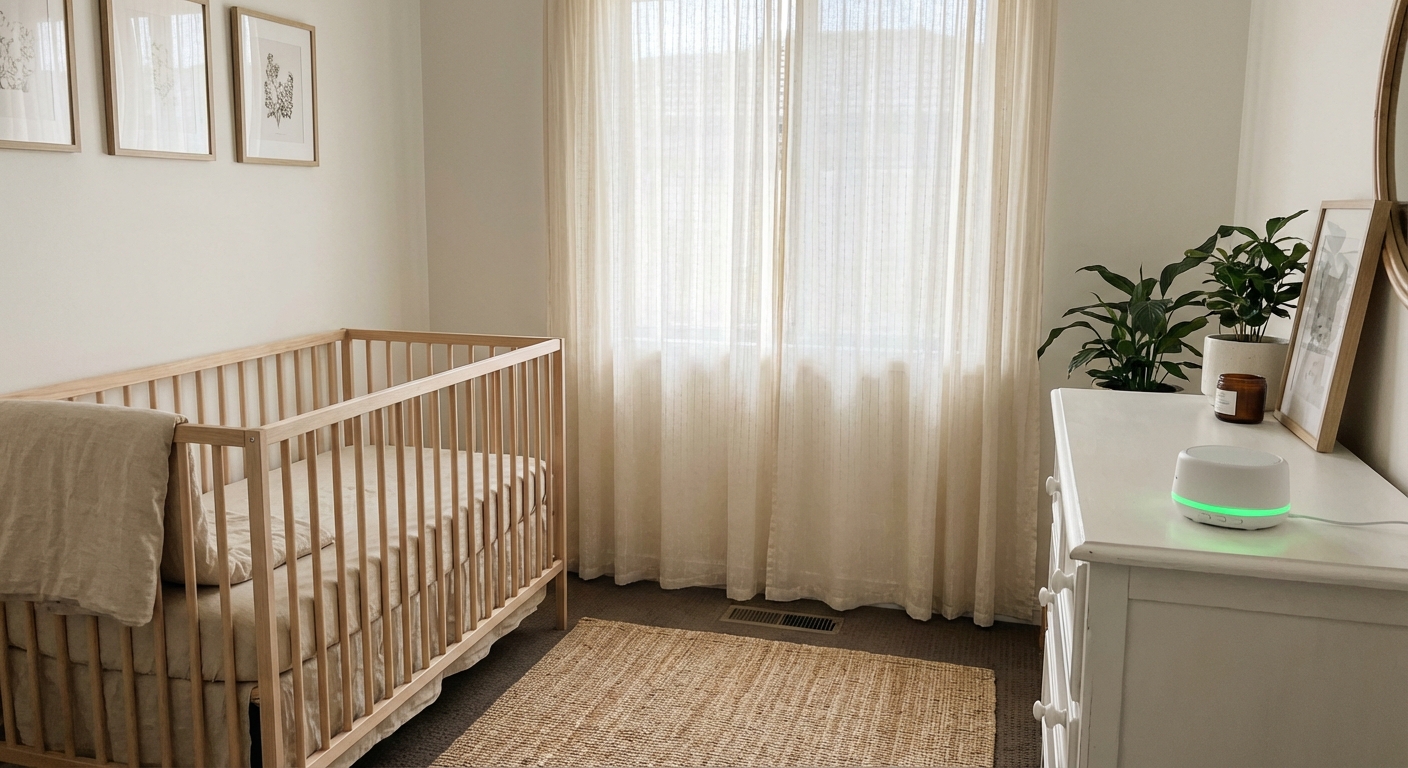
If you like specifics, here is a simple starting point: sound machine on a dresser on the far wall, roughly 6 to 10 feet from the crib, set around 20 to 30% volume, then measured at mattress height to land around the mid-40s dB. Adjust from there.
Safe placement
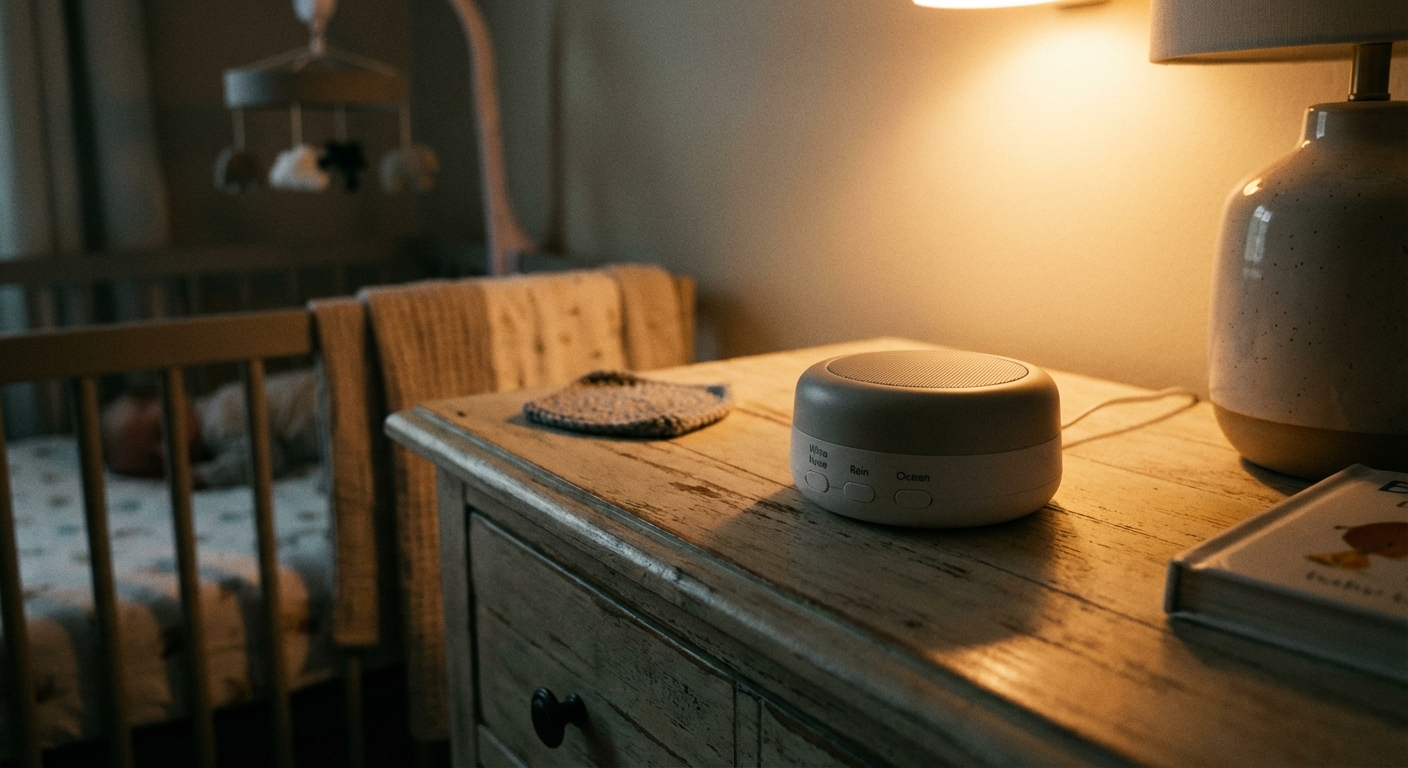
One of the most common unsafe setups I see is a sound machine sitting right on the crib rail or clipped to the crib. It feels convenient, but it brings sound too close to tiny ears and adds cord and device hazards in the sleep space.
A safer setup
- Place the device across the room when possible, not in or on the crib or bassinet.
- Keep it several feet away from where your baby’s head will be. Many experts suggest using the farthest stable surface in the room. If you want a number to aim for, roughly 6 feet or more is a commonly suggested starting point, then confirm with a dB check at the mattress.
- Do not point the speaker directly at the crib. If it is directional, aim it slightly away so the sound disperses.
- Secure cords so they are completely out of reach. Cords near sleep spaces are a strangulation hazard.
- Keep all devices out of the sleep space, including small portable units, phones, and chargers.
If your baby sleeps in your room, you can still use white noise. Treat your room like a nursery: put the device on the farthest stable surface from the bassinet, keep the volume low, and keep cords well out of reach.
Fans and air purifiers can work similarly for masking household noise. Use the same rules: distance, low volume, and nothing in or on the sleep space.
What the AAP says
The American Academy of Pediatrics (AAP) is very clear about safe sleep basics: a firm, flat sleep surface; baby placed on their back; and a sleep area free of loose items and hazards. The AAP does not have a widely cited policy statement that sets specific decibel limits for white noise machines in the home.
That said, the way I counsel families is to combine AAP safe sleep guidance with hearing safety common sense and published measurements of infant sound machine output. In practice, that means:
- Keep sound levels modest for continuous overnight use.
- Keep devices away from the sleep space to reduce sound intensity at the baby’s ear and to avoid cords or objects near the crib.
- Get the safe sleep setup right first: firm mattress, fitted sheet, baby on their back, crib or bassinet free of loose items.
Research measuring infant sound machines has found that some devices can reach potentially unsafe levels, especially when placed very close to the crib and turned up high. That is why “low and far” matters more than the brand name.
Can it hurt hearing?
It can, if it is too loud or too close for too long. The key risk factors are intensity (dB), distance, and duration.
Here is the reassuring part: most families can use white noise safely by keeping it around 50 dB or lower at the sleep surface and placing the device across the room. If you want an extra gut-check, stand next to the crib and listen. If it feels loud to you there, treat that as a cue to measure and lower it. Do not rely on the gut-check alone.
Extra caution
If your baby was in the NICU, has known hearing concerns, or failed a hearing screen and is awaiting repeat testing, talk with your pediatrician or audiologist about whether to use continuous sound and what level is appropriate.
Will my baby depend on it?
This is the most common question I get, usually right after: “Why does everyone on the internet sound like they are yelling at me about it?”
White noise can become a sleep association. That is not automatically bad. Adults have sleep associations too: a fan, a certain pillow, a particular playlist, blackout curtains.
Potential downsides are mostly practical:
- If you forget it while traveling, bedtime may be harder.
- If the power goes out and your baby is used to it, they may wake more easily.
- If you want daycare naps to match home naps, you may need a portable option.
In many cases, dependency is manageable and worth the tradeoff if your baby is sleeping better. If you want to keep flexibility, use a small travel sound machine and practice occasional naps without it once your baby is sleeping more consistently.
Safe use checklist
- Choose a steady sound: white, pink, or brown noise, or a consistent fan sound.
- Skip stimulating tracks: avoid songs, shifting soundscapes, or anything with voices.
- Aim for about 50 dB or lower at the crib or bassinet mattress.
- Place it across the room or at least several feet away, then confirm with a dB check.
- Never attach it to the crib and keep cords completely out of reach.
- Use it for sleep (naps and nights) rather than all day long.
- Consider a timer if it fits your household, but only if it will not cause a wakeup when it shuts off.
When to wean
There is no universal “right age” to stop. Some families stop around 6 to 12 months. Others keep it through toddlerhood, especially if siblings, pets, or street noise make the home loud.
Consider weaning if:
- Your child sleeps well and you want to simplify the routine.
- You are concerned the volume creeps higher over time.
- Your child seems to need it very loud to fall asleep.
- You want naps to be more flexible in different settings.
A gradual plan
- Lower the volume one small step every 3 to 5 nights.
- Move the machine farther away if volume controls are limited.
- Switch from white to pink noise if your goal is a softer sound while you taper.
- Keep everything else consistent: same bedtime routine, same schedule, same comfort items.
If your baby is in a sensitive sleep phase, like illness, travel, a move, or a developmental leap, it is okay to pause the wean. You are not “ruining sleep.” You are responding to real life.
Choosing a machine or app
Sound machines
- Wide volume range with very low settings
- Non-looping sound so there is no noticeable gap that can wake a light sleeper
- Simple controls you can operate in the dark
- Timer option if that fits your household
Phone apps
Apps can work, but be careful with:
- Notifications (nothing like a midnight “low battery” ding)
- Overheating if a phone is left running for long periods
- Cords near the sleep space if plugged in overnight
If you use an app, keep the phone well away from the crib or bassinet on a stable surface, with cords secured and out of reach.
Troubleshooting
My baby still wakes a lot. Should I turn it up?
First, check basics: hunger, temperature, reflux symptoms, congestion, schedule, and sleep environment. Then confirm your current dB level at the sleep surface. If you are already near your target range, do not turn it up. Instead, look for other causes of waking.
It shuts off and my baby wakes up
Try continuous play at a safe volume, or choose a longer timer. If you want to use a timer, experiment during naps first rather than at 2 AM when everyone is fragile.
My toddler demands “louder!”
This is a great moment to set a loving boundary. Keep the volume in a safe range and offer control elsewhere, like choosing between two safe sound options.
When to call the pediatrician
Reach out if:
- Your baby has persistent sleep struggles despite a consistent routine.
- You are worried about hearing, speech delays, or lack of startle response to loud sounds.
- Your baby snores regularly, has pauses in breathing, or seems to struggle to breathe during sleep.
- You feel like you need very loud noise for your baby to sleep.
You deserve support, and sometimes sleep problems are a medical issue, not a parenting issue.
The bottom line
White noise can be a safe, effective way to help babies sleep by masking sudden sounds and creating a steady background. The safety rules are simple and non-negotiable: keep the volume modest (often around 50 dB or lower at the sleep surface), place the device across the room, and keep cords and devices out of the sleep space.
And if you are using white noise because it helps you get more sleep, you are not “cheating.” You are problem-solving. That is parenting.
Medical note: This article is general education, not medical advice. For individualized guidance, especially for babies with hearing concerns or complex sleep issues, check in with your child’s clinician.