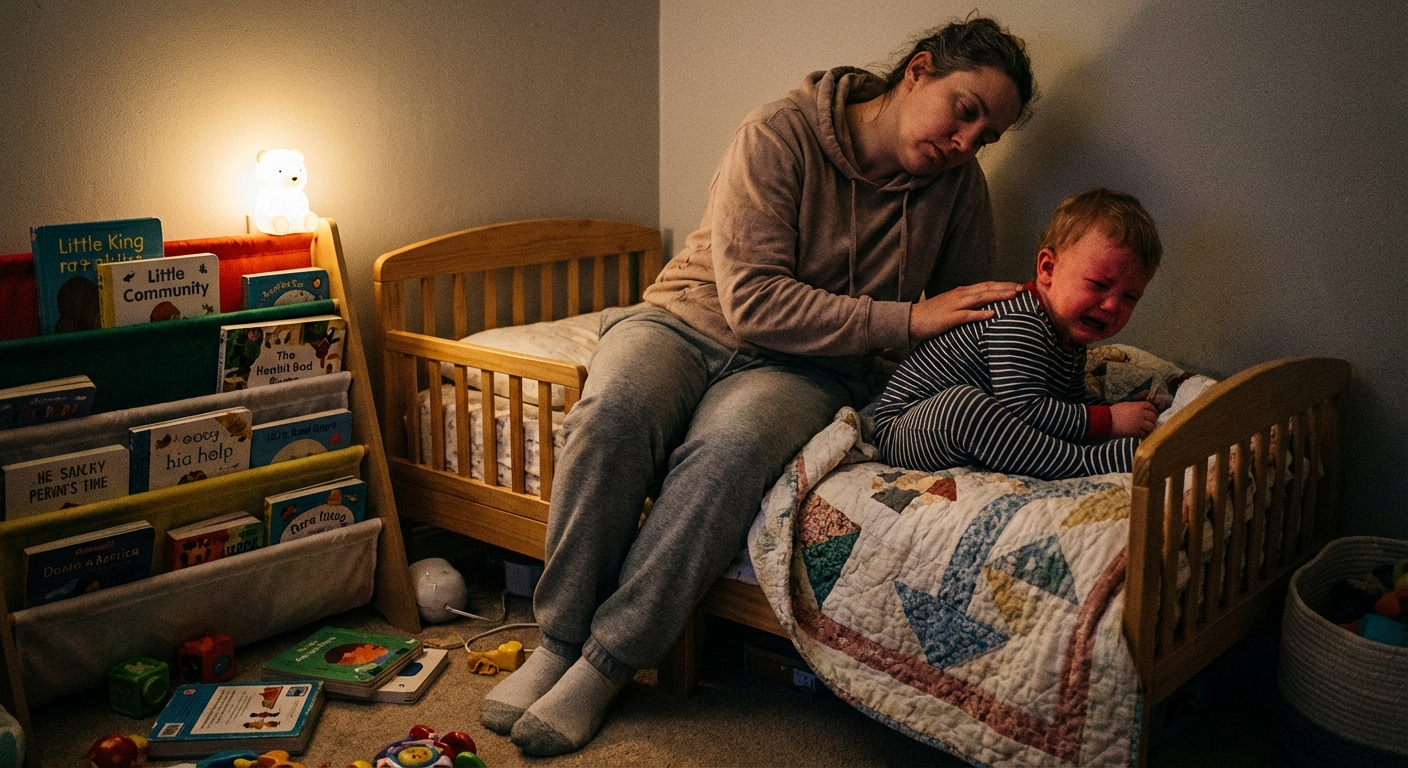
Night waking and nap refusal at 15 months often come from a language burst, teething, and boundary testing. Get realistic routines, scripts, and schedule twe...
16-Month Sleep Regression: Language Burst and Bedtime Battles

Sarah Mitchell
Sarah Mitchell is a Registered Pediatric Nurse and a mother of three who has spent over a decade helping families navigate the beautiful, chaotic early years of childhood. She combines evidence-based medical knowledge with real-world parenting experience to offer practical, compassionate advice. At Awesome Parent, Sarah's mission is to help exhausted parents find solutions, trust their instincts, and finally get some sleep.
If your 16-month-old used to sleep like a champion and is suddenly waking at 1 AM to practice new words, refusing naps like it’s their full-time job, or turning bedtime into a 45-minute negotiation, you’re not imagining things. Around 16 months, many toddlers hit a perfect storm: a language burst, new independence, and sometimes teeth moving under the gums. The result can look a whole lot like a “sleep regression.”
As a pediatric nurse and a mom of three, I’m going to give you the calm version: this phase is common, usually temporary, and you don’t need to overhaul your entire life at 3 AM. You just need a plan, a couple of consistent scripts, and a quick mental checklist to rule out pain or illness.
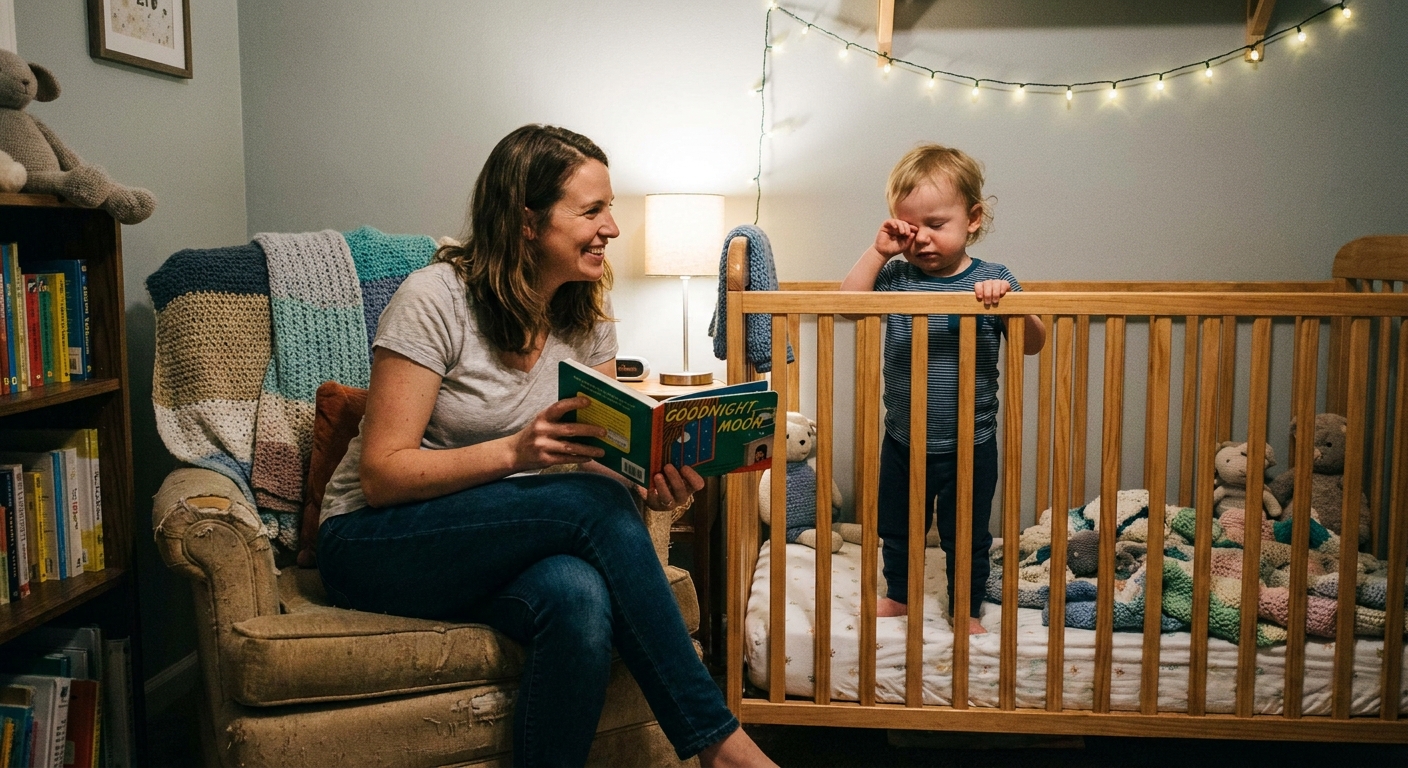
What is the 16-month sleep regression?
The “16-month sleep regression” isn’t an official medical diagnosis. It’s a pattern many families notice where a toddler who previously slept well suddenly has one or more of the following:
- More night waking (sometimes multiple times)
- Nap refusal or shorter naps
- Bedtime battles and stalling
- Early morning wakes (5 AM club, no membership required)
- More separation anxiety at bedtime or overnight
At 16 months, sleep disruptions are often fueled by development, not “bad habits.” That said, how you respond can either shorten the phase or accidentally stretch it out.
Why sleep falls apart at 16 months
1) The language explosion
Many toddlers have a noticeable jump in understanding and speech in the 15 to 18 month window. New words are exciting, and some kids seem to “rehearse” them at night. During periods of rapid development, sleep can also feel a little lighter for some children.
What it looks like at bedtime: sudden chatter in the crib, pointing, labeling, wanting “one more” book, or repeating a new phrase like it’s a concert encore.
2) Boundary testing and new independence
This age is peak “I have an opinion” energy. Your toddler is learning they can say no, delay, protest, and see what happens. They’re not trying to manipulate you. They’re experimenting with cause and effect, and bedtime is the easiest place to run the experiment.
What it looks like: wanting to choose pajamas, demanding to be carried, asking for water, asking for the other parent, then switching again. Classic.
3) Teething overlap (often molars)
Molars commonly come in during the second year, and they can be rough. Some parents notice teething discomfort feels worse when kids lie down, and it can disrupt both naps and night sleep.
What it looks like: increased drooling, chewing, swollen gums, crankiness, waking and settling briefly with comfort, then waking again.
4) Schedule pressure (two naps vs one)
Some 16-month-olds are happily on one nap. Others still truly need two. Many are in the messy middle where a two-nap day pushes bedtime too late, but a one-nap day makes them overtired. Overtired toddlers don’t always “crash.” They often wake more.

Two naps or one?
Most toddlers transition to one nap sometime between 12 and 18 months. Many land closer to 15 to 18 months, but there’s a wide normal. The right move depends on your child’s stamina and nap quality.
Stay on two naps for now if:
- Your toddler can only handle 4 to 5 hours awake comfortably.
- They still take two decent naps (for example 45 to 90 minutes each).
- When you try one nap, they melt down by late morning or fall asleep in the stroller or car.
- Bedtime becomes a disaster on one-nap days because they’re overtired.
Move toward one nap if:
- The second nap is consistently a fight or it’s pushing bedtime very late.
- They’re taking a solid midday nap (often 1.5 to 2.5 hours).
- They can handle 5 to 6 hours awake without falling apart.
- Night sleep improves on days with one nap.
The in-between approach
If you’re stuck between two naps and one, try this for 1 to 2 weeks:
- Most days: offer one nap after lunch.
- Rescue days (bad night or early wake): do a short morning nap (20 to 30 minutes) and keep the second nap brief, then protect bedtime.
This reduces overtired spirals without locking you into two naps forever.
Sample schedules
These are starting points, not rules carved into a pediatric nurse stone tablet. Aim for consistency within 30 minutes most days.
Two naps
- Wake: 6:30 to 7:00 AM
- Nap 1: 9:30 to 10:30 AM (cap at 60 minutes if bedtime is creeping late)
- Nap 2: 2:00 to 3:00 PM
- Bedtime: 7:30 to 8:00 PM
One nap
- Wake: 6:30 to 7:00 AM
- Nap: 12:00 to 2:00 PM (or 12:30 to 2:30 PM)
- Bedtime: 7:00 to 7:45 PM
When bedtime should be earlier
On days with nap refusal, short naps, or big meltdowns, an early bedtime is often the fix, not the problem. Many toddlers do better with bedtime moved up by 30 to 60 minutes rather than trying to “wear them out.”
Sleep basics (quick check)
Before you assume this is all developmental, make sure the basics aren’t quietly sabotaging you:
- Dark room: blackout curtains can make early wakes less tempting.
- Steady sound: white noise can help mask house noise and light sleep.
- Comfortable temp: toddlers often sleep better in a slightly cool room.
- Safe sleep space: follow your crib safety guidelines and keep the setup consistent.
- Same cues every night: routine, sleep sack, key phrase, then lights out.
Bedtime stalling scripts
At 16 months, your toddler is learning that language works. If stalling gets a big emotional response, it becomes very rewarding. Aim to be warm, boring, and consistent.
“One more thing” requests
You: “You want another book. Books are for tomorrow. Now it’s sleep time.”
Then do the same brief action every time (tuck in, kiss, key phrase, leave). If you add explanations, you accidentally turn it into a conversation.
Standing up and crying when you leave
You: “I hear you. You’re safe. It’s time to sleep.”
If you’re using brief check-ins, you can pause a moment, then leave. Keep any check-ins short and predictable (30 to 60 seconds), not a restart of bedtime.
Demands for water or snack
You: “Water is on your table. Kitchen’s closed. We’ll eat in the morning.”
Offer a small bedtime snack as part of the routine if hunger is plausible. But don’t open the snack bar at 10 PM unless you want to run it nightly.
Insisting on a different parent
You: “Daddy’s resting. Mommy’s doing bedtime tonight. We’ll see Daddy in the morning.”
Switching parents mid-protest often increases protest. Pick a plan and stick with it for at least a week.
Separation anxiety
You: “I’m right outside. You can cuddle your bear. I’ll see you when you wake up.”
Consider adding one predictable connection point: a special phrase, a quick song, or a two-minute cuddle. Keep it consistent so your toddler knows what to expect.

Night waking plan
Bedtime is only half the battle. Here’s a simple overnight plan that keeps you from reinventing parenting at 2 AM:
- Pause first: give them a minute or two to resettle if they’re fussing, not panicking.
- Keep it dark and boring: minimal light, minimal talking, no leaving the room “together.”
- Use the same key phrase: “You’re safe. It’s sleep time.” Then out.
- If you do check-ins: keep them brief and consistent (same timing, same words, no new negotiations).
- Avoid accidental rewards: no play, no snack buffet, and try not to start new habits you can’t repeat.
If you’re responding to a truly upset toddler, comfort is allowed. The goal is simply to keep your response calm and predictable so wakes don’t turn into a whole new routine.
Nap strikes
Nap refusal can be schedule-related, boundary-related, or pain-related. Here’s the practical approach I used as both a nurse and a very tired mom.
Step 1: Keep the nap opportunity
Even if your toddler doesn’t sleep, offer a consistent quiet rest time in their sleep space for 45 to 60 minutes. Dim room, white noise, sleep sack if you use one. No screens.
Step 2: Adjust timing before dropping the nap
If your toddler is fighting naps, try shifting nap start time by 15 to 30 minutes for 3 days before making bigger changes.
Step 3: Protect bedtime
Nap strike days usually need an early bedtime. Think of sleep as a 24-hour budget. If the nap didn’t happen, bedtime has to carry more of the load.
Step 4: Don’t create a new nap crutch
One emergency car nap isn’t going to ruin your child. But if the only way they nap is riding around the neighborhood, your future self will have opinions. Use motion naps sparingly while you stabilize the schedule.
How much sleep at 16 months?
Every kid is different, but many toddlers this age land around 11 to 14 hours total sleep in a 24-hour day (night sleep plus naps). If your child is regularly far outside that range and struggling, it’s a clue to look closer at schedule, environment, or discomfort.
Is it pain or illness?
This is the part I care about most as a triage nurse. Developmental regressions happen, but so do sick toddlers. If sleep suddenly changes, do a quick symptom scan.
Signs teething may be the main culprit
- Drooling, chewing, swollen gums
- More irritability, especially in the evening
- Waking and seeming uncomfortable, then settling with comfort
- A mild temp bump can happen, but teething alone shouldn’t cause a high fever
Teething meds note
If you’re considering pain relief, follow your pediatrician’s guidance for dosing. Avoid topical numbing gels with benzocaine in young children unless specifically directed by a clinician.
Ear infection (or pressure) red flags
Call your pediatrician if you’re seeing sleep disruption plus any of the following:
- Fever, especially if persistent, higher, or paired with ear pain or significant fussiness
- Ear tugging plus irritability or worse sleep
- New runny nose or cough followed by worse sleep and fussiness when lying down
- Drainage from the ear
- Balance changes or new clumsiness beyond typical toddler chaos
- Not acting like themselves: unusually lethargic, inconsolable, refusing fluids
Other reasons to get checked
- Night waking with new loud snoring, gasping, or breathing pauses
- Vomiting, diarrhea, or signs of dehydration (fewer wet diapers, very dry mouth)
- Rash with fever
- Pain that seems significant or persistent
Trust your gut. If you’re thinking, “This doesn’t feel like our normal regression stuff,” it’s reasonable to check in with your pediatrician.
What not to do
- Don’t add five new sleep changes at once. Change one thing, then reassess after 3 to 5 days.
- Don’t move bedtime later to “make them tired.” Overtired toddlers often wake more.
- Don’t turn check-ins into playtime. Keep the room dim and your voice low and boring.
- Don’t assume every wake needs milk or snacks. At 16 months, most toddlers can get calories during the day unless your pediatrician has told you otherwise.
How long does it last?
Many developmental sleep disruptions last around 1 to 3 weeks, give or take, depending on what’s driving it and how consistent the response is. Teething waves can come and go. Schedule transitions can take a couple of weeks to smooth out.
If things are getting worse after two weeks, or you’re seeing frequent night waking plus daytime behavior changes, it’s worth re-checking the schedule and considering an illness or discomfort factor.
A simple 7-night plan
- Pick your schedule target (two naps with capped naps, or one nap) and stick with it for a week.
- Lock in a short bedtime routine (20 to 30 minutes): snack, bath, pajamas, two books, lights out.
- Choose one bedtime phrase and repeat it every night: “I love you. You’re safe. It’s time to sleep.”
- Handle stalling the same way every time: warm voice, brief response, same outcome.
- Use early bedtime on nap-strike days.
- Scan for pain or illness before assuming it’s behavioral.
If you want one reassuring thought to hold onto: your toddler isn’t “breaking” sleep. They’re growing. Your consistency is what helps their sleep catch up with their brain.
When to get extra help
Consider looping in your pediatrician or a qualified sleep professional if:
- Sleep is severely disrupted for more than 3 to 4 weeks
- You suspect pain, reflux, frequent ear infections, or breathing issues
- You’re dealing with intense postpartum anxiety or depression, or sleep deprivation is becoming unsafe
You deserve support too. Sleep is a health need, not a luxury.
Sarah Mitchell
Sarah Mitchell is a Registered Pediatric Nurse and a mother of three who has spent over a decade helping families navigate the beautiful, chaotic early years of childhood. She combines evidence-based medical knowledge with real-world parenting experience to offer practical, compassionate advice. At Awesome Parent, Sarah's mission is to help exhausted parents find solutions, trust their instincts, and finally get some sleep.