
Wheezing, nighttime cough, or breathing trouble during play? Here are toddler asthma warning signs, how diagnosis works, treatments (including spacers), and ...
Asthma Action Plan for Daycare and Preschool

Sarah Mitchell
Sarah Mitchell is a Registered Pediatric Nurse and a mother of three who has spent over a decade helping families navigate the beautiful, chaotic early years of childhood. She combines evidence-based medical knowledge with real-world parenting experience to offer practical, compassionate advice. At Awesome Parent, Sarah's mission is to help exhausted parents find solutions, trust their instincts, and finally get some sleep.
The day you hand your child’s asthma meds to daycare can feel like sending them off with your whole nervous system in a paper bag. I get it. When I worked triage in a pediatric clinic, I watched parents do the same tight smile over and over: “It’s all written down.” But what they really meant was: Please don’t miss the early signs.
This is a simple, caregiver-friendly asthma action plan you can copy into your daycare form or email to your child’s teacher. The goal is not to turn preschool staff into medical professionals. It is to give them clear steps, clear “call me” triggers, and crystal-clear “call your local emergency number now” signs.

What daycare needs from you
Most childcare programs want two things: (1) your child’s written asthma plan from their clinician and (2) very practical instructions in parent language. Even when a clinic form exists, it often does not answer the real-life questions staff have in the moment.
Here’s what to provide, in addition to any required medical forms:
- Your child’s triggers: common ones include colds, smoke, strong scents, exercise, outdoor pollen, and weather changes.
- Your child’s usual early warning signs: this is gold. Some kids wheeze. Some just cough. Some get quiet or clingy.
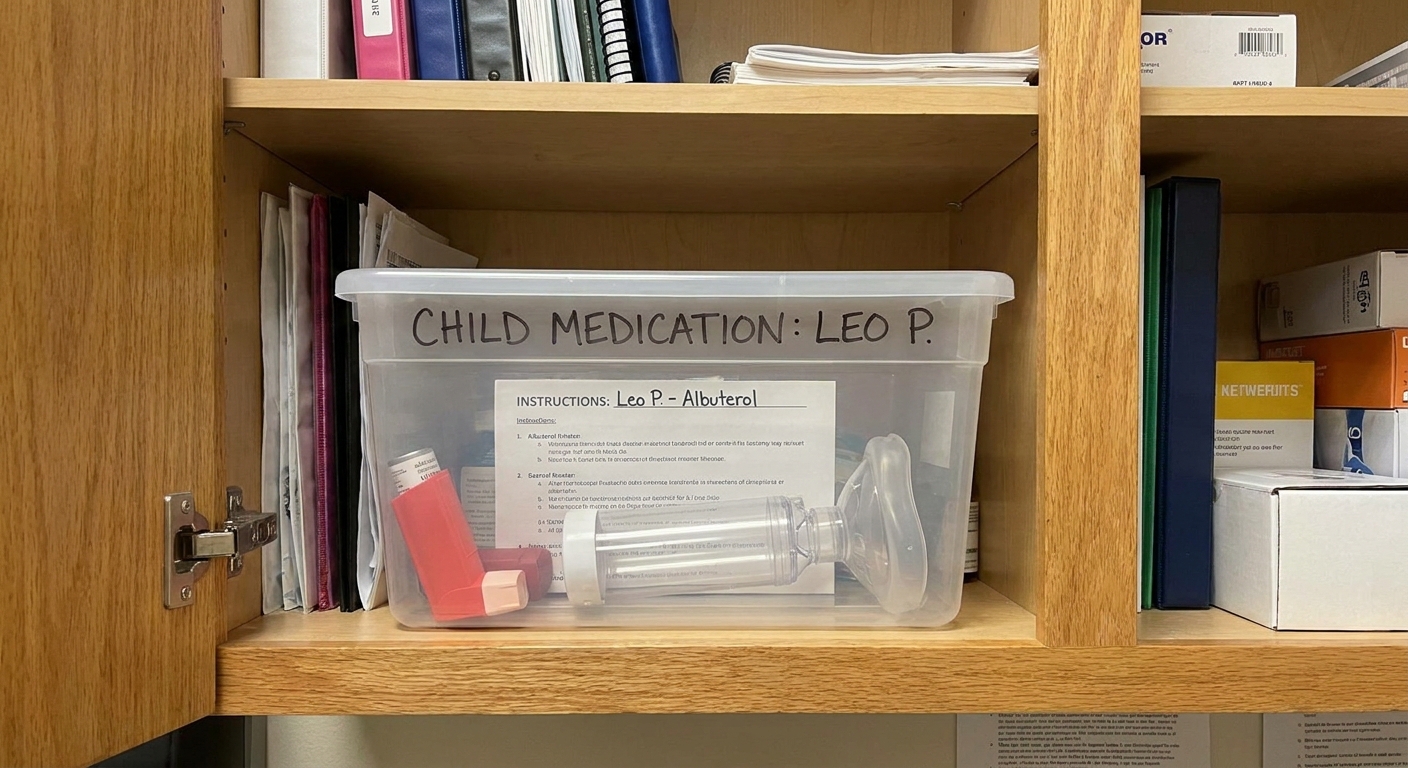
- Exactly where meds are stored and who can access them.
- Exact medication names and doses as written on the pharmacy label, plus when to use them.
- Step-by-step inhaler and spacer directions (keep reading, I’ll spell this out).
- When to call you and when to skip you and call emergency services.
- Backup contacts if you cannot answer.
One daycare paperwork note: many centers can only give medication with a signed authorization that matches the pharmacy label. They may also require the inhaler to be in its original labeled packaging, be unexpired, and be clearly child-specific. It is annoying. It is also one less thing to go wrong on a hectic day.
Green, yellow, red zones
Most asthma action plans use “zones” like a traffic light. Daycare staff tend to remember this well, especially if you keep each zone short and specific.
Green: doing well
What it looks like: Your child is playing, talking, and breathing comfortably. No cough that interrupts play or sleep. No wheeze. No chest tightness complaints. For toddlers, this may sound like “my tummy hurts” or “I don’t want to run.”
What daycare should do:
- Let your child participate normally.
- Help them avoid known triggers when possible (smoke, heavy fragrances, dusty play areas).
- Give daily controller medicine only if it is prescribed to be given at school. Many families do this at home, but some plans include a school dose.
Yellow: symptoms starting
What it looks like: Your child has asthma symptoms but is not in severe distress. This often includes:
- Coughing more than usual, especially with activity or during rest time
- Mild wheezing
- Breathing faster than usual
- Complaining of chest tightness or acting unusually tired
- Needing to pause play to catch their breath
What daycare should do:
- Stop activity and have your child sit upright and rest.
- Use the quick-relief inhaler exactly as your clinician-written plan says.
- Stay with your child. Do not leave them alone while symptoms are active.
- Reassess after the rescue dose. Many plans reassess in about 10 to 20 minutes, but the written plan is the rule.
- Call you with an update and to confirm next steps.
Key daycare note: Yellow zone means “treat and watch closely.” If symptoms are not improving quickly, it can turn into red zone.
Red: emergency
What it looks like: Your child is struggling to breathe or not improving after rescue medicine. If staff are unsure whether it is yellow or red, I want them to treat it as red and get help.
What daycare should do:
- Give the quick-relief inhaler as directed on your clinician-written plan.
- Call emergency services or your local emergency number right away if any emergency signs are present (see the next section).
- Stay with your child. Do not leave them alone.
- Call you after calling emergency services, not before.
Signs to call emergency services
This is the part I want daycare staff to be able to spot from across the room.
Call emergency services or your local emergency number immediately if your child has any of the following:
- Struggling to breathe or breathing is so hard they cannot keep playing, eating, or speaking normally
- Too breathless to talk in full sentences (or for toddlers, cannot cry normally or cannot speak more than a word or two without stopping for air)
- Lips, face, or nails look blue or gray
- Skin pulling in between ribs, under ribs, or at the neck with each breath (retractions)
- Nostrils flaring with breathing plus obvious distress
- Very fast breathing with worsening effort, especially at rest
- Looks unusually sleepy, confused, or “out of it”
- Rescue inhaler is not helping or the child is getting worse after using it
- Repeated coughing or wheezing with obvious distress, especially if the child cannot settle
Important: If staff are ever deciding between “Is this serious enough?” and “Maybe we should wait,” I want them to choose safety. Asthma can escalate quickly in little kids, especially during viral colds.

Inhaler and spacer notes
Daycare staff usually do best with a short script they can follow under stress. You can paste this into your medication authorization form or attach it as a one-page note.
1) Medication details
- Quick-relief inhaler name: as printed on the label
- Strength: as printed on the label
- When to use it: yellow zone symptoms and red zone symptoms (per clinician plan)
- Dose: number of puffs
- Repeat instructions: when to repeat and maximum times (per clinician plan)
If your child has a second inhaler intended for school, label it clearly and confirm it is not expired.
Personalization note: not every cough or wheeze is asthma. The goal here is to follow your child’s individualized clinician plan and your child’s typical pattern.
2) Spacer steps
Here is a general, caregiver-friendly sequence many clinicians teach. Always follow your child’s clinician-written plan and the device instructions, but this is a helpful way to write it down:
- Have child sit up.
- Remove cap from inhaler and shake it.
- Insert inhaler into spacer.
- Place spacer mouthpiece in mouth with lips sealed, or place mask snugly over nose and mouth (if using a mask spacer).
- Press inhaler once.
- Have child take slow breaths in and out for about 5 to 10 breaths (or as directed for your device) while keeping mask sealed.
- Wait about 30 to 60 seconds between puffs, or follow the label and clinician plan.
- Shake the inhaler again before the next puff, if directed by your device instructions.
- Repeat for the prescribed number of puffs.
Also include your child’s spacer type (mask or mouthpiece) and any cooperation tricks that work, like counting breaths together, or “needs a tight mask seal or medicine will not deliver well.”
3) Common errors
These are the small things I see trip people up:
- Not using the spacer (many young kids cannot coordinate an inhaler puff without it).
- Mask not sealed, so medicine leaks out.
- Puffing multiple times into the spacer without breathing in between.
- Child crying hard with the mask on. Delivery is often poorer. If they cannot calm enough to take effective breaths, follow the clinician plan closely and treat it as higher concern.
- Inhaler is empty or expired.
4) Side effects to expect
Quick-relief inhalers can sometimes cause temporary jitteriness or a faster heartbeat. This is usually short-lived. Tell staff what is normal for your child and what you want them to report to you.

A daycare message you can send
If writing this from scratch feels like one more thing on an already overloaded week, here is a copy-and-send version that reads like a real message, without any fill-in blanks. Just swap in your child’s real details before you send it.
Subject: Asthma plan for my child
Hi, I want to share my child’s asthma basics so everyone has the same clear steps on busy days. The quick-relief inhaler and spacer are stored in the designated medication area, and they are labeled with my child’s name. My child’s common triggers are viral colds and outdoor pollen, and their early warning sign is a cough that starts during play before any wheezing shows up.
Green (doing well): If my child is playing and breathing comfortably with no cough that interrupts play or rest, please let them participate normally. If the clinician plan includes a school-time controller dose, please give it exactly as ordered.
Yellow (symptoms starting): If you notice increased coughing, mild wheeze, faster breathing, needing breaks, or my child acting unusually tired, please stop activity and have them sit upright. Give the quick-relief inhaler with spacer exactly as written on the clinician plan. Please stay with them and reassess at the time listed on the plan. Please call me after the rescue dose with a quick update.
Red (emergency): If my child is struggling to breathe, cannot speak or cry normally because of breathing, has ribs or neck pulling in with breaths, looks blue or gray around lips or face, seems unusually sleepy or confused, or is not improving after rescue medicine, please give the rescue inhaler as directed and call emergency services or your local emergency number immediately. Please call me right after you call emergency services.
You can reach me at my primary phone number on file. If you cannot reach me, please call my backup contact listed in the enrollment paperwork. My child’s pediatrician or allergist information is also in the file if you need it for reference.
The biggest help is simply noticing the early cough and treating early. Thank you for keeping an eye out.
Extra tips
- Send two sets when possible: one inhaler and spacer that stays at school, and one that stays at home (if your clinician prescribes and your insurance allows). This prevents the “forgot it on the counter” scenario.
- Ask who is trained to give inhalers: some centers have a nurse or a designated medication admin person.
- Do a 60-second demo at drop-off: a quick show-and-tell with the spacer can eliminate a lot of confusion later.
- Confirm field trip coverage: who carries the meds, and where they will be stored during the trip.
- Update the plan after any ER visit or medication change: an old dose on paper is a very common problem.

When daycare should call you
Daycare staff should call a parent or guardian if:
- Your child needs their rescue inhaler at school
- Symptoms return the same day after rescue medicine
- Your child is sitting out repeatedly due to cough or breathing discomfort
- They notice new triggers (for example, coughing starts every time the class goes outside)
- Your child seems sicker than expected, especially during a cold
As a parent, I would much rather get a “just keeping you in the loop” call than find out at pickup that my child spent the day quietly working hard to breathe.
Quick FAQ
Nebulizer vs inhaler
Some children have a nebulizer plan, but many do great with an inhaler plus spacer. What matters is following your child’s clinician-written plan and using the device correctly.
If my child refuses the spacer
Ask staff to try when your child is upright and calm, using simple coaching like counting breaths together. If refusal is common, talk with your child’s clinician about strategies and whether the daycare needs additional training.
Can my child still play
Many kids with asthma can and should play. The green zone goal is full participation. The plan is there so staff know what to do if symptoms start.
Final nurse-mom reminder
You are not being “extra” by asking daycare to take asthma seriously. You are being appropriately prepared. A clear plan turns asthma from something scary and vague into something manageable and routine, which is exactly what we want for preschoolers and the adults caring for them.
If you want, bring your draft plan to your child’s next visit and ask the clinician to confirm the wording for school. The best action plan is the one everyone understands and can follow on a busy Tuesday at 11:12 a.m.
Sarah Mitchell
Sarah Mitchell is a Registered Pediatric Nurse and a mother of three who has spent over a decade helping families navigate the beautiful, chaotic early years of childhood. She combines evidence-based medical knowledge with real-world parenting experience to offer practical, compassionate advice. At Awesome Parent, Sarah's mission is to help exhausted parents find solutions, trust their instincts, and finally get some sleep.