
Speech milestones at 18–24 months, signs it may be more than a late talker, when to seek an evaluation, and practical at-home strategies you can start toda...
Toddler Speech Regression: When Lost Words Need Evaluation

Sarah Mitchell
Sarah Mitchell is a Registered Pediatric Nurse and a mother of three who has spent over a decade helping families navigate the beautiful, chaotic early years of childhood. She combines evidence-based medical knowledge with real-world parenting experience to offer practical, compassionate advice. At Awesome Parent, Sarah's mission is to help exhausted parents find solutions, trust their instincts, and finally get some sleep.
If your toddler used to say “mama,” “more,” or “dog” and now those words seem to have disappeared, it can feel like someone pulled the rug out from under you. You might be worried about autism, hearing, or whether you missed something important. Take a breath. In pediatric triage, I saw this exact worry all the time, and as a mom, I have felt that stomach drop too.
Speech regression can be meaningful, but it is not always an emergency and it is not always autism. The key is figuring out whether your child is having a normal plateau, a temporary dip from stress or illness, or a true regression that deserves timely evaluation.

Regression vs. plateau
A normal plateau
A plateau is when speech progress slows down for a while, but your child is not actually losing skills. Many toddlers pause their language growth when they are busy working on other big jobs like walking, climbing, potty training, or learning new routines at daycare.
- What it looks like: They still use the words they already have, but they are not adding many new ones.
- How long it can last: A few weeks is common. Sometimes longer during big developmental leaps.
Speech regression
Regression is when a child loses previously used words or communication skills. Parents usually describe it as: “He used to say it, and now he does not.”
- What it looks like: Fewer words overall, less frequent speech, or a child who no longer uses certain meaningful words they used consistently.
- Why it matters: True skill loss is a reason to check hearing and development promptly.
Important nuance: A toddler might stop saying a word because they are not interested in it anymore, or because their speech is changing as they learn to pronounce things differently. The pattern matters more than one single word.
Quick milestone context
If you are trying to decide, “Is this a dip, or are we behind overall?” here are broad, ballpark milestones. Kids vary a lot, so use this as context, not a test.
- Around 12 months: a few meaningful words (often 1 to 3), plus lots of gestures like pointing and waving.
- Around 18 months: many toddlers have about 10 to 25 words and use gestures to communicate needs and interests.
- Around 24 months: many toddlers have 50 or more words and start combining 2 words (“more milk,” “mommy up”).
What matters most is not hitting a perfect number. It is whether your child is building skills over time, and whether any skills are going backward.
Why toddlers lose words
In real life, speech changes rarely happen in a vacuum. Here are common, very plausible triggers I see again and again.
1) Hearing changes (often temporary)
Fluid behind the eardrum after a cold or ear infection can make speech sound muffled, like listening underwater. Middle ear fluid often causes a mild or fluctuating conductive hearing loss, and even mild changes can make it harder for a toddler to hear speech sounds clearly. If your toddler cannot hear clearly, they may talk less or stop using newer words.
- Frequent colds
- Ear infections
- Persistent congestion or mouth breathing
2) Illness, fatigue, and recovery
When toddlers feel lousy, they simplify. You might see more pointing, whining, or gestures and fewer words. Some kids bounce back fast. Others take a couple of weeks to return to baseline.
3) Big stressors or transitions
Toddlers are tiny humans with very limited coping skills. Language can dip during changes like:
- Starting daycare or switching classrooms
- Moving homes
- A new sibling
- Travel and disrupted sleep
- Family stress or a caregiver change
4) A communication shift
Some toddlers replace words with faster methods, like pointing, leading your hand, or using sounds. If those methods work, they may talk less. This is one reason we encourage parents to gently require a little communication effort before meeting a request.
5) Neurodevelopmental differences
Sometimes speech regression is part of a broader developmental pattern, including autism spectrum disorder (ASD) or global developmental delay. Regression is not the same thing as an autism diagnosis, but it is a reason to take a closer look at the whole picture.

Red flags to take seriously
Some signs suggest it is time to move from “watch and wait” to “let’s evaluate.” Call your pediatrician and ask specifically about a hearing test and developmental screening if you notice:
- Loss of multiple words or your child stops using words they used consistently and meaningfully.
- Loss of social communication, like less eye contact, fewer smiles back, less showing or sharing interest.
- They stop responding to their name or seem not to hear sounds they used to notice.
- Less pointing, waving, or gesturing (especially if gestures used to be there).
- Repetitive behaviors that are increasing and interfering with play, like lining up objects only, intense fixation on parts of toys, or repeated spinning.
- Play becomes less flexible, with less pretend play over time.
- Regression at any age is worth discussing. If you are seeing regression later in toddlerhood (often noticed around 18 to 24 months) bring it up promptly.
- Any regression plus missed milestones in other areas (motor, social, problem-solving).
Trust your gut: If you feel like your child is “less connected” than before, that observation matters and is absolutely appropriate to bring to your pediatrician.
Regression and autism
This is the part most parents are afraid to ask out loud, so I will say it gently and clearly.
Yes, language regression can occur in some children later diagnosed with autism. It is often paired with changes in social communication, like less responding to their name, less joint attention (sharing focus with you), and fewer gestures.
And also, many toddlers who lose words do not end up with an autism diagnosis. Hearing issues, stress, and typical developmental variability can all cause temporary dips.
Instead of trying to diagnose your child from an internet list at 2 AM, focus on two practical questions:
- Is my child losing skills? (Words, gestures, responsiveness)
- Is my child communicating back and forth? (Looking, pointing to share, bringing items to show you, responding to you)
Those answers help your pediatrician decide what screening and referrals make sense.
What to do and when
If words have dropped off, here is a realistic, parent-friendly plan. You do not have to do everything in one day.
Today and this week
- Write down examples: words lost, when you last heard them, and what you are seeing now (gestures, sounds, frustration).
- Note context: recent illness, ear infections, travel, sleep disruptions, daycare changes.
- Quick hearing clues: Do they respond to quiet sounds? Turn to noises you make behind them? Startle at loud noises? (This is not a hearing test, but it helps your story.)
Call your pediatrician
Call now if multiple words are lost, if you notice any red flags above, or if you simply feel uneasy about the change. If it seems mild and your child is otherwise acting well, it is still reasonable to check in within a week or two.
Ask for:
- An ear exam to look for fluid, infection, or wax blockage.
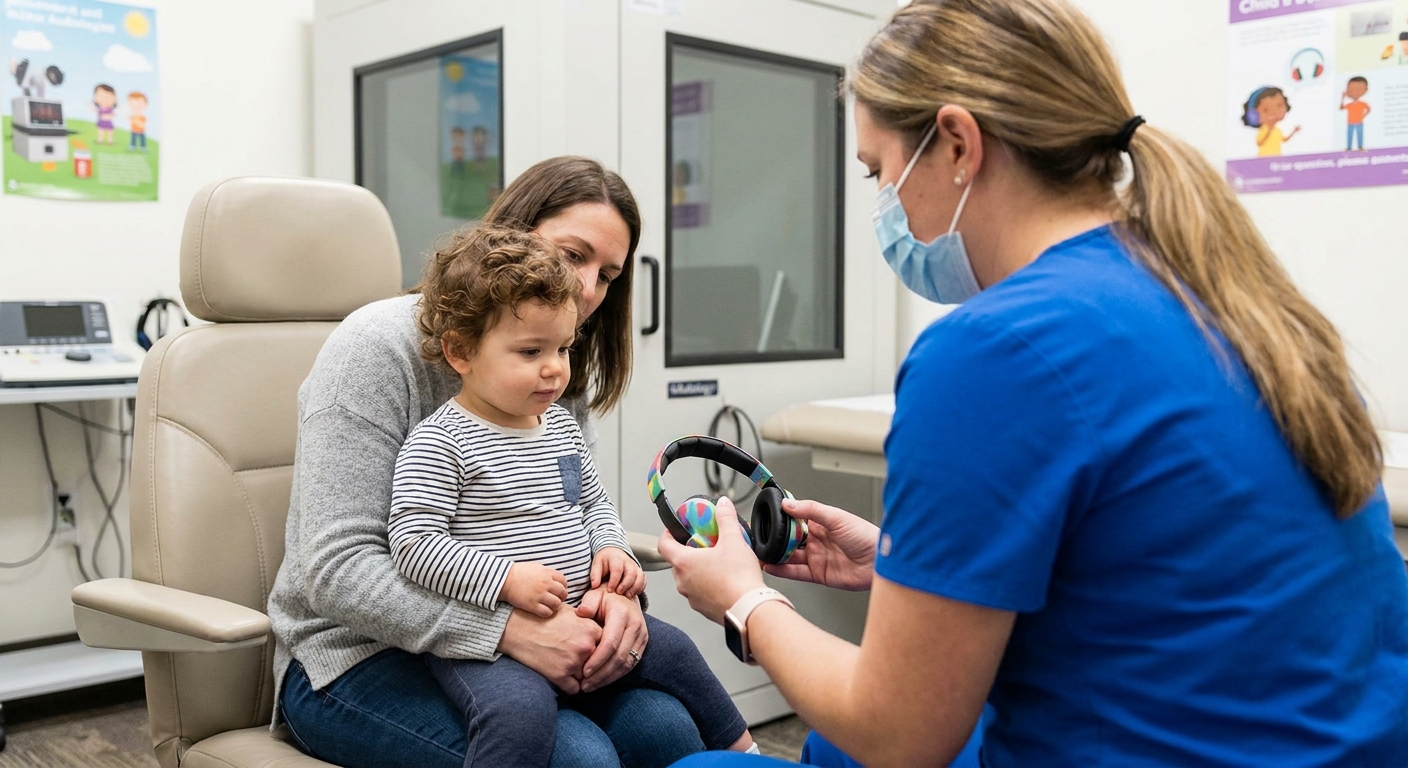
- A referral for formal hearing testing (audiology), especially if there have been frequent ear infections or you see reduced response to sound.
- Developmental screening (many practices use tools like the ASQ) and autism-specific screening when age-appropriate (often M-CHAT-R/F at 18 and 24 months, though concerns can be addressed at any age).
Within 2 to 4 weeks
Schedule hearing testing. If your child cannot hear clearly, speech therapy cannot fully do its job. An audiology evaluation is one of the highest value next steps for lost words.
Within 1 month
Contact Early Intervention (US) or your local equivalent. If you are in the United States, you can self-refer to Early Intervention (EI) for children under 3. You do not need to wait for a specialist appointment to get the ball rolling.
- What EI can include: speech-language therapy, developmental therapy, and parent coaching. Services vary by state and region.
- Why sooner is better: If your child qualifies, support can start while you continue investigating causes.
- If they do not qualify: You still gain useful developmental feedback and next steps.
Over the next 6 to 8 weeks
If words return after recovery from illness or a stressful transition, that is reassuring. If your toddler is still losing skills, not rebuilding words, or you are seeing social communication red flags, keep pushing forward with evaluation. You are not being difficult. You are being attentive.
What to do at home
You do not need to turn your living room into a therapy center. A few targeted changes can make a big difference, especially when a toddler is frustrated.
Keep language simple
- Use short phrases: “More crackers?” “Open please.” “Up?”
- Repeat key words many times during the day.
- Give extra wait time. Some toddlers need a few extra seconds to process and respond.
Model, then pause
If your child points to milk, you can say: “Milk. Milk please.” Then pause and look expectant. If they attempt a sound or word, respond warmly and give the milk. The goal is progress, not perfection.
More face-to-face talk
Toddlers learn a lot from watching your mouth and facial expressions. Try:
- Reading simple books with repetitive phrases
- Singing short songs with pauses (“Old MacDonald had a…”)
- Play that invites turn-taking (rolling a ball back and forth)
Less background noise
If hearing is even slightly off, TV and constant music make it harder to pick out speech sounds. Quiet environments help toddlers “catch” words again.
Do not punish silence
If your toddler is talking less, they may be overwhelmed or struggling. Keep your tone upbeat and neutral. You are building safety around communication.
When to get urgent help
Speech regression usually belongs in the “prompt but not panic” category. Rarely, loss of skills can be part of a broader medical or neurologic issue, and that is why safety-netting matters. Seek urgent medical care if your child also has:
- Sudden loss of skills paired with significant lethargy, weakness, or abnormal movements
- Signs of serious illness like dehydration, breathing trouble, or persistent high fever
- Concern for seizures (staring spells with unresponsiveness, rhythmic jerking, or episodes followed by confusion)
If you are unsure, call your pediatrician’s nurse line. That is exactly what we are there for.
Frequently asked questions
Can teething cause speech regression?
Teething can make toddlers cranky, sleepy, and less talkative for a few days. It is unlikely to cause a sustained loss of words for weeks. If you are seeing a longer pattern, consider hearing and developmental evaluation.
My toddler understands me but is talking less. Is that still regression?
Strong understanding (receptive language) is reassuring, but it does not rule out hearing issues, speech sound difficulties, or other language delays. Losing expressive words still deserves a check-in, especially if it is persistent.
What if my toddler is bilingual?
Bilingualism does not cause regression. Some bilingual toddlers may mix languages or have uneven word counts in each language, but skill loss is still skill loss. Track total communication across both languages and talk with your pediatrician if words are disappearing.
Will my pediatrician take this seriously?
A good pediatric clinician will. Bring your notes: which words were lost, when, and what else changed. Clear examples make it easier to act quickly.
A calm bottom line
When toddlers lose words, it is worth paying attention, and it is worth getting support early. Start with hearing, look at the whole developmental picture, and trust your day-to-day observations. If it turns out to be a temporary dip, great. If it is something that needs therapy or further evaluation, starting now is one of the kindest things you can do for your child and for your future sleep.
If you are sitting with this worry at 3 AM, please hear me: you are not overreacting. You are noticing your child. That is good parenting.
Sarah Mitchell
Sarah Mitchell is a Registered Pediatric Nurse and a mother of three who has spent over a decade helping families navigate the beautiful, chaotic early years of childhood. She combines evidence-based medical knowledge with real-world parenting experience to offer practical, compassionate advice. At Awesome Parent, Sarah's mission is to help exhausted parents find solutions, trust their instincts, and finally get some sleep.