Parent-tested ways to give liquid or chewable medicine to a stubborn toddler, with safer mixing tips, gentle technique, poison prevention reminders, and when...
How to Give Ear Drops to a Toddler

Sarah Mitchell
Sarah Mitchell is a Registered Pediatric Nurse and a mother of three who has spent over a decade helping families navigate the beautiful, chaotic early years of childhood. She combines evidence-based medical knowledge with real-world parenting experience to offer practical, compassionate advice. At Awesome Parent, Sarah's mission is to help exhausted parents find solutions, trust their instincts, and finally get some sleep.
The first time I had to give ear drops to one of my kids, I thought my triage nurse background would make it a quick, no-big-deal moment. Then my toddler acted like I was trying to rinse his brain. If you are staring at a tiny bottle while your child practices Olympic-level head turns, you are not doing anything wrong. Ear drops are just tricky.
This is a simple routine you can repeat each time. As little wrestling as possible, no scary surprises, and no complicated medical talk. Just practical steps to get the drops where they need to go.
Before you start: set yourself up
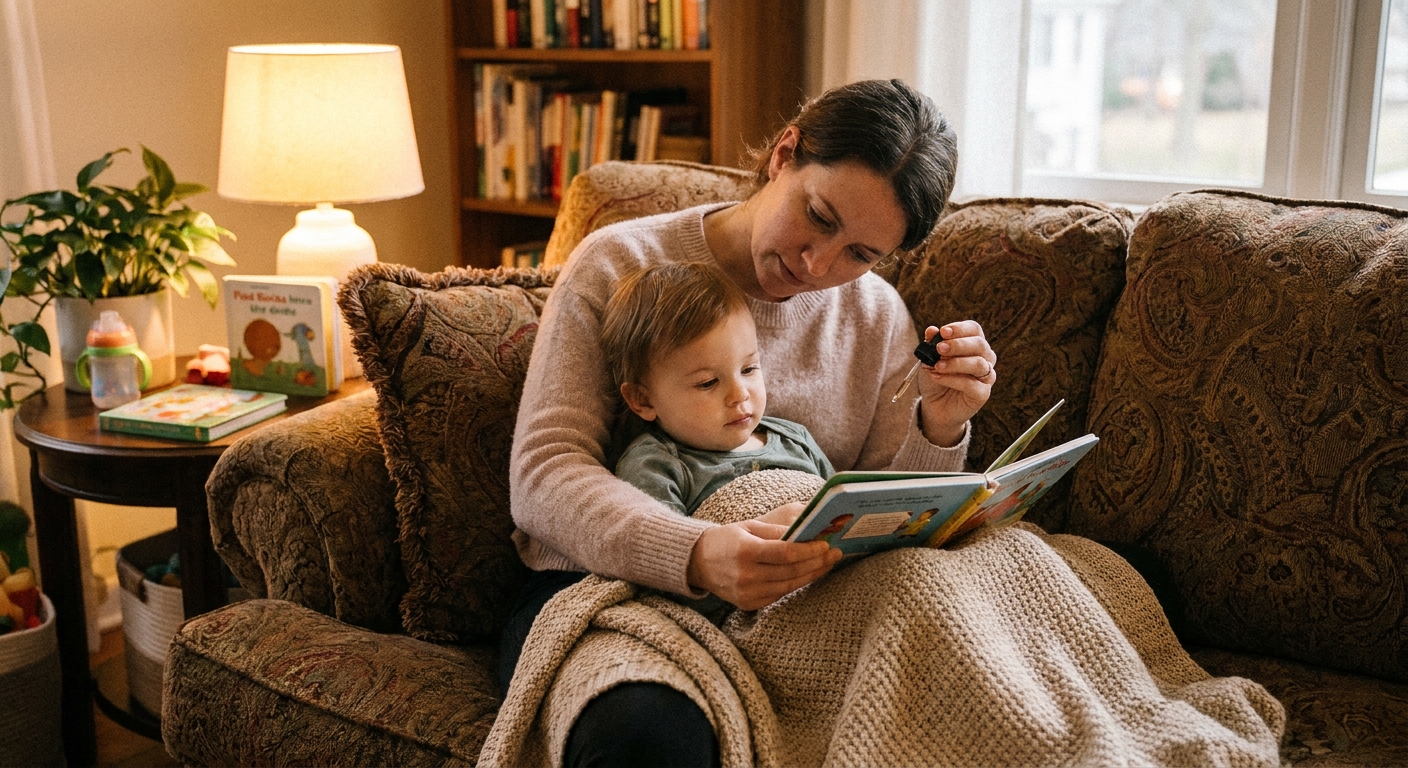
Ear drops go best when you treat the moment like a mini routine, not a sudden ambush. Your goal is calm, steady, and quick.
Gather everything first
- The ear drops
- Tissues or a soft cloth for drips
- A timer (your phone is fine)
- A distraction: a book, a small toy, a short video, or a snack for after
- A second grown-up if you have one available, especially for the first few tries
Check the label quickly
Before you uncap anything, take five seconds to confirm the basics: the right ear, how many drops, and how often. Also look for instructions like “shake well,” refrigerate, and any note about discarding after a certain number of days once opened.
Warm the bottle (gently)
Cold drops can be startling and uncomfortable. Hold the closed bottle in your palm for a minute or two to bring it closer to body temperature. If your label or pharmacist says it is okay, you can also set the closed bottle in a cup of warm (not hot) water for a few minutes. Do not microwave it or overheat it.
Pick a spot that helps you
A couch, bed, or padded rug is usually easiest. Choose a place where you can keep the treated ear facing up, and where you can sit with your back supported so you are not hovering over a squirmy toddler.
Best positions for a wiggly toddler
There is no single perfect position. Choose what feels safest and most controlled for your child’s age and energy level.
Option 1: Side-lying
This is the classic for a reason. Have your toddler lie on their side with the ear you are treating facing up. You can sit behind them and use your body as a gentle barrier so they cannot scoot backward.
Option 2: Lap cradle
Sit down and place your toddler sideways across your lap, with their head supported near your knees and the treated ear facing up. This works well for kids who want to be close to you.
Option 3: Two-parent teamwork
One adult holds the child in a comfortable hug from behind and keeps hands busy with a toy, while the other adult gives the drops. If your toddler fights hard, this can keep everyone safer and calmer.

How to put in ear drops
If your clinician gave you specific instructions for your child’s medication, follow those. What I am covering here is the technique.
Wash your hands. Quick but important.
Have your toddler in position before the cap comes off. Toddlers are fast. Get the body settled first.
Explain in one simple sentence. Something like: “Drops, then we read a book.” Big speeches tend to increase anxiety.
Steady your hand by resting it on their head. Instead of hovering, lightly rest the side of your hand on their temple or hairline. This helps prevent accidental pokes if they move.
Optional: gently pull the outer ear back and up. For many toddlers, a small pull back and up can help straighten the canal. If your clinician showed you a different technique for your child, use that.
Aim for the ear canal opening, not deep inside. You do not need to put the dropper tip into the ear. In fact, it is better if you do not. Keep the tip clean and avoid touching the ear if possible.
Give the drops, then keep the ear facing up. Try for 30 to 60 seconds, or whatever your prescription label says (some medications need longer).
A gentle trick to help drops go in
After the drops are in, you can lightly press the little flap of skin in front of the ear canal (the tragus) a few times. Think gentle tapping, not pushing. This can help the drops move into the canal. Skip it if it hurts.
If the dropper tip touches the ear
Do not rinse the dropper tip. Just wipe any liquid off the outside with a clean tissue and recap. If your medication label has contamination warnings or you are worried the bottle is no longer clean, call your pharmacy for guidance.
Keeping drops in (briefly)
Most toddlers do not want to stay still. That is normal. Your job is to buy a short window so the drops do not immediately run back out.
- Use a timer so you are not guessing. Many families aim for 30 to 60 seconds, unless the label says otherwise.
- Give a job: “Hold this book,” “Squeeze my finger,” or “Count to ten with me.”
- Offer a predictable reward after: sticker, one short video, a cuddle, or a bedtime story. I prefer “after the drops” instead of bribing mid-drop, which can drag it out.
If your child sits up and some liquid drips out, do not panic. A little leakage is common. Focus on making the next dose calmer rather than trying to fix it in the moment.
If your toddler fights hard
Some kids tolerate ear drops fine. Others treat them like a personal betrayal. If you are in the second group, here are strategies that actually help.
Offer choices that change nothing
Toddlers love control. You can offer:
- “Do you want drops on the couch or the bed?”
- “Do you want to hold the tissue or the teddy?”
- “Do you want to press the timer button?”
Keep your words boring and confident
Big emotional energy, even positive, can rev kids up. A calm script works best: “I know you do not like it. We are doing it quickly. Then all done.”
Use the burrito only if you truly need it
If your toddler flails their arms and you cannot safely control the dropper, wrapping them in a blanket with arms tucked can help prevent injury. Keep it gentle and brief, and stop if your child becomes very distressed or you feel you are escalating the situation.
Tag-team when possible
If you have another adult available, use them. One person can focus on comfort and steady holding while the other focuses on the drops.
If you find yourself having to pin your child down with significant force, pause and reassess. It is okay to call your pharmacy or clinician and ask for tips on administration for your specific medication and your specific kid.
Common ear drop mistakes
- Do not stick the dropper into the ear. It can hurt, and it can contaminate the bottle.
- Do not share bottles between children. Even siblings.
- Do not double up if you are unsure a dose went in. If you think a dose was missed, contact your pharmacist or prescribing clinician for advice.
- Do not skip the routine just because your child is upset. Consistency usually makes day two and three much easier than day one.
Quick tips for next time
The easiest ear drop session is the one your toddler trusts will end quickly.
- Practice with pretend. Let them put “drops” (a closed bottle) in a stuffed animal’s ear.
- Pair it with a predictable time. Many families do best with drops right after teeth brushing or right before story time, depending on the prescription schedule.
- Praise the effort, not perfection. “You held still for two seconds. That helped.” Small wins add up.

When to call urgently
This article is about technique, not diagnosing or dosing. Still, there are a few situations where you should stop and get medical advice right away:
- You cannot get the drops in at all after repeated attempts and your child is becoming increasingly distressed.
- Your child has a sudden severe reaction after the drops, like hives, swelling, wheezing, or trouble breathing.
- You see significant bleeding from the ear or your child has sudden, intense pain that is not settling.
- Your child has ear tubes, a known or possible eardrum perforation, or new ear drainage and you were not clearly told what to do. Some drops are not meant for certain ear conditions, so it is worth a quick call to confirm you are using the right product.
If you are ever unsure, your pharmacist is also a great resource for technique questions. They talk parents through this more often than you would think.
A simple script
If your brain goes blank the moment your toddler starts yelling, here is a calm script that works well:
“I hear you. You do not like this. I am going to put the drops in, then we will cuddle and read. Ready, set, drops. All done.”
You are not aiming for a Pinterest-perfect moment. You are aiming for safe, steady care with as little stress as possible for both of you. That counts as excellent parenting, even if it is loud.
Sarah Mitchell
Sarah Mitchell is a Registered Pediatric Nurse and a mother of three who has spent over a decade helping families navigate the beautiful, chaotic early years of childhood. She combines evidence-based medical knowledge with real-world parenting experience to offer practical, compassionate advice. At Awesome Parent, Sarah's mission is to help exhausted parents find solutions, trust their instincts, and finally get some sleep.