That squeaky newborn breathing is often laryngomalacia and usually improves with time. Here’s what to listen for, how it’s diagnosed, what helps at home, and...
Subglottic Stenosis in Babies

Sarah Mitchell
Sarah Mitchell is a Registered Pediatric Nurse and a mother of three who has spent over a decade helping families navigate the beautiful, chaotic early years of childhood. She combines evidence-based medical knowledge with real-world parenting experience to offer practical, compassionate advice. At Awesome Parent, Sarah's mission is to help exhausted parents find solutions, trust their instincts, and finally get some sleep.
There is “newborn noisy breathing,” and then there is the kind of breathing that makes your whole body tense up because it just does not sound right. As a pediatric triage nurse, I talked to a lot of parents who were told “it’s probably just croup” or “some babies are noisy.” Sometimes that’s true. But when the noise is happening on the way in and on the way out, or when “croup” keeps coming back again and again, we have to widen the lens.
One important possibility is subglottic stenosis, a narrowing in the airway just below the vocal cords. It is less common than more typical causes like laryngomalacia, but it matters because it is a more fixed, structural narrowing and it can worsen noticeably during a cold.

What it is
The subglottis is the short section of airway right under the vocal cords. Stenosis means narrowing. So subglottic stenosis is literally a narrowed airway below the vocal cords.
This narrowing can be:
- Congenital (present at birth because the airway formed narrower than usual).
- Acquired (develops after irritation or injury to the airway, most commonly after a baby has needed a breathing tube for a period of time).
Because babies already have tiny airways, even a small amount of narrowing can make a big difference, especially when a cold adds swelling on top of it.
What it can sound like
Parents often describe the sound as:
- Harsh or high-pitched noisy breathing (stridor).
- Noisy on inhale and exhale (often called biphasic stridor).
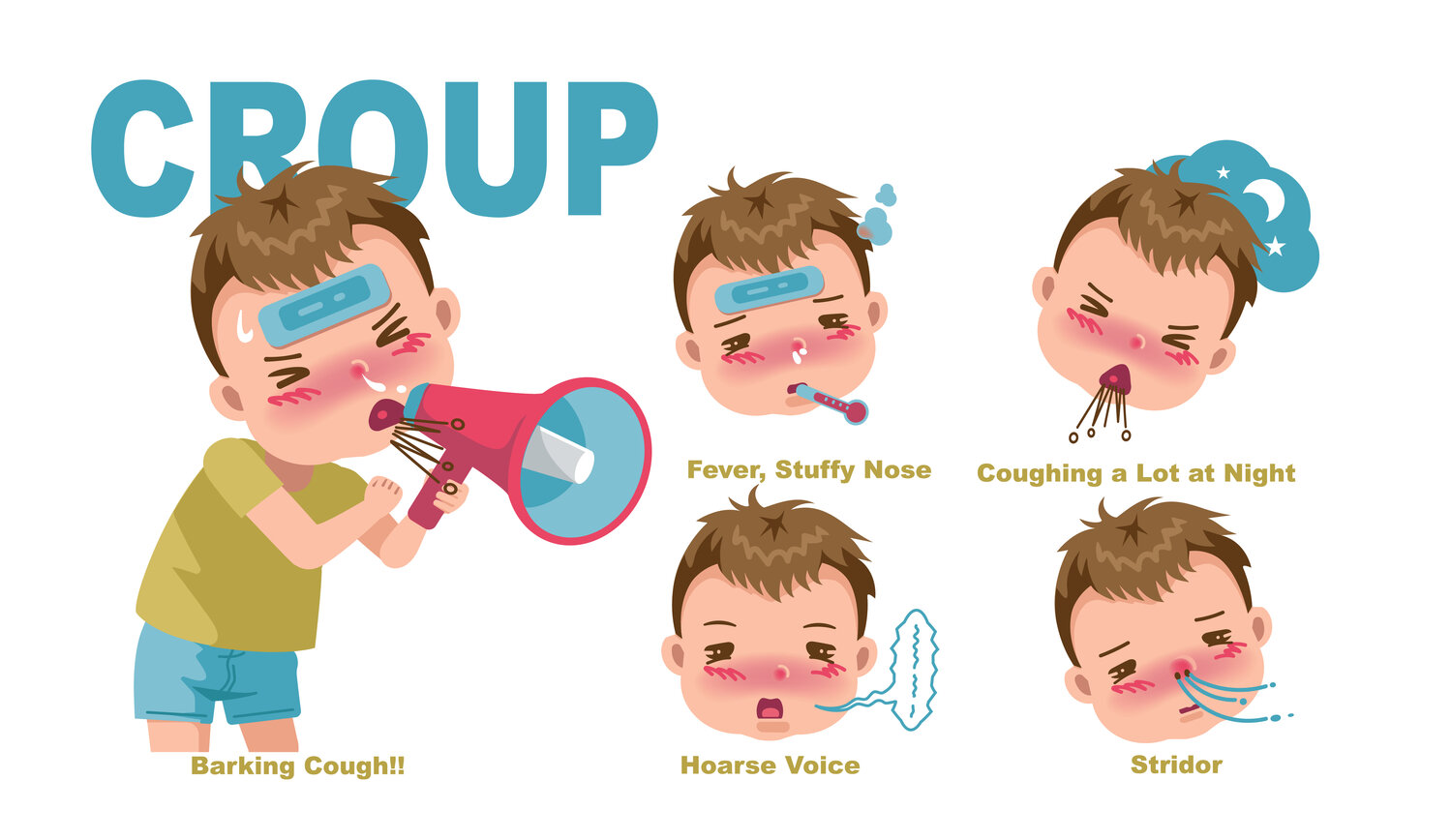
- “Like croup,” especially if there is a barky cough during viral illnesses.
- Worse with crying, feeding, excitement, or when a baby has a cold.
A key pattern I listen for in triage is recurrent croup. Lots of kids get croup once. Some get it a couple times. But if your child is having repeated “croup” episodes, unusually severe episodes, or symptoms that never fully go away between illnesses, your clinician may start thinking about whether there is a narrow spot underneath the vocal cords that keeps getting irritated and swollen.
One more note, just to keep us honest: recurrent or biphasic stridor does not automatically equal subglottic stenosis. Other causes your clinician may consider include subglottic hemangioma, vocal cord paralysis, tracheomalacia, an airway foreign body, or (more rarely) a vascular ring. The point is not to scare you. The point is to get the right people looking in the right place.

Clues that raise suspicion
Not every noisy baby has subglottic stenosis. But certain details make it more likely:
- History of intubation (a breathing tube), especially if it was in place for a longer period or there were multiple intubations.
- Premature birth or a NICU stay (not because prematurity automatically causes stenosis, but because some preemies need prolonged respiratory support).
- Biphasic noisy breathing (on inhale and exhale), particularly if it persists.
- Croup-like episodes that keep returning, or croup that seems unusually severe.
- Persistent hoarseness or a weak cry can sometimes travel with airway irritation, especially after intubation-related irritation or vocal fold injury, though not every child has this.
- Breathing symptoms out of proportion to the mildness of a cold.
How it differs from laryngomalacia
A very common cause of noisy breathing in babies is laryngomalacia, which is a floppy, collapsible structure above the vocal cords. That tends to cause a squeaky noise mostly on inhalation, and it often starts early in life, may peak over the first few months, and frequently improves with time.
Subglottic stenosis, on the other hand, is a fixed narrowing below the vocal cords. That difference matters because the evaluation and treatment plan can look very different.
Common differences parents notice
- Type of noise: laryngomalacia is often inspiratory; subglottic stenosis is often biphasic.
- Course over time: laryngomalacia often gradually improves; subglottic stenosis may be quiet between illnesses but can flare repeatedly with colds, or it may be persistently noisy depending on severity.
- Response to croup treatment: a child with subglottic stenosis might improve temporarily with steroids used for croup, but symptoms may recur or feel “too frequent.”
Real life is messy, and these are not perfect boxes. That is why persistent or worrisome noisy breathing deserves an in-person evaluation.
Age patterns that can help
Age is never the whole story, but it can provide clues:
- Croup is most common roughly between 6 months and 3 years.
- Congenital subglottic stenosis may show up earlier, sometimes as ongoing noisy breathing that does not fit the usual “viral croup” pattern.
- Acquired subglottic stenosis often shows up after an intubation history, sometimes with recurrent “croup” or stridor that appears with colds.
How it’s evaluated
If your pediatrician suspects an airway issue, they may refer you to a pediatric ENT (ear, nose, and throat specialist) or, depending on severity, to the emergency department for more urgent assessment.
Evaluation often includes a combination of:
- History: details about intubation, NICU course, frequency of “croup,” feeding issues, reflux symptoms, and growth.
- Physical exam: listening for stridor at rest versus only with agitation, checking work of breathing, oxygen level, hydration, and overall appearance.
- Airway visualization: many upper-airway conditions can be assessed with a flexible scope to look at the nose, throat, and larynx. But the subglottis can be harder to fully assess in the office.
- Direct laryngoscopy and bronchoscopy: if subglottic stenosis is strongly suspected, the gold standard for diagnosis and grading is often a procedure done by specialists to directly look at the airway (typically under anesthesia). Grading is commonly done during endoscopy with sizing.
Sometimes imaging is used in certain situations, but the key point for parents is this: subglottic stenosis is diagnosed by carefully looking at the airway, not just by listening to the sound.

When it’s an emergency
I am very relaxed about a lot of normal kid sounds. This is not one of those times. If you are seeing signs that your baby is working hard to breathe, do not wait for a callback.
Call emergency services or go to the ER now if your baby:
- Is struggling to breathe with visible pulling in at the ribs or above the collarbones (retractions).
- Has fast breathing that does not improve with calming or rest, or pauses in breathing.
- Looks pale, gray, or blue around the lips or face.
- Cannot feed because breathing is too hard, or is drooling with distress or trouble swallowing.
- Is unusually sleepy, limp, or hard to wake.
- Has a high-pitched sound at rest that is getting worse, especially after a cold starts.
- Has any episode where you feel like you are watching them breathe moment by moment to make sure they keep going.
If your parent gut is shouting that this is not okay, listen to it. You do not need to perfectly name the problem to seek urgent help.
What treatment can look like
Treatment depends on how severe the narrowing is and how your baby is doing day to day. Some children have mild narrowing and only struggle during respiratory infections. Others may have more persistent symptoms.
Depending on the situation, your ENT team may discuss options such as:
- Observation with close follow-up for mild cases.
- Managing triggers that can worsen swelling, like reflux or repeated airway irritation, when appropriate.
- Procedures to widen the airway in certain cases (your child’s specialist will explain the risks, benefits, and goals in plain language).
- Surgery for more significant stenosis, when needed, performed by pediatric airway specialists.
If your baby has been diagnosed, it is also worth asking your team for an “if this happens, do this” plan for colds and breathing flare-ups. Having a plan can take the edge off those 2 a.m. spirals.
What to do while you wait
If your baby is stable enough to be at home while you’re awaiting ENT evaluation, here are practical steps that often help you stay safe and organized:
- Record short videos of the noisy breathing (30 to 60 seconds). Capture both rest and a moment after crying if it is safe to do so. This is incredibly helpful in clinic.
- Track patterns: when is it worse? During feeds? When lying flat? Only with colds? Any fever?
- Prioritize hydration and feeding: if feeding is becoming hard work for your baby, call your pediatrician the same day.
- Avoid smoke and strong scents: any airway irritation can worsen symptoms.
- Keep expectations realistic about steam: a humidifier or steamy bathroom can be a comforting tool during viral croup, but it does not fix a structural narrowing. If your baby is struggling, comfort measures should not delay urgent care.
- Use your escalation rules: if breathing effort increases, do not “wait and see” overnight.

FAQ
Can subglottic stenosis be mistaken for croup?
Yes. Because the narrowed area is in the same general region affected by croup swelling, a child with subglottic stenosis may look like they are getting croup repeatedly, or their “croup” may seem unusually severe. The key clue is the pattern: frequent recurrences, severe symptoms, or noisy breathing that does not fully resolve between illnesses.
Does a history of intubation mean my baby will definitely have this?
No. Many babies who were intubated never develop subglottic stenosis. But a history of intubation is an important clue, especially if breathing noise and recurrent croup-like episodes show up afterward.
Is biphasic stridor always subglottic stenosis?
Not always. Biphasic stridor can occur with other airway problems too. But it is a reason to take the symptoms seriously and get an airway-focused evaluation rather than assuming it is a simple cold.
What is the difference between stridor and wheezing?
Stridor is typically a higher-pitched, harsher noise from the upper airway (throat or voice-box area). Wheezing is usually a whistling sound from the lower airways (lungs), often more noticeable on exhale. Parents are not expected to sort this out alone, but describing whether the noise seems to come from the throat versus the chest can help your clinician.
Can this improve as my baby grows?
Sometimes milder narrowing becomes less symptomatic as a child’s airway grows. But because subglottic stenosis is a structural narrowing, it is not something to “wait out” without specialist guidance. Your ENT team can explain what’s reasonable to monitor and what needs active treatment.
A final word
One of the hardest parts of airway issues is the uncertainty. You can be doing everything right and still end up with a baby who sounds scary when they breathe. If you are noticing recurrent croup-like episodes, noisy breathing on inhale and exhale, or any real work of breathing, you are not overreacting by asking for a deeper evaluation.
You do not have to diagnose subglottic stenosis at home. Your job is simpler and more important: notice the pattern, trust your instincts, and get urgent help when breathing looks hard.
Sarah Mitchell
Sarah Mitchell is a Registered Pediatric Nurse and a mother of three who has spent over a decade helping families navigate the beautiful, chaotic early years of childhood. She combines evidence-based medical knowledge with real-world parenting experience to offer practical, compassionate advice. At Awesome Parent, Sarah's mission is to help exhausted parents find solutions, trust their instincts, and finally get some sleep.