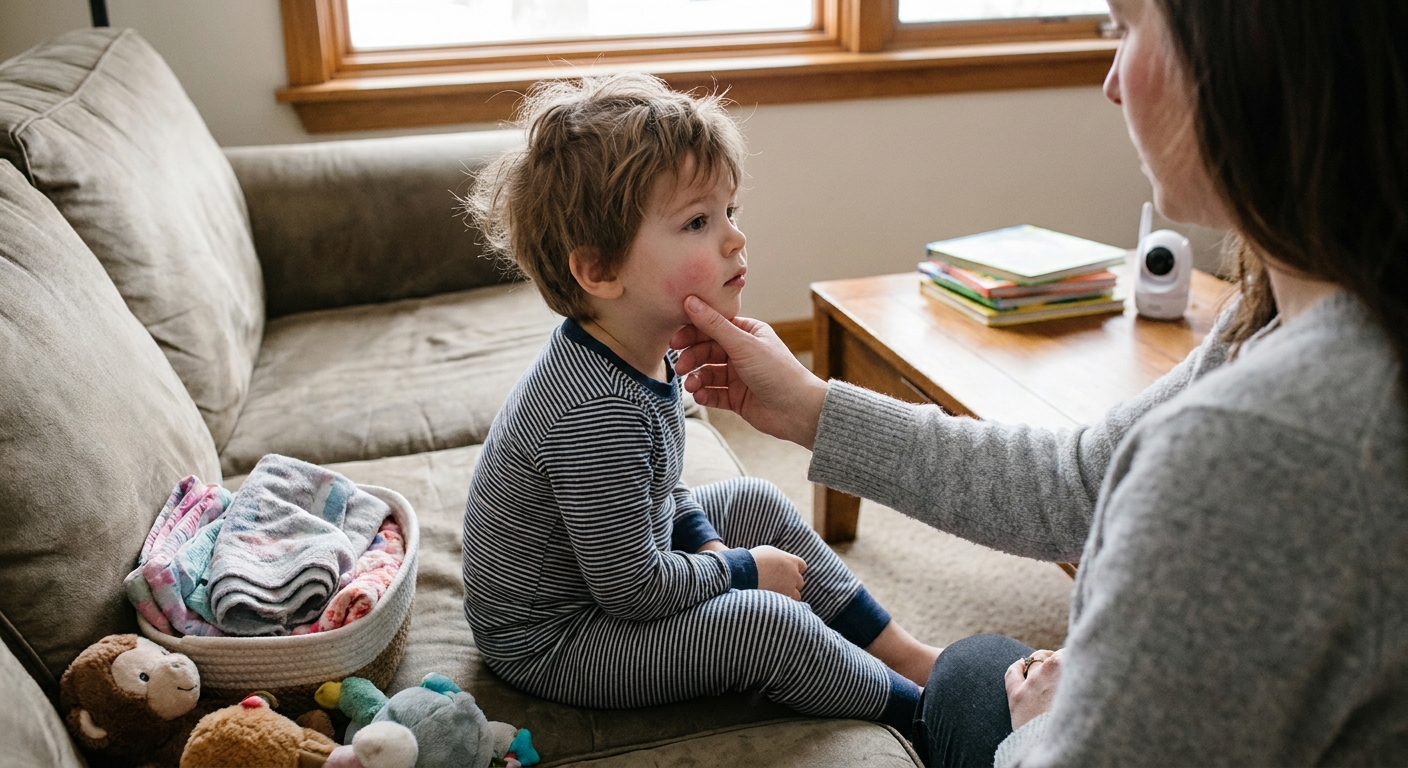
A calm, practical overview for parents on measles symptoms, rash progression, contagious timeline, isolation basics, vaccine protection, and what to do after...
Breakthrough Measles in a Vaccinated Child

Sarah Mitchell
Sarah Mitchell is a Registered Pediatric Nurse and a mother of three who has spent over a decade helping families navigate the beautiful, chaotic early years of childhood. She combines evidence-based medical knowledge with real-world parenting experience to offer practical, compassionate advice. At Awesome Parent, Sarah's mission is to help exhausted parents find solutions, trust their instincts, and finally get some sleep.
I still remember the first time a parent said to me, wide-eyed at triage, “But he’s vaccinated. It can’t be measles, right?” I wanted to give them a simple yes or no. The honest answer is: measles after the MMR vaccine is uncommon, but it can happen. And when it does, the next steps depend heavily on two things: exposure risk and how the illness looks.
This article will walk you through how clinicians think about a vaccinated child who has symptoms that could fit measles, why that is different from a routine fever and rash one to two weeks after the MMR shot, and which symptoms deserve same-day guidance and isolation planning.
Can a vaccinated child get measles?
Yes, but it is rare. Two doses of MMR are very effective at preventing measles. Still, no vaccine is 100% protective. A vaccinated child can occasionally develop “breakthrough” measles. It is more likely in situations like these:
- They have had only one dose (for example, a toddler vaccinated at 12 to 15 months who has not had the second dose yet).
- Their immune response was weaker than expected, so protection did not fully develop.
- They are immunocompromised or taking medications that affect immune function (and sometimes those children cannot receive MMR at all, depending on the situation).
Breakthrough measles is often milder than measles in an unvaccinated person, but not always. Either way, because measles spreads so easily, clinicians take suspected cases seriously.
The biggest clue: exposure
In a real clinic, we often start with one question before we over-interpret a rash: “Was your child likely exposed?”
Measles is extremely contagious. Clinicians get concerned when a child has symptoms that could fit measles and any of the following exposure situations:
- Known close contact with someone diagnosed with measles.
- Notice of exposure from school, childcare, a clinic, an emergency room, or public health.
- International travel (or close contact with someone who recently traveled internationally), especially if there are outbreaks.
- Community outbreak where public health reports ongoing spread.
- Household or close contact who is unvaccinated and ill with a measles-like illness.
If there is no exposure and no local outbreak, the odds that a vaccinated child’s random fever and rash is measles are generally much lower. Not zero, but much lower. That is why timing and symptom pattern matter so much. It is also why many fever-and-rash illnesses in kids turn out to be other common viruses, even in fully vaccinated children.
What a measles-pattern illness looks like
I am not going to give you a day-by-day rash map. In real life, many rashes blur together, especially early on.
Instead, here is what raises a clinician’s eyebrows for measles in a vaccinated child:
- Fever that is persistent and often high, especially when it is paired with a child who looks significantly unwell.
- Prominent cough, runny nose, and red or irritated eyes (parents often describe the eyes as watery, sensitive to light, or just “really red”).
- Those “cold-like” symptoms usually come first, then a widespread rash follows.
- A widespread rash that shows up in the setting of fever and respiratory symptoms, not a tiny localized rash.
- Koplik spots (tiny white spots in the mouth) can be a clue when present, but they are not always seen and parents should not feel pressured to hunt for them.
- Clear exposure risk, even if symptoms seem mild.
Put simply: when a vaccinated child has a meaningful exposure history plus fever plus cough and red eyes that feel like more than a routine sniffle, clinicians think, “We need to rule measles out,” even if the child has been vaccinated.

MMR reaction vs measles
One of the most common panic moments I see is this: a child gets their MMR vaccine, then about 7 to 14 days later develops a fever and a mild rash.
That timing can be a typical vaccine reaction for some kids. It happens because the vaccine is teaching the immune system to respond, and that immune practice run can briefly cause symptoms.
Here is the key difference clinicians use:
- MMR reaction is most likely when there is no known exposure to measles and symptoms are relatively mild and short-lived.
- Possible measles moves up the list when there is known exposure or outbreak risk, and symptoms fit a measles-pattern illness (fever plus significant cough, runny nose, red eyes, plus a rash).
Another helpful point: a routine post-MMR fever and rash is not the same thing as wild-type measles infection and is generally not considered contagious. That said, if there is a real exposure concern, clinicians may still use extra caution until they sort it out.
Practical parent takeaway: if your child develops a fever and rash 1 to 2 weeks after the MMR shot and there is no exposure, call your pediatrician for advice, but try to breathe. Many of these cases are routine post-vaccine reactions or other common viral rashes.
But if there is any chance of exposure, do not self-triage at home. Call and let the clinic guide you on next steps and where to be seen safely.
When to isolate and call today
If measles is even a possibility, the goal is to protect your child and prevent exposing others, especially infants and immunocompromised people.
Measles can spread from about 4 days before the rash appears through about 4 days after the rash starts. That is why clinics get so strict about call-ahead planning.
Call your child’s clinician the same day and ask for isolation instructions before you go anywhere if your child has:
- Known measles exposure (a confirmed contact or public health notice), with any new fever, cough, runny nose, red eyes, or rash.
- Fever plus rash and you live in or recently visited an area with an outbreak.
- Fever plus cough and red eyes with a spreading rash, even if vaccination is up to date.
- Any measles-like symptoms in an immunocompromised child (for example, on chemotherapy, high-dose steroids, post-transplant medications, or with certain immune disorders).
Until you get medical advice, use a “pause and isolate” approach:
- Keep your child home and away from visitors.
- Do not send them to school or childcare.
- Do not go sit in a waiting room without calling first.
- If you must seek urgent care, call ahead so they can bring you in safely.
- If your child is old enough to tolerate it, consider a well-fitting mask during transport, and mask any accompanying adult if advised by your clinic.
What happens when you call
Parents are sometimes surprised that a clinic will ask a lot of questions up front, or that they might route you differently than usual. That is not to scare you. That is infection control doing its job.
Your clinician or nurse line may ask about:
- MMR dose dates and how many doses your child has had
- Where your child has been in the last couple weeks (travel, school notices, known exposure)
- When fever started, and how high it has been
- Presence of cough, runny nose, red eyes, and rash
- Whether anyone at home is pregnant, unvaccinated, very young, or immunocompromised
If measles is a real concern, they may coordinate testing and evaluation in a way that reduces exposure to others. In many areas, this is coordinated with local public health.
Testing for suspected measles often includes a PCR swab (usually from the nose or throat) and a blood test to look at measles antibodies. Some protocols also include a urine sample. The exact plan depends on local guidance and timing of symptoms.
Common parent questions
What if my child had the MMR recently and now has symptoms?
Tell the clinician the exact vaccine date and the exact symptom start date. Timing matters. A fever and mild rash in the 1 to 2 week window after MMR, with no exposure, is often handled differently than an illness after a known contact.
Does vaccination change isolation advice?
It can, but it does not erase the need for caution. If your child has a true exposure and measles-like symptoms, clinicians may still advise isolation while they assess, regardless of vaccination status.
If it is breakthrough measles, is it less contagious?
It may be milder, but measles is so contagious that clinicians still treat suspected cases seriously. Do not assume “milder” means “not transmissible.”
When to get urgent help
Measles can become serious, especially in younger children and those with underlying health conditions. Regardless of the cause of your child’s rash, seek urgent care or emergency care right away if you notice:
- Trouble breathing, fast breathing, or ribs pulling in with breaths
- Signs of dehydration (very dry mouth, no tears when crying, significantly fewer wet diapers or peeing much less)
- Extreme sleepiness, hard to wake, confusion, or your child seems “not themselves” in a scary way
- Seizure
- Blue or gray lips
If you are heading in, call ahead when possible and mention “possible measles exposure” so the facility can help prevent spread.
Bottom line
Most vaccinated kids with a random fever and rash do not have measles. But measles can occasionally occur after vaccination, especially when there is a real exposure risk. The clinician mindset is simple: exposure plus a measles-pattern illness means we take precautions and rule it out safely.
If you are on the fence, do what I used to tell families on the phone at 3 AM: call, give the dates and details, and let us help you make a plan that keeps your child and your community safe.
This is general information, not a diagnosis. When measles is a concern, follow your clinician’s and local public health guidance closely.
Sarah Mitchell
Sarah Mitchell is a Registered Pediatric Nurse and a mother of three who has spent over a decade helping families navigate the beautiful, chaotic early years of childhood. She combines evidence-based medical knowledge with real-world parenting experience to offer practical, compassionate advice. At Awesome Parent, Sarah's mission is to help exhausted parents find solutions, trust their instincts, and finally get some sleep.