
A calm, practical guide to plugged ducts vs mastitis vs abscess, what symptoms mean, how to keep feeding safely, and when antibiotics or urgent care are needed.
Galactocele While Breastfeeding or Weaning

Sarah Mitchell
Sarah Mitchell is a Registered Pediatric Nurse and a mother of three who has spent over a decade helping families navigate the beautiful, chaotic early years of childhood. She combines evidence-based medical knowledge with real-world parenting experience to offer practical, compassionate advice. At Awesome Parent, Sarah's mission is to help exhausted parents find solutions, trust their instincts, and finally get some sleep.
I still remember the first time I felt a new lump while nursing. Even with years as a pediatric triage nurse, my brain immediately went to the worst places, because that is what sleep deprivation does. During breastfeeding and weaning, many new lumps are caused by milk flow issues. But not all of them are, which is why persistent lumps deserve a real check.
One of the less talked-about causes is a galactocele, which is basically a milk-filled cyst.
Let’s walk through what a galactocele is, how it feels compared with a clogged duct or mastitis, and when it makes sense to get checked out.

What is a galactocele?
A galactocele is a benign (non-cancerous) breast lump that forms when milk gets trapped and collects in a pocket, creating a cyst-like space. It most often happens during:
- Breastfeeding (especially if milk removal varies day to day)
- Weaning or dropping feeds (milk is still being produced, but less is being removed)
- After pumping changes (going longer stretches, switching flange sizes, stopping overnight pumps)
The milk inside can be watery, thick, or even creamy, depending on how long it has been sitting there. A galactocele is not an infection, and it is not the same thing as a “plug,” though ductal narrowing and inflammation can happen in the same neighborhood.
What does a galactocele feel like?
Parents describe galactoceles in remarkably similar ways. Typical features include:
- Smooth, round, or oval lump
- Soft to firm (it can feel squishy or rubbery, depending on the milk consistency)
- Usually not very tender (it can feel “noticeable,” but not like a bruise)
- Often movable under the skin
- May not change much after a feed or pump session
Some parents notice a galactocele grows gradually as they drop feeds, especially overnight. Others notice it suddenly after a skipped pump or a weekend of irregular nursing.

Galactocele vs clogged duct vs mastitis vs abscess
This is the part I wish every exhausted parent could tape to their fridge. These conditions can overlap, but they tend to have different “personalities.”
Galactocele
- Main clue: Smooth, well-defined lump, often not very painful
- Skin: Usually normal looking
- How you feel overall: Typically fine, no fever
- Response to feeding/pumping: May not shrink much afterward
Clogged duct (ductal narrowing)
- Main clue: Localized tender spot or firm area, often sore to touch
- Skin: May have mild redness, sometimes a wedge-shaped area
- How you feel overall: Usually no fever, may feel run-down
- Response to feeding/pumping: Often improves as milk flow normalizes
Mastitis
- Main clue: Increasing pain plus systemic symptoms, with or without fever
- Skin: Red, hot, swollen area can appear
- How you feel overall: Often fever, chills, body aches, flu-like feeling, or just feeling suddenly unwell
- Response to feeding/pumping: Sometimes worsens despite milk removal, may need medical treatment
Breast abscess
- Main clue: A localized pocket of infection that may feel fluctuant (like a water balloon) and is usually very tender
- Skin: Often significant redness, warmth, swelling
- How you feel overall: Can include fever and feeling quite ill
- Response to feeding/pumping: Usually does not resolve without drainage and medical care
If you take nothing else from this section, take this: a galactocele is typically a lump without the “I feel sick” piece. Mastitis and abscesses are where we start worrying about infection.
Why it can happen during weaning
When you wean, your body needs time to downshift milk production. If you drop feeds faster than your milk supply decreases, milk can back up. Sometimes that backup acts like a tender clogged area, but other times it collects and forms a galactocele.
This is especially common when:
- You drop night feeds first (longer stretches of fullness)
- You go from nursing to pumping less frequently
- You are down to one or two feeds per day and the schedule is inconsistent

Should you keep breastfeeding?
Usually, yes, you can continue breastfeeding or pumping if you are comfortable and there are no signs of infection. In many cases, ongoing milk removal helps prevent further backup. That said, a galactocele may not disappear immediately just because you nurse more, since it is a contained pocket.
Practical, gentle steps that are generally reasonable while you arrange follow-up if needed:
- Avoid aggressive massage. Deep, hard pressure can irritate tissue and make inflammation worse.
- Use comfort measures like a supportive bra and ibuprofen if you can take it.
- Feed or pump in a steady, consistent way rather than big swings (for example: not “nothing all day” and then an hour-long pump session).
- Watch for changes like redness, warmth, worsening pain, or fever.
If you are actively weaning, the goal is usually gradual reduction to avoid engorgement and inflammation. A galactocele is one more reason slow-and-steady tends to be kinder to your body.
When to call a clinician
Any new breast lump deserves attention, even during breastfeeding, because you cannot diagnose it by feel alone at home. Most breastfeeding-related lumps are benign, but it is still smart to get the right set of eyes and tools on it.
Reach out to your OB-GYN, midwife, family doctor, or a breast clinic promptly if:
- The lump is new and not improving after a day of your usual milk removal routine
- The lump persists beyond a couple of days, even if it is not painful
- It is getting larger or more tender
- You are weaning and keep getting recurrent lumps in the same area
- You have spontaneous, unilateral bloody nipple discharge (not just blood from a visible crack)
Also get checked sooner if you notice any of these red flags, breastfeeding or not:
- Skin dimpling or a peau d’orange (orange peel) texture
- New nipple inversion or retraction
- A lump that feels hard, fixed, or clearly different from surrounding tissue
- Enlarged lymph nodes near the armpit or above the collarbone
Get urgent care the same day if you have:
- Fever (especially 100.4°F / 38°C or higher), or you feel acutely ill even without a fever
- Chills, body aches, or flu-like symptoms
- Rapidly spreading redness or significant warmth
- Severe pain, or a lump that feels soft and squishy with worsening tenderness
Those symptoms push mastitis and abscess higher on the list, and you deserve prompt relief.
How it is diagnosed
In clinic, diagnosis usually starts with a history and breast exam. They will ask about where the lump is, whether it changes after feeds, and whether you have any fever or skin changes.
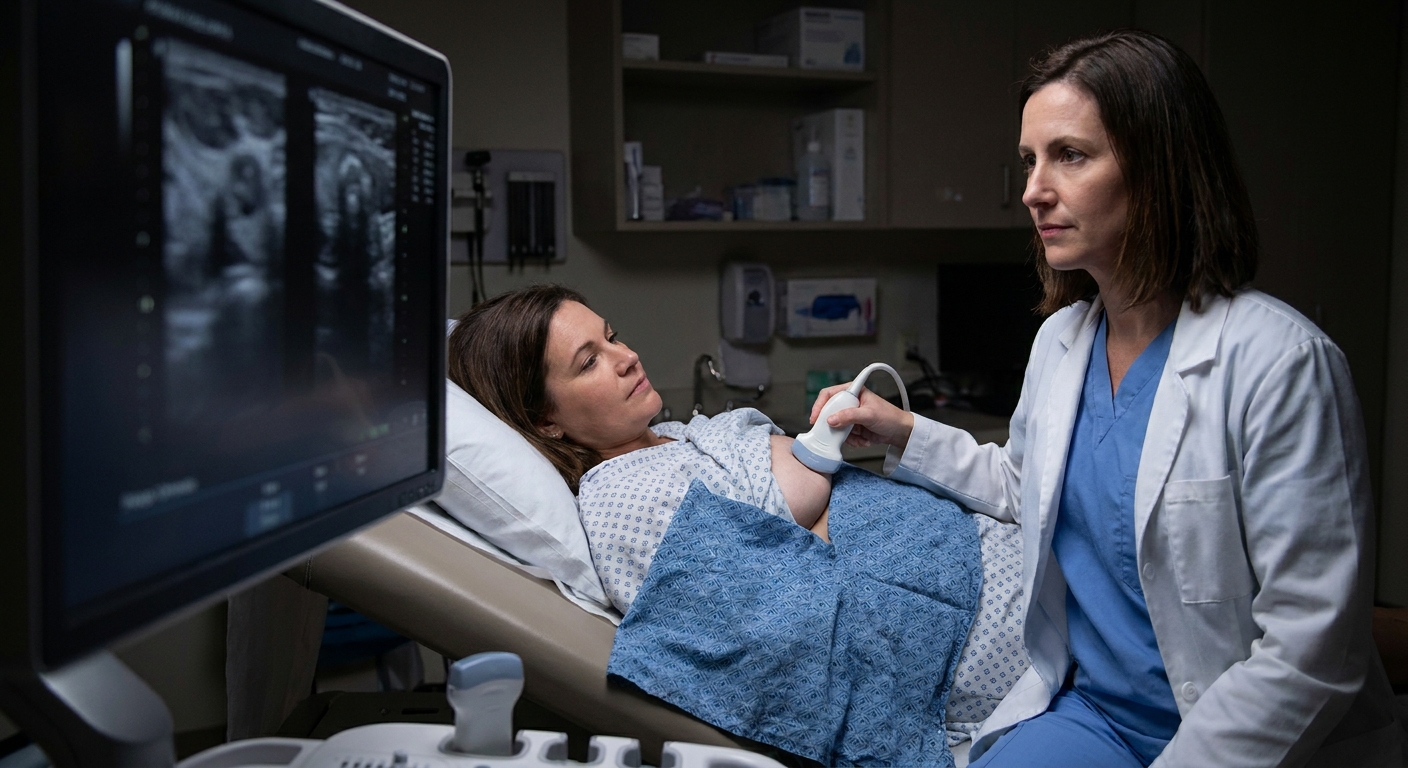
If the lump is persistent or the diagnosis is uncertain, a clinician often orders a breast ultrasound. Ultrasound is especially useful during lactation because it can help distinguish:
- A simple fluid-filled cyst or milk collection
- A solid mass
- An abscess pocket that may need drainage
On ultrasound, a galactocele often looks like a well-circumscribed cystic collection. It can have internal echoes, and sometimes a fat-fluid level, depending on the milk content.
Depending on what they see, they may reassure you and observe, refer you to a breast specialist, or in some cases perform aspiration (using a needle to remove fluid). Aspiration can confirm the diagnosis when the fluid looks like milk and can also relieve pressure if the lump is uncomfortable.
And yes, imaging is generally still on the table during lactation. Ultrasound is common, and a mammogram can be done when it is clinically indicated.
Other causes to rule out
One reason clinicians take persistent lumps seriously is that not every lump in a lactating breast is milk-related. Depending on the exam and imaging, they may also consider things like a simple cyst, fibroadenoma, lactating adenoma, or, more rarely, pregnancy-associated or lactation-associated breast cancer. Most of these are still benign, but you do not want to guess at home.
What treatment looks like
Galactoceles are often managed based on symptoms and size:
- If it’s small and not painful: your clinician may recommend watching it, staying consistent with milk removal, and following up.
- If it’s uncomfortable or large: aspiration may be offered for relief and confirmation.
- If there are signs of infection: the plan changes, because then we are talking about mastitis or abscess, not a simple galactocele.
Some galactoceles can recur, particularly if you are still producing milk. Others gradually shrink once lactation fully winds down after weaning.
Common questions
Can a galactocele turn into mastitis?
A galactocele itself is not an infection. That said, a trapped milk collection can become inflamed, and secondary infection is possible (it is not the most common outcome, but it can happen). If you develop new fever, spreading redness, warmth, or escalating pain, think mastitis until proven otherwise and get seen.
Is it normal that the lump doesn’t go away after a feed?
Yes, that can happen with a galactocele. A clogged duct often improves when milk flow increases. A galactocele is more like a pocket, so it may persist until it resolves on its own or is drained.
Is it safe to wean if I have one?
Often it is, but I recommend looping in a clinician so you have a plan. Weaning too quickly can worsen engorgement and inflammation. A gradual step-down usually makes everything calmer.
Could it be something more serious?
Most breastfeeding-related lumps are benign, but any new lump that persists should be evaluated. Ultrasound is commonly used in lactating breasts to help sort out what is going on, and additional imaging can be used when indicated.
The bottom line
A galactocele is a smooth, milk-filled lump that can show up during breastfeeding or while dropping feeds. It often feels different from a tender clogged duct and does not usually come with the fever and “I got hit by a truck” feeling that can show up with mastitis. Because breast lumps can overlap in how they present, a persistent lump should be checked, and ultrasound is a common next step when an exam is not enough to confirm the cause.
If you are staring at a new lump in the bathroom mirror at 3 a.m., I want you to hear this clearly: you are not overreacting by getting it evaluated. You are being a responsible human with a body doing something complicated.
Sarah Mitchell
Sarah Mitchell is a Registered Pediatric Nurse and a mother of three who has spent over a decade helping families navigate the beautiful, chaotic early years of childhood. She combines evidence-based medical knowledge with real-world parenting experience to offer practical, compassionate advice. At Awesome Parent, Sarah's mission is to help exhausted parents find solutions, trust their instincts, and finally get some sleep.