Walk through your home like a baby would. Use this practical room-by-room baby-proofing checklist, plus a printable checklist concept and a simple timeline b...
How to Anchor a Dresser or TV Before a Child Climbs

Sarah Mitchell
Sarah Mitchell is a Registered Pediatric Nurse and a mother of three who has spent over a decade helping families navigate the beautiful, chaotic early years of childhood. She combines evidence-based medical knowledge with real-world parenting experience to offer practical, compassionate advice. At Awesome Parent, Sarah's mission is to help exhausted parents find solutions, trust their instincts, and finally get some sleep.
I have had this conversation with hundreds of parents in clinic: “My dresser is solid wood. It weighs a ton. Do I really need to anchor it?” And as a mom of three, I get why it feels like overkill until the day your toddler decides the drawers are a ladder.
The hard truth is that heavy furniture is often more dangerous in a tip-over because it comes down fast and lands hard. The good news is that anchoring a dresser, bookcase, or TV often can be a 15–30 minute job with a drill, and it is one of the highest-impact safety upgrades you can do at home.
What to anchor (and what gets missed)
If it can tip and a child can reach it, treat it like a climbing challenge and anchor it.
Anchor these every time
- Dressers and chests of drawers (especially tall or narrow styles, or anything with smooth drawer slides)
- Bookcases, cube shelves, and storage towers
- TVs (on a stand, on a dresser, or on a rolling cart)
- Changing tables and dressers used as changing stations
- Nightstands if they are tall, top-heavy, or kids use them to climb onto beds
- Entryway consoles and any skinny tall cabinets
Often overlooked
- TVs on top of a dresser (you need to secure the TV and secure the dresser)
- Furniture with multiple pull-out bins (toy organizers, pantry pull-outs)
- Appliances that can be pulled forward (if your child can tug an oven door, use an anti-tip bracket as recommended by the manufacturer)
- Furniture that came with an anti-tip kit that is still in the box or never installed
If you are unsure, a quick rule: if the furniture is taller than your child’s chest, or if a drawer can open and be used as a step, anchor it.
Why heavy dressers still tip
Tip-overs are all about center of gravity and leverage, not just weight.
- Open drawers shift weight forward. The dresser becomes front-heavy when drawers are pulled out.
- Toddlers climb like it is their job. A child’s weight on an open drawer acts like pulling down on the end of a seesaw.
- Friction is not a safety plan. Carpet, felt pads, or a sturdy base can still slide or pivot.
- Uneven floors matter. Even a slight tilt can make tipping easier once the piece starts to move.
In urgent-care style visits, I have heard every version of “I was right there” and “it happened so fast.” That is exactly why anchoring matters. It protects kids during the normal chaos of real life.
Hardware options
There are a few common anti-tip systems. The best one is the one you will install correctly and keep tightened.
One important note: if your furniture came with an anti-tip kit, start there. Use the manufacturer instructions and hardware when you can, especially for cribs, changing tables, and flat-pack furniture where material thickness matters.
1) Anti-tip straps (nylon webbing with screws)
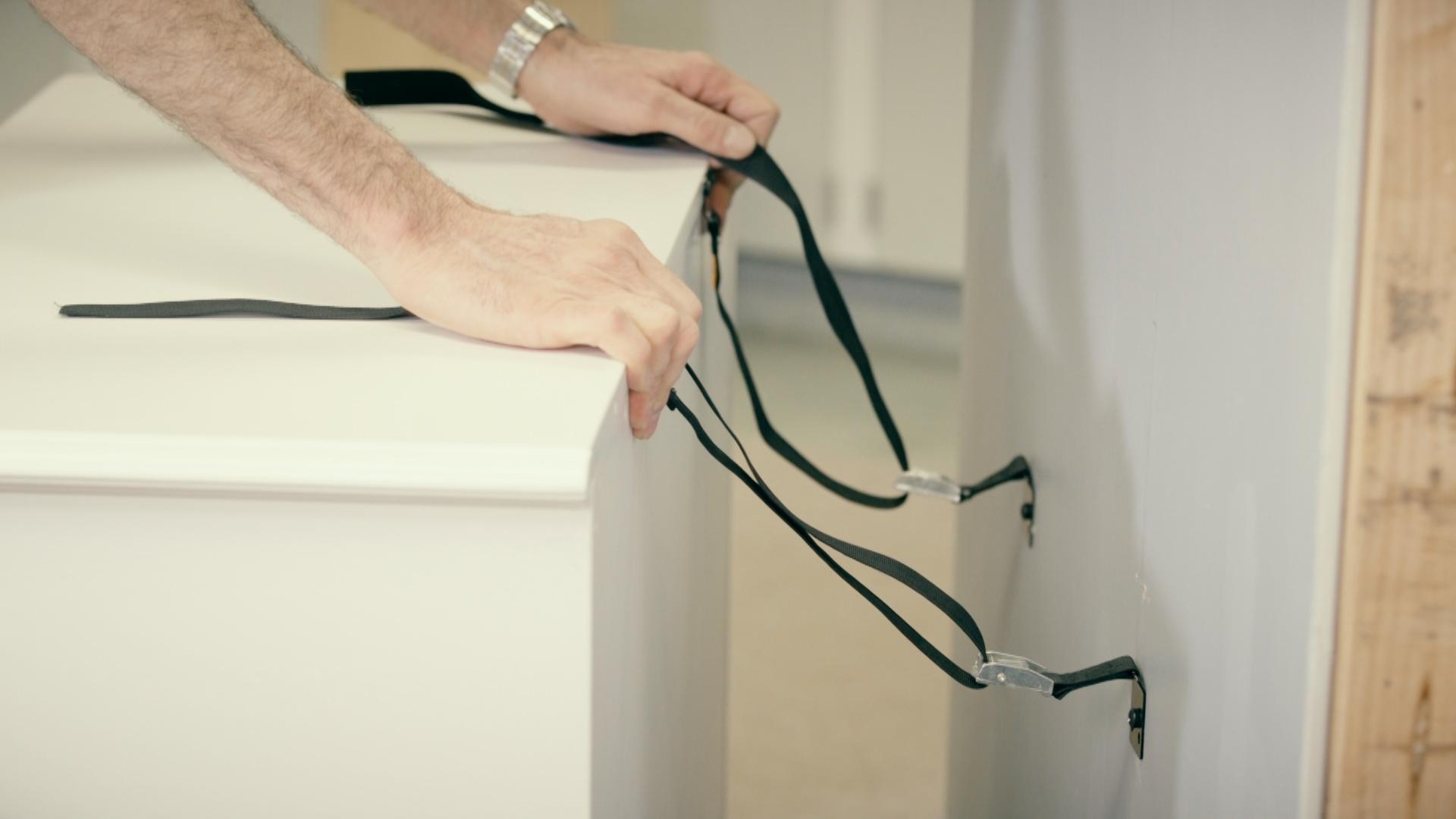
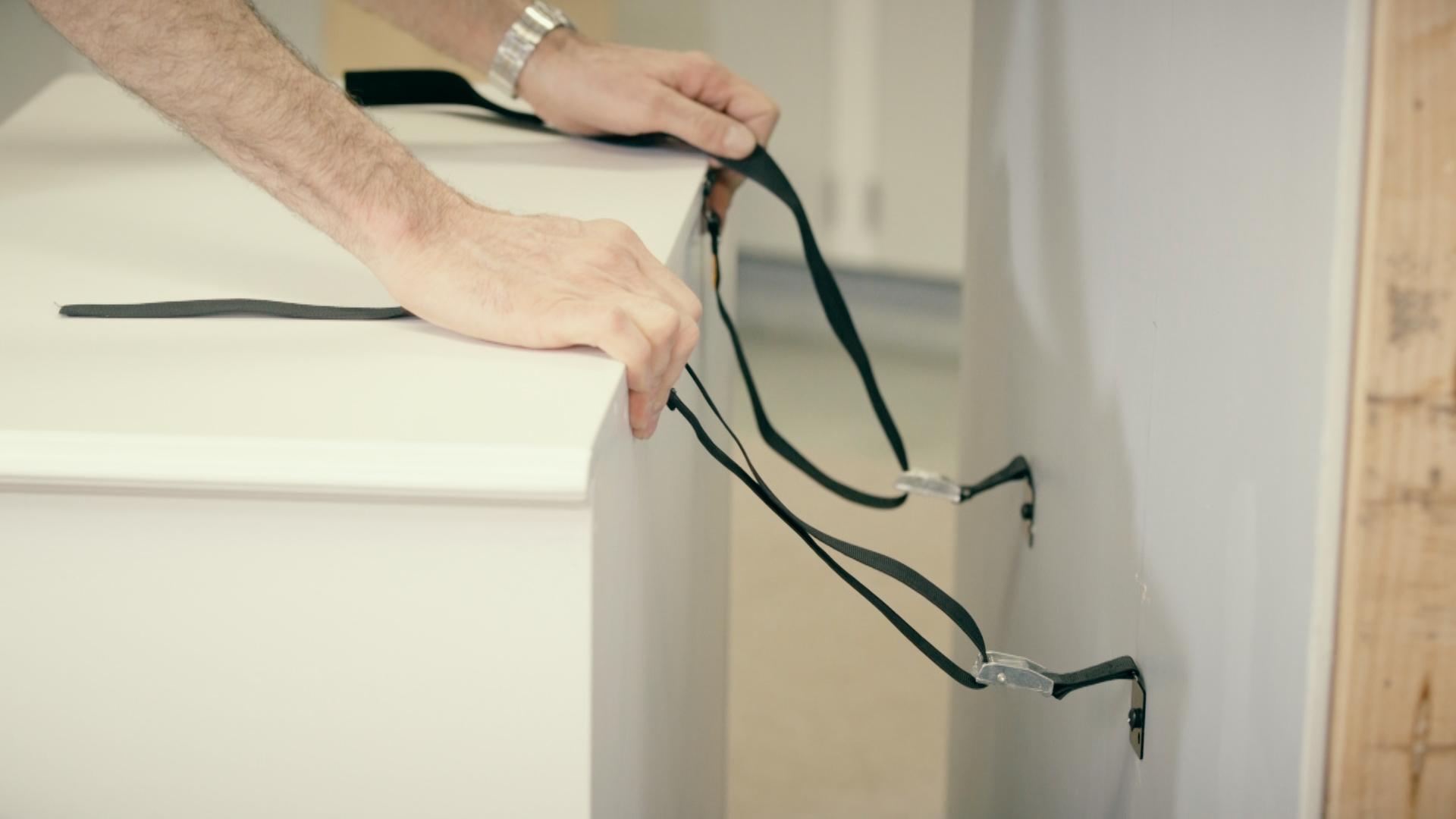
These are the most common for dressers and bookcases. They typically include two straps and mounting hardware.
- Pros: Flexible, fits most furniture shapes, allows a little movement for cleaning
- Cons: Must be installed into a stud or appropriate anchors, strap length matters
2) Metal L-brackets or furniture anti-tip brackets
These are rigid brackets that connect the furniture to the wall.
- Pros: Very sturdy when installed into studs
- Cons: Less forgiving for uneven backs, can be harder on particleboard furniture if over-tightened
3) TV safety straps (TV-to-wall)
TV straps attach to the TV’s mounting holes (the same pattern used for wall mounts, called VESA) and then to the wall, usually into studs.
- Pros: Helps prevent a TV from sliding or tipping forward
- Cons: Not a substitute for securing the furniture underneath the TV
What about drywall anchors?
If you can hit a stud, do it. If you truly cannot (for example, the only safe placement lands between studs), follow the furniture and anti-tip kit manufacturer instructions for the right anchor type. Many common drywall anchors are not designed for tip-over restraint, because the force during a tip is not the same as a static hang-a-picture load. When in doubt, move the furniture so you can use a stud, or ask a handy friend or professional for help.
Where to attach straps
The wall side
- Best: Screw into a wall stud.
- Finding studs: A stud finder is easiest. Outlets are often near studs, but treat that as a clue only and always verify with a stud finder (or a second confirmation method).
- Height: Place straps high on the furniture, near the top, so there is less leverage for tipping.
The furniture side
Your goal is to attach into a solid structural area, not a thin, flimsy backing panel.
- Best targets: A solid wood frame rail, the top back stretcher, or sturdy side panels near the top.
- Avoid: Thin fiberboard backing (the stapled-on panel) unless the kit is specifically designed to reinforce it and you can attach into framing behind it.
- Use washers if needed: On particleboard furniture, washers can help distribute the load so the screw head does not pull through.
Anchor a dresser or bookcase
You do not need to be handy. You just need five calm minutes where nobody is climbing on you.
What you need
- Anti-tip strap kit (or the hardware that came with your furniture)
- Stud finder
- Drill and bits
- Screwdriver
- Pencil
- Level (optional, but helpful)
Steps
- Empty the top drawers. You want the furniture stable while you work.
- Pull the furniture a few inches from the wall. Enough space to reach behind it.
- Find and mark your studs. Mark a spot that lines up with the strap location near the top of the furniture.
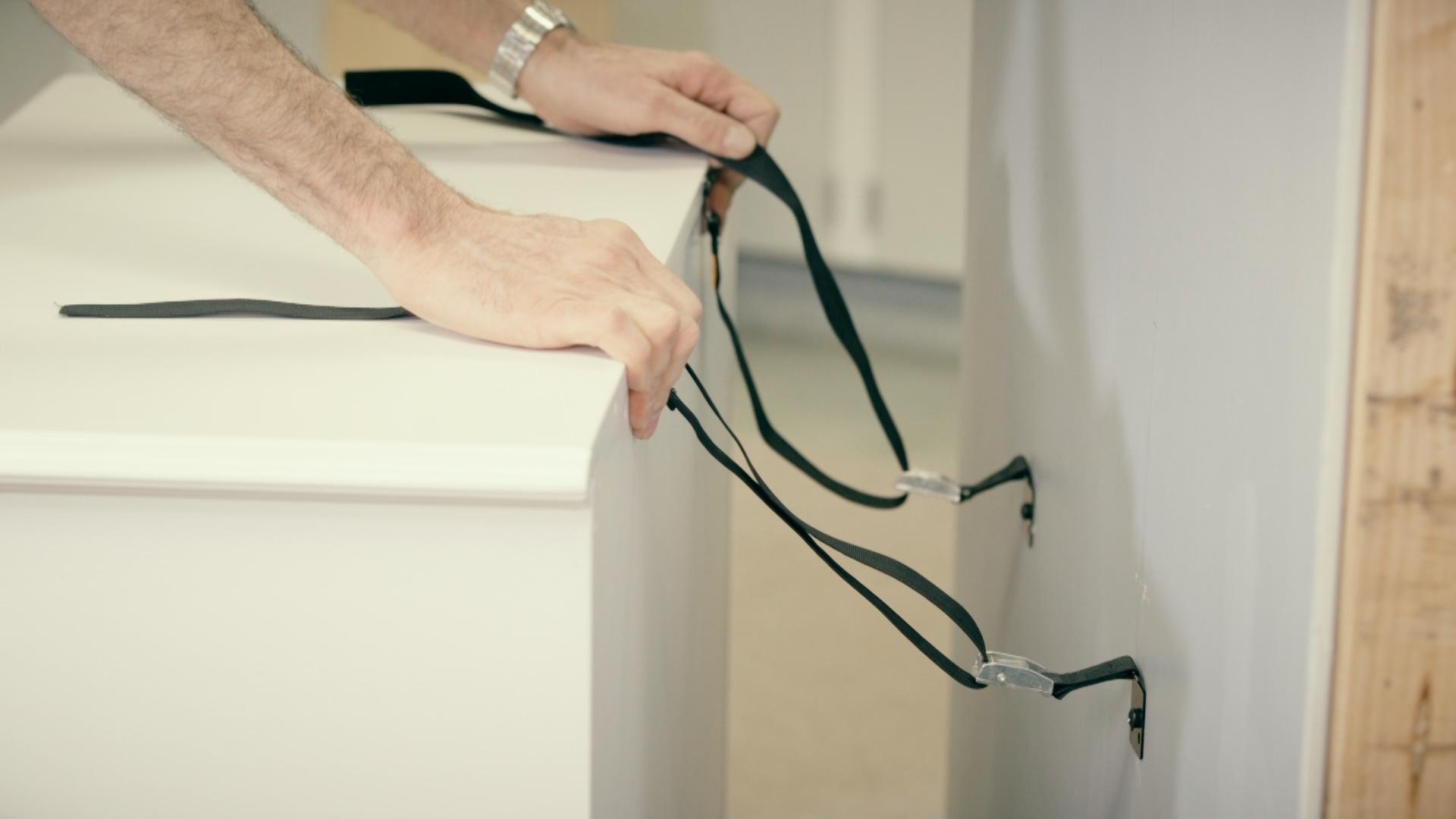
- Attach the wall brackets first. Pre-drill if the kit recommends it. Screw directly into the stud.
- Attach the furniture brackets. Choose a solid frame area near the top. If you are unsure, look for thicker wood pieces, not the thin back panel.
- Connect the straps and tighten. The furniture should sit close to the wall without bowing. You want it snug, not strained.
- Push furniture back into place and re-check tension. Open a drawer or two gently and make sure nothing shifts.
- Test thoughtfully. With drawers closed, give the top a firm, controlled wiggle. It should not tip forward. Do not intentionally try to tip the furniture to “see if it holds.”
If your kit includes two straps, use two. One strap can allow twisting.
Anchor a TV setup
TV setups cause confusion because there are usually two separate hazards: the TV tipping and the furniture tipping.
1) Secure the TV to the wall
- Locate the TV mounting holes. Most TVs have threaded holes on the back for mounting.
- Use the right screws. TV straps often include multiple screw sizes. Use the ones that fit your TV without forcing.
- Attach the TV strap to the TV first. Follow the kit instructions for washers and spacing.
- Find a stud and attach the wall end. Keep the straps slightly taut so the TV cannot lurch forward.
2) Secure the stand underneath it
Anchor the dresser, console, or stand using the dresser steps above. A strapped TV on an unanchored dresser can still end in a tip-over.
Extra TV safety wins
- Move the TV back. The closer the TV’s center is to the wall, the more stable it is.
- Manage cords. Kids pull cords fast. Route cords behind the furniture and secure them so they cannot be yanked.
- Avoid placing the remote or toys on the TV stand. If kids are reaching for things up high, climbing is next.
- Do not overload a dresser. If the furniture was not designed to hold a heavy TV (or an aquarium, for that matter), consider a proper TV stand or wall mounting solution.
Tricky situations
If you rent
Many leases allow small wall holes, and anti-tip screws are usually comparable to hanging a curtain rod. If you are unsure, ask your landlord. In my experience, most would much rather have a couple of patched holes than a preventable injury.
If your baseboard creates a gap
Many dressers do not sit flush because of baseboards. That is normal. Use straps long enough to bridge the gap without pulling the furniture backward at an angle. If the gap is large, you may need to adjust strap placement higher on the wall side so the strap runs cleanly and tight.
If the back panel is thin fiberboard
Try to attach into the frame instead. If you cannot, consider:
- Using L-brackets into a solid side panel near the top
- Adding washers to reduce pull-through risk
- Choosing a different anchor point on the furniture where the material is thicker
If you cannot find a stud where you need one
First, confirm stud placement with a stud finder and a second method (like measuring typical spacing). If you truly cannot hit a stud, follow your furniture and anti-tip kit instructions for an appropriate wall anchor. Then reduce risk in other ways: keep heavier items in lower drawers, do not leave drawers open, and consider childproof latches so drawers cannot become steps.
Make the anchor work
- Store heavy items low. Books, big toys, and spare wipes belong in lower drawers or shelves.
- One drawer at a time. Some dressers have built-in drawer stops, but kids can still open multiple drawers quickly.
- Do a monthly tug test. Straps can loosen over time as furniture shifts.
- Keep climbing bait off the top. Candy, tablets, favorite toys, and remotes turn furniture into a mission.
When to replace furniture
Anchors are powerful, but they cannot fix everything. Consider replacing the piece if:
- The furniture is structurally unstable (wobbly joints, cracked panels, missing hardware)
- The material is crumbling particleboard where screws will not hold
- The drawers fall out easily and create a serious climbing platform
- You cannot anchor it to the wall safely due to placement constraints you cannot change
If you are in that situation, you did not fail. Some furniture is simply not built to withstand toddler physics.
Quick FAQ
Do I need to anchor a short, wide dresser?
If a child can open drawers and climb, yes. Wider is generally more stable than tall-and-skinny, but drawer climbing can still pull the center of gravity forward.
How many straps do I need?
Use two straps for most dressers and bookcases. For long, wide pieces, two straps spaced apart helps prevent twisting.
Can I anchor into plaster walls?
Older plaster can be tricky. If you have plaster over lath, a stud finder may struggle. If you are not confident locating studs, it is worth asking a handy friend, a contractor, or your landlord for help. The goal is a solid connection, not a guess.
What if my child already climbs?
Anchor today. Then reduce the ladder effect by keeping drawers closed, using childproof latches if needed, and moving tempting items off the top. But anchoring is the non-negotiable baseline.
If a dresser or TV tips
If a tip-over happens and your child is pinned, call emergency services right away. Do not wait to see how they do. Even if a child looks okay, injuries can be internal. If there is any head injury, trouble breathing, significant pain, vomiting, unusual sleepiness, or your gut says something is off, get evaluated urgently.
And when you are ready, anchor the rest. Parents usually do not need more guilt. You need a plan, a drill, and about twenty minutes.
Sarah Mitchell
Sarah Mitchell is a Registered Pediatric Nurse and a mother of three who has spent over a decade helping families navigate the beautiful, chaotic early years of childhood. She combines evidence-based medical knowledge with real-world parenting experience to offer practical, compassionate advice. At Awesome Parent, Sarah's mission is to help exhausted parents find solutions, trust their instincts, and finally get some sleep.