A calm, parent-friendly guide to spotting epiglottitis versus croup or a sore throat, plus what to do right away to protect your child’s airway.
Retropharyngeal Abscess in Kids: Fever, Stiff Neck, Drooling, and When It’s an Emergency

Sarah Mitchell
Sarah Mitchell is a Registered Pediatric Nurse and a mother of three who has spent over a decade helping families navigate the beautiful, chaotic early years of childhood. She combines evidence-based medical knowledge with real-world parenting experience to offer practical, compassionate advice. At Awesome Parent, Sarah's mission is to help exhausted parents find solutions, trust their instincts, and finally get some sleep.
There are a few kid illnesses that make my triage nurse brain sit up straight. A toddler with a recent sore throat who now has a fever, is drooling, and will not move their neck normally is one of them.
Most sore throats are annoying but straightforward. A retropharyngeal abscess is different. It is a deep infection in the space behind the throat that can swell quickly and, in some cases, start to affect breathing. The goal of this article is not to make you panic. It is to help you recognize the pattern and know when to seek urgent care.
What is a retropharyngeal abscess?
A retropharyngeal abscess is a collection of pus caused by bacterial infection in the tissues behind the throat (the retropharyngeal space). It most often happens in young children, especially toddlers and preschoolers, because they have lymph nodes in that area that can become infected after a regular upper respiratory infection.
It commonly starts after:
- a recent cold with worsening throat symptoms
- strep throat or tonsillitis
- an ear or sinus infection
- less commonly, a small injury in the mouth or throat
This is not something you treat at home with honey, popsicles, and comfort measures. It typically needs urgent medical evaluation, imaging, and IV antibiotics. Sometimes it needs drainage by an ENT specialist.
Who is at higher risk? It is most common in young kids (roughly ages 6 months to 6 years), often after a recent upper respiratory infection. Any child with immune compromise or significant medical complexity should be evaluated quickly for worsening infections in general.
Signs and symptoms parents notice
Parents usually tell me some version of: “They had a sore throat, then suddenly they got worse and now they will not swallow.” That “suddenly worse” piece matters.
Common symptoms
- Fever, often high
- Severe sore throat
- Difficulty swallowing (dysphagia) or pain with swallowing
- Drooling because swallowing hurts too much
- Neck stiffness or refusal to move the neck normally
- Holding the neck oddly (very still, turned, or in a position that seems “stuck”)
- Muffled, “hot potato” voice (sounds like they are talking with something in their mouth)
- Decreased appetite and fluids
- Irritability, clinginess, or looking very unwell
A common clue: neck position changes
One commonly taught clue is a child who does not want to extend their neck, meaning they resist looking up. You may notice them keeping their chin slightly down, turning their whole body instead of their head, or crying when you try to position them for a car seat.
But here is the nuance: some kids do not show this clearly, and some may hold their neck more neutral or even slightly extended to find the least painful position. So think of it as a pattern, not a single “gotcha” sign.
Neck symptoms paired with fever + drooling + trouble swallowing after a throat infection needs a same-day evaluation.

When breathing symptoms mean emergency care
Any deep throat or neck infection can swell and start to affect the airway. If you see breathing red flags, do not wait for a morning appointment.
Call 911 or go to the ER now if your child has:
- Stridor (a harsh, high-pitched sound when breathing in)
- Obvious trouble breathing (working hard to breathe, fast breathing, belly pulling in, ribs sucking in)
- Tripod positioning (leaning forward with neck extended, using arms to brace, looks like they cannot get comfortable)
- Blue, gray, or very pale lips/skin
- Pauses in breathing or extreme sleepiness/hard to wake
- Inability to swallow saliva with constant drooling plus breathing difficulty
Parenting note from the triage desk: If your child is drooling and struggling to breathe, keep them upright, keep them calm, and do not force them to lie back for a throat look. Head to emergency care.
How it’s different from other serious infections
Several infections can cause fever, drooling, and a very sick looking child. The details help doctors separate them quickly, but as a parent, you mainly need two things: (1) recognize the concerning pattern and (2) know when breathing is involved.
Retropharyngeal abscess vs epiglottitis
Epiglottitis is an emergency where the flap at the base of the tongue (the epiglottis) swells and can block the airway. It is rarer now in vaccinated kids, but it still happens.
- Both can cause: fever, drooling, sore throat, refusal to swallow, muffled voice
- Can be seen with retropharyngeal abscess: neck stiffness, pain with neck movement, limited range of motion, several days of URI symptoms that then worsen
- Can be seen with epiglottitis: sudden severe illness, significant breathing distress, stridor, tripod posture, and often less coughing
Either one with breathing trouble is an ER situation. Epiglottitis, in particular, is a “do not wait” condition.
Retropharyngeal abscess vs peritonsillar abscess
A peritonsillar abscess is a pocket of infection next to a tonsil. It is more common in older kids and teens than true retropharyngeal abscess.
- More suggestive of peritonsillar abscess: one-sided throat pain, one tonsil looks larger, uvula may look pushed to one side, “hot potato” voice, trouble opening the mouth wide (trismus)
- More suggestive of retropharyngeal abscess: neck stiffness, refusal to move the neck, pain with neck motion, drooling and swallowing refusal in a younger child
Retropharyngeal abscess vs bacterial tracheitis
Bacterial tracheitis is an infection of the windpipe (trachea) that can follow a viral illness like croup and can create thick secretions that obstruct airflow.
- More suggestive of bacterial tracheitis: prominent cough, noisy breathing that looks like severe croup, high fever, child looks toxic, may not improve with typical croup treatments
- More suggestive of retropharyngeal abscess: drooling from painful swallowing, stiff neck, refusal to move the neck normally, less of a barking cough pattern
Bottom line: if breathing is compromised, the exact label can wait. Emergency evaluation cannot.
What to do right now
If your child has fever plus drooling and will not swallow, especially with a stiff neck or limited neck movement, this is not a “watch and wait for two days” situation.
Best next steps
- If any breathing red flags are present: go to the ER or call 911.
- If breathing seems okay but the pattern fits: call your pediatrician for a same-day evaluation or go to urgent care that can quickly refer to the ER if needed.
- Keep your child upright and calm. Crying and struggling can worsen breathing effort.
- Offer small sips only if they can swallow comfortably. Do not force food or fluids.
- Do not repeatedly try to “check the throat” if it upsets them or triggers gagging.
- Do not give oral medicine if they cannot swallow safely. If they are refusing all liquids or choking on saliva, that is part of the emergency picture.
If you are headed in, bring basics: your child’s medication list, allergy info, and how long symptoms have been going on. The timeline helps a lot.

How doctors diagnose and treat it
In clinic and triage, what we can see is limited. In the hospital, the team can evaluate safely and quickly.
Diagnosis may include
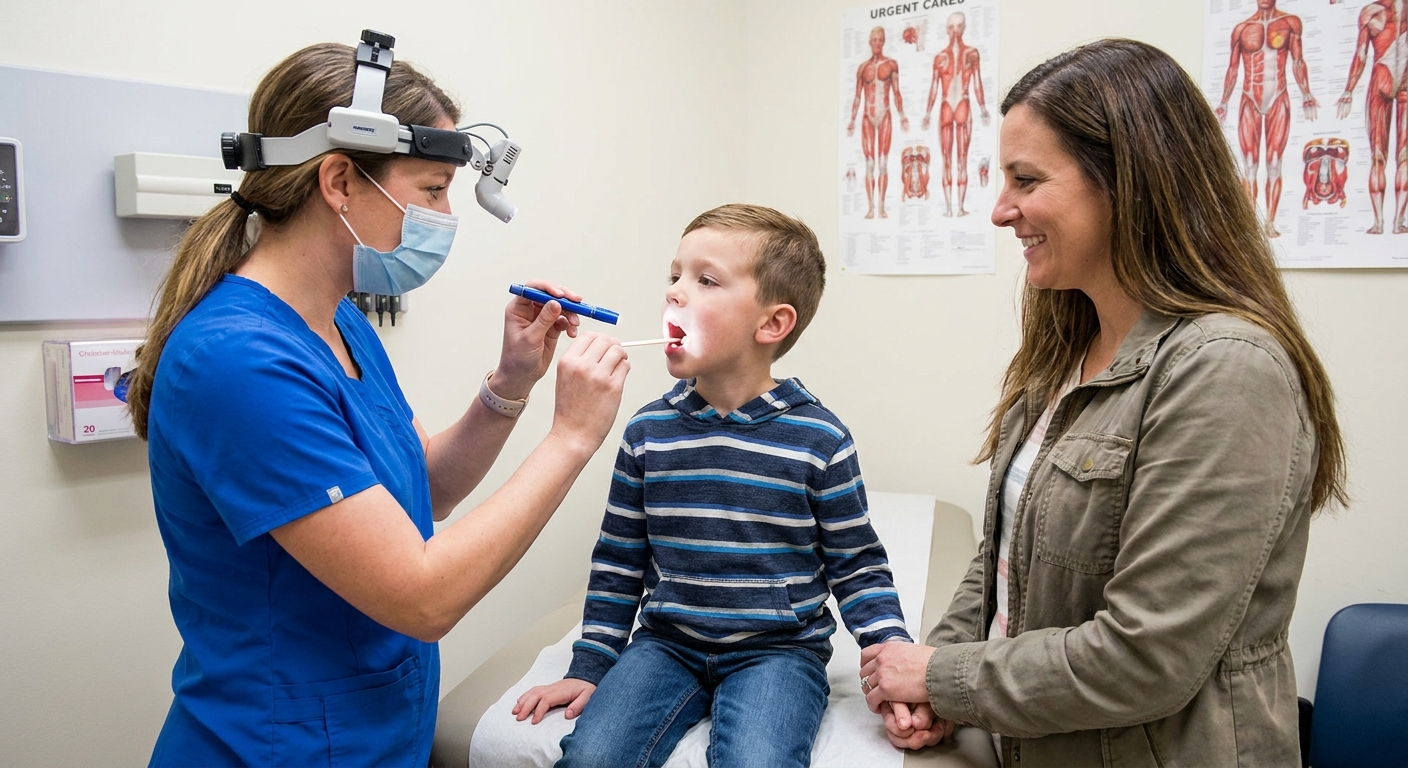
- a careful exam of the throat and neck
- vital signs and oxygen level
- bloodwork to look for infection
- imaging, often a CT scan with contrast to look for an abscess versus swelling (cellulitis)
- ENT consultation (ear, nose, and throat specialist)
Depending on how stable your child is and what resources are available, some teams may use other imaging too (like an X-ray, ultrasound, or MRI). The goal is the same: confirm what is going on without risking the airway.
Treatment often includes
- Airway first if there are any signs of compromise
- IV antibiotics
- hospital monitoring, especially if there are airway concerns or dehydration
- drainage if there is a sizable abscess or the child is not improving
- pain control and IV fluids as needed
Most children do very well once treated. The key is not missing it early, when swallowing and neck symptoms are ramping up.
One more reason we take this seriously: if a deep neck infection is delayed, it can sometimes spread or become severe (including bloodstream infection). That is why clinicians move quickly when the symptom cluster fits.
FAQ
Can retropharyngeal abscess start from strep throat?
Yes. Any bacterial throat infection can potentially spread into deeper tissues. Many kids with strep recover normally. This is an uncommon complication, but it is on the “must not miss” list.
My child is drooling with a fever. Is it always serious?
No. Teething, mouth sores (like hand, foot, and mouth disease), and a very sore throat can all cause drooling. What raises concern for deeper infection is drooling plus refusal to swallow plus neck stiffness or refusal to move the neck normally, or any breathing issues.
What if my child has neck stiffness but no drooling?
Neck stiffness can come from many things, including muscle strain and swollen lymph nodes. But if it is paired with fever and your child looks unwell, it should be evaluated the same day.
Also, a quick safety note: fever plus significant neck stiffness (especially with severe headache, light sensitivity, rash, confusion, or extreme sleepiness) can also be a sign of meningitis or other serious infection. That is another reason not to sit on these symptoms at home.
Is this contagious?
The abscess itself is not “caught” like a cold, but the infections that lead to it (viral colds, strep) can be contagious. Good hand hygiene and not sharing cups and utensils still matter.
A calm gut check
If you are reading this at an odd hour because your child is drooling, feverish, and holding their neck strangely, trust that nagging feeling. Most parents who bring kids in for these symptoms are not overreacting. They are noticing a pattern that is outside the normal sore throat script.
When it comes to deep neck infections, earlier evaluation usually means a smoother path to feeling better. And that is the kind of “overcautious” I can live with.
Sarah Mitchell
Sarah Mitchell is a Registered Pediatric Nurse and a mother of three who has spent over a decade helping families navigate the beautiful, chaotic early years of childhood. She combines evidence-based medical knowledge with real-world parenting experience to offer practical, compassionate advice. At Awesome Parent, Sarah's mission is to help exhausted parents find solutions, trust their instincts, and finally get some sleep.