
Thinking about goat milk for your baby? Here is why plain goat milk, raw milk, and homemade mixes are not safe under 12 months, plus safer options like stand...
Are Almond, Oat, or Rice Milks Safe Before 12 Months?

Sarah Mitchell
Sarah Mitchell is a Registered Pediatric Nurse and a mother of three who has spent over a decade helping families navigate the beautiful, chaotic early years of childhood. She combines evidence-based medical knowledge with real-world parenting experience to offer practical, compassionate advice. At Awesome Parent, Sarah's mission is to help exhausted parents find solutions, trust their instincts, and finally get some sleep.
At least once a week in triage, I’d get a call that started with some version of: “We ran out of formula” or “My baby’s tummy seems upset with formula” followed by, “Can I just use almond milk or oat milk for a bit?”
I get why this question pops up at 2 a.m. when you are staring at an empty formula container. Plant milks feel gentle, they are everywhere, and the carton says things like “with calcium.” But in the first year of life, almond milk, oat milk, rice milk, and most other plant milks are not safe replacements for breast milk or infant formula.

Quick answer: safe before 12 months?
As a main milk drink, no. For babies under 12 months, the recommended primary milks are:
- Breast milk
- Iron-fortified infant formula
- Pasteurized donor human milk (when available, typically through a regulated milk bank and often prioritized for medically fragile infants)
Plant milks are sometimes used in tiny amounts as an ingredient in family foods (for example, a small splash in oatmeal for an older baby who is already thriving on breast milk or formula). This assumes your baby is otherwise getting enough breast milk or formula, and that there is no allergy concern with the ingredient itself. But plant milks should not replace bottles or daily milk feeds in the first year unless your baby’s clinician has given you a very specific plan.
Why plant milks are not formula
Infant formula is tightly regulated to meet a baby’s nutritional needs during a period of extremely fast growth. Plant milks are not designed for that job. Even when they are “fortified,” they can miss the mark in a few big ways, and it varies a lot by brand.
1) Too few calories for growth
Babies need a lot of energy in a small volume. Many plant milks are much lower in calories than breast milk or standard infant formula. If a baby fills up on a low-calorie milk, they can end up taking in fewer total calories than they need.
2) Not enough protein
Protein is essential for growth, brain development, and overall health. Almond milk and rice milk are especially low in protein. Oat milk varies by brand, but most are still not comparable to breast milk or infant formula for a baby’s needs. To make this concrete: many almond or rice milks have around 0 to 1 gram of protein per cup, while cow’s milk is often around 8 grams per cup. Infant formula is built to meet infant needs in a way plant beverages are not.
3) Not the right kind or amount of fat
Infants need fat for brain development and as a major calorie source. Many plant milks are low-fat, and even versions that contain added oils do not reliably match the balance babies need.
4) Micronutrients can still come up short
Even “fortified” plant milks may fall short on nutrients that matter in infancy, or deliver them inconsistently across brands and batches, including:
- Iron (a big one for preventing anemia)
- Vitamin B12 (especially important in vegan households)
- Iodine (important for thyroid function and development)
- Zinc
- Vitamin D
- Calcium (some products are well-fortified on the label, but amounts and absorption can vary, and it still does not fix the calorie, fat, and protein gaps)
5) Added sugars and sodium can be a surprise
Some plant milks include added sugars, flavorings, thickeners, or higher sodium than you would expect. For babies, avoid sweetened plant milks as a drink.
Almond milk
Almond milk is a common one parents ask about because it feels “light.” Nutritionally, that is the problem.
- Very low protein
- Often low calorie
- Not enough fat for infant growth
Even when fortified with calcium and vitamin D, it does not provide the full package babies need in the first year.

Oat milk
Oat milk is trendy for a reason. It tastes good and works well in coffee. Some older kids and adults find it easier to tolerate than dairy. For babies under 12 months, though, it still is not equivalent to breast milk or formula.
Compared with almond or rice milk, oat milk may be higher in calories depending on the brand, but it is typically still low in protein and not formulated for infant nutrition. Fortification varies widely, and babies need consistency.
If your baby has a diagnosed cow’s milk protein allergy or another medical reason to avoid standard formula, your pediatrician can guide you toward an appropriate infant formula option (for example, extensively hydrolyzed or amino-acid-based formulas). Oat milk is not the workaround.
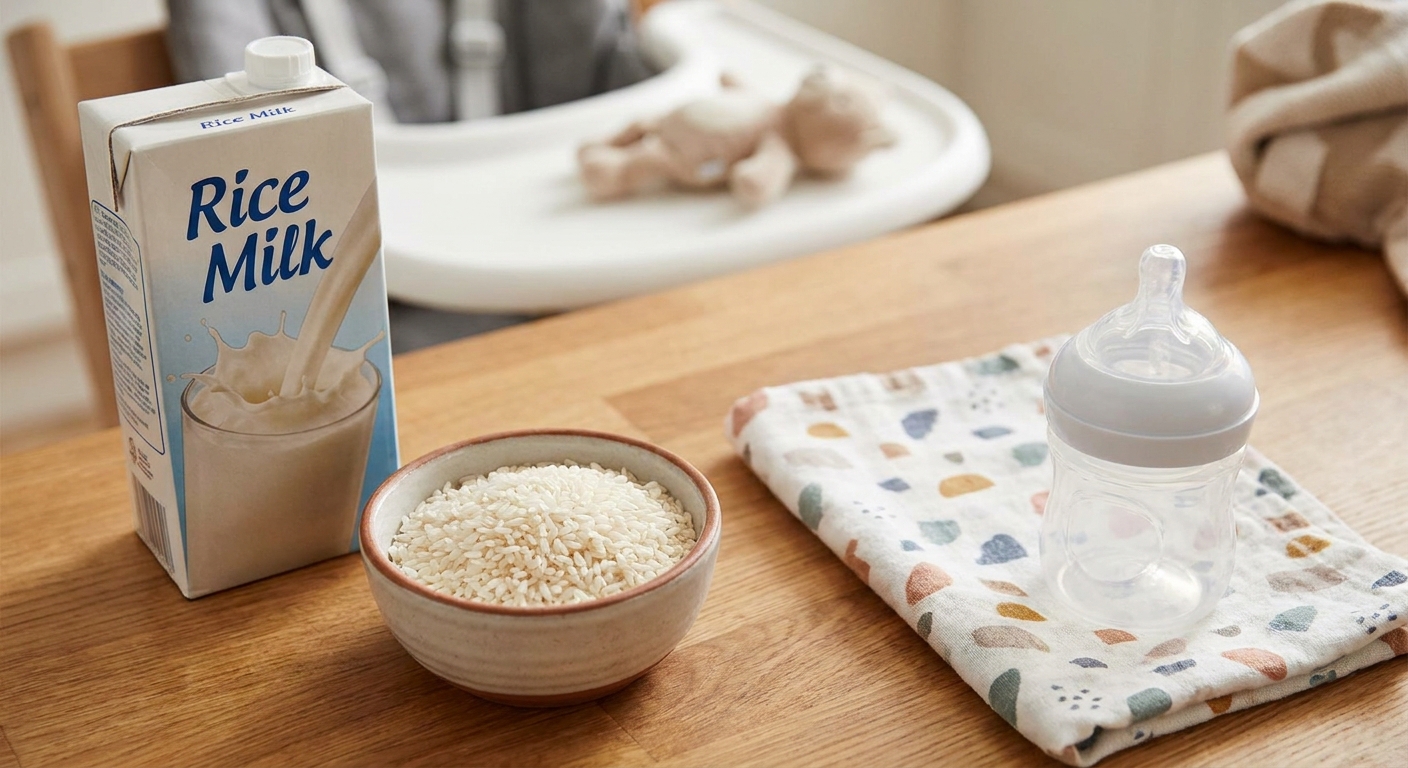
Rice milk and arsenic
Rice milk gets its own special caution sign.
Rice tends to absorb arsenic from the environment more than many other crops. Because of that, rice and rice-based products can contain higher levels of inorganic arsenic, which is the type we worry about most.
Babies are small, their brains and bodies are developing quickly, and they can be more vulnerable to environmental exposures. For that reason, many health authorities advise limiting rice-based drinks for young children, and rice milk is not recommended as a milk substitute for infants.
On top of the arsenic concern, rice milk is also very low in protein and fat, making it a poor nutritional match for babies.
What to offer instead
If your baby is under 12 months and needs milk feeds, here are the safe, nutritionally appropriate options.
Breast milk
If breastfeeding is going well, keep going. If you are struggling with supply, latch, pain, or pumping, you are not failing. A lactation consultant can be incredibly helpful, and combination feeding is a valid, healthy option for many families.
Iron-fortified infant formula
Standard infant formula is designed to be a complete nutrition source for babies who are not exclusively breastfed. If one type is not agreeing with your baby, talk with your pediatrician before switching repeatedly, since symptoms like gas, spit-up, or fussiness can have multiple causes.
Pasteurized donor human milk
In some areas, screened and pasteurized donor milk is available through regulated milk banks. Access varies, and it is often prioritized for premature or medically fragile infants, but it is worth asking your child’s clinician what is available locally.
A safety note: Avoid informal milk sharing because screening and handling standards are not consistent, which can increase infection risk.
If you ran out of formula tonight
If you cannot feed your baby breast milk or formula today, call your pediatrician right away (or the after-hours nurse line). In real life, these are some of the paths that sometimes help, depending on where you live and what is available:
- Your pediatrician’s office (some have samples or can suggest acceptable substitutions if a specific product is out of stock)
- Pharmacies and big-box stores (asking a pharmacist can help you find an equivalent type in another brand)
- WIC or local public health programs (they may be able to direct you to supply options)
- Hospital social work or community resource lines (some communities have emergency infant feeding support)
Please do not dilute formula to make it last longer, and do not use homemade formula recipes. Both can be dangerous.
Common parent questions
“My baby is almost 1. Can I start plant milk at 11 months?”
I know the last month can feel like a technicality, especially if your baby is eating lots of solids. But nutritionally, it matters. Stay with breast milk or formula until 12 months, then talk with your pediatrician about what milk fits your child’s needs and your family’s diet.
“What if we are vegan and want to avoid dairy?”
You can absolutely raise a healthy child in a vegan household, but infancy is not the time to wing it with beverages.
Use breast milk or an appropriate infant formula. A key distinction: soy-based infant formula is not the same thing as soy milk. After 12 months, your pediatrician may recommend fortified soy milk as a closer nutritional match to cow’s milk than other plant milks, depending on your child’s growth and overall diet.
“Can I use plant milk in cereal or cooking for my baby?”
For an older baby who is already getting adequate breast milk or formula, a small amount of plant milk used as an ingredient in food is typically fine. Use unsweetened versions when possible, and remember the key point: it is not replacing the nutrition of milk feeds.
“Can I just use cow’s milk or goat’s milk instead?”
This comes up all the time. Whole cow’s milk or goat’s milk is not recommended as the main drink before 12 months. One reason is iron. Early cow’s milk introduction is associated with iron deficiency in infants, and babies need iron for rapid growth and brain development. Cow’s milk and goat’s milk also are not designed to match an infant’s nutritional needs the way breast milk or infant formula is.
If your baby is close to a year or has a medical situation that changes feeding plans, this is a good “call your pediatrician” moment so you get advice tailored to your child.
When to call urgently
If a baby under 12 months has been relying on plant milk for feeds, or you are concerned they have not been getting enough nutrition, it is worth checking in promptly. Call urgently if you notice:
- Fewer wet diapers than usual
- Signs of dehydration (very dry mouth, no tears when crying, sunken soft spot)
- Extreme sleepiness or unusual lethargy
- Persistent vomiting
- Poor weight gain or weight loss
- Fast breathing or your baby looks like they are working hard to breathe
The bottom line
Almond milk, oat milk, and rice milk might be great for adults, but they are not safe substitutes for breast milk or infant formula before 12 months. Babies can fall behind on calories, protein, fats, and key nutrients, and rice milk adds an extra concern about arsenic exposure.
If you are stuck and tired and trying to make the best decision in the moment, I want you to hear this clearly: you do not have to solve it alone. Your pediatrician, nurse line, and local feeding resources can help you get a safe plan in place quickly.

FAQ
Is soy milk safe before 12 months?
As a main drink, soy milk is not a substitute for breast milk or infant formula in the first year. If dairy is an issue, talk with your pediatrician about an appropriate soy-based infant formula or another specialized infant formula option.
What is the best plant milk after 12 months?
For many toddlers who cannot or do not drink cow’s milk, pediatricians often consider fortified soy milk the closest nutritional match among common plant milks, especially for protein. The best choice depends on your child’s growth, overall diet, allergies, and what else they eat in a day.
Can plant milks contribute to anemia?
They can contribute if they replace iron-rich nutrition from breast milk or formula and the child is not getting enough iron from solids. Iron needs are high in infancy, and iron deficiency can sneak up quickly.
What if my baby has constipation or reflux on formula and plant milk seems to help?
Constipation and reflux are common, and switching to plant milk may seem like it helps because it changes intake volume and composition. But it is not the right fix for a baby under 12 months. Talk with your pediatrician about troubleshooting feeds, formula types, and other safe strategies.
Sarah Mitchell
Sarah Mitchell is a Registered Pediatric Nurse and a mother of three who has spent over a decade helping families navigate the beautiful, chaotic early years of childhood. She combines evidence-based medical knowledge with real-world parenting experience to offer practical, compassionate advice. At Awesome Parent, Sarah's mission is to help exhausted parents find solutions, trust their instincts, and finally get some sleep.